Category: Discrimination

  • Illegal Interview Questions – Protecting Your Rights in CA

    Illegal Interview Questions – Protecting Your Rights in CA

    Illegal Interview Questions in California: What Employers Can’t Ask You

    Most tech employees in California are surprised to learn that violating interview privacy laws can result in hefty fines and lawsuits. Understanding your rights matters because even one illegal question about age, family, or citizenship could jeopardize fair hiring.

    This guide empowers you to confidently navigate interviews, spot illegal questions, and respond in ways that protect your career and uphold California’s employment standards.

    Defining Illegal Interview Questions in California

    California labor laws strictly prohibit employers from asking interview questions that could potentially discriminate against job candidates. Discriminatory interview practices are designed to prevent employers from making hiring decisions based on protected personal characteristics that have no bearing on professional capabilities.

    Illegal interview questions in California are fundamentally those targeting a candidate’s membership in a protected class.

    These protected characteristics include:

    • race,
    • color,
    • religion,
    • sex,
    • gender identity,
    • sexual orientation,
    • age,
    • national origin,
    • citizenship status,
    • disability,
    • pregnancy status,
    • and family circumstances.

    Employers are legally required to focus exclusively on job-related qualifications during interviews, ensuring fair and unbiased candidate evaluation.

    Some common examples of illegal interview questions include direct inquiries about a candidate’s age, marital status, birthplace, religious affiliations, sexual orientation, or plans for having children.

    For instance, asking “Are you planning to get pregnant?” or “How old are you?” are inappropriate and potentially discriminatory. Instead, employers should phrase questions to assess job-related skills and professional capabilities.

    Workplace discrimination types can manifest in subtle ways during the interview process, making awareness crucial for both employers and job seekers.

    Candidate reacts to inappropriate interview question

    Pro tip: If you encounter an illegal interview question, remain professional and consider redirecting the conversation to your professional qualifications or consulting with California labor authorities if you feel discriminated against.

    Key Categories of Prohibited Interview Questions

    California law establishes comprehensive protections against discriminatory interview practices by identifying specific categories of questions employers cannot legally ask.

    Prohibited interview categories are designed to prevent potential workplace discrimination and ensure fair hiring practices across the state.

    Infographic of California illegal interview categories

    The primary prohibited categories encompass deeply personal characteristics that have no direct relevance to job performance.

    Employers are legally mandated to focus solely on a candidate’s professional qualifications, skills, and ability to perform essential job functions.

    Specific examples of illegal questions within these categories reveal the nuanced nature of workplace discrimination.

    Asking “Are you planning to have children?” or “What is your age?” are direct violations of California employment law. Similarly, inquiries like “Where were you born?” or “What religious holidays do you observe?” cross legal boundaries.

    Workplace discrimination types demonstrate that seemingly innocent questions can constitute serious legal violations, potentially exposing employers to significant legal risks and penalties.

    Here’s a summary of key protected characteristics under California law and their impact on interview questions:

    Protected Characteristic Example of Discriminatory Question Impact on Hiring Process
    Age “How old are you?” May lead to age discrimination
    Citizenship Status “Are you a U.S. citizen?” Risks exclusion of non-citizens
    Gender Identity “Do you identify as male or female?” Can result in gender bias
    Family Planning/Pregnancy “Are you planning to have kids soon?” May impact perceptions of reliability
    Religion “Which holidays do you observe?” Could lead to religious discrimination
    Disability “Do you have any health issues?” Might exclude candidates with needs

    Pro tip: If an interviewer asks an inappropriate question, professionally redirect the conversation to your professional qualifications and job-related skills.

    California provides robust legal protections specifically designed to safeguard tech employees from workplace discrimination, unfair labor practices, and potential exploitation.

    California worker protections ensure comprehensive coverage for tech professionals across various employment scenarios, from startup environments to established technology corporations.

    The state’s legal framework offers multiple layers of protection for tech employees, addressing critical areas such as wage regulations, workplace safety, anti-discrimination measures, and employment contract fairness.

    Tech workers are entitled to minimum wage protections, overtime compensation, meal and rest break requirements, and protection from retaliatory actions when reporting workplace violations. These protections are particularly crucial in the rapidly evolving technology sector, where employment dynamics can be complex and sometimes challenging.

    Significant upcoming legislative changes are set to further strengthen tech employee rights. New worker protections will expand protections for gig workers, enhance unionization rights, and implement stricter accountability measures for employers.

    These legal advancements demonstrate California’s commitment to creating equitable working conditions, especially in technology-driven industries where traditional employment models are continually transforming.

    Pro tip: Document and save all communication and employment records, as these can be critical evidence if you need to assert your workplace rights.

    How to Respond to Illegal Interview Questions

    When confronted with an illegal interview question, tech employees have multiple strategic options for protecting their rights while maintaining professional composure.

    Handling inappropriate interview queries requires a careful balance of assertiveness and diplomacy, ensuring you do not compromise your job prospects or personal dignity.

    The most effective response strategies typically involve redirecting the conversation to your professional qualifications while subtly indicating the question’s inappropriateness.

    For instance, if an interviewer asks about your family plans, you might respond by emphasizing your commitment to the role and your ability to meet job responsibilities.

    Alternatively, you can directly but politely challenge the question by saying, “I’m not comfortable discussing personal matters. I’m excited to talk about my professional skills and how they align with this position.”

    Candidate interview rights also provide you the option of declining to answer without penalty. Some candidates choose to document inappropriate questions, which can be valuable if formal discrimination complaints become necessary.

    Tech professionals should remember that reputable employers understand and respect legal boundaries, and any organization persistently asking discriminatory questions is likely not an ideal workplace environment.

    Pro tip: Prepare diplomatic, professional redirection scripts in advance to confidently handle unexpected inappropriate interview questions.

    Reporting Violations and Seeking Remedies

    Tech employees in California have multiple avenues for addressing illegal interview practices and workplace discrimination. Filing discrimination charges involves a strategic process of documenting violations and pursuing appropriate legal channels to protect your professional rights and seek potential remedies.

    The primary mechanisms for reporting violations include filing formal complaints with state and federal agencies. The U.S. Equal Employment Opportunity Commission (EEOC) and the California Department of Industrial Relations (DIR) offer comprehensive platforms for workers to submit detailed accounts of discriminatory practices.

    Worker rights enforcement mechanisms protect employees from retaliation, ensuring that individuals can confidently report inappropriate interview questions or workplace misconduct without fear of professional consequences.

    Successful reporting requires meticulous documentation, including:

    • specific details of the illegal questions,
    • interview dates,
    • interviewer names,
    • and any supporting evidence.

    Tech professionals should maintain a chronological record of interactions, save communication emails, and note specific instances of inappropriate questioning.

    These detailed records can significantly strengthen a potential legal claim or complaint, providing concrete evidence of discriminatory practices that violate California’s rigorous employment protection laws.

    Below is a comparison of the main avenues for reporting violations and their distinct features:

    Reporting Avenue Key Features Typical Outcomes
    EEOC (Federal) Broad protections, nationwide Investigation, possible claim
    California Dept. of Industrial Relations State-specific expertise Mediation, state-level penalties
    Internal Company Report Faster resolution, company focused Policy change, HR intervention
    Legal Counsel Personalized legal advice Lawsuit, negotiation, settlement

    Pro tip: Create a dedicated digital folder to securely store all interview-related communications and documentation, ensuring you have a comprehensive record if legal action becomes necessary.

    Stand Strong Against Illegal Interview Questions with Trusted California Labor Law Support

    Facing illegal interview questions can feel overwhelming and unfair. You have the right to be evaluated based solely on your skills and qualifications without being asked about protected personal characteristics like your age, family plans, or citizenship status.

    These intrusive questions are not just uncomfortable—they violate California labor laws designed to protect your workplace rights and ensure fair hiring practices.

    California Labor Law offers comprehensive legal guides, real-time law updates, and clear advice tailored to California employees like you.

    Do not wait until a single question can affect your career, contact us at 1-866-355-9991 today to find out your legal options.

    Frequently Asked Questions

    What are examples of illegal interview questions in California?

    Illegal interview questions in California include inquiries about a candidate’s age, marital status, sexual orientation, nationality, religious beliefs, or family planning such as, “Are you planning to get pregnant?” or “How old are you?”

    What should I do if I am asked an illegal question during an interview?

    If you encounter an illegal interview question, remain professional. You can redirect the conversation to your qualifications or express your discomfort with the question. Document the incident and consider reporting it if you feel it was discriminatory.

    How can I protect my rights as a job candidate in California?

    You can protect your rights by being aware of what constitutes illegal interview questions, knowing your rights under California law, and maintaining documentation of any inappropriate questions during the interview process.

    What are the legal protections for tech employees in California?

    California offers robust legal protections for tech employees, including:

    • protections against workplace discrimination,
    • rights to a minimum wage,
    • overtime compensation,
    • and the ability to report workplace violations without fear of retaliation.

  • Job Discrimination Lawyers: Protecting California Workers

    Job Discrimination Lawyers: Protecting California Workers

    Most workers in California tech and retail industries face hidden risks at their jobs. Discrimination affects thousands every year, but too many believe myths that leave their rights unprotected. A surprising fact is that California law shields employees against unfair treatment, no matter the size of their company or the subtleness of discrimination. This overview breaks down what really counts as job discrimination and gives clarity on the crucial protections every California worker deserves.

    Defining Job Discrimination and Common Myths

    Job discrimination represents a serious workplace violation that impacts thousands of California workers annually. Workplace discrimination occurs when an employer treats an employee unfairly based on protected characteristics such as race, gender, age, disability, or sexual orientation. These actions can manifest in various workplace scenarios – from hiring and firing decisions to compensation, promotions, and daily work environment interactions.

    Contrary to popular misconceptions, discrimination isn’t always overt or dramatic. Subtle forms of discrimination can be equally damaging, including microaggressions, systematic exclusion, unequal opportunity allocation, or unexplained performance evaluations that disproportionately target specific worker groups. Some common workplace discrimination myths include:

    • Myth: Only intentional, obvious acts count as discrimination
    • Myth: Small companies are exempt from discrimination laws
    • Myth: Workers must prove deliberate malicious intent
    • Myth: Discrimination only happens in certain industries

    The reality is far more complex. California discrimination laws protect workers across all employment sectors, regardless of company size or apparent intent. Employers can be held legally accountable for discriminatory practices even when harm is unintentional or systemic.

    Pro tip: Document every instance of potential workplace discrimination, including dates, witnesses, and specific interactions, as contemporaneous evidence can be crucial in substantiating legal claims.

    Key Types of Discrimination Cases in California

    California employment law recognizes multiple complex forms of workplace discrimination that can significantly impact workers’ rights and professional opportunities. Workplace discrimination types fundamentally fall into several critical categories, each with unique legal implications and potential remedies for affected employees.

    The primary types of discrimination cases in California include:

    • Disparate Treatment: Direct discrimination where employees are explicitly treated differently based on protected characteristics like race, gender, age, disability, or sexual orientation
    • Disparate Impact: Policies or practices that appear neutral but disproportionately harm specific protected groups
    • Harassment: Creating a hostile work environment through repeated offensive conduct targeting protected characteristics
    • Retaliation: Punishing employees who report discrimination or assert their legal workplace rights

    Moreover, California law provides robust protections across various employment contexts. Discrimination claims can emerge from scenarios involving hiring, firing, promotions, compensation, job assignments, and workplace conditions. Employers cannot use protected characteristics as a basis for employment decisions, and violations can result in significant legal consequences.

    Pro tip: Preserve all documentation related to potential discriminatory incidents, including emails, performance reviews, and witness contact information, as these can serve as critical evidence in building a strong legal case.

    How Job Discrimination Lawyers Support Employees

    Job discrimination lawyers play a critical role in protecting California workers by providing comprehensive legal support through complex employment challenges. Workplace discrimination types can be intricate and difficult to navigate, which is why experienced legal professionals become essential advocates for employees facing unfair treatment.

    The primary ways job discrimination lawyers support employees include:

    • Legal Consultation: Providing initial case evaluations and professional assessments of potential discrimination claims
    • Evidence Gathering: Helping clients collect and organize documentation that substantiates discriminatory practices
    • Strategic Advice: Guiding employees through complex reporting and legal complaint processes
    • Negotiation: Representing employees in settlement discussions and mediation proceedings
    • Litigation: Pursuing legal action through administrative agencies or court systems when necessary

    Moreover, discrimination lawyers understand the nuanced protections provided by California employment laws. They can help workers identify subtle forms of discrimination that might otherwise go unrecognized, such as systemic bias in promotion practices, unequal compensation, or persistent workplace harassment. These legal professionals act as critical intermediaries, translating complex legal standards into actionable strategies that protect workers’ fundamental rights.

    Male lawyer reviews employment evidence documents

    Pro tip: Schedule a confidential consultation with an employment lawyer immediately after experiencing potential workplace discrimination, as critical evidence and legal timelines can quickly become compromised.

    Understanding California and Federal Discrimination Laws

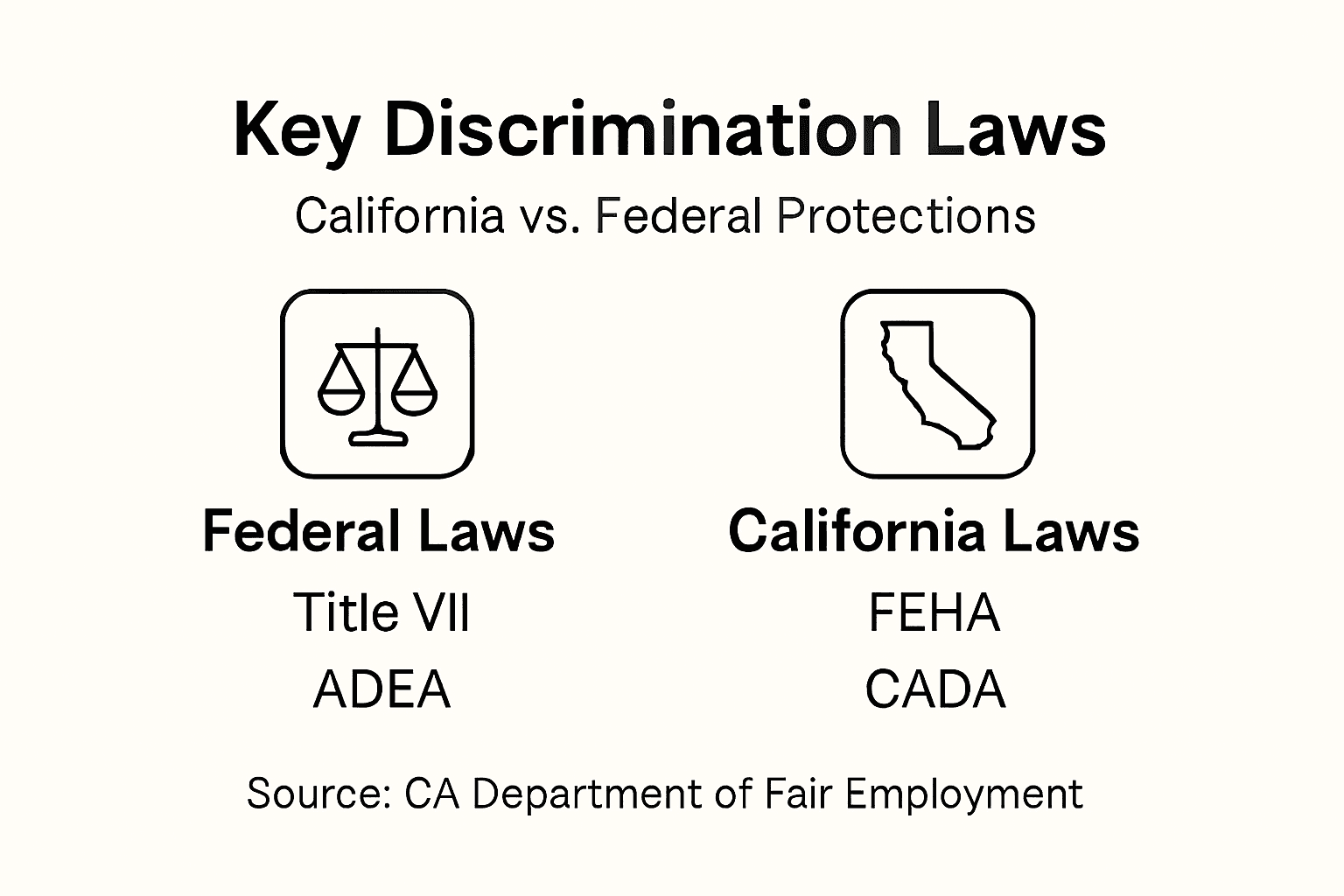
    Workplace discrimination laws in California represent a comprehensive legal framework that combines robust federal protections with state-specific safeguards. California employment discrimination laws create a multi-layered system of worker protections that go beyond national standards, ensuring comprehensive coverage for employees across various industries.

    The key legal frameworks protecting workers include:

    • Federal Laws:
      • Title VII of the Civil Rights Act
      • Americans with Disabilities Act (ADA)
      • Age Discrimination in Employment Act (ADEA)
    • California State Laws:
      • Fair Employment and Housing Act (FEHA)
      • California Civil Rights Department regulations

    California’s legal approach distinguishes itself by providing broader protections than federal statutes. The Fair Employment and Housing Act applies to employers with five or more employees and prohibits discrimination based on an extensive range of protected characteristics, including race, gender identity, sexual orientation, disability, age, and more. Workplace harassment prevention is particularly emphasized, with mandatory training requirements and strong retaliation protections for employees who assert their legal rights.

    Infographic comparing state and federal discrimination laws

    Here’s a comparison of how federal and California discrimination laws protect employees:

    Aspect Federal Law Protections California Law Protections
    Minimum Employer Size 15 employees for most statutes 5 employees under FEHA
    Covered Characteristics Race, color, sex, religion, etc. Broader list, including gender ID
    Harassment Training Not specifically required Mandatory for many employers
    Retaliation Protections Protected for complaints Stronger, including whistleblowers

    Pro tip: Keep detailed records of any potential discriminatory interactions, including dates, witnesses, and specific comments, as documentation can be crucial in substantiating legal claims.

    California employees have robust legal protections against workplace discrimination, with multiple avenues for addressing and resolving unfair treatment. Employee discrimination rights provide comprehensive mechanisms for workers to challenge and seek remedies for workplace violations, ensuring that individuals can defend themselves against unjust employment practices.

    Key employee rights and reporting processes include:

    • Right to File Complaints: Employees can submit discrimination claims to:
      • California Civil Rights Department (CRD)
      • Equal Employment Opportunity Commission (EEOC)
    • Potential Legal Remedies:
      • Lost wage compensation
      • Job reinstatement
      • Emotional distress damages
      • Punitive damages
    • Protection Against Retaliation: California law strictly prohibits employers from retaliating against workers who report discrimination

    The legal process typically requires employees to document incidents carefully and follow specific administrative procedures. Workers must usually exhaust administrative remedies before pursuing litigation, which often involves obtaining a right-to-sue letter from state or federal agencies. This structured approach ensures that discrimination claims are thoroughly investigated and provides multiple opportunities for resolution before entering courtroom proceedings.

    The following table summarizes the main types of evidence that can strengthen a workplace discrimination claim:

    Evidence Type Example Importance in Legal Claims
    Written Documentation Emails, memos, performance reviews Establishes a timeline and motive
    Witness Accounts Coworker statements, supervisor Supports claims of unfair treatment
    Contemporaneous Notes Incident logs with dates/details Demonstrates ongoing conduct pattern

    Pro tip: Preserve all communication records, performance evaluations, and witness contact information when experiencing potential workplace discrimination, as comprehensive documentation strengthens legal claims.

    Costs, Fee Structures, and Common Mistakes

    Navigating the financial landscape of job discrimination legal representation requires understanding the various fee structures and potential costs involved. Discrimination lawyer costs typically follow several predictable models that can help employees make informed decisions about pursuing legal action.

    Primary fee structures for discrimination lawyers include:

    • Contingency Fee Arrangement:
      • No upfront legal fees
      • Lawyer receives 33% to 40% of settlement or award
      • Minimal financial risk for the client
    • Hourly Rate Model:
      • Rates range from $300 to $500 per hour
      • Requires consistent client payments
      • More common in complex or uncertain cases
    • Flat Fee Services:
      • Predetermined cost for specific legal tasks
      • Less common in discrimination cases
      • Typically used for straightforward legal consultations

    Employees should be aware of common mistakes that can undermine their discrimination claims. Critical errors include failing to document incidents thoroughly, missing crucial filing deadlines, neglecting administrative remedies, and selecting lawyers without specialized employment discrimination experience. These missteps can significantly reduce the likelihood of a successful legal outcome and potentially forfeit potential compensation.

    Pro tip: Request a detailed fee agreement in writing and clarify all potential costs and payment structures before signing with a discrimination lawyer.

    Protect Your Rights with Expert Job Discrimination Support

    Facing job discrimination in California can be overwhelming and isolating. The article highlights how subtle and systemic unfair treatment affects your career, compensation, and work environment every day. If you have experienced disparate treatment, harassment, or retaliation remember you are not alone and the law protects you. Understanding your rights under California’s strong discrimination laws is the first step to reclaiming your workplace dignity.

    At California Labor Law, we empower you with clear legal guidance based on proven employment statutes and practical advice on documenting incidents that matter. Don’t let confusion or fear keep you from getting justice. Take action now to protect your job and future by calling California Labor Law at 1-866-355-9991 and learn how to start defending your rights today.

    Frequently Asked Questions

    What is job discrimination?

    Job discrimination occurs when an employer treats an employee unfairly based on protected characteristics such as race, gender, age, disability, or sexual orientation. This can happen in hiring, firing, promotions, compensation, and daily workplace interactions.

    How can a job discrimination lawyer help me?

    A job discrimination lawyer can provide legal consultations, help gather evidence, guide you through the complaint process, negotiate settlements, and pursue litigation if necessary. Their expertise is crucial in navigating complex discrimination claims.

    What are the types of workplace discrimination recognized in California?

    California recognizes several types of discrimination including disparate treatment, disparate impact, harassment, and retaliation. Each type has unique legal implications and may require different approaches to resolve the issues.

    What legal protections do employees have against discrimination?

    Employees have the right to file complaints with the California Civil Rights Department or the Equal Employment Opportunity Commission and seek remedies such as lost wages, job reinstatement, and protection against retaliation by their employers.


  • Reporting Discrimination at Work: Your Step-by-Step Guide

    Reporting Discrimination at Work: Your Step-by-Step Guide

    Reporting workplace discrimination can feel overwhelming and high-stakes for any employee. Over 50 percent of workers who face discrimination never report it at all. What might surprise you is that most complaints get ignored, not for lack of evidence, but simply because the first step is skipped. Detailed documentation is what actually turns your experience into a defensible case.

    Step 1: Document Incidents of Discrimination

    Reporting discrimination at work begins with creating a comprehensive and detailed record of every incident you experience. Thorough documentation is your most powerful tool in building a credible case and protecting your legal rights. This crucial first step transforms your personal experience from an isolated incident into evidence that can substantiate your claim.

    Start by creating a dedicated journal or digital document specifically for tracking discriminatory events. Your documentation should be precise, objective, and include specific details that paint a clear picture of what occurred. Write down the date, time, location, individuals involved, and a detailed description of the discriminatory action. Include verbatim quotes if possible, as precise language can be critical in demonstrating the nature of the discrimination.

    Capture contextual information that provides depth to your documentation. Note who was present as witnesses, describe the workplace environment, and record how the incident made you feel professionally and emotionally. While emotional impact matters, focus on presenting factual, observable details. Learn more about documenting workplace harassment to ensure you capture all relevant information.

    Use multiple methods to preserve evidence. Screenshots of digital communications, emails, text messages, or work platform interactions can provide additional context. Save copies of performance reviews, communication records, or any documents that might demonstrate a pattern of discriminatory behavior. If possible, save original files and create backup copies to prevent potential tampering or loss.

    Be consistent in your documentation. Update your record promptly after each incident, using clear and professional language. Avoid inflammatory statements or emotional language that could undermine the credibility of your documentation. Your goal is to create a factual, chronological account that can withstand professional and legal scrutiny.

    Below is a checklist table to help you verify you have documented every necessary aspect of each discrimination incident before proceeding to the next steps.

    Documentation Item Description Completed (Yes/No)
    Date and Time Record the specific date and exact time of the incident
    Location Note the exact workplace area or location where it occurred
    Individuals Involved Identify everyone directly involved in the incident
    Witnesses List any witnesses who were present during the incident
    Detailed Description Provide a factual, precise account of what happened
    Verbatim Quotes Include any direct statements or language used, if possible
    Emotional/Professional Impact Briefly note how the incident affected you
    Supporting Evidence Attach digital screenshots, emails, or related documented proof
    Backup Copies Created Ensure copies are securely saved and protected against alteration

    Remember that your documentation serves as the foundation for potential legal action or workplace complaint procedures. Approach this process with strategic precision, treating each entry as a potential piece of evidence that could be reviewed by human resources, management, or legal professionals.

    Document Incidents of Workplace Discrimination

    Step 2: Review Company Policies on Discrimination

    After documenting discriminatory incidents, your next critical step is to thoroughly review your company’s official policies on discrimination. Understanding these policies provides a strategic roadmap for addressing workplace harassment and creates a formal foundation for your potential complaint. Company policy documents are your primary reference point for understanding the official procedures and expectations surrounding discrimination reporting.

    Locate your employee handbook or human resources documentation, typically available through your company’s internal network, HR portal, or by directly requesting a copy from the HR department. Pay close attention to sections specifically addressing workplace discrimination, harassment prevention, reporting mechanisms, and employee protection protocols. Look for explicit definitions of what constitutes discriminatory behavior, the steps for filing a formal complaint, and the protections guaranteed to employees who report such incidents.

    Learn more about workplace discrimination policies to ensure you understand your rights and the formal reporting process. Most comprehensive policies will outline a clear sequence of actions, including confidentiality protections, investigation procedures, and potential consequences for substantiated discriminatory behavior.

    Carefully analyze the specific reporting channels outlined in your company’s documentation. Some organizations require initial reporting to an immediate supervisor, while others mandate direct communication with human resources or a dedicated ethics department. Identify the precise contact person or department responsible for receiving discrimination complaints. Note any specific forms, documentation, or communication methods required when initiating a formal complaint.

    Pay special attention to anti-retaliation clauses within the policy. Legitimate company policies should explicitly protect employees who report discrimination in good faith, preventing potential workplace repercussions for speaking up. Understanding these protections provides additional confidence and legal ground when preparing to report discriminatory incidents.

    Before proceeding, create a summary of key policy points relevant to your specific situation. This preparation demonstrates your professionalism and thorough approach to addressing workplace discrimination. Your goal is to understand the official channels and requirements, positioning yourself to navigate the complaint process with clarity and strategic precision.

    The following table summarizes the main steps in the reporting process, along with their primary objectives and key actions to take.

    Step Main Objective Key Actions
    Document Incidents of Discrimination Build credible, factual evidence Keep detailed, objective records
    Review Company Policies Understand official reporting mechanisms and protections Locate and study policy documentation
    Seek Guidance from HR or Legal Transform evidence into actionable complaints Consult HR and/or employment attorney
    Submit a Formal Complaint Trigger formal investigation and response Complete and submit written complaint
    Follow Up on Complaint Status Ensure accountability and progress Track updates, document all responses
    Know Your Rights and Next Steps Assess options for resolution or escalation Consult legal agencies if needed

    Navigating workplace discrimination requires strategic support, making guidance from human resources or legal professionals a critical step in your journey. Your objective in this stage is to transform your documented experiences into a formal, actionable complaint with professional guidance. Approaching this step requires careful preparation and a clear understanding of your potential support resources.

    Initiate contact with your company’s human resources department, presenting your documented evidence in a calm, professional manner. Prepare a concise summary of incidents, focusing on factual details and referencing specific company policy provisions. HR representatives are trained to handle discrimination complaints, and their initial response can provide valuable insights into how your organization will address the situation. Be prepared for potential scenarios, understanding that HR’s primary responsibility is to the company, which means their investigation may not always align perfectly with your expectations.

    Understand the role of an employment attorney who can provide independent legal perspective on your situation. Legal professionals offer an objective assessment of your case, helping you understand the strength of your potential claims and the most strategic approach to addressing workplace discrimination. They can evaluate whether your experiences constitute legal violations and guide you through potential resolution strategies.

    When consulting with HR or legal advisors, maintain meticulous records of all communications. Document the date, time, individuals spoken with, and key discussion points. Request written confirmation of your complaint and any subsequent steps promised. This documentation creates an additional layer of accountability and provides a paper trail that could be crucial if further legal action becomes necessary.

    Be prepared to provide comprehensive documentation from your earlier evidence gathering. Organize your records chronologically, highlighting patterns of discriminatory behavior rather than isolated incidents. Your goal is to present a clear, coherent narrative that demonstrates the systemic nature of the discrimination you have experienced.

    Remember that seeking guidance is not just about filing a complaint, but about understanding your rights and determining the most effective path forward. Each conversation with HR or a legal advisor should move you closer to a resolution that protects your professional integrity and personal well-being.

    Step 4: Submit a Formal Complaint

    Submitting a formal complaint transforms your documented experiences into an official workplace record, signaling your commitment to addressing discrimination. This critical step requires precision, professionalism, and strategic documentation. Your complaint becomes the formal mechanism through which your organization must investigate and respond to discriminatory behaviors.

    Prepare a comprehensive written complaint that follows your company’s specific procedures. Craft a clear, factual narrative that outlines discriminatory incidents with objective language. Include specific dates, times, locations, involved parties, and direct references to company policies that were violated. Your written complaint should read like a professional legal document, presenting evidence without emotional language or inflammatory statements.

    Learn more about finding the right employment lawyer to understand potential legal strategies if your internal complaint process proves ineffective. While your immediate goal is resolving the issue internally, having legal knowledge can strengthen your approach.

    When submitting your complaint, choose the most appropriate communication channel outlined in your company’s discrimination policy. Some organizations require formal written complaints submitted through specific HR platforms or email addresses. Others might mandate in-person submissions or require standardized complaint forms. Follow these procedural requirements precisely to ensure your complaint receives proper consideration.

    Make multiple copies of your complaint and maintain a detailed record of submission. Request written confirmation of receipt from the appropriate department, including the date and name of the person who accepted your complaint. This documentation creates an official trail and prevents potential claims that your complaint was never received or processed.

    Be prepared for potential follow-up investigations. Your complaint may trigger interviews with you, witnesses, and the individuals accused of discriminatory behavior. Maintain professional composure throughout this process, focusing on presenting factual information and avoiding personal attacks or emotional rhetoric.

    Understand that submitting a formal complaint is a significant step that requires courage and commitment. Your goal is to create meaningful change, protect your professional rights, and establish a workplace environment free from discriminatory practices. By following proper procedures and maintaining thorough documentation, you demonstrate your professionalism and dedication to resolving workplace discrimination.

    Submit a Formal Complaint About Workplace Discrimination

    Step 5: Follow Up on Your Complaint Status

    After submitting a formal discrimination complaint, proactive and consistent follow-up becomes crucial in ensuring your case receives proper attention. Tracking the progress of your complaint is not passive waiting, but an active management of your professional rights. Your strategic engagement demonstrates commitment and prevents your complaint from becoming lost in administrative bureaucracy.

    Establish a systematic approach to following up on your complaint. Create a dedicated communication log documenting every interaction, including dates, names of individuals contacted, methods of communication, and key discussion points. Set a schedule for regular check-ins, typically every 7-10 business days, to inquire about the investigation’s status. During these follow-ups, maintain a professional, calm tone that focuses on understanding the process rather than expressing frustration.

    Learn more about finding the right employment lawyer who can provide guidance if your internal complaint process becomes unresponsive or appears to stall. Legal professionals can offer strategic advice about escalating your complaint or understanding your rights during the investigation period.

    During your follow-up communications, request specific information about the investigation’s timeline, expected next steps, and potential outcomes. Document these conversations in writing, preferably through email, which creates an official record of communications. If verbal conversations occur, send a follow-up email summarizing the key points discussed to ensure a paper trail exists.

    Prepare for potential variations in the complaint resolution process. Some investigations might conclude quickly, while others could take weeks or months. Your documentation and consistent follow-up demonstrate professionalism and signal to your organization that you are serious about addressing the discrimination.

    Be aware of potential retaliation risks during this process. While company policies should protect you from adverse actions, document any changes in workplace treatment that might suggest retaliatory behavior. Your careful record-keeping can serve as additional evidence if the investigation does not resolve your concerns satisfactorily.

    Remember that following up is not just about monitoring progress, but maintaining your professional dignity and commitment to a fair workplace. Your persistent, professional approach communicates that you are serious about addressing discriminatory practices and protecting your rights.

    Step 6: Know Your Rights and Next Steps

    Understanding your legal rights is the cornerstone of effectively addressing workplace discrimination. This final step empowers you with knowledge and strategic options for moving forward, whether your internal complaint process has been successful or requires further action. Your comprehensive approach to documenting, reporting, and now understanding your rights creates a robust defense against discriminatory practices.

    Carefully evaluate the outcomes of your complaint investigation. If your company’s response is unsatisfactory or inadequate, you have multiple legal avenues to pursue. Federal and state laws provide strong protections against workplace discrimination, offering various mechanisms for seeking justice. Learn more about understanding your workplace rights to ensure you are fully informed about potential legal strategies.

    Consider filing a formal complaint with external agencies if internal resolution proves ineffective. The Equal Employment Opportunity Commission (EEOC) and state-level civil rights departments offer robust mechanisms for addressing workplace discrimination. These agencies can conduct independent investigations, mediate disputes, and potentially support legal proceedings if discrimination is substantiated.

    Understand the strict timelines associated with filing external complaints. Discrimination claims typically have specific statute of limitations, which vary depending on the type of discrimination and jurisdictional requirements. Some federal claims must be filed within 180 days of the discriminatory incident, while state-level claims might offer extended timelines. Prompt action preserves your legal options and demonstrates your commitment to addressing workplace injustice.

    Consult with an employment law attorney who specializes in discrimination cases. Legal professionals can provide nuanced guidance about the strength of your case, potential compensation, and the most strategic approach to pursuing your claim. They can help you understand the potential outcomes, including monetary settlements, workplace policy changes, or reinstatement.

    Prepare yourself mentally and professionally for potential outcomes. External complaints can be complex, potentially impacting your current employment relationship. Maintain professionalism, continue documenting all interactions, and focus on achieving a fair resolution. Your goal is not just personal vindication, but contributing to a workplace culture that respects and protects all employees from discriminatory practices.

    Take Control of Workplace Discrimination With Trusted Guidance

    You have read the step-by-step process for documenting and reporting discrimination at work. The fear of retaliation, the confusion around complex policies, and uncertainty about legal rights create real obstacles. If you feel overwhelmed by gathering evidence, navigating company procedures, or understanding your next steps, you are not alone. The right information and support can help you move from uncertainty to action. Visit California Labor Law to get the employment help you need or call us at 1-866-355-9991 to schedule a free workplace discrimination consultation.

    Frequently Asked Questions

    What should I include in my documentation when reporting discrimination at work?

    Thorough documentation should include the date, time, and location of each incident, as well as the individuals involved and a detailed description of what occurred. Make sure to write everything down promptly and objectively, focusing on facts rather than emotions.

    How do I find my company’s policies on discrimination?

    Locate your employee handbook or HR documentation, typically available through your company’s internal network or by requesting a copy from HR. Pay special attention to sections on discrimination reporting procedures and employee protection protocols.

    What steps should I take before submitting a formal complaint?

    Before submitting a formal complaint, review your documented evidence and ensure it is organized chronologically. Prepare a clear and factual narrative that outlines discriminatory incidents and references relevant company policies to strengthen your complaint.

    How can I follow up on the status of my discrimination complaint?

    Establish a communication log to document every interaction regarding your complaint and set a schedule for regular check-ins, typically every 7-10 business days. During these follow-ups, maintain a calm and professional tone while asking for updates on the investigation’s timeline and next steps.

    What should I do if my company’s response to my complaint is unsatisfactory?

    If the response to your complaint is inadequate, consider filing a formal complaint with external agencies that handle workplace discrimination cases. Evaluate your legal options and consult with an employment law attorney to understand potential next steps and strategies moving forward.

    How can I ensure my rights are protected throughout this process?

    Document all interactions and keep a record of any retaliatory behavior you may experience after reporting discrimination. Understanding your rights and maintaining meticulous records empowers you to take further action if necessary and reinforces your standing in the complaint process.

  • Understanding Workplace Discrimination Types and Impacts

    Understanding Workplace Discrimination Types and Impacts

    Recognizing discrimination requires awareness, documentation, and a commitment to maintaining professional environments that respect individual dignity and equal opportunity. Workplace discrimination is more common than most people realize, and it touches nearly every industry. Thousands of complaints are filed with the EEOC every year, resulting in millions paid out in settlements. Most expect discrimination to look obvious or loud. The real shock is how often it happens through quiet policies or subtle cues that many never spot until damage is done.

    Defining Workplace Discrimination Types

    Workplace discrimination represents a complex legal and ethical challenge that undermines professional environments and individual worker rights. Understanding the various workplace discrimination types is crucial for employees and employers alike to recognize, prevent, and address potential violations.

    Discrimination in the workplace occurs when an employee or job applicant receives unfair treatment based on protected characteristics. According to Equal Employment Opportunity Commission, discrimination involves treating someone differently or less favorably because of specific inherent or personal attributes.

    Key Protected Characteristics Include:

    • Race and ethnicity
    • Gender and sexual orientation
    • Age (40 and above)
    • Disability status
    • Religious beliefs
    • National origin

    Common Workplace Discrimination Categories

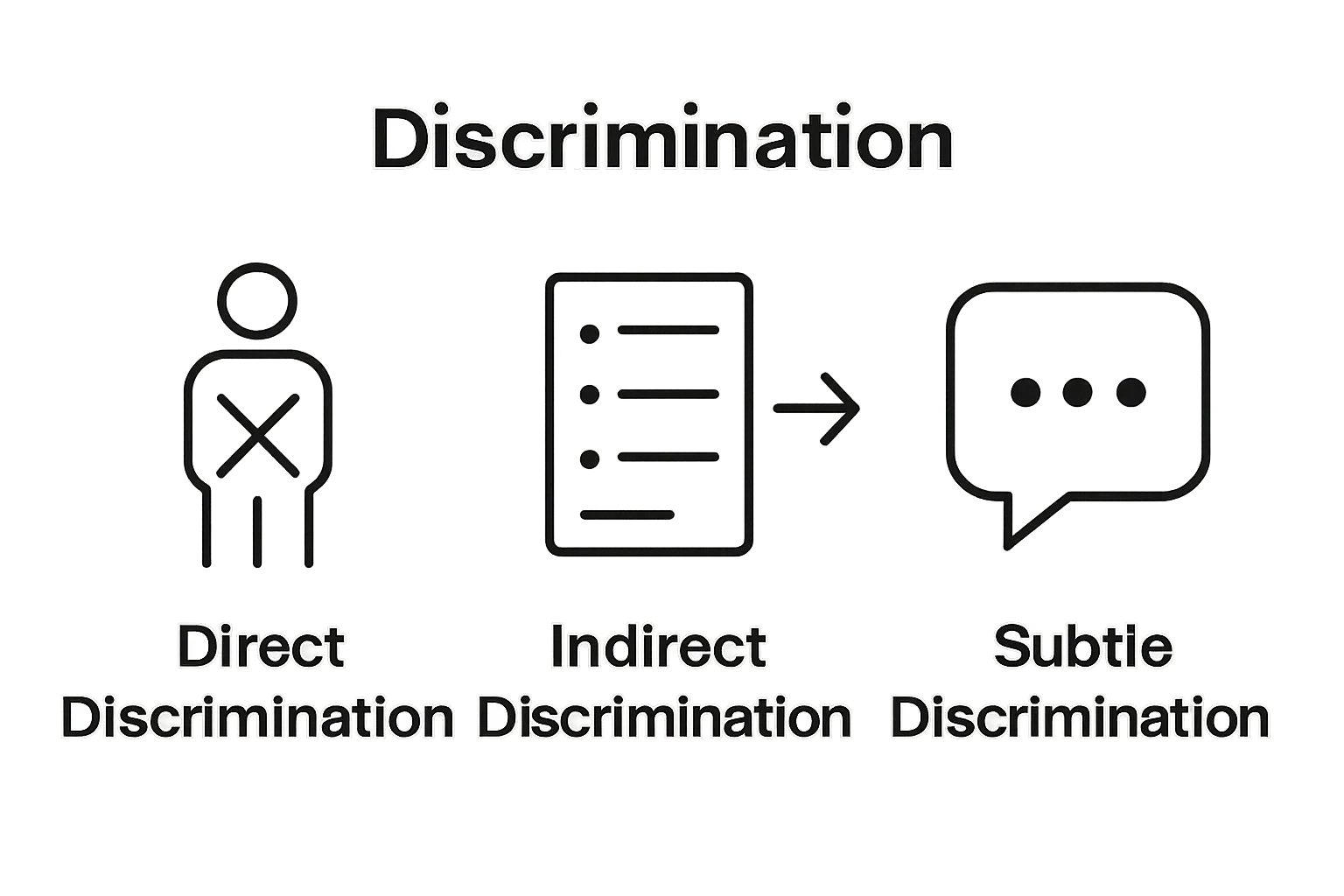
    Workplace discrimination manifests through multiple complex mechanisms, each targeting specific aspects of employment and professional interactions. The primary discrimination types include:

    Comparison of direct, indirect, and subtle workplace discrimination with icons

    Direct Discrimination:

    • Explicit negative actions targeting protected group characteristics
    • Clear preferential treatment excluding certain individuals
    • Direct statements or policies demonstrating bias

    Indirect Discrimination:

    • Seemingly neutral policies disproportionately impacting specific groups
    • Unintentional practices creating systemic barriers
    • Employment requirements unnecessarily excluding particular candidates

    Recognizing Subtle Discrimination Patterns

    Discrimination often operates through nuanced and sophisticated mechanisms beyond obvious mistreatment. American Psychological Association research highlights that discrimination can manifest through microaggressions, implicit biases, and structural workplace practices that create unequal opportunities.

    Understanding these intricate workplace discrimination types empowers employees to identify potential violations and seek appropriate legal recourse.

    To clarify how different types of discrimination operate in the workplace, the following table compares direct and indirect discrimination based on their characteristics and effects.

    Type of Discrimination Description Common Examples Impact on Employees
    Direct Discrimination Explicit unfavorable treatment based on protected characteristics Biased hiring, unequal pay, exclusionary policies Immediate and obvious exclusion
    Indirect Discrimination Neutral actions or policies that disproportionately impact specific groups Attendance policies, physical requirements, dress codes Hidden barriers, reduced opportunities

    Recognizing discrimination requires awareness, documentation, and a commitment to maintaining professional environments that respect individual dignity and equal opportunity.

    The Importance of Recognizing Discrimination

    Recognizing workplace discrimination represents a critical strategy for protecting employee rights, maintaining organizational integrity, and creating inclusive professional environments. Understanding the deeper implications of discrimination goes beyond legal compliance and touches fundamental human dignity and professional respect.

    Psychological and Professional Impact

    Discrimination creates profound psychological consequences for targeted individuals. American Psychological Association research demonstrates that persistent workplace discrimination can lead to significant mental health challenges, including:

    • Increased stress and anxiety
    • Reduced job satisfaction
    • Diminished professional confidence
    • Higher risk of depression
    • Lower workplace productivity

    Psychological Trauma: Repeated discriminatory experiences can create long lasting emotional scars that extend far beyond the immediate workplace context, potentially affecting an individual’s career trajectory and personal well being.

    Beyond individual impact, discrimination carries substantial legal and organizational risks. Companies that fail to recognize and address discriminatory practices expose themselves to significant financial and reputational damage. According to U.S. Equal Employment Opportunity Commission, thousands of discrimination charges are filed annually, resulting in substantial monetary settlements.

    Potential Organizational Risks Include:

    • Expensive legal litigation
    • Substantial financial penalties
    • Damaged organizational reputation
    • Decreased employee morale
    • Potential loss of talented workforce members

    Building Inclusive Work Environments

    Recognizing discrimination is not merely about avoiding legal challenges but actively constructing supportive, respectful professional spaces. Successful organizations understand that diversity and inclusion are strategic advantages that drive innovation, creativity, and overall organizational performance.

    Effective recognition requires ongoing education, transparent communication, and a genuine commitment to understanding different employee experiences. By proactively identifying and addressing discriminatory patterns, organizations can create environments where every individual feels valued, respected, and empowered to contribute their full potential.

    The Importance of Recognizing Discrimination

    California maintains one of the most comprehensive legal frameworks in the United States designed to protect employees from workplace discrimination. These robust protections go beyond federal standards, offering workers extensive safeguards and clear pathways for addressing discriminatory practices.

    State and Federal Protection Mechanisms

    The legal landscape of workplace discrimination in California combines both state and federal regulations to create multilayered protections. California Department of Fair Employment and Housing provides critical guidance on these comprehensive anti-discrimination statutes.

    Key Protective Legislation Includes:

    Distinctive California Anti Discrimination Standards

    Unlike many states, California offers broader and more expansive discrimination protections. The state recognizes a wider range of protected characteristics and provides stronger legal remedies for workers experiencing unfair treatment. California Labor Code establishes stringent requirements that employers must follow to ensure workplace equality.

    Unique California Protections:

    • Protection for additional categories beyond federal law
    • Lower thresholds for proving discrimination
    • More substantial monetary damages
    • Stronger retaliation protections

    Employees facing discrimination have multiple avenues for seeking justice. The legal framework provides clear mechanisms for filing complaints, pursuing administrative remedies, and initiating civil litigation. For workers seeking guidance on navigating these complex processes, our comprehensive guide on employment retaliation offers detailed insights into protecting workplace rights.

    California’s legal approach demonstrates a commitment to creating equitable work environments by establishing strong, proactive protections that empower employees and hold employers accountable for maintaining fair and respectful professional spaces.

    The table below summarizes major legal protections against workplace discrimination in California and how they differ from general federal standards, helping employees and employers understand their coverage.

    Legal Protection Scope Unique to California
    California Fair Employment and Housing Act (FEHA) Broad state protections for many characteristics Yes
    Title VII Civil Rights Act Federal protection for race, color, religion, sex No
    Americans with Disabilities Act Federal protection for disability No
    Age Discrimination in Employment Act Federal protection for age (40+) No
    California Labor Code Standards Stricter requirements and extra categories protected Yes

    Impact of Discrimination on Employees and Work Environment

    Workplace discrimination creates profound negative consequences that extend far beyond individual experiences, fundamentally disrupting organizational dynamics and employee well being. The ripple effects of discriminatory practices can undermine entire workplace cultures and professional ecosystems.

    Psychological and Personal Consequences

    National Institutes of Health research demonstrates that persistent workplace discrimination significantly impacts mental and physical health. Employees experiencing discrimination often encounter extensive psychological challenges that compromise their professional and personal functioning.

    Critical Psychological Effects Include:

    • Chronic stress and anxiety
    • Reduced self esteem
    • Emotional exhaustion
    • Increased risk of depression
    • Potential development of post traumatic stress symptoms

    Impact of Discrimination on Employees and Work Environment

    Organizational Performance Implications

    Discrimination does not merely affect individual workers but substantially compromises organizational effectiveness. Companies experiencing systemic discriminatory practices face significant productivity challenges and potential talent loss. The undermined workplace environment creates barriers to innovation, collaboration, and employee engagement.

    Organizational Performance Disruptions:

    • Decreased team productivity
    • Higher employee turnover rates
    • Reduced overall workplace morale
    • Compromised creative problem solving
    • Potential reputation damage

    Long Term Professional Consequences

    The impact of workplace discrimination extends beyond immediate workplace interactions, potentially derailing career trajectories and professional development. California ADA Violations Guide highlights how discriminatory experiences can create systemic barriers that limit professional advancement and economic opportunities.

    Addressing workplace discrimination requires a holistic approach that recognizes its multifaceted impacts.

    Organizations must develop proactive strategies that not only prevent discriminatory practices but actively cultivate inclusive environments where every employee can thrive professionally and personally.

    Strategies for Addressing Workplace Discrimination

    Addressing workplace discrimination requires a comprehensive, proactive approach that involves individual awareness, organizational commitment, and strategic implementation of inclusive practices. Effective strategies must simultaneously prevent discriminatory behaviors and create supportive professional environments.

    Individual Empowerment and Documentation

    Employees play a critical role in combating workplace discrimination by understanding their rights and maintaining meticulous documentation. Equal Employment Opportunity Commission recommends specific steps for individuals facing potential discriminatory treatment.

    Key Documentation Strategies:

    • Record specific dates and details of discriminatory incidents
    • Collect supporting evidence like emails or witness statements
    • Maintain a chronological log of interactions
    • Preserve communication records
    • Note potential witnesses or corroborating individuals

    Organizational Policy and Training

    Successful discrimination prevention begins with robust organizational policies and continuous educational initiatives. Companies must develop clear, comprehensive guidelines that explicitly define unacceptable behaviors and establish consequences for violations.

    Essential Policy Components:

    • Clear anti discrimination statement
    • Explicit reporting mechanisms
    • Transparent investigation procedures
    • Consistent enforcement protocols
    • Regular policy review and updates

    When internal resolution proves insufficient, employees have multiple legal pathways for addressing workplace discrimination. Employment Lawyers in California offer guidance on navigating complex administrative and judicial processes.

    Addressing workplace discrimination demands a multifaceted approach that balances individual empowerment, organizational accountability, and systemic change. By implementing comprehensive strategies, workplaces can transform potential conflict into opportunities for growth, understanding, and genuine inclusivity.

    Ready to Take Control After Facing Workplace Discrimination?

    If you are feeling the stress and uncertainty that comes with workplace discrimination from subtle microaggressions to clearly unfair treatment you are not alone. Many California employees experience decreased job satisfaction and emotional distress when their rights are violated. Understanding the legal framework and the different types of discrimination is the first step, but knowing how to act is the key to real change.

    You deserve a fair and respectful workplace. Contact California Labor Law for a free consultation or call us at toll free at 1-866-355-9991 for a free workplace discrimination consultation.

    Frequently Asked Questions

    What is workplace discrimination?

    Workplace discrimination occurs when employees or job applicants receive unfair treatment based on protected characteristics, such as race, gender, age, or disability.

    What are the main types of workplace discrimination?

    The main types of workplace discrimination include direct discrimination, which involves explicit negative actions towards certain groups, and indirect discrimination, which refers to neutral policies that disproportionately impact specific groups.

    How can workplace discrimination affect employees?

    Workplace discrimination can lead to significant psychological effects, including increased stress, anxiety, reduced job satisfaction, and lower productivity. It can also impact an individual’s professional trajectory and overall well-being.

    What steps should I take if I experience discrimination at work?

    If you experience discrimination, it’s important to document specific incidents, gather evidence, and report the behavior through your organization’s established channels. You may also seek legal guidance if needed.