Category: Employment Contracts

  • Are Non-Compete Contracts Legal in California?

    Are Non-Compete Contracts Legal in California?

    Non-Compete Contracts in California: Legal or Not? (Complete Guide)

    Facing a new job offer or exit in California can leave employees in technology and healthcare wondering if a non-compete agreement will limit their next career step.

    Understanding California’s strict prohibition on non-compete agreements is crucial, especially with so many contracts still including these clauses despite clear state law.

    This guide provides concise, up-to-date answers so you can approach your next move with confidence and protect your right to work.

    What Are Non-Compete Contracts?

    Non-compete contracts are legal agreements that restrict employees from working for competitors or starting similar businesses after leaving their current employment. These contractual provisions protect business interests by limiting an employee’s professional activities for a specified duration and geographic region.

    Typically, non-compete contracts contain several key components that define their scope and enforceability:

    • Duration of restrictions (usually 6-24 months)
    • Geographic limitations defining where restrictions apply
    • Specific competitive activities prohibited
    • Potential financial penalties for violation
    • Compensation considerations for the employee

    Business motivations for non-compete agreements are complex. They aim to prevent employees from immediately transferring specialized knowledge, client relationships, or proprietary strategies to direct competitors. These agreements are intended to protect employer investments in human capital, particularly in industries where intellectual property and specialized skills are critical.

    However, non-compete contracts are not universal or unconditionally enforceable. Different states have varying regulations, with California being notably strict about limiting such contractual restrictions. The primary goal is balancing legitimate business protection with an employee’s right to pursue professional opportunities.

    Pro tip: Always carefully review the specific terms of any non-compete agreement and consider consulting an employment lawyer to understand potential implications for your career trajectory.

    California Law on Non-Compete Agreements

    California stands out as a unique state with an exceptionally strict stance on non-compete agreements. California law explicitly prohibits employers from enforcing non-compete agreements, making these contracts essentially unenforceable across most industries and employment scenarios.

    The key aspects of California’s legal approach to non-compete contracts include:

    • Complete prohibition of most non-compete agreements
    • Protection of worker mobility and professional freedom
    • Rejection of geographic or time-based restrictions on employment
    • Severe penalties for employers attempting to enforce such agreements
    • Strong legal support for employees’ right to work

    Under California Business and Professions Code Section 16600, the state takes an unequivocal position that any contract restraining an individual from engaging in a lawful profession, trade, or business is void.

    This means that regardless of how an employer drafts a non-compete clause, California courts will typically invalidate such provisions, prioritizing an employee’s right to earn a living and maintain professional opportunities.

    Attorney reviewing California non-compete law

    Federal regulations are also aligning with California’s worker-friendly approach, with the Federal Trade Commission recently proposing rules that would significantly limit non-compete agreements nationwide. This trend underscores California’s long-standing commitment to protecting worker mobility and preventing anti-competitive business practices.

    Pro tip: Always request a copy of your employment contract and have it reviewed by a local employment attorney to understand your specific rights under California law.

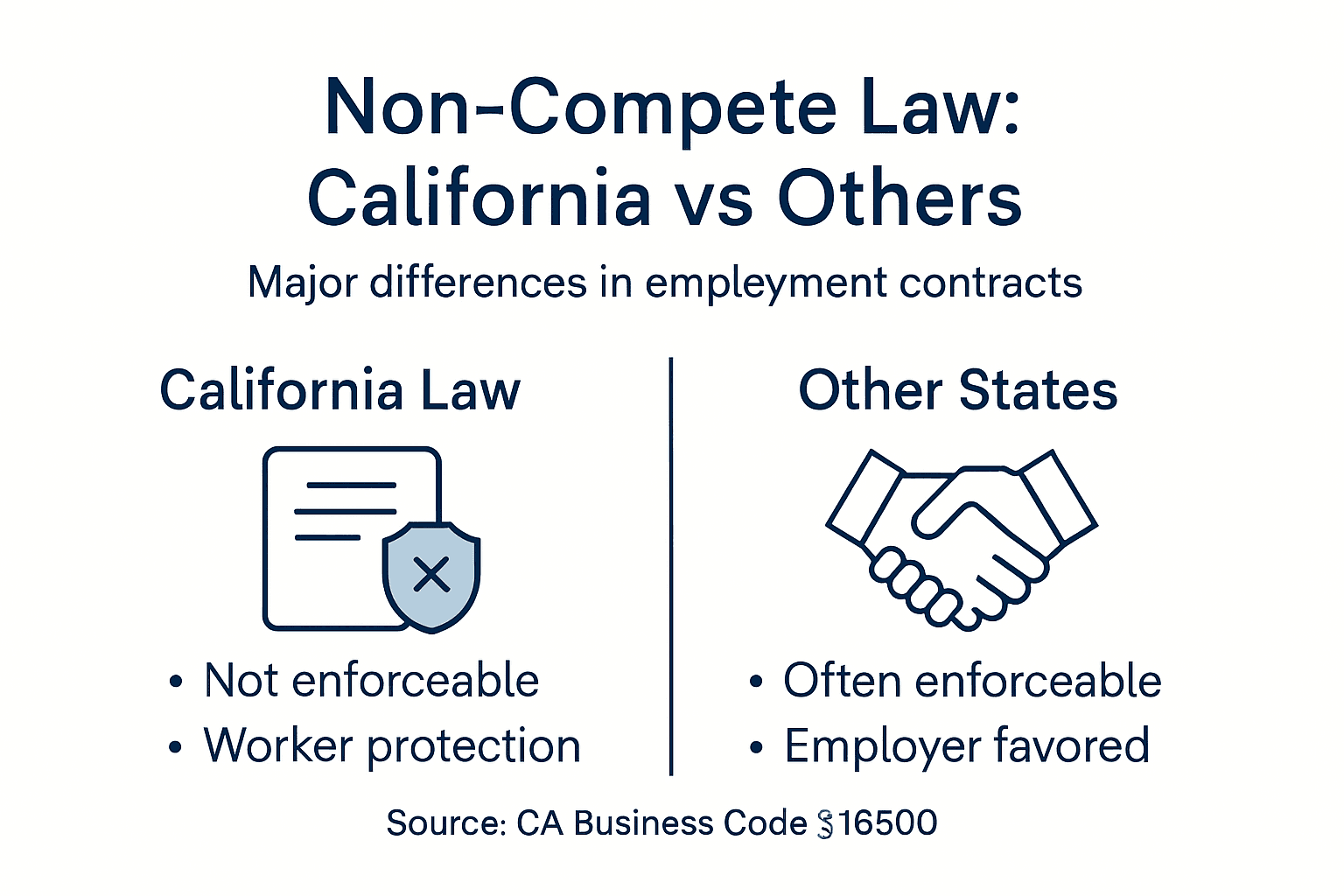
    Here’s how California’s approach to non-compete contracts compares with the general U.S. legal landscape:

    Aspect California Law Most Other States
    Enforceability Void in nearly all cases Often enforceable with limits
    Worker Mobility Fully protected Limited by contract terms
    Employer Penalties Severe sanctions possible Typically minor or none
    Use of Alternatives Focus on NDAs, IP laws Alternatives plus non-competes

    Infographic comparing non-compete laws by state

    Exceptions: Trade Secrets and Non-Solicitation

    While California’s stance against non-compete agreements remains firm, the state recognizes legitimate business interests that require protection. Employers can still safeguard critical business assets through carefully crafted legal mechanisms, specifically focusing on trade secrets and client relationships.

    The key alternative legal protections for businesses include:

    • Non-disclosure agreements (NDAs) that prevent information sharing
    • Non-solicitation clauses targeting client and employee poaching
    • Trade secret protection under state and federal laws
    • Confidentiality contracts with specific legal boundaries
    • Intellectual property safeguards that don’t restrict employment

    Trade secret protection represents the most robust exception to California’s non-compete restrictions. Businesses can take legal action if an employee misappropriates confidential information, technical processes, or proprietary strategies.

    This means while an employer cannot prevent you from working for a competitor, they can absolutely pursue legal remedies if you steal or improperly use their confidential information.

    Non-solicitation agreements provide another nuanced approach to protecting business relationships, allowing companies to prevent former employees from directly soliciting clients or other employees. These agreements must be narrowly crafted to avoid being interpreted as de facto non-compete contracts, which California courts will swiftly invalidate.

    Pro tip: Always carefully read the specific language of any confidentiality or non-solicitation agreement, and consider consulting an employment lawyer to understand your precise obligations.

    Here are the main legal alternatives California employers use instead of non-compete agreements:

    Method Primary Purpose Risk to Employee Common Use Case
    Non-Disclosure Agreement (NDA) Prevent secret info sharing Requires ongoing confidentiality Protecting client lists or formulas
    Non-Solicitation Clause Prevent poaching clients or staff Restrictions must be narrow Retaining customers or teams
    Trade Secret Protection Secure proprietary business data Legal action if misappropriated Technology or product design
    Confidentiality Contract Limit disclosure of sensitive data Clarifies information boundaries General business operations

    Employee Rights and Employer Obligations

    California workers have robust legal protections against anti-competitive employment restrictions, ensuring their fundamental right to pursue professional opportunities without undue constraints.

    The state’s legal framework prioritizes employee mobility and career freedom, placing significant responsibilities on employers to respect these rights.

    Key employee rights and employer obligations include:

    • Right to work in chosen profession without unreasonable restrictions
    • Prohibition of anti-competitive employment agreements
    • Protection against wage suppression tactics
    • Freedom to seek better employment opportunities
    • Legal recourse for workers facing unfair labor practices

    Employer obligations are comprehensive and strictly enforced. Businesses cannot create, enforce, or imply non-compete agreements that restrict an employee’s ability to work. This means employers are legally prohibited from developing contract language that could discourage or prevent workers from changing jobs, even within the same industry or with direct competitors.

    California’s Department of Justice actively monitors and enforces worker protection standards, ensuring that companies maintain fair labor practices. Employers who violate these standards can face significant legal penalties, including potential lawsuits, financial sanctions, and reputational damage.

    The state’s commitment to protecting worker mobility extends beyond merely invalidating non-compete agreements to actively preventing any practices that might limit professional opportunities.

    Pro tip: Document any suspicious contract language or employment practices that seem designed to restrict your career mobility, and consider consulting an employment lawyer if you feel your professional rights are being compromised.

    California has strengthened its legal stance against non-compete agreements with significant legislative updates effective January 1, 2024. These changes represent a comprehensive approach to protecting worker mobility and preventing anti-competitive employment practices across the state.

    The key recent legal modifications include:

    • Complete prohibition on drafting or enforcing non-compete agreements
    • Expanded worker protection mechanisms
    • Increased penalties for employers attempting to restrict employee movement
    • Retroactive invalidation of existing non-compete contracts
    • Enhanced legal recourse for workers facing contractual restrictions

    Statutory updates dramatically transform the legal landscape for employment contracts. Employers are now explicitly forbidden from not only enforcing non-compete agreements but also from attempting to create or negotiate such provisions.

    This represents a more aggressive approach compared to previous interpretations of California’s long-standing prohibitions against restricting worker mobility.

    Multistate legal coalitions are actively supporting nationwide efforts to ban non-compete agreements, signaling a broader movement toward protecting employee rights.

    California continues to lead these efforts, with Attorney General Rob Bonta playing a prominent role in supporting federal initiatives that would extend similar protections across the United States.

    Pro tip: Review any existing employment contracts with a legal professional to ensure they comply with the latest California non-compete regulations and do not contain any potentially unenforceable restrictive provisions.

    Understand Your Rights and Protect Your Future in California

    Navigating non-compete agreements in California can be confusing and stressful, especially with strict laws that often render these contracts unenforceable.

    If you are concerned about your employment contract, confidentiality clauses, or non-solicitation terms, you are not alone. Knowing your rights under California labor law is essential to safeguard your career mobility and prevent unlawful restrictions on your ability to work.

    At California Labor Law, we provide clear, reliable guidance tailored to California employees facing these challenges.

    Do not let confusing agreements limit your professional opportunities. Call 1-866-355-9991 today to schedule a free non-compete contract consultation and empower yourself with knowledge and get the support you deserve to stand up for your rights.

    Frequently Asked Questions

    Are non-compete contracts enforceable in California?

    Non-compete contracts are generally void in California, making them unenforceable across most industries and employment scenarios.

    What legal protections do employees have regarding non-compete agreements in California?

    California law protects employees’ rights to work without unreasonable restrictions, prohibiting anti-competitive agreements like non-compete contracts.

    What are the exceptions to non-compete restrictions in California?

    While non-compete agreements are typically unenforceable, businesses can protect trade secrets and client relationships through non-disclosure agreements (NDAs) and non-solicitation clauses.

    What recent changes have been made to non-compete laws in California?

    As of January 1, 2024, California has strengthened its prohibition against non-compete agreements, including increased penalties for violations and retroactive invalidation of existing contracts.

  • Understanding Employment Contract Basics for California Workers

    Understanding Employment Contract Basics for California Workers

    Most people think an employment contract is just paperwork to sign before starting a new job. But in California, a contract often spells out more than your schedule or salary. The real surprise is that a well-written employment agreement can protect your rights, guarantee fair pay, and shield you from unfair treatment—sometimes even in court.

    What is an Employment Contract and Its Purpose?

    An employment contract represents a legally binding agreement between an employer and an employee that establishes the fundamental terms of their professional relationship. When you start a new job in California, this critical document defines the expectations, responsibilities, and rights for both parties.

    Understanding the Basic Structure

    Employment contracts outline several key elements that create a clear framework for the working relationship. These typically include:

    • Job title and description of primary responsibilities
    • Compensation details including salary, wages, or hourly rate
    • Work schedule and expected hours
    • Duration of employment (permanent, contract, temporary)
    • Performance expectations and evaluation processes

    According to the California Department of Industrial Relations, employment contracts can be written or oral, but written contracts provide the most comprehensive protection and clarity for both employers and employees.

    Employment contracts serve multiple crucial functions beyond simply documenting job details. They provide legal protection by establishing clear boundaries and expectations that prevent misunderstandings. In California, these contracts help define the scope of work, compensation terms, and potential conditions for termination.

    The contract also specifies important workplace elements such as confidentiality requirements, potential non-compete clauses, and intellectual property ownership. By clearly articulating these terms upfront, both parties can understand their obligations and potential consequences of contract breach.

    While not every employment relationship requires a formal written contract, having a comprehensive agreement significantly reduces potential conflicts and provides a solid legal foundation for the professional relationship. Workers should carefully review all contract terms and seek clarification on any unclear provisions before signing.

    Why Employment Contracts Matter for Employees

    Employment contracts are more than just paperwork. They represent a critical legal instrument that protects employee rights, establishes clear workplace expectations, and provides a framework for resolving potential disputes. Understanding the significance of these contracts can empower workers to make informed decisions about their professional relationships.

    Protecting Employee Rights and Interests

    Employment contracts serve as a fundamental safeguard for workers, establishing clear boundaries and expectations. Key protections typically include:

    • Guaranteed compensation and wage structures
    • Defined working hours and overtime compensation
    • Conditions for termination and potential severance
    • Protection against arbitrary workplace treatment
    • Clarity on job responsibilities and performance expectations

    According to the California Department of Industrial Relations, these contracts provide workers with a legal mechanism to ensure fair treatment and understand their professional obligations.

    Financial and Professional Security

    Beyond basic protections, employment contracts offer significant financial and professional advantages. They establish transparent compensation frameworks that prevent potential wage disputes and provide clarity on salary expectations, bonuses, and potential pay increases.

    Moreover, these contracts help workers understand their legal rights when facing potential workplace challenges. By clearly defining the terms of employment, workers can more effectively defend themselves against potential unfair practices or unexpected job changes.

    While no contract can guarantee perfect workplace harmony, a well-constructed employment agreement provides both employees and employers with a clear roadmap for their professional relationship. This mutual understanding reduces potential conflicts and creates a more stable, predictable work environment for everyone involved.

    Key Components of Employment Contracts Explained

    Employment contracts are complex legal documents that outline the intricate relationship between employers and employees. Understanding their core components is crucial for workers to protect their rights and ensure fair treatment in the workplace.

    Essential Contractual Elements

    Every comprehensive employment contract contains several fundamental sections that define the professional relationship. Critical elements typically include:

    • Job title and specific job responsibilities
    • Compensation structure including base salary and potential bonuses
    • Work schedule and expected hours of employment
    • Duration of employment (permanent, contract, or temporary)
    • Performance evaluation criteria and processes

    According to the California Labor Commissioner’s Office, these elements provide a clear framework for understanding workplace expectations and legal obligations.

    The following table summarizes the key components commonly found in California employment contracts to provide a quick reference for employees reviewing their agreements.

    Component Description
    Job Title & Responsibilities Defines your position and main job duties
    Compensation Structure Details salary, hourly wage, and possible bonuses
    Work Schedule & Hours Sets standard work days, hours, and overtime expectations
    Duration of Employment Specifies if employment is permanent, temporary, or contract
    Performance Evaluations Outlines how your work will be reviewed and measured
    Termination Conditions States reasons and process for ending employment

    Compensation and Benefits Details

    A significant portion of employment contracts focuses on financial arrangements. Key compensation considerations include:

    • Base salary or hourly wage rate
    • Overtime compensation rules
    • Performance-based bonus structures
    • Healthcare and retirement benefits
    • Paid time off and vacation policies

    Workers should understand their legal protections when reviewing compensation terms. Carefully examining these details helps prevent potential disputes and ensures fair treatment.

    Beyond financial terms, employment contracts also address critical workplace dynamics such as confidentiality requirements, potential non-compete clauses, and intellectual property ownership. Each section plays a vital role in establishing clear expectations and protecting both employer and employee interests. Thoroughly understanding these components empowers workers to make informed decisions about their professional opportunities and rights.

    Employment contracts can present complex legal challenges that require careful navigation and understanding. Workers must be aware of potential pitfalls and legal nuances that could significantly impact their professional rights and opportunities.

    Identifying Potential Contract Risks

    Employment contracts often contain provisions that might restrict employee rights or create unexpected obligations. Key risks workers should watch for include:

    • Non-compete clauses that limit future job opportunities
    • Overly broad confidentiality agreements
    • Unclear termination conditions
    • Ambiguous performance evaluation standards
    • Potential wage and hour violations

    According to the California Attorney General’s Office, certain contract provisions like non-compete agreements are typically unenforceable in California, providing critical protection for workers.

    California law provides robust protections for employees facing contract disputes. Important legal safeguards include:

    • Protection against discriminatory contract terms
    • Right to challenge unfair or illegal contract provisions
    • Guaranteed minimum wage and overtime protections
    • Legal recourse for wrongful termination
    • Protections against retaliation for asserting employee rights

    Workers can learn more about their legal options when confronting potential contract violations. Understanding these protections is crucial for maintaining workplace fairness and defending individual rights.

    This table compares some of the most common contract risks California workers should watch for with the corresponding legal protections available under state law.

    Common Contract Risk California Legal Protection
    Non-compete clauses Typically unenforceable; state law supports job mobility
    Overly broad confidentiality Subject to reasonable limits under California law
    Unclear termination conditions Employees protected against wrongful or retaliatory discharge
    Ambiguous performance standards Employees can challenge unfair or subjective assessments
    Wage and hour violations Guaranteed minimum wage and overtime; legal recourse available

    Navigating employment contract challenges requires a proactive approach. Employees should carefully review contract terms, seek clarification on unclear provisions, and not hesitate to consult legal professionals when encountering potentially problematic language. Knowledge and vigilance are the most powerful tools in protecting one’s professional interests and ensuring fair treatment in the workplace.

    How Employment Contracts Protect Your Rights as an Employee

    Employment contracts serve as crucial legal shields that safeguard employee rights and establish clear boundaries in the workplace. These documents are not merely administrative paperwork but powerful tools that define and defend workers’ professional interests and legal protections.

    Preventing Workplace Discrimination

    Employment contracts play a critical role in protecting employees from discriminatory practices. Key protections against workplace discrimination include:

    • Prohibiting hiring decisions based on protected characteristics
    • Ensuring equal opportunities for advancement
    • Preventing unequal treatment in compensation and benefits
    • Establishing clear performance evaluation standards
    • Creating mechanisms for reporting discriminatory behavior

    According to the California Civil Rights Department, state laws strictly prohibit employment discrimination, and contracts must align with these fundamental legal protections.

    Comprehensive employment contracts establish explicit protections that shield workers from potential exploitation. Important legal safeguards encompass:

    • Guaranteed minimum wage and overtime compensation
    • Clear termination conditions
    • Protection against retaliatory actions
    • Transparent performance expectations
    • Mechanisms for dispute resolution

    Workers can learn more about protecting themselves from wage violations and understand the legal frameworks that defend their workplace rights.

    Employment contracts are living documents that continuously evolve to reflect changing workplace dynamics and legal standards. They represent more than just a formal agreement between employer and employee. These contracts are powerful instruments that provide workers with a structured approach to understanding their rights, establishing professional boundaries, and ensuring fair treatment in an increasingly complex employment landscape.

    employee rights California contract

    Ready to Protect Your Rights in Your Employment Contract?

    If you are feeling uncertain about the terms in your employment contract or worry about confusing clauses like non-compete agreements, vague compensation, or unfair termination rules, you are not alone. Many California workers struggle to understand if their agreements truly protect their legal rights or leave them at risk for wage theft or wrongful termination. The article above explains why it is critical to know what your contract says, and how these documents can either empower you or leave you vulnerable in the workplace.

    Do not wait until a contract dispute threatens your job security or paycheck. Visit California Labor Law for free guides and practical tools to check your contract, estimate your owed wages, and get fast answers about your rights. If you think your rights have been violated or you want a trained professional to review your situation, reach out to California Labor Law and get a free California employment contract consultation by calling 1-866-355-9991. Take the first step to understanding and defending your employment rights today.

    Frequently Asked Questions

    What is the purpose of an employment contract in California?

    An employment contract serves as a legally binding agreement that outlines the terms of the relationship between an employer and an employee, including job responsibilities, compensation, and rights.

    What are the key components typically included in an employment contract?

    Key components often include job title, job responsibilities, compensation details, work schedule, duration of employment, and performance expectations.

    How can employment contracts protect employee rights in the workplace?

    Employment contracts establish clear boundaries, prevent workplace discrimination, ensure fair compensation, and provide mechanisms for dispute resolution and protection against unfair treatment.

    Are non-compete clauses enforceable in California employment contracts?

    Generally, non-compete clauses are unenforceable in California, which offers protection for employees regarding their future job opportunities and professional freedom.