Category: Employment Law

  • New California Employment Laws 2026: Key Changes for Workers

    New California Employment Laws 2026: Key Changes for Workers

    New California Employment Laws 2026

    If you work in California’s restaurant, retail, or hospitality sectors, changes are coming that will impact your paycheck and workplace rights. Starting in 2026, California’s minimum wage will rise to $16.90 an hour, paired with stricter rules to prevent wage theft and new protections for rideshare drivers.

    The latest laws mean stronger pay transparency, an extended window to recover unpaid wages, and tougher penalties for employers who break the rules—you now have more tools to protect your earnings.

    What Are California’s 2026 Employment Law Changes?

    California is set to implement significant employment law reforms in 2026, dramatically expanding worker protections and rights across multiple industries. These comprehensive changes aim to address critical workplace challenges and provide enhanced legal safeguards for employees throughout the state.

    The most notable modifications include several key updates that workers should understand:

    • Minimum Wage Increase: Raising hourly rates to $16.90
    • Rideshare Driver Rights: Enabling unionization opportunities
    • Contract Restrictions: Banning restrictive “stay-or-pay” employment agreements
    • Wage Theft Prevention: Implementing stronger enforcement mechanisms

    Under these new regulations, workplace rights will significantly expand, providing more comprehensive protections for California workers. The legislative changes reflect a strategic effort to create more equitable work environments and address historical power imbalances between employers and employees.

    One particularly transformative aspect involves enhanced pay transparency and reporting requirements. Employers will now face stricter accountability measures, including more detailed documentation and expanded disclosure requirements about compensation structures. These changes aim to combat wage disparities and provide workers with clearer insights into potential earning opportunities.

    Additionally, the 2026 laws introduce robust mechanisms for workers to challenge unfair employment practices. The legislation expands leave protections, strengthens independent contractor classifications, and creates more stringent guidelines for workplace conduct and compensation.

    Pro tip: Review your current employment contract and understand how these 2026 law changes might impact your specific work situation.

    Minimum Wage, Pay Transparency, and Wage Equity

    California continues to lead the nation in progressive labor reforms, with groundbreaking changes to minimum wage, pay transparency, and wage equity set to take effect in 2026. These comprehensive legislative updates represent a significant step toward creating more equitable workplaces and addressing long-standing compensation disparities.

    Key changes in the 2026 employment landscape include:

    • Minimum Wage Increase: Statewide hourly rate rising to $16.90
    • Pay Transparency: Enhanced disclosure requirements for job postings
    • Wage Equity: Expanded protections for non-binary and diverse employee groups
    • Statute of Limitations: Extended to six years for pay equity claims

    Pay equity laws will dramatically transform workplace compensation practices. Employers must now provide more comprehensive salary information, including good faith salary range estimates in job postings. This shift aims to combat historical wage disparities and provide workers with greater transparency about potential earnings.

    HR coordinator reviewing wage reports

    The new regulations introduce sophisticated mechanisms to address wage inequities. Employers will face stricter requirements for documenting and justifying pay scales, with civil penalties for violations. These changes extend beyond traditional gender pay gaps, explicitly protecting non-binary workers and creating more inclusive compensation frameworks.

    Additionally, the extended six-year statute of limitations for pay equity claims empowers workers to challenge historical wage disparities. This provision gives employees significantly more time to pursue legal recourse for compensation inequities, marking a substantial advancement in workers’ rights to fair and transparent compensation.

    Pro tip: Carefully document your work history and compensation details, as the extended six-year window provides more opportunities to address potential wage inequities.

    Contract Restrictions and ‘Stay-or-Pay’ Ban

    California’s groundbreaking AB 692 legislation represents a significant shift in employment contract regulations, fundamentally transforming how employers can structure financial agreements with workers. Starting January 1, 2026, the state will implement comprehensive restrictions designed to protect employee mobility and prevent exploitative contract practices.

    Key provisions of the new stay-or-pay ban include:

    • Prohibition of mandatory repayment for relocation expenses
    • Restrictions on training expense recovery
    • Requirement for separate, transparent repayment agreements
    • Prorated and interest-free repayment terms
    • Mandatory right to legal counsel consultation

    Contract restrictions will dramatically reshape employer-employee financial relationships. The legislation specifically targets agreements that previously limited worker mobility by imposing significant financial penalties for early job termination. Employers must now create more flexible and employee-friendly contract structures that respect workers’ rights to change employment.

    The law introduces strict guidelines for any remaining repayment provisions. Employers can only implement narrow exceptions, such as sign-on bonuses or tuition reimbursement, and must follow explicit rules. These agreements must be clearly documented, provide deferred payment options, and offer employees full transparency about potential financial obligations.

    Workers now have enhanced legal protections against predatory contract practices. Noncompliant agreements can be voided, and employees may seek damages and attorney fees if employers violate the new regulations. This represents a powerful mechanism to prevent financial coercion and support worker autonomy in career decisions.

    Pro tip: Carefully review any employment contract that includes repayment clauses and consult legal counsel to understand your rights under the new 2026 regulations.

    Expanded Notice, Leave, and Rehire Protections

    In a landmark move to enhance worker protections, California is introducing comprehensive new regulations in 2026 that dramatically expand employee rights through enhanced notification, leave, and workplace safeguards. These legislative changes represent a significant shift toward creating more transparent and supportive work environments.

    Key provisions of the new workplace protections include:

    • Mandatory annual ‘Know Your Rights’ written notice
    • Expanded emergency contact notification requirements
    • Enhanced Cal-WARN layoff and relocation disclosure
    • Increased immigration-related workplace protections
    • Expanded labor organizing rights

    Workplace notification requirements will transform employer communication practices. Starting February 1, 2026, employers must distribute comprehensive written notices explaining workers’ fundamental rights, creating unprecedented transparency about legal protections and workplace standards.

    The new regulations introduce sophisticated mechanisms to protect worker autonomy and safety. Employers must now collect emergency contact information and commit to notifying designated contacts if an employee experiences workplace detention or significant disruption. This represents a critical advancement in ensuring worker safety and maintaining critical communication channels during unexpected workplace events.

    Additionally, Cal-WARN notices will require more detailed information about potential layoffs and relocations, giving employees earlier and more comprehensive insights into potential workforce changes. These expanded disclosure requirements aim to provide workers with critical information that can help them make informed career decisions and prepare for potential transitions.

    Pro tip: Keep a copy of your employer’s annual ‘Know Your Rights’ notice and review it carefully to understand your complete workplace protections.

    Stronger Enforcement, Penalties, and Worker Rights

    California is implementing unprecedented worker protection measures in 2026, dramatically transforming the landscape of labor law enforcement and employee rights. These comprehensive reforms represent a significant shift toward creating more accountable and transparent workplace environments.

    Key enforcement enhancements include:

    • Tripled penalties for unpaid wage judgments
    • Expanded Labor Commissioner investigative powers
    • Public posting of unresolved wage awards
    • Increased civil penalties for wage theft
    • Faster wage recovery mechanisms

    Wage enforcement mechanisms will fundamentally change how employers are held accountable for worker compensation. The Labor Commissioner now possesses robust new tools to investigate wage violations, with penalties reaching up to three times the original wages owed if employers delay payment beyond 180 days.

    The new regulations introduce sophisticated accountability measures that go beyond traditional enforcement approaches. Employers will face significantly increased financial risks for noncompliance, including substantial civil fines and public exposure of unresolved wage disputes. These mechanisms create powerful incentives for businesses to proactively address potential wage violations and maintain transparent compensation practices.

    Under these enhanced protections, workers gain unprecedented ability to challenge unfair workplace practices. The extended enforcement capabilities mean employees have more robust legal pathways to recover unpaid wages, with streamlined processes and stronger financial deterrents against employer misconduct. This represents a transformative approach to protecting worker rights and ensuring fair compensation across California’s diverse industries.

    Use this quick reference guide to understand the new requirements for California employers starting 2026:

    Requirement Applies To Key Employer Duty Consequence for Noncompliance
    Minimum Wage of $16.90 All businesses Pay new wage baseline Civil penalties, wage actions
    Comprehensive Pay Reporting All employers Detailed salary disclosure Fines, potential lawsuits
    Ban on ‘Stay-or-pay’ Contracts All industries Avoid repayment clauses Contract void, legal fees
    Annual ‘Know Your Rights’ Notice Large and small firms Give written rights info Fines, worker legal claims
    Cal-WARN Expanded Notification Employers with layoffs Early layoff disclosure Penalties, compliance audits

    Pro tip: Document all work hours and communications meticulously, as detailed records can be crucial in potential wage dispute proceedings.

    Stay Informed and Empowered with California Labor Law Resources

    The new California employment laws coming in 2026 bring important changes like a higher minimum wage, stricter contract restrictions, and stronger enforcement against wage theft. These updates can be confusing and overwhelming, especially if you are uncertain about how the new rules impact your rights to fair pay, pay transparency, and workplace protections.

    At California Labor Law, we specialize in helping workers like you navigate these complex employment issues. Our comprehensive legal guides and up-to-date resources break down complicated legislation into clear, actionable information. Whether you want to check if you are owed unpaid wages or need advice on your rights under the new pay equity rules, we provide the tools and advocacy you need.

    Do not wait until you face problems with your employer. Call 1-866-355-9991 now to schedule a free employment laws consultation and learn how to stand strong and claim the protections you deserve under the 2026 laws.

    Frequently Asked Questions

    What is the new minimum wage in California for 2026?

    The new minimum wage in California will increase to $16.90 per hour, effective January 1, 2026.

    How will the new employment laws impact wage transparency?

    The 2026 laws will require employers to provide more detailed salary information in job postings, including good faith salary range estimates, to promote pay equity and transparency.

    What restrictions are being placed on employment contracts starting in 2026?

    Starting in 2026, the new laws will ban ‘stay-or-pay’ contracts, eliminating mandatory repayment for relocation expenses and requiring more transparent repayment agreements for training expenses.

    What protections are being introduced for workers regarding workplace notifications?

    California employees will receive mandatory annual ‘Know Your Rights’ notices, and employers must provide enhanced notification requirements for layoffs and relocations to ensure greater awareness of workers’ rights.


  • Employment Lawsuits in California: Typical Timeline and Delays

    Employment Lawsuits in California: Typical Timeline and Delays

    Employment Lawsuits in California

    Watching your paycheck fall short of what you earned stirs up real frustration. For California retail and hospitality workers, understanding the timeline of an employment lawsuit is more than curiosity, it means setting expectations and planning your next steps.

    Whether your wage theft dispute resolves quickly or turns into a lengthy battle, knowing the key factors that influence settlement timing helps you stand strong and make informed choices.

    When Will My Employment Lawsuit Settle?

    There’s no single answer because settlement timelines in California employment cases vary dramatically based on dozens of factors. Some wage theft claims settle within 6 to 12 months, while others drag on for 2 to 3 years. The honest truth: you won’t know your exact timeline until your case develops.

    Settlement depends heavily on whether your employer wants to fight or negotiate. If your company’s insurance carrier decides early that settling makes financial sense, you could reach an agreement relatively quickly.

    But if they believe they can win at trial or drag out litigation until you get exhausted, expect a much longer wait. The strength of your evidence matters too. If you have clear documentation of wage violations, unpaid overtime, or retaliatory actions, your leverage increases significantly.

    Most employment cases in California settle before trial. Courts are overwhelmed with cases, and judges actively encourage settlement through mandatory mediation. Once both sides understand their risks, many employers realize settling is cheaper than fighting. However, this only happens after months of discovery, depositions, and legal maneuvering.

    Your attorney’s strategy affects timing too. Aggressive litigation can actually speed things up by creating pressure on the other side. Conversely, attempting early settlement discussions with an employer who isn’t ready to talk wastes valuable time.

    Understanding wrongful termination settlement amounts helps you evaluate what reasonable compensation looks like in your situation.

    Attorneys negotiating at cluttered law office table

    Complexity adds months or years. Cases involving multiple violations, numerous employees, or retaliation claims require extensive investigation. A straightforward unpaid overtime dispute settles faster than a case alleging discrimination across your entire department.

    The court’s calendar also matters. If your case gets assigned to a judge handling thousands of cases, you’ll wait longer for hearing dates. Some courthouses have backlogs stretching 18 months or more.

    Pro tip: Ask your attorney for a realistic timeline estimate within your first month, including best-case and worst-case scenarios. This helps you mentally prepare and plan financially while your case develops.

    Why Employment Litigation Takes So Long

    Employment lawsuits move at a crawl compared to what most people expect. You might think a straightforward wage theft case could wrap up in months. Reality is messier. The California court system processes thousands of cases annually, and employment disputes aren’t prioritized over criminal matters or family law cases.

    Discovery is the biggest time killer. Both sides must exchange documents, emails, text messages, payroll records, and any evidence relevant to your claim. If your employer has poor record-keeping or intentionally buries documents, this phase alone can stretch 6 to 12 months. Your attorney needs time to review everything, identify inconsistencies, and build your case.

    Depositions add significant delays. These are sworn interviews where both sides question key witnesses and parties under oath. Scheduling depositions with multiple people, their attorneys, and court reporters requires coordinating calendars weeks or months in advance. A single deposition can last hours, and transcripts take weeks to prepare.

    Motions practice slows everything down further. Your employer’s legal team will file motions to dismiss, motions for summary judgment, and various procedural challenges. Each motion requires written responses from your attorney, and judges need time to rule on them. This back and forth can consume 3 to 6 months of your timeline.

    Mediation and settlement negotiations happen throughout the process but rarely resolve things quickly. Understanding California employee rights helps you negotiate from a position of knowledge, but these discussions require patience and multiple rounds of offers and counteroffers.

    Court backlogs create artificial delays. Trial dates get pushed back repeatedly. Judges get reassigned. Emergency motions from other cases bump your hearing. You could wait 18 months just to get a trial date on the calendar.

    Pro tip: Build your financial reserves now so you’re not desperate to settle quickly just because your case takes longer than expected. Financial breathing room gives your attorney leverage in negotiations.

    The Timeline for Employment Lawsuit Litigation

    A typical employment lawsuit in California follows predictable phases, though the total duration varies wildly. From initial complaint to final resolution, expect anywhere from 18 months to 4 years. Most cases cluster around the 2 to 3-year range, but outliers exist on both ends.

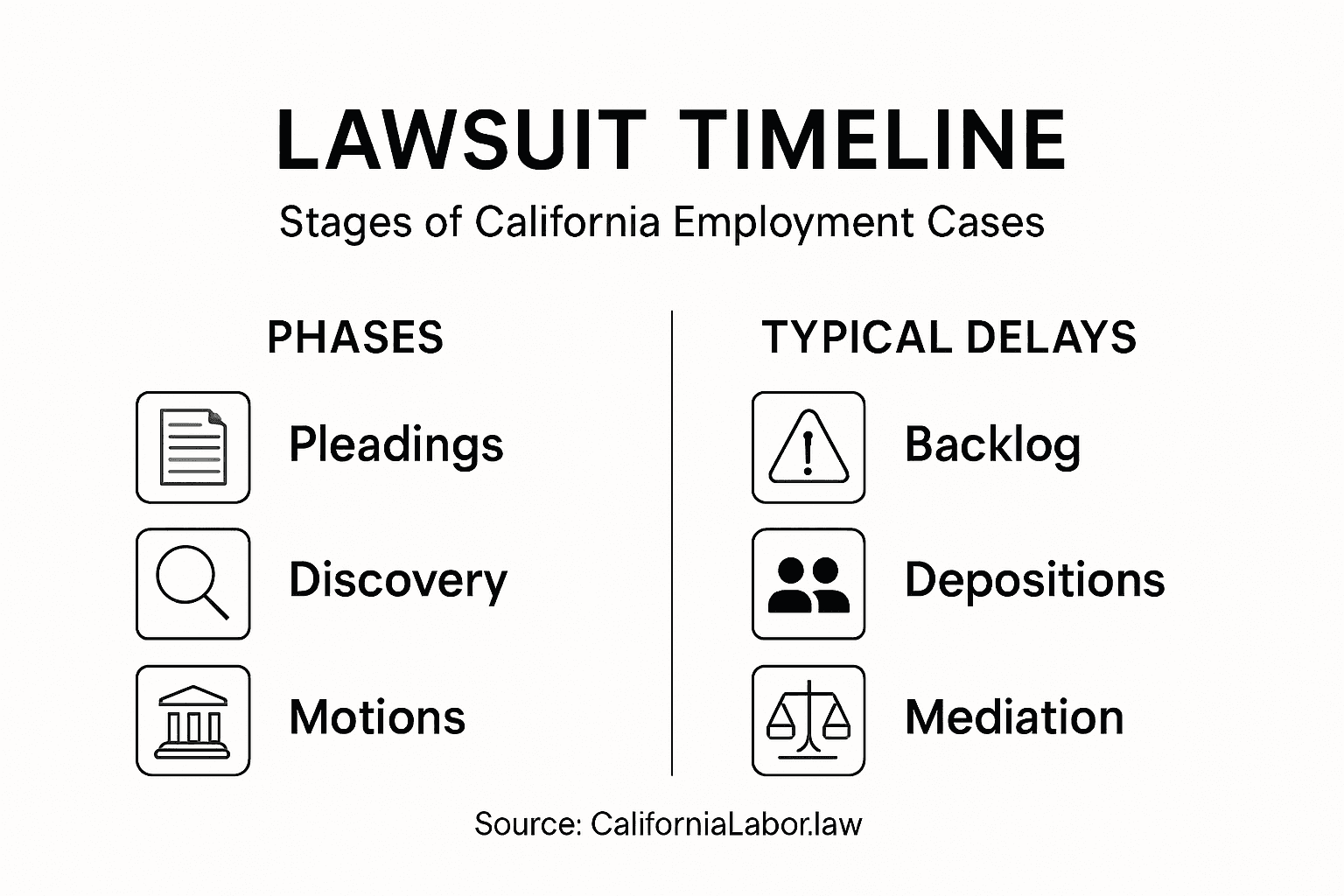
    Infographic showing lawsuit phases and delays

    The first phase is the pleadings stage. You file your complaint, your employer responds with an answer or motion to dismiss, and basic procedural matters get resolved. This takes 2 to 4 months. Nothing dramatic happens here, but it officially launches your case into the system.

    Discovery follows next and typically consumes 6 to 12 months. This is when both sides request and exchange documents, interrogatories, and requests for admissions. You’ll answer written questions under oath. Your employer will do the same. Depositions happen during this phase too, with schedules stretching across months as attorneys coordinate availability.

    Motions practice occurs simultaneously with discovery and afterward. Expect your employer to file a motion for summary judgment arguing there are no disputed facts and they should win without trial. You respond. The judge rules. This entire cycle takes 3 to 6 months. Your attorney’s role becomes critical here, and having skilled employment law representation directly impacts whether weak claims get dismissed early.

    Mediation typically happens after discovery concludes. Courts often require it. Both sides meet with a neutral mediator who helps facilitate settlement discussions. If you don’t settle, trial preparation begins. This includes finalizing witness lists, organizing exhibits, and preparing opening statements.

    Trial itself might last anywhere from 3 to 10 days depending on complexity. Then judges take weeks or months to issue written decisions. Add another 2 to 4 months here.

    Below is a summary of typical phases and estimated timeframes for an employment lawsuit in California:

    Lawsuit Phase Typical Duration Main Activities
    Pleadings 2–4 months Filing complaint, employer response
    Discovery 6–12 months Evidence exchange, depositions
    Motions Practice 3–6 months Motions to dismiss, summary judgment
    Mediation/Negotiation Varies, often post-discovery Settlement discussions, mediation
    Trial & Decision 3–10 days trial; 2–4 months for decision Trial presentations, verdict

    Pro tip: Request a detailed litigation roadmap from your attorney showing anticipated dates for each phase, so you understand what’s coming and can plan accordingly.

    What to Expect as a Plaintiff in California

    Being a plaintiff in an employment lawsuit means stepping into a process that’s equal parts tedious and stressful. You’ll spend months answering questions under oath, reviewing documents until your eyes blur, and waiting for developments that often don’t happen on your timeline. Understanding what lies ahead helps you prepare mentally and strategically.

    You’ll be deposed early in the discovery phase. Your employer’s attorney will ask you detailed questions about everything related to your case. Bring documents, stay composed, and answer only what you’re asked. Don’t volunteer information or get emotional, even when questions feel accusatory. This deposition becomes part of the trial record if your case goes to court.

    Document review consumes enormous amounts of time. You’ll receive thousands of pages of emails, text messages, and payroll records. Your attorney needs you to review these materials, identify relevant ones, and explain context that only you know. This isn’t glamorous work, but it’s essential for building your case.

    You’ll need to be honest about your own conduct. If you violated company policies, made mistakes at work, or behaved poorly, opposing counsel will find out and use it against you. The best plaintiffs are those who acknowledge their own imperfections while still proving their employer violated the law. Understanding workplace discrimination types and impacts helps you recognize what violations occurred and what didn’t.

    Mediation requires patience and realistic expectations. Judges won’t force settlement, but most cases resolve through negotiation. You’ll make an opening statement about why your case has value, listen to your employer’s position, and gradually work toward compromise. Settlement rarely feels fair to either side, but it ends uncertainty.

    Prepare for emotional ups and downs. Lawsuits trigger anxiety about your career, finances, and reputation. Some days you’ll feel hopeful. Other days you’ll question whether fighting is worth it. Having strong legal representation and emotional support from friends or family makes this bearable.

    Pro tip: Keep a detailed timeline of employment events from day one, noting dates, witnesses, and what happened. This document becomes invaluable during depositions and saves your attorney countless hours of investigation.

    Key Factors Impacting Resolution Time

    Not all employment lawsuits follow the same timeline. Several critical factors either accelerate your case or bog it down for years. Understanding these variables helps you anticipate delays and work with your attorney to stay on track.

    The strength of your evidence makes an enormous difference. If you have payroll records showing unpaid wages, text messages proving retaliation, or witness statements confirming violations, your case moves faster. Strong evidence encourages settlement because the other side recognizes their risk. Conversely, cases built on circumstantial evidence or inconsistent accounts drag through lengthy discovery as both sides battle over interpretation.

    The number of witnesses involved directly impacts timeline. A simple wage theft case with just you and your manager moves quicker than a case involving 50 employees across multiple locations. Each additional person requires depositions, coordination, and potential conflicts in testimony.

    Your employer’s litigation strategy shapes everything. Some companies have insurance policies that encourage settlement to protect their ratings. Others fight aggressively on principle or to avoid setting precedents. An employer with significant resources can afford prolonged litigation and will use that advantage. Cases involving workplace harassment or discrimination often take longer because they require proving intent and pattern behavior.

    Case complexity matters significantly. Straightforward wage theft claims settle faster than claims involving trade secret theft, non-compete violations, or systematic discrimination. More legal issues mean more motions, more discovery disputes, and more time before judges.

    The judge assigned to your case affects pacing too. Some judges push cases toward settlement aggressively. Others allow extensive discovery and lengthy briefing schedules. An overworked judge might delay hearings repeatedly, extending your timeline involuntarily.

    Mediation timing influences outcomes. Early mediation sometimes resolves cases before expensive discovery, but it can also waste time if either party isn’t ready. Late mediation occurs after discovery concludes, when both sides understand their positions better and settlement becomes more realistic.

    Pro tip: Ask your attorney to identify which factors in your case create delays versus accelerate resolution, then focus energy on controlling what you can to keep momentum.

    Here’s how common factors affect the timeline of California employment lawsuits:

    Factor Tends to Speed Up Case Tends to Cause Delays
    Evidence Strength Clear, direct documentation Weak, circumstantial, in dispute
    Number of Witnesses Few witnesses Multiple or hard-to-find witnesses
    Claims Complexity Simple wage or overtime case Multitude or pattern violations
    Employer’s Strategy Seeks early negotiation Fights or prolongs litigation
    Court/ Judge Assignment Efficient judge, low backlog Overloaded judge, long backlog

    Understand Your Employment Lawsuit Timeline and Take Control Today

    Facing the uncertainty of a prolonged employment lawsuit can be overwhelming. Whether you are struggling with delays caused by complex discovery, numerous depositions, or aggressive employer tactics, knowing what to expect is vital.

    At California Labor Law, we provide essential legal guides and tools to help you understand your rights and the typical timelines for employment disputes.

    Call 1-866-355-9991 now to schedule a free employment lawsuit consultation, plan strategically, and connect with legal advocates ready to assist you. Time matters—empower yourself to act today.

    Frequently Asked Questions

    How long does the typical employment lawsuit process take in California?

    A typical employment lawsuit in California can take anywhere from 18 months to 4 years, with most cases settling around the 2 to 3-year mark.

    What factors influence the timeline for an employment lawsuit?

    The timeline can be influenced by the strength of your evidence, the number of witnesses, case complexity, your employer’s litigation strategy, and the assigned judge’s workload.

    Why does the discovery process take so long in employment lawsuits?

    Discovery involves the exchange of evidence between both parties, which can be time-consuming, especially if there are many documents to review, depositions to schedule, and potential disputes over the evidence.

    What role does mediation play in the resolution of employment lawsuits?

    Mediation allows both parties to negotiate a settlement with a neutral third party. It often occurs after discovery and can lead to quicker resolutions if both sides are ready to compromise.

  • What is an Employment Attorney? Understanding Their Role

    What is an Employment Attorney? Understanding Their Role

    What is an Employment Attorney?

    Employment disputes can get messy fast. Every year, over 45,000 workplace discrimination charges are filed in the US. Most think you need to be in a major lawsuit for an employment attorney to matter. Actually, these legal experts often change the whole outcome before a case ever hits the courtroom.

    Defining Employment Attorneys: What Do They Do?

    An employment attorney serves as a specialized legal professional dedicated to navigating the complex landscape of workplace rights, regulations, and disputes. These legal experts focus exclusively on addressing the intricate legal challenges that emerge between employers and employees, providing critical guidance and representation across multiple dimensions of labor law.

    Core Responsibilities of Employment Attorneys

    Employment attorneys handle a broad spectrum of workplace legal issues, representing both employees and employers in various scenarios. Their primary responsibilities include:

    Infographic comparing employee rights and employer obligations

    • Interpreting and applying federal and state labor laws
    • Providing legal counsel on workplace discrimination cases
    • Defending employees against wrongful termination
    • Negotiating employment contracts and severance agreements
    • Advising on workplace harassment and retaliation claims

    These legal professionals play a crucial role in ensuring fair treatment and protecting the rights of workers across different industries. According to the Executive Office for Immigration Review, employment attorneys provide strategic advice on complex labor law cases, developing comprehensive legal strategies that address systemic workplace challenges.

    Types of Cases Employment Attorneys Handle

    Employment attorneys work on diverse legal matters that span multiple areas of workplace interaction. Their expertise covers scenarios like:

    • Wage and hour disputes involving unpaid overtime
    • Sexual harassment and workplace discrimination claims
    • Breach of employment contract violations
    • Workers’ compensation disputes
    • Workplace safety regulation enforcement

    By understanding the nuanced world of employment law, these attorneys serve as critical advocates who bridge the gap between legal frameworks and real-world workplace interactions. They ensure that both employers and employees understand their rig

    To help you understand the types of cases employment attorneys commonly handle, the table below categorizes the different legal matters and provides brief descriptions of each.

    Type of Case Description
    Wage and Hour Disputes Issues involving unpaid overtime, minimum wage violations, or illegal wage deductions.
    Discrimination Claims Allegations of unfair treatment based on race, gender, age, disability, or other protected status.
    Workplace Harassment Cases addressing inappropriate conduct, including sexual harassment and hostile work environments.
    Breach of Contract Legal disputes involving violations of employment or severance contracts.
    Wrongful Termination Defending employees who believe they were fired for unlawful reasons.
    Workers’ Compensation Disputes Representation related to claims for workplace injuries or illnesses.
    Workplace Safety Enforcement Legal action involving the enforcement of safety regulations in the workplace.

    Whether representing an individual employee facing workplace discrimination or advising a company on regulatory compliance, employment attorneys provide essential legal expertise that protects workers’ rights and maintains professional workplace standards.

    The Importance of Employment Attorneys in Protecting Workers’ Rights

    Employment attorneys serve as critical guardians of workplace justice, providing essential legal protection for workers facing complex employment challenges. Their role extends far beyond simple legal representation, functioning as strategic advocates who defend fundamental workplace rights and ensure fair treatment across diverse professional environments.

    Safeguarding Workers Against Systemic Discrimination

    Employment attorneys play a pivotal role in combating workplace discrimination, addressing fundamental violations of employee rights. According to the U.S. Department of Labor, legal professionals are instrumental in enforcing critical protections that prevent unfair treatment based on protected characteristics.

    Their comprehensive approach to defending workers includes:

    • Investigating discriminatory practices
    • Documenting evidence of workplace bias
    • Filing formal complaints with regulatory agencies
    • Negotiating settlements
    • Representing clients in court proceedings

    Employment attorneys utilize sophisticated legal strategies to address complex workplace issues. Exploring comprehensive worker protection resources reveals the multifaceted approaches these legal professionals employ to secure justice for employees.

    These strategies often involve:

    • Analyzing employment contracts
    • Identifying potential legal violations
    • Developing targeted litigation strategies
    • Providing expert guidance on employee rights
    • Challenging systemic workplace inequities

    By offering specialized legal expertise, employment attorneys transform abstract legal principles into concrete protections for workers. They bridge the gap between complex labor regulations and real-world workplace experiences, ensuring that employees have robust mechanisms to address potential rights violations and seek meaningful remedies.

    Ultimately, employment attorneys do more than resolve individual disputes. They contribute to broader systemic changes that promote fairness, accountability, and respect within professional environments, making them essential defenders of workplace dignity and legal rights.

    Understanding Common Employment Law Issues Addressed by Attorneys

    Employment law encompasses a complex web of legal challenges that require specialized knowledge and strategic intervention. Employment attorneys are uniquely positioned to navigate these intricate workplace legal landscapes, addressing a wide range of critical issues that impact workers’ professional lives and fundamental rights.

    Discrimination and Harassment Cases

    One of the most significant areas of employment law involves addressing workplace discrimination and harassment. According to Georgetown Law, employment attorneys focus on cases involving discrimination based on protected characteristics such as:

    • Race and ethnicity
    • Gender and sexual orientation
    • Age
    • Disability status
    • Religious beliefs
    • National origin

    These legal professionals work diligently to ensure that employees are protected from unfair treatment and have meaningful recourse when their rights are violated. They investigate claims, gather evidence, and develop comprehensive legal strategies to combat systemic workplace discrimination.

    Wage and Hour Disputes

    Wage and hour disputes represent another critical area where employment attorneys provide essential legal support. Learn more about recent employment law developments to understand the complexities of these legal challenges. Employment attorneys address issues such as:

    • Unpaid overtime compensation
    • Minimum wage violations
    • Employee misclassification
    • Illegal wage deductions
    • Meal and rest break violations

    Employment attorneys serve as crucial advocates who translate complex legal statutes into actionable protections for workers. They help employees understand their rights, negotiate fair settlements, and pursue legal action when employers fail to comply with established labor regulations.

    Beyond individual case resolution, these legal professionals play a broader role in promoting workplace fairness. By challenging unlawful practices and holding employers accountable, employment attorneys contribute to creating more equitable and respectful professional environments. Their work ensures that legal principles of workplace justice are not just theoretical concepts but practical realities for workers across various industries.

    For a clear overview of common employment law issues addressed by attorneys, the following table summarizes key issue areas and examples of situations employees may face.

    Issue Area Example Situations
    Discrimination Unfair treatment based on race, gender, age, religion, or disability.
    Harassment Sexual harassment, bullying, or creation of a hostile environment.
    Wage and Hour Violations Unpaid overtime, minimum wage issues, meal and rest break disputes.
    Employee Misclassification Incorrectly labeling workers as independent contractors.
    Breach of Employment Contract Employer not honoring contract terms or severance agreements.
    Retaliation Penalization for reporting illegal conduct or asserting rights.

    employment attorney team meeting

    How Employment Attorneys Navigate California Labor Laws

    California labor laws represent one of the most complex and employee-protective legal frameworks in the United States. Employment attorneys specializing in California law must possess an intricate understanding of state-specific regulations that often exceed federal employment protections, requiring sophisticated legal expertise and strategic approach.

    Employment attorneys must navigate a multilayered legal environment that combines federal regulations with robust state-level protections. According to the California Civil Rights Department, attorneys must comprehensively understand laws governing:

    • Employee classification
    • Workplace discrimination protections
    • Minimum wage requirements
    • Overtime compensation rules
    • Family and medical leave regulations
    • Sexual harassment prevention standards

    These legal professionals develop deep expertise in California’s nuanced labor code, which frequently provides more comprehensive worker protections than federal statutes. Their role involves interpreting these complex regulations and translating them into actionable strategies for employees and employers alike.

    Discover expert insights into California employment law that highlight the intricate approach employment attorneys take in addressing workplace legal challenges. Their strategic navigation involves:

    • Conducting comprehensive legal research
    • Analyzing specific workplace scenarios
    • Identifying potential regulatory violations
    • Developing proactive compliance strategies
    • Representing clients in administrative hearings

    Employment attorneys serve as critical interpreters of California’s dynamic labor law landscape. They understand that legal compliance is not a static concept but a continuously evolving framework requiring constant vigilance and adaptive strategies.

    By combining deep legal knowledge with practical insights, these attorneys help organizations and individuals understand their rights and obligations. Their expertise ensures that workplace interactions remain fair, legally compliant, and respectful of both employee protections and employer responsibilities within California’s unique legal environment.

    Real-World Impacts: The Role of Employment Attorneys in Employee Advocacy

    Employment attorneys serve as powerful advocates who transform legal principles into tangible protections for workers, bridging the gap between theoretical rights and practical workplace justice. Their work extends far beyond courtroom representation, creating meaningful change in professional environments where individual employees might otherwise feel powerless.

    Confronting Systemic Workplace Inequities

    Employment attorneys play a critical role in challenging systemic workplace inequities by addressing complex legal challenges that individual workers cannot easily navigate alone. According to the U.S. Department of Justice Civil Rights Division, these legal professionals are instrumental in exposing and challenging discriminatory practices across various industries.

    Their advocacy involves:

    • Identifying patterns of systematic discrimination
    • Gathering comprehensive evidence
    • Representing vulnerable worker populations
    • Pursuing class action lawsuits
    • Negotiating systemic workplace reforms

    By taking on cases that highlight broader institutional problems, employment attorneys create precedents that protect not just individual clients but entire workforce communities.

    Learn more about navigating complex workplace legal challenges to understand the transformative power of legal advocacy. Employment attorneys empower workers by:

    • Providing free initial consultations
    • Explaining complex legal rights
    • Offering strategic legal guidance
    • Representing workers without upfront costs
    • Challenging power imbalances between employers and employees

    These legal professionals recognize that many workers lack the resources or knowledge to challenge workplace violations independently. By offering accessible legal support, they level the playing field and ensure that workers have meaningful mechanisms to defend their professional rights.

    Employment attorneys are more than legal representatives. They are catalysts for workplace cultural change, using legal expertise to challenge unfair practices, promote equitable treatment, and create environments where workers can thrive with dignity and respect.

    Are you facing tough questions about discrimination, wrongful termination, or wage disputes? In our article, you learned just how complex California employment law can be and why expert advocacy is crucial to protect your rights. If you feel overwhelmed by wage theft, harassment, or confusing legal terms, you do not have to face these challenges alone. Our platform, California Labor Law, is built specifically to help California workers like you fight back against unfair treatment.

    Explore our free legal guides and wage calculators made for California employees, and get answers that protect your job and your future. Visit California Labor Law today for immediate access to legal resources and personal advocacy. Do not wait, take action now with a free California workplace rights consultation by calling 1-866-355-9991 to secure the justice and dignity you deserve in your workplace.

    Frequently Asked Questions

    What does an employment attorney do?

    Employment attorneys specialize in workplace rights and legal disputes, providing guidance and representation to both employees and employers on issues like discrimination, wrongful termination, and wage disputes.

    When should I hire an employment attorney?

    You should consider hiring an employment attorney when facing issues such as discrimination, harassment, wrongful termination, or when you need legal advice regarding an employment contract or workplace rights.

    How can employment attorneys help with discrimination cases?

    Employment attorneys assist with discrimination cases by investigating claims, gathering evidence, filing complaints with regulatory agencies, negotiating settlements, and representing clients in court to ensure their rights are protected.

    Common issues employment attorneys handle?

    Common issues include wage and hour disputes, workplace discrimination and harassment claims, breach of employment contracts, and workers’ compensation disputes.

  • Combatting Employer Wage Theft: Know Your Rights

    Combatting Employer Wage Theft: Know Your Rights

    Is Your Employer Stealing from You? There will be signs.

    Wage theft is a serious issue affecting many workers. It occurs when employers fail to pay employees what they are owed. This can include unpaid wages, overtime, or illegal deductions.

    Millions of workers experience wage theft each year. It can happen in any industry, from retail to construction. Often, low-wage and immigrant workers are most affected.

    Understanding your rights is crucial. Employees have the right to be paid for all hours worked. This includes overtime and minimum wage protections.

    The Fair Labor Standards Act (FLSA) sets federal standards for wages. However, state laws may offer additional protections. Knowing both is important for safeguarding your earnings.

    Keeping detailed records of your hours and pay is essential. This can help identify any discrepancies. If you suspect wage theft, addressing it promptly is key.

    Start by discussing concerns with your employer or HR. If this doesn’t resolve the issue, filing a complaint with the Department of Labor is an option. Legal action may be necessary if your employer doesn’t comply.

    Retaliation for reporting wage theft is illegal. Employees should feel empowered to stand up for their rights. Understanding the process can help you recover what you’re owed.

    A concerned employee reviewing their pay stub

    What Is Employer Wage Theft?

    Employer wage theft occurs when companies deny workers their rightful earnings. It encompasses various unlawful practices. These practices deprive employees of fair compensation for their labor.

    Common signs of wage theft include not being paid overtime or minimum wage. Other indicators are improper deductions from paychecks. Misclassifying employees to avoid paying benefits is also a form of theft.

    Types of Wage Theft:

    • Unpaid Overtime: Failing to pay for hours beyond the standard work week.
    • Minimum Wage Violations: Paying less than the legal minimum hourly rate.
    • Illegal Deductions: Deducting costs for uniforms or tools without consent.
    • Time Shaving: Reducing recorded hours to avoid paying overtime.
    • Misclassification: Labeling employees as contractors to bypass wage and hour laws.

    Wage theft is more prevalent than many realize. It affects both blue-collar and white-collar workers. Industries like hospitality, retail, and construction are often hotspots for these practices.

    The impact on workers can be devastating. Unpaid wages can lead to financial instability. It can affect one’s ability to meet basic needs.

    Victims of wage theft face challenges in recovering lost earnings. Understanding employer wage theft can empower workers. Knowledge is the first step toward reclaiming your hard-earned money.

    Common Types of Wage Theft

    Wage theft manifests in various forms. Each type can significantly impact an employee’s financial well-being. These practices are not just unethical; they are illegal.

    One prevalent form is unpaid overtime. Employers may demand extra work without proper pay. This violates the Fair Labor Standards Act (FLSA), which mandates overtime compensation.

    Another common issue is minimum wage violations. Employers might pay below the federal or state minimum wage. Workers in low-wage sectors are often most affected.

    Illegal deductions are another concern. Employers may deduct expenses for equipment or uniforms improperly. This reduces take-home pay without consent.

    Examples of Illegal Deductions:

    • Charging for required uniforms.
    • Deducting training costs after resignation.
    • Subtracting breakages or losses from wages.

    Time shaving is also widespread. Companies may alter time records to avoid paying overtime. This denial of compensation for actual hours worked is a clear breach of labor laws.

    Misclassification as independent contractors is another tactic. Employers label employees as contractors to sidestep wage laws. This denies them benefits like health insurance and paid leave.

    Woman looking at pay stub total with a questionable look on her face.

    Ways to Identify Misclassification:

    • Lack of control over work hours.
    • Employer dictates tasks and methods.
    • Employee performs core business functions.

    Other forms include denying meal or rest breaks. This can happen when schedules are tight. Workers may feel forced to skip essential breaks due to pressure.

    Knowing the different types of wage theft is vital. It enables employees to recognize when their rights are being violated. Taking prompt action can help recover lost earnings.

    An employee working late hours without receiving overtime pay

    by Milo Bauman (https://unsplash.com/@mjearlb)

    How to Recognize If You’re a Victim

    Identifying wage theft is the first step to recovery. Many employees may be unsure if they’re victims. Being informed can empower you to take action.

    Start by examining your pay stubs. Ensure your pay reflects all hours worked, including overtime. Discrepancies might indicate wage theft.

    Another sign is consistently being paid late. Regular delays in receiving your wages are a red flag. Employers must pay promptly and on schedule.

    Reflect on your breaks. Are you being forced to work through them? If yes, this could be a violation. You’re entitled to meal and rest periods.

    Consider your job classification. Being improperly labeled as a contractor may be unlawful. Misclassification denies you important rights and benefits.

    Key Indicators of Wage Theft:

    • Unpaid for overtime hours.
    • Paychecks are less than expected.
    • Deductions made without consent.

    Communication is also crucial. If your employer evades wage discussions, take note. Avoidance can signify an unwillingness to comply with laws.

    Trust your instincts. If something feels off, investigate further. Wage theft often relies on employees being unaware of their rights.

    By recognizing these signs, you can protect yourself. Knowledge is your best tool in preventing and identifying wage theft.

    man in suit with suitcase full of money

    Your Legal Rights as an Employee

    Understanding your rights as an employee empowers you to take action. The law protects workers against unfair treatment, including wage theft.

    You have the right to be paid for all hours worked. This includes overtime at the federally mandated rate. Employers must comply with these standards.

    The Fair Labor Standards Act (FLSA) provides the framework for wage laws. It ensures minimum wage and overtime protection for eligible employees.

    State laws often offer additional safeguards. Familiarize yourself with both federal and state regulations. This knowledge is crucial for defending your rights.

    Employees are entitled to know how their pay is calculated. This means transparent access to records of hours worked and wages received.

    Key Employee Rights Include:

    • Receiving minimum wage for all hours worked.
    • Being compensated for overtime.
    • Reviewing employer records of your wages and hours.

    Moreover, you have the right to challenge wage theft without fear of retaliation. Employers cannot legally penalize you for asserting these rights.

    If you suspect a violation, act promptly. There are statutes of limitations for recovering wages. Timely action is critical to securing owed compensation.

    Assert your rights confidently. Doing so can initiate positive changes, both for you and your workplace. Your willingness to stand up is vital.

    Federal and State Laws Protecting Workers

    Worker protection laws exist to ensure fair treatment in the workplace. At the core are federal regulations, primarily the Fair Labor Standards Act (FLSA). This essential law sets the minimum standards for wages and overtime.

    The FLSA applies to most workers. It mandates time-and-a-half pay for any hours worked beyond 40 per week. This prevents employers from exploiting workers through excessive unpaid overtime.

    However, labor laws vary by state. Some states enhance worker protections beyond the FLSA. These include higher minimum wages and stricter overtime rules. Always check your state’s specific requirements to fully understand your entitlements.

    States like California and New York have robust labor laws. They often provide more generous worker benefits than federal mandates. This can include additional break periods and higher pay minimums.

    Protections Provided by Federal and State Laws:

    • Minimum wage standards.
    • Overtime pay requirements.
    • Meal and rest break mandates.

    Department of Labor

    Employees should also be aware of laws regarding pay transparency. Employers must provide clear, understandable pay stubs. These documents detail wages and deductions, ensuring workers understand their pay.

    Knowing these laws helps you identify potential wage theft. Understanding both federal and state regulations is your first line of defense. It empowers you to take informed action against unfair labor practices.

    Steps to Take If You Suspect Wage Theft

    Suspecting wage theft can be daunting. Your first step should be to confirm your suspicions. Review your pay stubs and hours worked meticulously. Compare these with your employment terms.

    Accurate record-keeping is crucial. Maintain a log of worked hours and pay received. Compare these against employer records to identify discrepancies. Note any unpaid overtime or unexpected deductions.

    Once discrepancies are evident, approach your employer. A conversation with your supervisor or HR department may resolve the issue amicably. Approach discussions calmly, presenting facts rather than accusations.

    Steps to Address Suspected Wage Theft:

    • Review Employment Records: Check pay stubs and hours documented.
    • Approach Employer Calmly: Start with a conversation with your supervisor.

    However, if discussions fail, escalate the matter. Consider filing a complaint with the Department of Labor (DOL). This can trigger an investigation into your employer’s wage practices.

    You may also contact your state labor agency. They often handle wage disputes specific to your state’s laws. Many states have dedicated departments for wage theft claims.

    More Actionable Steps:

    • Contact a Labor Agency: Reach out for state-specific guidance.
    • File a DOL Complaint: If unresolved, trigger an official inquiry.

    While pursuing these channels, consult with legal professionals. Seek advice from lawyers who specialize in labor disputes. They can guide your options and provide necessary legal documentation.

    Remember, timely action is critical. Wage claims often come with time limits, so act without delay. Taking swift, informed steps can help you recover lost wages and reinforce your rights in the workplace.

    How to Document Wage Theft

    Proper documentation is vital in wage theft cases. Without a record, proving claims becomes difficult. Start by keeping a detailed log of your work hours. Note dates, start and end times, and any breaks.

    Retain copies of your pay stubs. Pay stubs show what you’re paid and any deductions. Compare these to your recorded hours. Look for any discrepancies between your records and your paycheck.

    Document communication with your employer. Save emails, messages, or notes from conversations about your pay. This can serve as evidence if disputes arise.

    Essential Documentation for Wage Theft:

    • Work Hour Logs: Track daily hours and breaks.
    • Pay Records: Keep pay stubs and payment summaries.
    • Employer Communications: Preserve all relevant interactions.

    If possible, keep a journal describing your experiences. Include descriptions of your duties, any instructions for unpaid work, and other relevant events. This narrative can strengthen your case.

    Photocopy any documents related to your employment. Contracts, employee handbooks, and company policies are essential. They outline terms that may support your claim.

    Monthly Planner

    by 2H Media (https://unsplash.com/@2hmedia

    Being organized is key to building a strong case. A thorough and precise record collection streamlines the complaint process. With solid documentation, you position yourself better to recover owed wages effectively.

    Approaching Your Employer or HR

    Approaching your employer about wage theft can be daunting. But it’s often the first crucial step. Begin by scheduling a meeting with your supervisor or HR representative.

    Prepare for the conversation with detailed evidence. Bring your documentation showing discrepancies between hours worked and wages received. Explain calmly and clearly why you believe you’re owed additional wages.

    Tips for Discussing Wage Issues:

    • Be Professional: Maintain a calm and respectful tone.
    • Present Evidence: Use your documentation to support your claim.
    • Clarify Expectations: Clearly state what you need resolved.

    Ask for their explanation. Sometimes, wage issues stem from misunderstandings or clerical errors. Your employer might not be aware of the mistake and may resolve it quickly.

    After discussing, document the conversation. Note any promises made, proposed actions, and timelines. If possible, obtain written confirmation from them summarizing your discussion.

    Understanding that this is a necessary step helps you move forward. Whether resolved internally or not, you’ll be better equipped for any further action. Proceeding calmly and professionally increases the chances of a positive outcome.

    Filing a Complaint with Government Agencies

    If internal attempts fail, government agencies can help. You have options at both federal and state levels to file complaints. These agencies are equipped to handle and investigate wage theft claims.

    The U.S. Department of Labor (DOL) is a good starting point. They oversee wage and hour complaints through the Wage and Hour Division (WHD). Filing a complaint with them is straightforward.

    Steps to File a Federal Complaint:

    • Gather Evidence: Collect records of hours worked and pay received.
    • Contact WHD: Provide details about your employer and the nature of your complaint.
    • Submit the Complaint: You can often do this online or in person at a local office.

    Many states also have labor departments or dedicated wage theft units. These state bodies often offer protections that complement federal laws. They can be instrumental if federal paths stall or delay.

    Filing at the State Level:

    • Research State Laws: Confirm additional state protections or deadlines.
    • Document State Agencies: Contact the applicable state labor board.
    • Report the Issue: Follow state-specific procedures to file your complaint.

    Timeliness matters. Wage theft claims often have a statute of limitations. Acting quickly ensures you remain eligible for recovery.

    Remember, government agencies aim to protect worker rights. They work to hold employers accountable, pressing for recovery of owed wages. If their investigation confirms wage theft, they will pursue remedies on your behalf. Each report plays a role in broader accountability and reform efforts, enhancing workplace fairness.

    Seeking Legal Help and Representation

    When facing employer wage theft, legal aid can be invaluable. Lawyers understand complex wage and hour laws. They can navigate legal avenues to reclaim unpaid wages.

    Consider contacting an attorney experienced in labor law. They’ll assess your case and advise on possible outcomes. A good lawyer will strategize the best approach to your situation.

    When to Seek Legal Representation:

    • If internal resolutions fail and complaints don’t resolve the issue.
    • When the amount of unpaid wages is substantial.
    • If you suspect you’re not the only victim at your workplace.

    Legal consultations can clarify your rights. Many attorneys offer initial consultations for free or at a reduced cost. This can help you decide if pursuing legal action is worth it.

    Legal representation can offer peace of mind. Your lawyer will handle communications and negotiations with your employer. They can also represent you in court if needed.

    If cost is a concern, explore pro bono services. Many organizations offer free legal aid to those who qualify. Labor unions and worker advocacy groups are also resources to consider. These groups may provide or recommend legal assistance. Exploring all options ensures a comprehensive approach to recovering your due wages.

    Lawyer reviewing wages of client

    What to Expect During the Wage Recovery Process

    The wage recovery process can vary in complexity and duration. It’s important to stay informed and patient throughout.

    Initially, you’ll gather evidence and file a complaint. Whether with a government agency or in court, documentation is key. Having detailed records will support your claim.

    Key Stages of the Process:

    • Filing a Complaint: Submit your documentation and grievance.
    • Investigation: The agency or court reviews your evidence.
    • Resolution: A decision is made; this may involve negotiations or hearings.
    • Enforcement: If successful, your employer is compelled to pay.

    Timeframes can differ based on factors like case complexity and jurisdiction. Stay proactive by following up regularly on your claim’s status.

    Communication with involved parties is crucial during this time. Be prepared for challenges, but remember that persistence is often necessary. Knowing what to expect helps manage stress and ensures you stay organized and focused on achieving a fair outcome.

    Retaliation: What It Is and How to Protect Yourself

    Retaliation occurs when an employer punishes you for asserting your rights. This may include demotion, termination, or harassment. Protection against retaliation is essential when pursuing wage theft claims.

    Knowing the signs of retaliation is critical. Sudden changes in job duties or negative performance reviews could be warning signals. Document these events meticulously.
    It’s vital to understand your rights under the law. The Fair Labor Standards Act (FLSA) prohibits retaliatory actions by employers. Stay informed about these protections to safeguard your interests.

    Steps to Protect Yourself from Retaliation:

    • Document Everything: Keep records of any retaliatory behaviors.
    • Seek Legal Counsel: Professional advice can help guide your actions.
    • Report Retaliation: Notify appropriate agencies or use internal reporting channels.

    Shoe on a spring kicking employee in the back

    Handling retaliation can be stressful, but there are resources available. Consider reaching out to worker advocacy groups for support and advice. Being proactive and knowledgeable empowers you to stand up against employer misconduct and maintain your dignity in the workplace.

    Special Issues: Misclassification and Independent Contractors

    Misclassification is a tricky issue in labor rights. Employers sometimes wrongly label workers as independent contractors. This can lead to wage theft problems.

    When misclassified, workers lose out on key benefits. These include paid overtime and minimum wage protections. Misclassification is not always intentional, but it often results in unfair compensation.

    Knowing the difference between an employee and an independent contractor is vital. Employees generally have set schedules and oversight. Independent contractors usually have more flexibility and autonomy.

    Signs of Misclassification:

    • Control: You lack control over your work hours.
    • Benefits: Your benefits are missing or limited.
    • Duties: Your duties resemble those of employees.

    If you suspect misclassification, take action. Confirm your status through legal channels. Accurate classification ensures rightful compensation and legal protections.

    Wage Theft in Different Industries

    Wage theft occurs across many industries, but some are more affected. Low-wage sectors are particularly vulnerable. Workers in these industries often experience wage violations.

    The hospitality industry sees frequent unpaid overtime and improper tip pooling. Retail workers face similar issues, with employers failing to pay for all hours worked. Construction workers are also affected, often facing underpayment for their labor.

    Certain industries rely heavily on seasonal or part-time work. This can lead to confusion about wage rights. In such roles, employers sometimes exploit legal loopholes to deny fair pay.

    Industries Commonly Affected by Wage Theft:

    • Hospitality: Unpaid overtime and wage violations.
    • Retail: Pay for all hours not always given.
    • Construction: Frequent underpayment issues.
    • Agriculture: Seasonal work often leads to confusion.

    Employees in different industries, construction, chef, blue collar, white collar workers

    Awareness is key to preventing wage theft in these sectors. Employees must understand their rights and be vigilant. Reporting violations helps foster fair workplace practices.

    The Impact of Wage Theft on Workers and Society

    Wage theft causes serious harm to workers, especially financially. Victims often struggle to meet basic needs due to lost income. This financial strain can also lead to increased debt or even homelessness.

    Beyond the individual, wage theft affects society at large. It contributes to economic inequality, as it disproportionately impacts low-wage earners. Communities suffer when workers are not fairly compensated.

    Employers who engage in wage theft also damage the economy. They create an uneven playing field by unfairly reducing labor costs. This can lead to unfair competition among businesses.

    Consequences of Wage Theft:

    • Financial instability for workers.
    • Increased economic inequality in communities.
    • Strain on social services due to workers’ financial needs.
    • Damage to business competition and economic health.

    Addressing wage theft benefits everyone by promoting fair labor practices and a healthier economy.

    Resources and Support for Employees

    Experiencing employer wage theft can feel overwhelming. However, resources and support are available to help employees navigate this challenge. Understanding where to find assistance can empower you.

    Several organizations offer guidance and support for wage theft victims. Government agencies, such as the Department of Labor, enforce wage and hour laws. They provide resources to help recover unpaid wages.

    Nonprofit organizations and worker advocacy groups also offer valuable help. They provide education, legal assistance, and sometimes even direct financial support. Labor unions are another crucial resource, providing solidarity and legal backing.

    Useful Resources for Employees:

    • U.S. Department of Labor
    • State labor departments
    • Worker advocacy groups
    • Labor unions

    These resources aim to ensure all workers receive fair compensation. Reaching out can make a significant difference in reclaiming rightful wages. Employees should utilize these tools for a more just workplace.

    Prevention is key to tackling employer wage theft. Employees can protect themselves by staying informed about their rights and responsibilities.
    Regularly review pay stubs and keep meticulous records of hours worked. Awareness is a powerful tool against wage theft.

    Employers also play a critical role. Conducting regular audits and ensuring compliance with labor laws help maintain a fair workplace. Employers should offer training about wage laws and foster open communication channels.

    Steps to Prevent Wage Theft:

    • Maintain detailed work records
    • Ensure compliance with labor laws
    • Conduct regular wage audits
    • Stay informed about rights

    By working together, employees and employers can foster a culture of trust and fairness. Preventing wage theft benefits everyone involved. A proactive approach can lead to a more just and equitable workplace.

    Frequently Asked Questions About Wage Theft

    Wage theft raises many questions for employees. Here are some common inquiries and clarifications.

    Is wage theft really that common? Sadly, yes. Millions face this issue annually. It’s a widespread problem that crosses industries.

    What can I do if I suspect it? First, talk to your employer. If unresolved, seek assistance from government agencies or legal counsel.

    What if I’m retaliated against? Retaliation for reporting wage theft is illegal. If you face retaliation, additional legal actions may be available to protect you.

    Common Questions:

    Is wage theft legal?

    No, wage theft is not legal. All 50 states have some form of wage theft law.

    How do I report wage theft?

    You can report wage theft by contacting the U.S. Department of Labor (DOL) or Wage and Hour Division (WHD)

    Can my employer retaliate against me?

    Yes, but you can file a claim with the WHD or call 1-866-487-9243

    What documentation should I keep?

    Payroll and wage records, time sheets, paystubs, wage notices, employment contracts. Anything that could prove your claim.
    Understanding these answers can empower workers to take necessary action. Awareness is the first step to ensuring your rights are protected.

    Conclusion: Standing Up for Your Rights

    Standing up for your rights is crucial in the fight against wage theft. Every employee deserves fair compensation for their work.

    It’s not just about getting the money owed; it’s about fairness and respect. Knowing your rights helps maintain dignity in the workplace.

    Taking action can be daunting but remember, support is out there. From labor unions to legal resources, you’re not alone in this fight.

    By speaking up, you not only protect yourself but also help others. Collective awareness and action drive positive changes in workplace cultures.

    Have you been a victim of wage theft in California? Contact California Labor Law for a free consultation from a top attorney and get the justice you deserve. We hold employers accountable for stealing from employees. Call 1-866-355-9991 or fill out our free wage theft form for more information.

  • Wrongful Termination Guide: Know Your Rights

    Wrongful Termination Guide: Know Your Rights

    A Complete Guide to Wrongful Termination and What You Can Do About It

    Wrongful termination can be a confusing and stressful experience. Understanding your rights is crucial in such situations.

    Many employees are unaware of the legal protections available to them. This lack of knowledge can lead to missed opportunities for justice.

    Wrongful termination occurs when an employee is fired for illegal reasons. These reasons can include discrimination or retaliation.

    (more…)