
Category: Exemptions

  • Exempt vs Nonexempt Employees – Rights Under California Law

    Exempt vs Nonexempt Employees – Rights Under California Law

    Nearly half of hourly workers in California report confusion about their exempt and nonexempt status, directly affecting their unpaid overtime claims. For those in the service industry, this misunderstanding can mean missing out on thousands in extra pay every year. Clear definitions matter because your classification decides whether you receive essential wage protections and overtime benefits. This guide breaks down the difference so you can confidently assess your rights under California’s labor laws.

    Exempt vs Nonexempt Status Defined Clearly

    In California’s complex labor landscape, understanding the difference between exempt and nonexempt employees is crucial for workers seeking fair compensation. Unlike simple job titles, employee classification hinges on specific legal criteria that go far beyond what most workers realize. Detailed classification standards reveal a nuanced framework determining workers’ rights and wage protections.

    To qualify as an exempt employee in California, workers must meet three critical requirements: earning a minimum salary, performing specific job duties, and demonstrating independent decision-making capacity. Specifically, exempt employees must earn at least twice the state’s minimum wage and spend more than 50% of their time performing executive, administrative, or professional tasks that involve significant independent judgment. This means a manager’s job title alone does not automatically make them exempt – their actual daily responsibilities determine their status.

    HR manager highlighting exempt employee checklist

    Nonexempt employees, by contrast, receive critical wage protections including overtime pay, mandatory meal and rest breaks, and minimum wage guarantees. These workers are entitled to compensation for hours worked beyond 8 per day or 40 per week, with overtime calculated at 1.5 times their regular hourly rate. Worker classification guidelines emphasize that job duties, not titles, ultimately define an employee’s legal status and accompanying rights.

    Here’s a side-by-side look at major differences between exempt and nonexempt employees in California:

    Category Exempt Employees Nonexempt Employees
    Pay Structure Fixed salary Hourly wages
    Overtime Eligibility Not eligible for overtime Receive overtime after 8 hrs/day
    Meal & Rest Breaks Not entitled to protected breaks Guaranteed meal and rest breaks
    Job Duties Advanced, independent tasks Routine or supervised tasks

    Pro tip: If you suspect your employer might be misclassifying your employment status, document your actual job duties meticulously and consult with a California labor law specialist to understand your rights.

    Key Differences in Wages and Overtime Rights

    Understanding the wage and overtime rights for exempt and nonexempt employees is critical for California workers seeking fair compensation. Employee classification standards create stark differences in how workers are compensated, with significant implications for monthly and annual earnings. The core distinction lies in the legal protections and financial entitlements afforded to each worker classification.

    Nonexempt employees enjoy robust wage protections that guarantee overtime compensation at 1.5 times their regular hourly rate. These workers receive payment for all hours worked, with mandatory overtime for any time exceeding 8 hours per day or 40 hours per week. Additionally, nonexempt workers are entitled to mandatory meal and rest breaks, ensuring basic workplace protections. California overtime regulations specifically mandate these financial safeguards, creating a safety net for hourly and part-time workers.
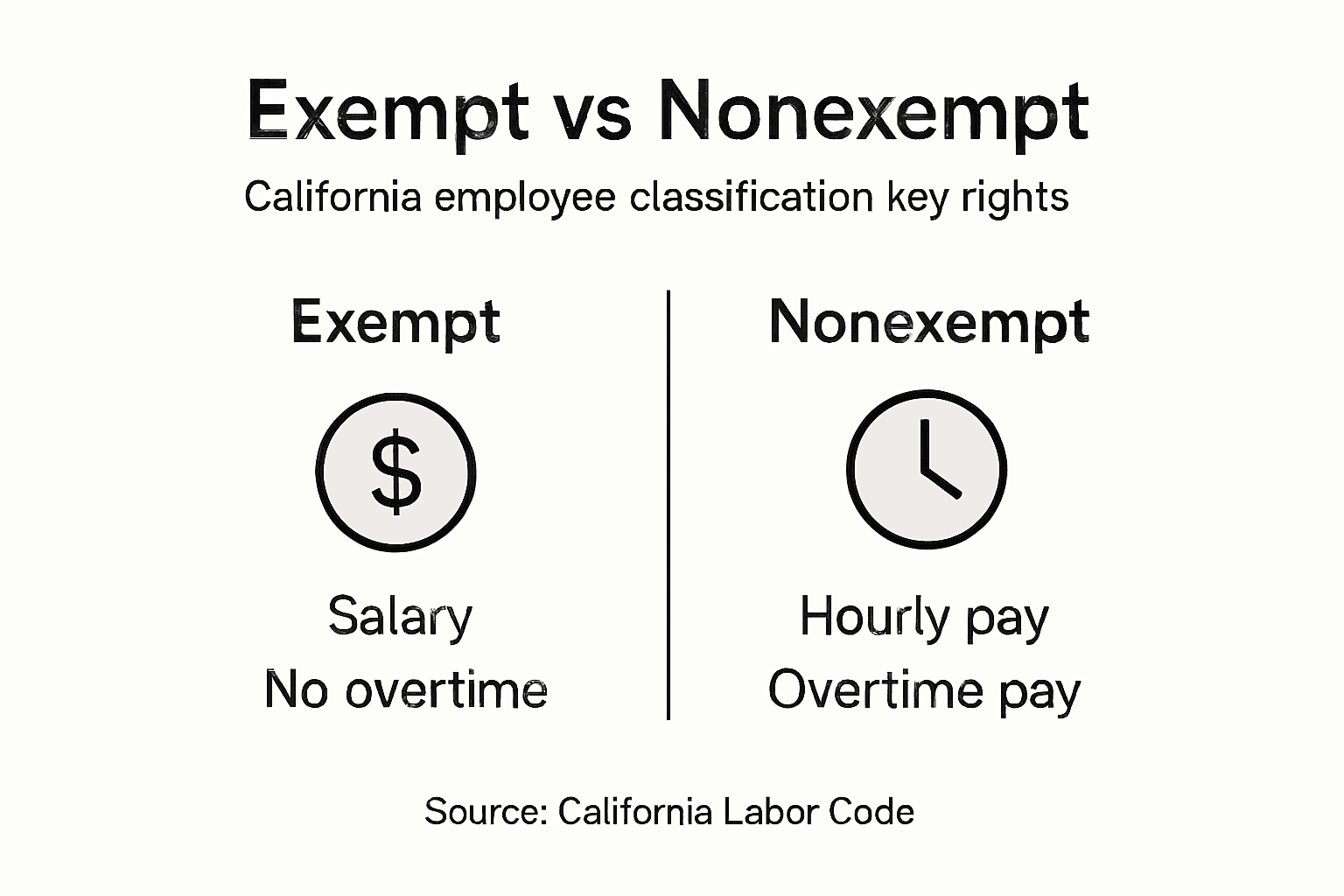
    Infographic comparing exempt and nonexempt employee rights

    Exempt employees, typically in professional, executive, or administrative roles, trade these hourly protections for a fixed salary. While they receive consistent pay regardless of hours worked, they lose critical overtime and break-time rights. This classification means exempt workers might work extended hours without additional compensation, making their effective hourly rate potentially lower than nonexempt employees. The trade-off involves presumed higher-level responsibilities and more autonomy in job performance.

    Pro tip: Carefully review your job description and actual daily responsibilities to determine whether your current classification accurately reflects your work, as misclassification can result in significant lost wages.

    California’s legal framework for employee classification is remarkably complex, designed to protect workers while providing clarity for employers. Independent contractor rights underscore the state’s commitment to precise worker categorization. The state employs a multi-factor test that goes far beyond simple job titles, examining the actual nature of work performed, level of control, and economic realities of the employment relationship.

    The primary legal criteria for classification involve three critical components: salary level, job duties, and degree of independent decision-making. Exempt employees must consistently earn a minimum salary at least twice the state’s minimum wage, spend over 50% of their time performing specialized tasks, and demonstrate substantial independent judgment in their role. This means a manager’s title alone does not automatically confer exempt status – the actual responsibilities and decision-making authority are paramount in determining classification.

    The California Labor Commissioner’s office uses a comprehensive set of guidelines that consider multiple factors beyond traditional job descriptions. These include the worker’s skill level, the permanence of the working relationship, the extent of investment in equipment or materials, and the degree of control exercised by the employer. The goal is to prevent misclassification that could deprive workers of essential protections like overtime pay, meal breaks, and minimum wage guarantees. By implementing such rigorous standards, California aims to ensure fair treatment across diverse industries and job roles.

    Pro tip: Maintain detailed documentation of your actual job duties, hours worked, and decision-making responsibilities to protect yourself against potential misclassification.

    Common Misclassifications and Employer Duties

    Employee misclassification remains a persistent challenge in California, with significant legal and financial consequences for employers who fail to comply with state labor regulations. Employer classification risks expose businesses to potential lawsuits, substantial wage penalties, and regulatory scrutiny. The most common mistakes occur when employers incorrectly assume that job titles or salary alone determine an employee’s exempt status.

    The California Industrial Welfare Commission Wage Orders outline specific criteria that must be met for legitimate exempt classification. Employers must demonstrate that workers consistently perform executive, administrative, or professional duties that involve independent decision-making. Simply paying a worker a salary does not automatically make them exempt. Critical factors include the percentage of time spent on specialized tasks, the level of independent judgment exercised, and the complexity of the work performed. Misclassification can result in retroactive payment of overtime, meal and rest break penalties, and potential legal damages.

    Employers bear the entire burden of proving an employee’s exempt status, which requires comprehensive documentation and a thorough understanding of California’s nuanced labor laws. Common red flags include classifying workers as exempt while requiring them to perform predominantly non-exempt tasks, making improper salary deductions, or failing to meet the precise salary threshold. The financial risks are substantial – employers can face penalties including unpaid wages, interest, legal fees, and potential civil penalties for willful misclassification.

    This summary outlines common employer pitfalls and their financial risks:

    Misclassification Error Potential Employer Consequence Example Scenario
    Relying on job titles alone Retroactive overtime owed “Manager” doing hourly tasks
    Not meeting salary threshold Penalties plus back pay Salary below twice minimum wage
    Inadequate job duty documentation Legal disputes, increased fines Vague worker responsibilities

    Pro tip: Conduct a comprehensive internal audit of employee classifications annually, consulting with a California labor law specialist to ensure full compliance and minimize potential legal risks.

    How to Verify and Address Classification Errors

    Navigating employee classification requires a systematic approach to identifying and correcting potential legal vulnerabilities. Wage theft prevention begins with a comprehensive review of job descriptions, actual work performed, and compensation structures. Employers must conduct a meticulous audit that goes beyond surface-level job titles to examine the true nature of each worker’s responsibilities and decision-making authority.

    The verification process involves a detailed multi-step analysis of each employee’s role. Critical evaluation points include the percentage of time spent on exempt-level tasks, the degree of independent judgment exercised, and the complexity of work performed. Employers should create a detailed job duty worksheet that breaks down daily responsibilities, comparing them against California’s strict exempt classification criteria. This documentation must demonstrate that workers consistently perform high-level duties that justify exempt status, with concrete evidence of strategic decision-making, independent analysis, and specialized knowledge.

    Addressing classification errors requires a proactive and transparent approach. When misclassification is discovered, employers must immediately reclassify the worker, adjust compensation, and potentially provide back pay for overtime and missed breaks. The process involves calculating retroactive wages, documenting the correction, and implementing safeguards to prevent future misclassification. Legal consultation is crucial during this process, as errors can lead to significant financial penalties and potential civil litigation.

    Pro tip: Create a detailed job classification matrix that tracks each employee’s actual duties, decision-making authority, and compensation, updating it quarterly to ensure ongoing compliance with California labor regulations.

    Understand Your Employee Classification and Protect Your Rights Today

    If you are unsure whether your job duties truly match your exempt or nonexempt classification, you are not alone. Many California workers face challenges like misclassification that can lead to unpaid overtime, missed meal and rest breaks, and lost wages. This article explained critical concepts such as salary thresholds and employer duties that affect your legal protections. Knowing your exact employment status is essential to claim the rights you deserve.

    Visit California Labor Law to explore comprehensive guides and use free legal tools designed to help you verify your classification and calculate owed wages. Our expert resources cover everything from wage theft prevention to understanding overtime rules. Don’t wait for employer audits or penalties find you first. Take control of your situation now by reviewing your job duties and salary details with trusted advice at California Labor Law. Protect your hard-earned money and workplace rights today by calling 1-866-355-9991 for a free California employment law consultation.

    Frequently Asked Questions

    What is the main difference between exempt and nonexempt employees?

    Exempt employees are not entitled to overtime pay and typically earn a fixed salary, while nonexempt employees are paid hourly and are eligible for overtime compensation after 8 hours of work in a day or 40 hours in a week.

    How can I determine if I am classified as an exempt or nonexempt employee?

    To determine your classification, examine your job duties, salary level, and the degree of independent decision-making in your role. If you perform executive, administrative, or professional tasks and earn at least twice the minimum wage, you may be classified as exempt.

    What are my rights as a nonexempt employee in California?

    Nonexempt employees in California are entitled to minimum wage, mandatory overtime pay at 1.5 times the regular hourly rate for overtime hours, and guaranteed meal and rest breaks.

    What should I do if I believe I am misclassified as an exempt employee?

    If you suspect misclassification, document your actual job duties and responsibilities. Consult with a labor law specialist to understand your rights and discuss potential next steps for addressing the issue.

  • Who is Exempt From Overtime in California?

    Who is Exempt From Overtime in California?

    Quick Answer: In California, employees who earn at least $70,304 per year (as of January 1, 2026) and perform executive, administrative, or professional duties are exempt from overtime. Other exempt categories include computer professionals earning $58.85/hour or more, outside salespersons, certain commissioned employees, union workers under qualifying agreements, and licensed physicians earning at least $107.17/hour. If you don’t meet both the salary and duties tests, your employer must pay you overtime.

    Who Is Exempt From Overtime Pay in California?

    California’s overtime exemptions affect an estimated 4.2 million salaried workers statewide, yet research shows that up to 30% of exempt-classified employees may actually be misclassified (Southern California Law Review, 2024). Understanding which exemptions apply to your job is essential to protecting your right to overtime pay.

    Under California labor law, most employees are entitled to time-and-a-half pay for hours worked beyond 8 in a day or 40 in a week. However, specific categories of workers are exempt from these protections if they meet strict salary and job duties requirements.

    The major exempt categories include:

    • Executive, administrative, and professional employees
    • Computer software professionals
    • Outside salespersons
    • Certain commissioned employees
    • Union employees under qualifying collective bargaining agreements
    • Licensed physicians and surgeons
    • Specific occupational exemptions (agricultural workers, truck drivers, and others)

    To qualify as exempt, an employee must satisfy both a salary threshold test and a duties test. Meeting one but not the other does not create an exemption. Learn more about how exempt and nonexempt classifications work in California.

    What Is the 2026 Exempt Employee Salary Threshold?

    As of January 1, 2026, exempt employees in California must earn a minimum annual salary of $70,304 ($5,858.67 per month), according to the California Department of Industrial Relations. This threshold applies to executive, administrative, and professional exemptions and represents a significant increase from the 2025 minimum of $68,640.

    Office worker reviewing salary and overtime exemption requirements at her desk

    The salary threshold is calculated by taking twice the state minimum wage ($16.90 per hour in 2026) multiplied by 2,080 hours (a full-time work year). This means the exempt salary floor rises automatically whenever the minimum wage increases.

    Key point: Salary alone does not make an employee exempt. Even workers earning well above $70,304 are entitled to overtime if their actual job duties don’t meet the duties test for their exemption category. Use our California overtime calculator to estimate what you may be owed.

    Which Executive, Administrative, and Professional Employees Are Exempt?

    The executive, administrative, and professional (EAP) exemptions under Labor Code Section 515 are the most common overtime exemptions in California. Each has a distinct duties test that employers must apply strictly, and the Bureau of Field Enforcement has issued more than 2,200 citations for labor law violations between January 2022 and November 2025.

    Executive Exemption

    To qualify for the executive exemption, an employee must meet all of the following criteria:

    • Earn a salary of at least $70,304 per year (2026 threshold)
    • Primarily manage the enterprise or a recognized department
    • Regularly direct the work of two or more other employees
    • Have the authority to hire or fire, or have their recommendations on hiring and firing carry significant weight
    • Exercise discretion and independent judgment in their role

    A common example is a restaurant general manager who sets schedules, hires staff, and controls daily operations. A shift supervisor who simply follows a manager’s instructions would likely not qualify.

    Administrative Exemption

    The administrative exemption covers employees whose work directly relates to management policies or general business operations. The employee must:

    • Earn at least $70,304 per year
    • Perform office or non-manual work directly related to management or general business operations
    • Regularly exercise discretion and independent judgment on matters of significance

    This exemption typically applies to HR managers, financial analysts, and marketing directors. It does not apply to administrative assistants or clerical workers, even if they earn above the salary threshold.

    Professional Exemption

    The professional exemption applies to employees in learned or creative professions, including:

    • Lawyers, doctors, dentists, optometrists, and pharmacists
    • Architects, engineers, and certified public accountants
    • Teachers and professors
    • Artists and musicians performing work requiring invention, imagination, or talent

    The employee must perform work requiring advanced knowledge typically obtained through specialized education or training. A paralegal, for example, would generally not qualify for the professional exemption despite working in a law firm.

    Are Computer Professionals Exempt From Overtime?

    California sets a separate, higher pay threshold for the computer professional exemption. As of January 1, 2026, computer professionals must earn at least $58.85 per hour, $10,214.44 per month, or $122,573.13 annually to be exempt from overtime under Labor Code Section 515.5 (CalChamber, 2025).

    Software engineer working at a computer who may qualify for the California computer professional overtime exemption

    Beyond meeting the pay threshold, the employee must be primarily engaged in one or more of the following duties:

    • Applying systems analysis techniques and procedures
    • Designing, developing, documenting, testing, or modifying computer systems or programs
    • Designing or creating machine operating systems

    This exemption does not cover IT help desk staff, hardware technicians, website content managers, or data entry workers. The employee’s actual day-to-day duties must involve high-level intellectual work in software or systems analysis. Learn more about how salary overtime rules apply to different employee categories.

    What About Outside Sales and Commissioned Employees?

    Outside salespersons and certain commissioned employees have unique exemption rules that do not require meeting the standard $70,304 salary threshold. These exemptions are based on how and where the employee works rather than how much they earn in base salary.

    Outside Salesperson Exemption

    An outside salesperson is exempt from overtime if they:

    • Regularly spend more than 50% of their working time away from the employer’s place of business
    • Are primarily engaged in selling tangible or intangible items, or obtaining orders or contracts for products, services, or facility use

    An employee who makes sales calls from a company office or primarily works from a desk does not qualify, even if their job title includes “sales.” The focus is on where the work is performed.

    Commissioned Employee Exemption

    Employees in retail, professional, technical, or clerical occupations may be exempt from overtime if:

    • Their total earnings exceed one-and-a-half times the minimum wage ($25.35/hour in 2026)
    • More than half of their total compensation comes from commissions

    If commissions fall below the 50% mark in any pay period, the employee is entitled to overtime for that period.

    Can Union Employees Be Exempt From Overtime?

    Union employees covered by a collective bargaining agreement (CBA) may be exempt from California’s overtime requirements, but only when the CBA meets specific legal standards. This exemption recognizes that unions negotiate their own terms for overtime and premium pay.

    For the exemption to apply, the CBA must:

    • Explicitly address wages, hours of work, and working conditions
    • Include premium wage rates for all overtime hours worked
    • Provide a regular hourly rate of pay that is at least 30% above the state minimum wage ($21.97/hour in 2026, based on the $16.90 minimum)

    If any of these conditions are missing from the CBA, the standard California overtime rules apply. Union employees who believe their agreement does not meet these requirements should review the contract with their union representative.

    What Other Occupations Have Overtime Exemptions?

    Beyond the major exemption categories, California law provides overtime exemptions for several specialized occupations. Licensed physicians and surgeons must earn at least $107.17 per hour in 2026 to qualify under Labor Code Section 515.6 (CalChamber, 2025). This rate is adjusted annually for inflation.

    Other occupational exemptions include:

    • Agricultural workers: Some farm workers have modified overtime rules, though protections have expanded significantly under recent California law
    • Interstate truck drivers: Drivers subject to federal Department of Transportation regulations may be exempt from state overtime rules
    • Ski industry employees: Workers at ski establishments may be exempt during the active operating season
    • Nonprofit personal attendants: Personal attendants at nonprofit organizations are exempt from daily overtime but must receive overtime after 40 hours per week or after working six consecutive days
    • Live-in employees: Domestic workers who reside in the employer’s home have modified overtime rules
    • Resident managers: Certain managers at residential care facilities for the elderly may qualify for exemption

    Each of these exemptions has detailed requirements. If you work in one of these industries, review the applicable IWC Wage Order for your specific situation.

    How Do You Know If You’re Misclassified as Exempt?

    Employee misclassification is one of the most common employer violations in California. The Los Angeles metropolitan area alone loses an estimated $1.6 to $2.5 billion per year to wage theft, much of it driven by misclassification (Southern California Law Review, 2024).

    Employee reviewing work documents to determine if they are correctly classified as exempt from overtime

    Warning signs that you may be misclassified as exempt include:

    • You earn less than $70,304 per year but are classified as exempt
    • Your job title sounds managerial, but you don’t actually supervise anyone or make independent decisions
    • You perform the same tasks as hourly co-workers but are salaried
    • Your employer changed your classification from hourly to salary without changing your actual duties
    • You regularly work more than 8 hours per day without additional compensation

    Remember, your job title does not determine your exemption status. California courts look at the employee’s actual daily job duties, not the title on a business card. Understanding the difference between independent contractors and employees is also critical for classification questions.

    What Should You Do If Your Employer Wrongly Classifies You as Exempt?

    If you believe your employer has incorrectly classified you as exempt from overtime, California law provides several paths to recover unpaid wages. The California Labor Commissioner’s Bureau of Field Enforcement has issued over 2,200 citations against employers for labor law violations between January 2022 and November 2025 (CA DIR, 2025).

    Steps you can take:

    1. Document your hours: Keep personal records of your actual hours worked, including start and end times, even if your employer doesn’t require you to clock in
    2. File a wage claim: Submit a claim with the California Division of Labor Standards Enforcement (DLSE) at dir.ca.gov
    3. Know the deadline: You have up to 3 years to file a claim for unpaid overtime under California’s statute of limitations, or 4 years if the violation was willful under the Unfair Competition Law
    4. Consult an employment attorney: An attorney can evaluate whether you have a case and may pursue additional penalties on your behalf

    Employers who misclassify employees may face penalties including back pay for all unpaid overtime, liquidated damages, interest, and attorney’s fees. California law also protects employees from retaliation for filing wage claims.

    If you need help calculating how much overtime you may be owed, try our free overtime calculation guide or use the California overtime calculator.

    References

    Frequently Asked Questions

    What is the minimum salary to be exempt from overtime in California in 2026?

    The minimum salary for exempt employees in California is $70,304 per year ($5,858.67 per month) as of January 1, 2026. This is calculated at twice the state minimum wage of $16.90 per hour for full-time employment (2,080 hours). Computer professionals have a higher threshold of $58.85 per hour ($122,573.13 annually), and licensed physicians must earn at least $107.17 per hour (CA DIR, 2025).

    Can my employer make me work overtime without extra pay if I’m salaried?

    Being salaried does not automatically make you exempt from overtime pay. Your employer can only deny overtime if you meet both the salary test ($70,304 minimum in 2026) and the duties test for a recognized exemption category. If you earn a salary but your actual job duties don’t qualify for an exemption, you’re entitled to overtime at 1.5x your regular rate after 8 hours in a day or 40 hours in a week. Learn more about salary overtime rules in California.

    What is the penalty for misclassifying an employee as exempt?

    Employers who misclassify employees face significant financial consequences. Penalties can include up to 3 years of back overtime pay, liquidated damages equal to the unpaid wages, interest, and the employee’s attorney’s fees. Under California meal and rest break laws, misclassified employees may also recover one hour of premium pay for each missed meal or rest break. Willful misclassification can extend the statute of limitations to 4 years.

    Are all salaried employees exempt from overtime in California?

    No. A common misconception is that paying an employee a salary automatically exempts them from overtime. In California, exemption requires meeting both a minimum salary threshold ($70,304/year in 2026) and performing specific exempt duties such as managing a department, exercising independent judgment on significant matters, or performing work requiring advanced professional education. Many salaried workers, including administrative assistants and entry-level supervisors, are entitled to overtime regardless of how they’re paid.

    How do I file a wage claim for unpaid overtime in California?

    You can file a wage claim directly with the California Labor Commissioner’s office (DLSE) online at dir.ca.gov or at a local DLSE office. You’ll need documentation of your hours worked and pay received. The process is free and you do not need an attorney, though consulting one may help with complex cases. Claims must be filed within 3 years of the violation (4 years for willful violations under the Unfair Competition Law).