Category: Legal Help

  • Understanding Employment Reference Laws: Key Insights

    Understanding Employment Reference Laws: Key Insights

    Most people think a work reference is just a quick phone call or a basic email about your job history. But that simple message can trigger big legal consequences if not handled correctly. In fact, false or misleading statements in a reference can seriously damage a career and open the door to lawsuits, which means reference checks are much more than routine paperwork.

    What Are Employment Reference Laws?

    Employment reference laws are complex legal frameworks that govern how employers can provide information about current or former employees to potential new employers. These regulations protect both employees and employers by establishing guidelines for sharing professional background details while preventing unfair or discriminatory practices.

    Employment reference laws create a delicate balance between an employer’s right to share truthful information and an employee’s right to be evaluated fairly. Generally, these laws permit employers to disclose factual, job-related information about an employee’s work history, performance, and professional conduct. However, employers must ensure that the information shared is accurate, verifiable, and not maliciously intended.

    Key protections under employment reference laws typically include:

    • Prohibiting false or misleading statements about an employee’s work performance
    • Preventing discriminatory references based on protected characteristics
    • Shielding employers from potential legal liability when providing good faith references
    • Establishing guidelines for what information can be legally disclosed

    Infographic comparing legal and illegal types of employment references

    Most jurisdictions recognize that employers have a qualified privilege to share work-related information. According to Nolo Legal Research, this means employers can provide truthful, job-related information about former employees without fear of legal repercussions. However, references that are demonstrably false, malicious, or discriminatory can expose employers to potential lawsuits.

    Employees interested in understanding their rights can learn more about workplace protections to ensure they are treated fairly during professional transitions. Understanding these legal nuances helps both employers and employees maintain professional integrity and respect throughout the reference process.

    To help clarify the foundational legal protections offered by employment reference laws, the following table organizes the main types of protections and how they serve both employees and employers.

    Legal Protection Description
    Prohibition of false or misleading statements Employers cannot provide untrue or deceptive information about an employee
    Protection from discrimination References cannot be based on protected personal characteristics (age, race, gender, etc.)
    Qualified privilege for employers Employers are shielded from liability for truthful, job-related references given in good faith
    Legal recourse for employees Employees can seek remedies for inaccurate or malicious references
    Record retention requirements Employers must keep employment records to support reference accuracy and legal compliance

    Why Employment Reference Laws Matter for Employees

    Employment reference laws play a critical role in protecting employees from potential professional harm and ensuring fair treatment during career transitions. These legal frameworks are not just bureaucratic guidelines but powerful mechanisms that safeguard workers’ professional reputations and future opportunities.

    Professional Reputation Protection

    Employment reference laws serve as a crucial shield against unfair or malicious characterizations of an employee’s work performance. False or misleading statements about an employee’s professional capabilities can significantly damage their career prospects. These laws create legal accountability, ensuring that employers cannot arbitrarily harm an individual’s professional standing through inaccurate or discriminatory references.

    Key protections for employees include:

    • Prevention of retaliatory or vindictive references
    • Legal recourse against employers who provide false information
    • Protection from discrimination based on personal characteristics
    • Ensuring references remain factual and job-performance related

    Preventing Discriminatory Practices

    Employment reference laws are fundamental in combating workplace discrimination. By establishing clear legal boundaries, these regulations prevent employers from using references as a mechanism for unfair treatment. According to Washington State Law, employers are expected to provide references that focus exclusively on job performance and professional conduct.

    Employees facing potential reference challenges can explore legal support options to understand their rights and protect their professional interests. Understanding these laws empowers workers to challenge inappropriate or discriminatory reference practices and maintain their professional dignity throughout their career journey.

    How Employment Reference Laws Operate in California

    California employment reference laws represent a comprehensive legal framework designed to protect workers while providing employers reasonable latitude in sharing professional information. These state-specific regulations go beyond federal guidelines, offering robust protections for employees during professional transitions.

    Under California law, employers have specific obligations when providing references about current or former employees. The state mandates that references must be factual, job-performance related, and free from discriminatory content. This means employers cannot include personal opinions or information unrelated to an employee’s professional capabilities.

    Key operational principles of California employment reference laws include:

    • Strict prohibition of references based on protected characteristics
    • Requirements for maintaining accurate employment records
    • Legal mechanisms to challenge inaccurate or malicious references
    • Protections against retaliatory reference practices

    According to California Government Code Section 12946, employers must preserve employment records for a minimum of four years. This requirement ensures transparency and provides a mechanism for employees to challenge potentially unfair or discriminatory references.

    Employees seeking to understand their rights in complex reference situations can consult professional legal guidance to navigate potential challenges. The intricate nature of employment reference laws in California underscores the importance of being informed and proactive about one’s professional documentation and potential legal recourse.

    This table presents a comparison of California state-specific employment reference law requirements versus general federal law, highlighting unique protections and obligations for employers and employees in California.

    Feature/Requirement California Law Federal Law
    Scope of Permitted Reference Must be factual and job-performance related; excludes personal opinions Focus on job-related, factual data
    Prohibition of Discriminatory References Strictly enforced, including additional protected categories Required under anti-discrimination laws
    Record Keeping Requirement Minimum 4-year employment record retention mandated Varies, not always required
    Challenging Malicious References Legal mechanisms specifically outlined General legal recourse
    Anti-Retaliation Protections Protections against retaliatory references Less explicit

    Employment references represent a critical intersection between professional communication and legal accountability. These communications are not mere routine exchanges but complex interactions governed by nuanced legal standards designed to protect both employers and employees from potential misconduct.

    Employment reference laws establish clear boundaries for professional information sharing, ensuring that references remain objective, factual, and focused on job-related performance. These legal frameworks prevent arbitrary or discriminatory practices that could unfairly impact an individual’s career trajectory.

    Critical legal protections in employment references include:

    • Prohibition of references based on protected personal characteristics
    • Requirements for accuracy and good faith reporting
    • Limitations on sharing confidential or irrelevant personal information
    • Legal mechanisms for challenging inaccurate references

    Understanding Reference Scope and Limitations

    According to U.S. Department of Labor guidelines, employment references must comply with federal anti-discrimination laws. This means references cannot reveal information related to an employee’s age, race, gender, disability status, or other protected characteristics. Employers who violate these standards may face significant legal consequences.

    Workers seeking comprehensive insights into their workplace rights can explore detailed legal guidance to understand the intricate protections surrounding professional references. By understanding these legal concepts, employees can better safeguard their professional reputation and challenge potential misconduct during career transitions.

    employee reference legal guidance

    Protect Your Professional Future with Trusted California Employment Law Resources

    Worried that a past employer might unfairly harm your reputation or job search by providing a misleading or discriminatory reference? Many California employees share this concern. The protections described in our article highlight how important it is to understand employment reference laws and your rights to accurate, good faith information. If you are facing negative references or feel your background is being misrepresented, you are not alone and you do not have to face this confusing process without guidance.

    Now is the time to take control of your professional narrative. Call us at 1-866-355-9991 or fill out the form for your free California employment law consultation.

    Frequently Asked Questions

    What are employment reference laws?

    Employment reference laws are legal frameworks that dictate how employers can provide information about current or former employees to potential new employers, protecting both parties by ensuring truthful and fair reference sharing.

    What information can employers legally share about a former employee?

    Employers can legally share factual, job-related information about an employee’s work history, performance, and conduct, as long as it is accurate and not malicious.

    How do employment reference laws protect employees?

    These laws prevent unfair or malicious references, protect against discriminatory practices, and provide employees with legal recourse if false information is shared about them.

    What specific protections do California employment reference laws provide?

    California employment reference laws require that references be factual and job-performance related, prohibiting any references based on protected characteristics, and mandate employers to keep accurate employment records.


  • 7 Essential Tips for Starting a New Job in California

    7 Essential Tips for Starting a New Job in California

    Starting a New Job? Here are 7 Essential Tips

    Did you know that California ranks among the top states for employee protections? Starting a new job here means you step into a workplace where your rights are backed by some of the strongest labor laws in the country. From paychecks to fair treatment, knowing what you are entitled to is the best way to avoid common pitfalls. This guide gives you the facts and tools to protect yourself on the job from day one.

    1. Know Your California Employee Rights from Day One

    When you start a new job in California, understanding your employee rights is not just smart. It is your shield against potential workplace injustices. According to the California Labor Commissioner’s Office, workers have robust legal protections that safeguard their wages, working conditions, and personal dignity.

    Your first line of defense is knowing exactly what employers legally must provide. California labor laws mandate clear expectations for workplace treatment, which means employers cannot simply make up rules that violate your fundamental rights. This includes proper wage payment, legally required breaks, accurate pay statements, and protection from retaliation.

    Specifically, your rights include:

    • Receiving minimum wage according to state standards
    • Getting paid overtime for work beyond 8 hours per day or 40 hours per week
    • Taking mandatory rest and meal breaks
    • Receiving accurate and transparent pay statements
    • Being free from workplace discrimination and harassment

    To truly protect yourself, read the know your rights posters displayed in your workplace. These official postings outline critical information about your legal protections and whom to contact if those rights are violated.

    Remember: Knowledge is power. By understanding your rights from day one, you create a foundation of respect and legal awareness that will serve you throughout your professional journey in California.

    Know Your California Employee Rights from Day One

    2. Understand Minimum Wage and Overtime Laws

    Navigating California’s wage landscape requires understanding two critical components: minimum wage and overtime regulations. These laws are not just legal fine print. They are your financial safeguards in the workplace.

    Minimum wage in California is straightforward but powerful. As of January 2025, the state mandates a minimum wage of $16.50 per hour for all employers, regardless of company size. This means every hour you work must be compensated at or above this rate.

    Overtime laws add another layer of worker protection. Nonexempt employees have specific rights to additional compensation. If you work more than 8 hours in a single day or over 40 hours in a week, you are entitled to overtime pay. Specifically:

    • Hours worked over 8 per day are paid at one and one-half times your regular rate
    • Hours worked over 12 in a single day receive double time compensation
    • Overtime applies to hours beyond 40 in a workweek

    To make sense of these California overtime calculations, the overtime calculation guide can help you understand exactly how your additional hours translate into increased earnings.

    Protecting your wage rights starts with knowledge. Track your hours carefully, understand your pay rate, and do not hesitate to ask questions about overtime calculations. Your financial well-being depends on being an informed and proactive employee.

    3. Keep Accurate Records of Work Hours and Breaks

    In California’s workplace, documentation is your most powerful ally. Keeping meticulous records of your work hours and breaks is not just recommended it is a legal necessity. Employers are legally required to maintain precise documentation of employee work time, and you should do the same to protect your rights.

    Accurate record keeping serves multiple crucial purposes. It ensures you are paid correctly for all hours worked, tracks your meal and rest breaks, and provides protection in case of potential wage disputes. Think of your work records as a personal financial shield.

    Your documentation should include:

    • Exact start and end times for each workday
    • Total hours worked per day and week
    • Meal and rest break times
    • Any overtime hours performed
    • Descriptions of work tasks, if relevant

    To make tracking easier, consider using digital tools or apps that help log your hours. While employers must maintain official records, having your own independent log provides an additional layer of protection. If discrepancies arise, your personal documentation can be critical evidence.

    For additional guidance on understanding your break rights, the rest break laws guide offers comprehensive insights into California’s workplace regulations. Remember: your time is valuable, and accurate record keeping ensures you are compensated fairly for every minute worked.

    Keep Accurate Records of Work Hours and Breaks

    4. Ask About Workplace Policies for Fair Treatment

    Knowledge is power. Understanding your workplace policies is not just about following rules it is about protecting your professional rights. The moment you start a new job, you should proactively seek clarity about the company’s policies and your legal protections.

    Every California workplace must have clear policies that ensure fair treatment. This means establishing guidelines that prevent discrimination, harassment, and retaliation. Asking about these policies is not just acceptable it is a critical step in safeguarding your professional well being.

    Key questions to ask during onboarding or early employment include:

    • What are the company’s anti discrimination policies?
    • How does the organization handle workplace harassment complaints?
    • What is the process for reporting potential workplace violations?
    • Are there formal channels for addressing workplace concerns?
    • What protections exist against potential retaliation?

    If you want to understand the deeper nuances of workplace discrimination, the guide on workplace discrimination types provides comprehensive insights. Remember that employers are legally obligated to maintain a safe and fair work environment. By asking informed questions, you demonstrate professionalism while simultaneously protecting your rights.

    5. Be Aware of Protections Against Retaliation

    Retaliation is illegal in California workplaces. Your right to speak up about workplace issues is protected by law, and employers cannot punish you for exercising your legal rights. Understanding these protections is crucial for maintaining a safe and fair work environment.

    Retaliation can take many forms. It might look like reduced hours, sudden negative performance reviews, exclusion from important meetings, or even termination after you have raised legitimate workplace concerns. The law is clear: employers cannot take adverse actions against employees who are standing up for their rights.

    Specific actions protected from retaliation include:

    • Reporting wage violations
    • Discussing pay with coworkers
    • Filing a complaint about workplace harassment
    • Requesting legally mandated breaks or overtime pay
    • Inquiring about workplace safety conditions

    If you believe you are experiencing retaliation, documentation is key. Keep detailed records of interactions, communications, and any potential retaliatory actions. For comprehensive guidance on your legal options, the California employer retaliation guide provides critical insights into protecting your professional rights. Remember: your voice matters, and the law is on your side.

    6. Learn How to Handle Unpaid Wages or Wage Theft

    Wage theft is a serious problem that can silently drain your hard earned income. Understanding how to recognize and combat unpaid wages is critical for protecting your financial rights in the workplace. California provides robust legal mechanisms to help workers recover stolen wages.

    Wage theft can occur in many subtle forms. It might look like unpaid overtime, incorrect pay calculations, denied meal breaks, or withheld final paychecks. Your first line of defense is knowing exactly what constitutes wage theft and documenting everything meticulously.

    Steps to address potential wage theft include:

    • Gather all pay stubs and work records
    • Calculate the total amount of wages you believe are owed
    • Request a written explanation from your employer
    • File a wage claim with the Labor Commissioner’s Office
    • Consider consulting with an employment lawyer

    To fully understand the nuances of wage theft, the guide on wage theft and your rights provides comprehensive insights into recognizing and addressing these violations. Remember that you are not alone. California labor laws are designed to protect workers and ensure fair compensation for your hard work.

    Learn How to Handle Unpaid Wages or Wage Theft

    Navigating workplace challenges can feel overwhelming, but you are never alone. California provides robust legal resources designed to support workers in understanding and protecting their employment rights. Knowing how and where to access these resources can make a significant difference in addressing potential workplace issues.

    The Labor Commissioner’s Office serves as a critical first line of support for employees seeking guidance. They offer comprehensive resources that help workers understand their legal protections and take appropriate action when workplace violations occur.

    Key legal resources to connect with include:

    • California Labor Commissioner’s Office
    • Department of Industrial Relations
    • Local legal aid organizations
    • Employment law attorneys specializing in worker rights
    • Online legal support platforms

    To help you start your journey, the guide on finding the right employment lawyer provides expert insights into selecting professional legal support. Remember that understanding your rights is the first step toward creating a fair and respectful workplace environment. Do not hesitate to seek help when you need it.

    Below is a comprehensive table summarizing the key points and strategies discussed throughout the article about understanding and exercising employee rights in California.

    Topic Description Key Considerations
    Employee Rights Know your rights including minimum wage, overtime pay, and protection from discrimination. Important for safeguarding against workplace injustices.
    Minimum Wage & Overtime Minimum wage set at $16.50/hr; overtime for over 8 hours/day or 40 hours/week. Ensure financial safeguards by understanding your entitlements.
    Record Keeping Keep detailed records of work hours and breaks. Protect against wage disputes with accurate documentation.
    Workplace Policies Clarify workplace policies on discrimination and harassment. Safeguards professional rights and ensures a fair environment.
    Retaliation Protections Illegal to retaliate against reporting rights violations. Know protected actions; documentation is crucial.
    Wage Theft Response Address unpaid wages through documentation and legal channels. File claims or consult attorneys to recover owed wages.
    Legal Resources Access the Labor Commissioner and other resources for support. Know where to seek help to address workplace issues.

    Protect Your Rights From Day One With Expert Support

    Starting a new job in California can bring excitement but also uncertainty about your legal protections. If you want to confidently navigate complex issues like minimum wage, overtime pay, meal and rest breaks, or retaliation protections, gaining clear, trustworthy guidance is essential. Many employees face challenges enforcing their rights without the right tools or support.

    Take control today by turning to California Labor Law, your dedicated resource for understanding workplace rights and defending against wage theft or unfair treatment. Explore detailed guides on wage theft and your rights, learn how to file complaints effectively, and connect with real legal help fast. Don’t let confusion or employer misconduct rob you of what you deserve. Act now with the confidence that expert advocacy is just a click away.

    If you are an employee and have lost your job for approaching any of these topics with your employer, reach out to California Labor Law. We can assist you in holding your employer accountable and protecting your interests. Call us at  1-866-355-9991 or fill out the form for a free no-obligation consultation.

    Frequently Asked Questions

    What are my basic employee rights when starting a new job in California?

    Understanding your employee rights is essential. You are entitled to minimum wage, overtime pay, legally required breaks, and protection from discrimination and harassment. Familiarize yourself with these rights immediately upon starting your job to ensure a respectful work environment.

    How do I calculate my pay for overtime in California?

    To calculate your overtime pay, identify your regular hourly rate and apply the following: for hours worked over 8 per day, multiply by 1.5; for hours over 12 in a day, multiply by 2. Keep a detailed log of your hours worked to ensure you’re accurately compensated, especially if overtime is common in your role.

    What documentation should I keep for my work hours and breaks?

    You should meticulously document your exact start and end times, total hours worked, and any meal and rest breaks taken. Consider using a simple spreadsheet or app to log this information daily, as it protects you in case of wage disputes or discrepancies.

    What should I ask about my workplace policies during onboarding?

    Proactively inquire about anti-discrimination policies, processes for reporting complaints, and protections against retaliation. This will help you understand how issues are handled and empower you to navigate workplace concerns effectively.

    How can I recognize and address potential wage theft?

    Identify wage theft by checking for discrepancies in overtime, unpaid breaks, or incorrect pay calculations. If you suspect wage theft, document your pay stubs and work records, and address it with your employer to seek resolution, or consider taking further action if necessary.

    What legal resources are available if I encounter workplace issues?

    If you face workplace challenges, connect with local legal aid organizations or employment law attorneys who specialize in worker rights. Having legal support is vital, so make a list of contacts to reach out to as soon as you begin your job.

  • Understanding Layoff vs Termination: Key Differences Explained

    Understanding Layoff vs Termination: Key Differences Explained

    Deciding whether a job loss is a layoff or a termination sounds simple but the consequences for your career and wallet couldn’t be more different. Over 71 percent of layoffs in the US are triggered by factors outside the employee’s control, like company restructuring or economic downturn. Many people think both situations feel the same and carry equal baggage but that assumption could cost you money and future job opportunities.

    Defining Layoff and Termination: Core Concepts

    Employment relationships can end through various mechanisms, with layoff and termination representing two distinct pathways that significantly impact workers’ professional trajectories. Understanding the nuanced differences between these employment separation methods is crucial for workers navigating complex workplace environments.

    What is a Layoff?

    A layoff represents a temporary or permanent job separation that occurs due to business factors beyond an individual employee’s performance. According to Bureau of Labor Statistics, layoffs typically result from broader organizational changes such as:

    • Restructuring or downsizing
    • Economic downturns
    • Reduction in business demand
    • Technological transformations
    • Mergers and acquisitions

    Layoffs are generally considered non-punitive actions, meaning they do not reflect negatively on an employee’s individual work quality or conduct. Employees experiencing layoffs often retain potential re-employment opportunities and might receive severance packages or transitional support.

    What is a Layoff?

    Understanding Termination

    Termination differs fundamentally from layoffs by focusing on an individual’s specific job performance, behavior, or conduct violations. As Society for Human Resource Management explains, termination can be categorized into two primary types:

    • Involuntary Termination: Employee dismissed due to poor performance, misconduct, or policy violations
    • Voluntary Termination: Employee chooses to leave the organization voluntarily

    Unlike layoffs, terminations are typically more personalized and can potentially impact future employment prospects. Employers must typically document specific reasons for termination to protect against potential wrongful dismissal claims.

    In the complex landscape of employment separation, understanding these core distinctions helps workers recognize their rights, potential next steps, and strategic career considerations when facing workplace changes.

    To help distinguish between layoffs and terminations, the following table compares their core characteristics, reasons, and impact on employees.

    Aspect Layoff Termination
    Main Cause Business-related factors beyond employee control Individual performance or conduct
    Nature of Action Non-punitive, not personal Usually punitive, personalized
    Potential for Rehire Often possible Rare, depending on circumstances
    Financial Support Unemployment benefits, severance, continued health coverage May limit benefits (especially for misconduct)
    Impact on Reputation Neutral, less stigma Can harm future job prospects
    Documentation Requirement Generally less detailed Requires documentation for justification
    Common Triggers Restructuring, economic downturns, mergers Policy violation, underperformance, misconduct

    Why Layoff vs Termination Matters for Employees

    The distinction between layoff and termination extends far beyond mere semantics, profoundly impacting an employee’s professional trajectory, financial stability, and future career opportunities. Understanding these differences becomes critical when navigating complex employment landscapes and protecting one’s professional interests.

    Layoffs and terminations carry dramatically different financial and legal consequences for employees. According to National Employment Law Project, the key financial distinctions include:

    • Layoffs: Often provide unemployment benefits, potential severance packages, and continued health insurance coverage
    • Terminations: May limit unemployment benefit eligibility, especially in cases of misconduct
    • Voluntary Termination: Generally offers least legal protection and financial support

    These financial nuances can significantly influence an individual’s economic stability during career transitions.

    Employees facing separation must carefully understand their potential entitlements and legal protections based on the specific circumstances of their job loss.

    Professional Reputation and Future Employability

    The manner of job separation directly impacts an individual’s professional reputation and future employment prospects. Society for Human Resource Management highlights that different separation methods create varying perceptions among potential employers:

    • Layoffs are typically viewed neutrally and do not carry significant negative stigma
    • Involuntary terminations can create challenges in future job searches
    • Documented performance issues during termination can potentially impact reference checks and hiring potential

    Professional networking and transparent communication become essential strategies for mitigating potential reputation challenges arising from job separation.

    Why Layoff vs Termination Matters for Employees

    Navigating employment separations requires strategic awareness, understanding of legal rights, and proactive career management. By comprehending the intricate differences between layoffs and terminations, employees can better protect their professional interests and maintain career momentum during challenging workplace transitions.

    The Reasons Behind Layoffs and Terminations

    Workplace separations are complex processes driven by diverse organizational and individual factors. Understanding the underlying motivations behind layoffs and terminations provides critical insights into workplace dynamics and employment relationships.

    Organizational Factors Driving Layoffs

    Layoffs emerge from broader strategic and economic considerations that extend beyond individual employee performance. U.S. Department of Labor indicates that organizations initiate layoffs due to several systematic reasons:

    • Economic constraints causing reduced operational budgets
    • Technological transformations eliminating specific job roles
    • Corporate restructuring and strategic realignments
    • Mergers and acquisitions resulting in position redundancies
    • Seasonal business fluctuations in certain industries

    These organizational decisions reflect complex business strategies rather than individual employee shortcomings. Companies often view layoffs as necessary mechanisms for maintaining financial sustainability and competitive positioning.

    Unlike layoffs, terminations focus specifically on individual employee behavior and professional performance. Employers typically pursue termination when an employee consistently fails to meet established workplace standards. Key reasons for termination include:

    • Repeated violations of company policies
    • Consistent underperformance against defined job expectations
    • Serious misconduct or ethical breaches
    • Violation of professional conduct guidelines
    • Inability to adapt to evolving workplace requirements

    Terminations represent targeted actions addressing specific individual workplace challenges, distinguishing them from broader organizational layoff strategies.

    Ultimately, both layoffs and terminations represent critical mechanisms through which organizations manage workforce composition, maintain operational efficiency, and respond to dynamic business environments. Employees benefit from understanding these nuanced separation processes to better navigate their professional trajectories and anticipate potential workplace changes.

    California offers robust legal protections for employees facing job separation, distinguishing itself with comprehensive worker safeguards that extend beyond federal employment standards. Understanding these legal nuances becomes critical for employees navigating layoffs and terminations.

    Unemployment Benefits and Protections

    The state provides significant legal frameworks to support workers during employment transitions. California Employment Development Department outlines specific protections that differentiate between layoff and termination scenarios:

    • Layoff Protections: Employees typically qualify for unemployment benefits without challenging eligibility requirements
    • Misconduct Terminations: May require additional documentation to prove unemployment benefit eligibility
    • Voluntary Resignation: Generally limits access to unemployment compensation

    These legal distinctions ensure that workers receive appropriate support based on the circumstances of their job separation, with layoffs offering more straightforward pathways to temporary financial assistance.

    Wrongful Termination Considerations

    California law provides strong protections against discriminatory or retaliatory job separations. According to California Department of Fair Employment and Housing, employees cannot be terminated based on:

    • Protected characteristics like race, gender, age, disability
    • Whistleblowing activities
    • Filing workplace discrimination complaints
    • Requesting reasonable workplace accommodations
    • Exercising legal employment rights

    Employees facing potential wrongful termination have legal recourse to challenge unjust separation, with potential remedies including job reinstatement, back wages, and additional compensatory damages.

    Navigating employment separation requires strategic understanding of legal rights.

    The table below outlines the most common legal implications and eligibility for benefits depending on the type of job separation, specifically as they apply in California.

    Type of Separation Unemployment Benefits Eligibility Typical Protections
    Layoff Usually eligible Strong protections, straightforward
    Involuntary Termination Eligible unless for serious misconduct Eligibility may require documentation
    Voluntary Termination Rarely eligible Fewer legal and financial protections
    Misconduct Termination Often ineligible or must prove eligibility Legal recourse limited unless wrongful
    Wrongful Termination Eligible if proven Subject to legal remedy in California

    California’s comprehensive worker protection laws aim to balance employer operational needs with fundamental employee rights, providing a robust framework for fair and transparent workplace practices.

    Wrongful Termination Considerations

    Employment disputes represent complex legal interactions where employees must strategically balance protecting their professional interests with maintaining constructive workplace relationships. Understanding the nuanced approaches to resolving conflicts becomes essential in effectively addressing potential separation challenges.

    Documentation and Evidence Gathering

    Preparing for potential employment disputes requires meticulous documentation and strategic evidence collection. Equal Employment Opportunity Commission recommends employees maintain comprehensive records including:

    • Performance evaluations and work history documentation
    • Written communication with supervisors and HR representatives
    • Dates and details of specific workplace incidents
    • Copies of employment contracts and company policies
    • Witness statements or corroborating evidence

    Detailed documentation serves as critical protection, providing objective evidence to support potential legal claims or workplace dispute resolution processes.

    Professional Resolution Strategies

    Addressing employment disputes requires a strategic and professional approach that prioritizes constructive dialogue and potential reconciliation. Recommended strategies include:

    • Initiating direct communication with supervisors or HR representatives
    • Utilizing internal grievance procedures
    • Seeking mediation or neutral third-party intervention
    • Consulting employment law professionals for guidance
    • Understanding potential legal and professional consequences

    Professional dispute resolution emphasizes maintaining dignity, seeking mutual understanding, and exploring solutions that protect both employee rights and organizational interests.

    Successful navigation of employment disputes requires a balanced approach combining legal awareness, strategic communication, and a clear understanding of individual and organizational rights. By maintaining professionalism and preparedness, employees can effectively address workplace challenges while preserving their long-term career prospects.

    Protect Your Rights When Facing Layoff or Termination in California

    Are you worried about the financial and legal impact of a layoff or termination? If your employment is ending, it is easy to feel overwhelmed by questions about unemployment benefits, wrongful dismissal, and reputational damage. The article above explains how complex these employment separations can be and how important it is to understand your rights, especially in California.

    Take the next step now. Do not let uncertainty stop you from getting the support you deserve. Visit California Labor Law to access free legal guides, wage calculators, and recent law updates. If you suspect wrongful termination or need help understanding your eligibility for benefits, you can connect directly with an advocate right away. Take control of your future, call us at 1-866-355-9991 and get clear answers to your most urgent questions today at California Labor Law.

    Frequently Asked Questions

    What is the difference between a layoff and termination?

    A layoff is a temporary or permanent separation from employment due to external business factors, like economic downturns or restructuring. In contrast, termination is the end of employment based on an individual’s performance or behavior.

    Are employees eligible for unemployment benefits after a layoff?

    Yes, employees who are laid off typically qualify for unemployment benefits without challenging eligibility requirements, providing financial support during their job transition.

    Can a termination affect my future job prospects?

    Yes, involuntary terminations can create challenges in future job searches, as they may carry negative perceptions among potential employers, especially if performance issues are documented.

    What documentation should I maintain if I face a potential termination?

    It’s important to keep records such as performance evaluations, written communication with supervisors, details of workplace incidents, and copies of employment contracts to support any potential legal claims.

  • 5 Warning Signs You Need a California Employment Lawyer Now

    5 Warning Signs You Need a California Employment Lawyer Now

    The EEOC received 88,531 new discrimination charges in FY 2024, a 9.2% jump from the year before (EEOC, 2025). That record number tells you something: workplace violations in California aren’t slowing down, and most workers don’t realize they need legal help until it’s almost too late.

    Knowing when to call a California employment lawyer is just as important as knowing who to call. Miss a filing deadline or let evidence go stale and even the strongest case can collapse. This guide walks you through the five clearest warning signs that it’s time to talk to an attorney, the deadlines you can’t afford to miss, and what a free consultation actually looks like.

    Key Takeaways

    • The EEOC recovered a record $700 million for 21,000+ discrimination victims in FY 2024 (EEOC, 2025).
    • California gives you just 3 years to file a FEHA discrimination complaint with the Civil Rights Department.
    • Workers with legal representation receive an average wrongful termination settlement of $48,800 vs. $19,200 without a lawyer (Nolo).
    • Most California employment lawyers work on contingency (30-40%), meaning you pay nothing upfront.

    Listen to this article:

    Why Does an Employment Lawyer Matter for Your Case?

    The EEOC recovered nearly $700 million for over 21,000 workers in FY 2024 alone (EEOC, 2025). Those recoveries didn’t happen by accident. Employment lawyers specialize in workplace disputes, from unpaid wages to wrongful termination, and they know how to work with both state agencies like the California Civil Rights Department and the federal EEOC.

    Here’s something most people don’t realize: in California, you often can’t go straight to court. Many claims require you to first file with a state or federal agency, wait for a right-to-sue letter, and then file your lawsuit within a separate deadline. An employment lawyer manages that entire timeline so you don’t accidentally waive your rights. For a deeper look at what these attorneys handle day to day, see our guide on what an employment attorney does.

    Warning Sign 1: Have You Experienced Discrimination or Harassment at Work?

    Disability discrimination accounted for 43.2% of EEOC litigation suits filed in FY 2024, making it one of the most common bases alongside sex discrimination at 46.8% (EEOC Office of General Counsel Report, 2025). If you’ve been treated differently because of your race, gender, age, disability, religion, sexual orientation, or national origin, that’s not just unfair. It’s illegal under both California’s Fair Employment and Housing Act and federal civil rights law.

    What counts as discrimination in practice? It goes well beyond being called a slur. Watch for these patterns:

    • Denied promotions while less-qualified colleagues advance
    • Different disciplinary standards applied to you vs. coworkers outside your protected class
    • Hostile work environment where offensive conduct is severe or pervasive enough to interfere with your job
    • Retaliation after you complained to HR about discriminatory treatment

    So how do you know whether your situation crosses the legal line? If HR dismissed your complaint, or if the behavior continues after you reported it, that’s exactly when a lawyer’s assessment becomes essential. Most offer free initial consultations specifically to evaluate whether you have an actionable claim.

    EEOC FY 2024 Top Charge Categories horizontal bar chart showing Sex Discrimination 46.8%, Disability ADA 43.2%, Retaliation 38.7%, Harassment 35.1%, Accommodation Denied 33.6%
    EEOC FY 2024 charge categories. Sex discrimination and disability claims led all filings. Source: EEOC Annual Performance Report, 2024.

    Warning Sign 2: Were You Fired and Something Doesn’t Feel Right?

    The average wrongful termination settlement in California is roughly $48,800 with legal representation versus $19,200 without, according to a Martindale-Nolo reader survey (Nolo). California is an at-will employment state, meaning your employer can technically fire you for any lawful reason. But “at-will” doesn’t mean “anything goes.”

    Your termination may be illegal if it happened because:

    • You filed a wage claim or reported safety violations
    • You took protected leave under FMLA or the California Family Rights Act
    • You refused to participate in illegal activity
    • Your employer retaliated against you for a discrimination complaint
    • You were replaced by someone outside your protected class shortly after being terminated

    Discharge or constructive discharge was alleged in 72.1% of all EEOC charges in FY 2024, making it by far the most common issue workers raise (EEOC, 2025). If your firing felt sudden, suspiciously timed, or pretextual, don’t wait to get a legal opinion.

    In our experience, the workers who get the best outcomes are the ones who contact a lawyer within the first two weeks of being fired. Evidence is fresher, witness memories are intact, and you haven’t accidentally signed away rights in a severance agreement.

    Just Got Fired? Here’s Your Immediate Action Checklist

    California employee rights infographic covering termination checklist, illegal firing claims, and evidence log template

    The first 72 hours after being fired are the most important for protecting your legal rights. What you do right now, before you’ve even spoken to a lawyer, can make or break your case. Here’s exactly what to do:

    1. Document the Termination Meeting

    Stay calm and take mental notes. As soon as you leave, write down everything: who was in the room, what reasons they gave, their exact words if possible, and the time and date. Request copies of all personnel documents before you leave the building, including your personnel file, which you’re entitled to under California Labor Code section 1198.5.

    2. Verify Your Final Paycheck

    California law requires employers to pay all wages owed at the time of termination, not on the next regular payday. If you were fired, that final check should be immediate. If you quit with 72 hours notice, it’s due on your last day. Late payment triggers wait time penalties of up to 30 days of additional wages.

    3. Do Not Sign a Severance Agreement Without Legal Review

    This is where many workers lose their claims before they even start. Severance agreements almost always include a release of all legal claims against the employer. You aren’t required to sign on the spot. Take the document home. If you’re over 40, federal law (the Older Workers Benefit Protection Act) gives you 21 days to consider it. Get a lawyer to review it before signing anything.

    4. Build Your Evidence Log

    Start a personal log tracking every relevant incident. Use this simple format:

    Date/Time Incident/Action People Involved Evidence Type
    Example: 01/10, 2:00 PM Manager made discriminatory comment Supervisor, coworker witness Personal journal entry
    Example: 01/15, 9:00 AM Fired after reporting the comment HR representative Termination letter
    Example: 01/15, 5:00 PM Denied final paycheck Payroll department Bank statement, pay stub

    Save all evidence to a personal device or account, not your work computer or email. Forward relevant emails to your personal address before you lose access. Screenshots of text messages, photos of workplace postings, and copies of performance reviews all strengthen your case.

    In our experience, the employees who build a clear evidence log in those first few days give their attorneys the strongest foundation. Memories fade fast. A detailed, timestamped record written the same day it happened carries far more weight than a recollection six months later.

    Warning Sign 3: Is Your Employer Stealing Your Wages?

    California workers file roughly 30,000 wage theft claims each year seeking about $320 million in stolen pay, yet they recover only about $40 million, barely 12% of what they’re owed (CalMatters, 2025). That gap is exactly why legal representation matters for wage theft claims. If your paycheck doesn’t match the hours you worked, your employer may be violating California Labor Code sections 510 and 1194.

    Common wage theft patterns to watch for:

    • Unpaid overtime: California requires 1.5x pay after 8 hours in a day or 40 in a week, and 2x after 12 hours
    • Missed meal and rest breaks: Employers owe you one hour of premium pay for each violation
    • Misclassification: Being labeled an independent contractor or exempt employee when you shouldn’t be
    • Off-the-clock work: Required to answer emails, set up, or clean up without pay
    • Tip theft: Employers or managers taking a share of your tips

    Should you file on your own or hire a lawyer? For simple wage claims under a few thousand dollars, the DLSE complaint process works well enough. But if your employer owes you significant back wages, misclassified you, or the violation affected multiple employees, a lawyer can pursue a much larger recovery, sometimes as a class action. The California Labor Commissioner’s Bureau of Field Enforcement issued over 2,200 citations between January 2022 and November 2025, recovering $49.1 million in stolen wages and damages (CA DIR, 2025). Imagine what a dedicated attorney could recover for your specific case.

    Warning Sign 4: Did Your Employer Retaliate After You Spoke Up?

    Retaliation charges accounted for 38.7% of all EEOC filings in FY 2024, making it one of the top three charge categories for seventeen consecutive years (EEOC, 2025). California law explicitly protects employees who report violations, and Labor Code section 1102.5 is one of the strongest whistleblower statutes in the country.

    Retaliation doesn’t always look like getting fired. It can be subtle:

    • Reduced hours or a sudden shift change
    • Exclusion from meetings or projects
    • A negative performance review that contradicts prior positive feedback
    • Being transferred to a less desirable role or location
    • Increased micromanagement or scrutiny that didn’t exist before

    What makes retaliation cases particularly strong in California is the timing. If something negative happened within weeks or months of your complaint, that close timing creates a strong inference of retaliation that shifts the burden to your employer to prove a legitimate reason.

    Here’s what matters: you don’t have to prove your original complaint was correct to win a retaliation claim. Even if the discrimination you reported turns out not to be legally actionable, your employer still can’t punish you for raising the concern in good faith. That protection alone makes it worth talking to a lawyer if you’ve faced blowback after speaking up.

    Warning Sign 5: Are You Running Out of Time to File?

    California’s filing deadlines are strict, and missing one can permanently kill your claim, no matter how strong the evidence. The clock starts ticking the day the violation happens, not the day you realize it was illegal.

    California Employment Claim Deadlines timeline showing 180 days for Federal EEOC basic, 300 days for CA cross-file, 2 years for Wrongful Termination, 3 years for FEHA Discrimination, 4 years for Written Contract Breach
    California employment claim filing deadlines. The shortest deadline is 180 days for basic federal EEOC claims. Sources: CA Civil Rights Dept, EEOC, CA Labor Code.

    Here are the key deadlines every California worker should know:

    Claim Type Deadline Where to File
    FEHA discrimination/harassment 3 years CA Civil Rights Dept
    Wrongful termination (public policy) 2 years Superior Court
    Whistleblower retaliation 2 years Superior Court
    Federal EEOC claims 300 days (CA cross-file) EEOC
    Written contract breach 4 years Superior Court
    Wage claims 3 years (4 for written contract) DLSE

    Why does this matter right now? Because multiple deadlines may apply to your situation at the same time. A wrongful termination with a discrimination component means tracking both the 2-year tort deadline and the 3-year FEHA deadline, plus potential federal cross-filing within 300 days. An employment lawyer maps all of these out so nothing slips through.

    What Should You Expect During a Free Consultation?

    Most California employment lawyers offer free initial consultations, and the majority work on a contingency fee basis, meaning you pay nothing unless they win your case. Under California Business and Professions Code section 6147, contingency agreements must be in writing and the fee is negotiable (State Bar of California, 2025). Contingency fees typically range from 30% to 40% of your settlement or award.

    What actually happens in that first meeting? It’s more structured than most people expect:

    1. You describe the situation and the lawyer listens for legally actionable facts
    2. They identify which laws apply (FEHA, Labor Code, FLSA, Title VII, etc.)
    3. They assess the strength of your evidence and identify gaps
    4. They explain your options: file an agency complaint, negotiate directly, or litigate
    5. They outline the timeline, including deadlines and likely duration

    Bring everything you have. Emails, text messages, pay stubs, performance reviews, your employment contract, any written warnings, and a timeline of events. The more organized you are, the better the lawyer can evaluate your case in that first meeting.

    Lawyer and Client at Table reviewing a contract

    From what we’ve seen, the consultations that go best are the ones where the employee brings a simple one-page timeline: dates, what happened, who was involved. It helps the lawyer spot patterns immediately and gives you a straight answer faster.

    Once you’ve found a lawyer you’re comfortable with, the next step is making sure they’re the right fit for your specific case. We’ve put together a detailed guide on 7 expert tips for finding the right California employment lawyer that covers specialization, track records, fee structures, and what to look for in client reviews.

    Take Action Now: Protect Your Rights Before Deadlines Pass

    Every day you wait is a day closer to a filing deadline. Document everything right now: save emails to a personal account, photograph relevant documents, and write down dates and details while they’re fresh. Don’t discuss your potential claim with coworkers, and avoid signing anything from your employer, especially a severance agreement, without legal review.

    Here are your next steps:

    1. Write a timeline of the key events with dates and names
    2. Gather documents: pay stubs, emails, texts, reviews, contracts
    3. Check your deadlines using the table above
    4. Schedule a free consultation with a California employment lawyer
    5. Don’t sign anything from your employer until a lawyer reviews it

    The EEOC secured $700 million for workers in FY 2024, proving that legal action works. If any of the five warning signs above sound familiar, the next step is a phone call.

    Get a free employment law consultation by calling 1-866-355-9991 today.

    Frequently Asked Questions About Hiring a California Employment Lawyer

    How much does a California employment lawyer cost?

    Most California employment lawyers work on contingency, charging 30-40% of your settlement only if they win. That means zero upfront cost for you. Hourly rates, when applicable, typically range from $300 to $500+ per hour depending on experience and location (State Bar of California, 2025). Many firms offer free initial consultations to evaluate your case before any commitment.

    What types of cases do California employment lawyers handle?

    Employment lawyers handle discrimination, harassment, wrongful termination, wage theft, overtime disputes, retaliation, whistleblower claims, and contract breaches. In FY 2024, the EEOC processed 88,531 new charges with sex discrimination (46.8%), disability claims (43.2%), and retaliation (38.7%) leading all categories (EEOC, 2025).

    How long do I have to file an employment claim in California?

    It depends on the claim type. FEHA discrimination complaints must be filed within 3 years with the California Civil Rights Department. Wrongful termination claims have a 2-year deadline. Federal EEOC charges must be filed within 300 days in California. Wage claims generally have a 3-year statute of limitations under Labor Code section 338.

    What should I bring to my first consultation with an employment lawyer?

    Bring your employment contract, recent pay stubs, any written communications (emails, texts, HR complaints), performance reviews, termination letter or severance offer, and a written timeline of key events. The State Bar of California recommends asking about the attorney’s fee structure and experience with similar cases during this first meeting.

    Can I sue my employer while still employed?

    Yes, California law protects your right to file complaints and lawsuits while employed. Labor Code section 98.6 and section 1102.5 prohibit employers from retaliating against you for exercising legal rights. However, we’ve found that consulting a lawyer before filing helps you prepare for potential workplace tension and document any retaliatory behavior from the start.

    What’s the difference between a wage claim and a lawsuit?

    A wage claim is filed with the California Division of Labor Standards Enforcement (DLSE) and is handled through an administrative hearing. It’s simpler and doesn’t require a lawyer. A lawsuit is filed in court and typically involves larger amounts or more complex issues like misclassification affecting multiple workers. California workers file about 30,000 wage theft claims per year, but recover only 12.5% of what they seek through the administrative process (CalMatters, 2025), which is one reason many workers choose to hire an attorney for significant claims.

  • When Should You Hire a California Overtime Lawyer

    When Should You Hire a California Overtime Lawyer

    A 2024 study by Harvard Kennedy School and UC San Francisco found that 46% of hourly workers in California experienced at least one serious employment violation in the prior year, including unpaid overtime (Harvard Kennedy School/UCSF, 2024). If your employer isn’t paying you correctly for hours worked beyond eight in a day or 40 in a week, you likely need a California overtime lawyer.

    Most workers don’t realize they’re being shortchanged until the losses add up to thousands. Here’s how to tell whether it’s time to call a lawyer, what California overtime law actually requires, and how much you could recover.

    Key Takeaways

    • California overtime kicks in after 8 hours/day (not just 40/week like federal law), and the 2026 minimum overtime rate is $25.35/hour (DIR, 2026).
    • Workers in California’s four largest metro areas lose $2.3 to $4.6 billion annually to wage theft (Rutgers Workplace Justice Lab, 2023).
    • You have 3 years to file an overtime claim (4 years if it involves unfair business practices).
    • Average individual overtime settlements range from $25,000 to $100,000, with class actions reaching millions.
    • Most California overtime lawyers work on contingency, so you pay nothing unless you win.

    What Are the Warning Signs You Need an Overtime Lawyer?

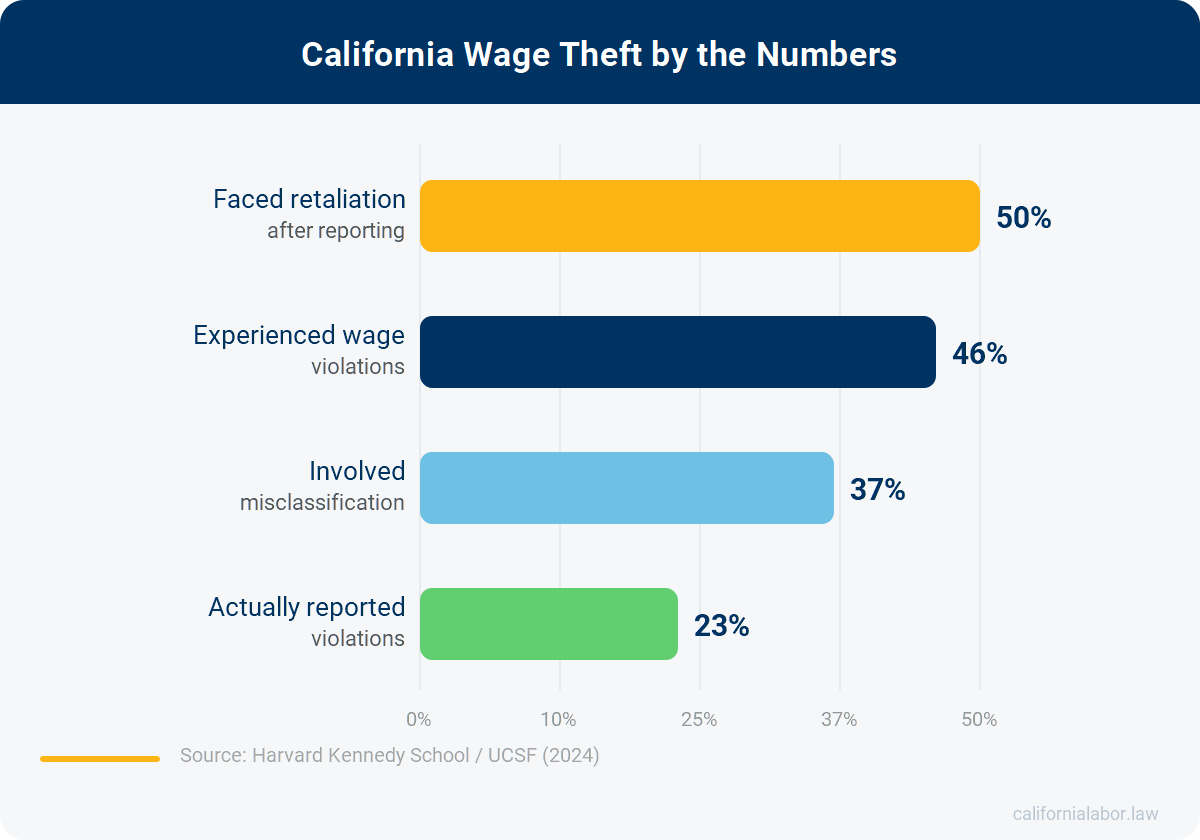
    Only 23% of California workers who experienced wage violations actually reported them, according to the Harvard/UCSF survey. Over 50% of those who did report faced retaliation. That gap between violations happening and workers taking action is exactly why overtime lawyers exist.

    You should talk to an overtime lawyer if any of these situations sound familiar:

    • You work more than 8 hours a day without extra pay. California’s daily overtime threshold catches violations that federal law misses entirely.
    • Your employer labels you “exempt” or “salary” but you don’t manage anyone. In 2023, 37% of the 12,000 wage violation cases filed with the California Labor Commissioner involved employee misclassification (CA Labor Commissioner, 2023).
    • You’re asked to work off the clock. Checking emails before your shift, staying late to close up, or working through lunch all count as compensable time.
    • Your employer changed your time records. Altering timesheets is illegal under California Labor Code Section 1174.
    • You experienced retaliation after asking about overtime. Employers who punish workers for raising overtime questions violate Labor Code Section 98.6.
    • You’re an independent contractor who works set hours at one company. Under California’s AB 5 and related laws, you may actually be an employee entitled to overtime.

    Don’t wait for the situation to resolve itself. The longer you delay, the more wages you lose and the closer you get to the statute of limitations.

    Bar chart showing California wage theft statistics: 50 percent faced retaliation, 46 percent experienced violations, 37 percent involved misclassification, only 23 percent reported violations. Source Harvard Kennedy School UCSF 2024
    Nearly half of California hourly workers experience wage violations, but less than a quarter report them.
     

    What Does California Overtime Law Require in 2026?

    California’s overtime protections are among the strongest in the country. As of January 1, 2026, the state minimum wage is $16.90 per hour, which sets the minimum overtime rate at $25.35/hour (1.5x) and double time at $33.80/hour (2x) (California DIR, 2025).

    Under Labor Code Section 510, here’s when overtime and double time apply:

    California vs. Federal Overtime Rules
    Rule California (2026) Federal (FLSA)
    Daily overtime trigger After 8 hours (1.5x rate) No daily overtime requirement
    Weekly overtime trigger After 40 hours (1.5x rate) After 40 hours (1.5x rate)
    Double time After 12 hours/day (2x rate) No double time requirement
    7th consecutive day First 8 hrs at 1.5x, then 2x No 7th-day rule
    Exempt salary threshold $70,304/year ($5,858.67/month) $35,568/year ($684/week)
    Statute of limitations 3 years (4 with UCL claims) 2 years (3 if willful)
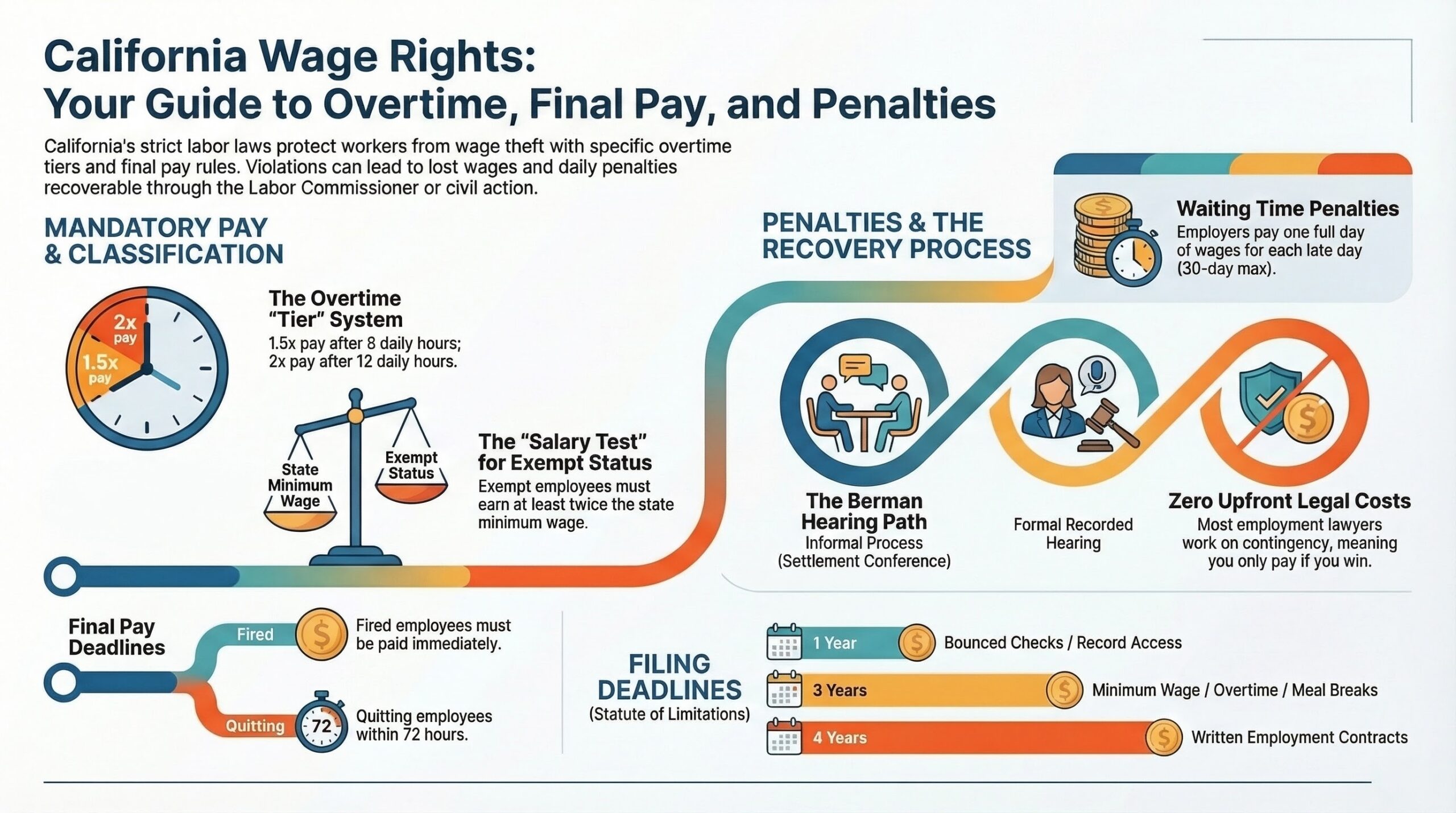
    Infographic showing California wage rights including the overtime tier system, exempt salary test, Berman hearing process, filing deadlines of 1 to 4 years, and zero upfront legal costs on contingency
    California overtime tiers, exemption tests, and filing deadline overview.
     

    Notice the differences? A worker putting in 10-hour days but staying under 40 hours a week would get zero overtime under federal law. Under California law, they’d earn 1.5x pay for those extra 2 hours every single day. That’s why California-specific legal expertise matters.

    How Much Could You Be Owed? A 2026 Overtime Calculation

    The Rutgers Workplace Justice Lab found that affected workers lost roughly 20% of their total paychecks to wage theft on average, with full-time workers losing about $4,000 per year (Rutgers, 2023). Here’s what a real-world scenario looks like with 2026 numbers.

    Example: Maria earns $20/hour and works 10-hour shifts, 5 days a week.

    Weekly Overtime Calculation at $20/Hour
    Hours Rate Pay
    First 8 hrs/day x 5 days = 40 hrs $20.00 (regular) $800.00
    Extra 2 hrs/day x 5 days = 10 hrs OT $30.00 (1.5x) $300.00
    Total correct weekly pay $1,100.00
    What employer pays without OT $20.00 x 50 hrs $1,000.00
    Weekly underpayment $100.00

    That’s $100 per week. Over a year, Maria loses $5,200. Over the 3-year statute of limitations, she’s owed $15,600 in unpaid overtime alone, before penalties and interest.

    And that’s a modest scenario. Workers earning more than minimum wage or pulling 12-hour shifts (triggering double time) can be owed significantly more. Have you run the numbers on your own situation?

    What Are the Most Common Overtime Violations?

    California employers owe workers billions in stolen wages every year. The Rutgers Workplace Justice Lab documented that workers across California’s four largest metro areas lost between $2.3 billion and $4.6 billion annually to wage theft between 2014 and 2023, with minimum wage violations nearly doubling over that period (Rutgers, 2023).

    The violations that an overtime lawyer sees most often include:

    Misclassification as exempt. Your employer calls you “salaried” or “manager” to avoid paying overtime. In 2026, an exempt employee must earn at least $70,304 per year and perform specific executive, administrative, or professional duties (DIR, 2026). A title alone doesn’t make you exempt.

    Off-the-clock work. Employers who expect you to answer emails, set up equipment, or attend meetings before clocking in owe you for that time. Period.

    Altered time records. Some employers shave minutes or round hours down. If your paystub doesn’t match your actual hours, that’s wage theft under Labor Code Section 1174.

    Denied meal and rest breaks. Missed breaks trigger premium pay of one additional hour at your regular rate. These premiums often stack on top of overtime violations.

    Independent contractor misclassification. Under California’s ABC test, you’re likely an employee unless your employer can prove otherwise. Workers who set their own schedules, use their own tools, and perform work outside the company’s core business may qualify as independent contractors. Most don’t.

    Los Angeles has the highest rate of wage theft nationally, with workers losing an estimated $1.6 to $2.5 billion annually in that metro area alone.

    Should You File a Claim Yourself or Hire a Lawyer?

    You actually have three options for recovering unpaid overtime in California, and the right choice depends on how much you’re owed and the complexity of your situation.

    Option 1: File a wage claim with the Labor Commissioner (DLSE). This is free, doesn’t require a lawyer, and works well for straightforward claims. You file a claim, attend a settlement conference, and if that fails, go to a hearing. The state invested $18 million through its Workers’ Rights Enforcement Grant Program to boost enforcement capacity in 2024-2026 (DIR, 2024).

    Option 2: File a lawsuit with a private attorney. Better for larger claims, systemic violations, or when you need stronger legal firepower. Attorneys can pursue additional penalties, interest, and attorney’s fees that boost your recovery.

    Option 3: File a PAGA claim. The Private Attorneys General Act lets you sue on behalf of yourself and other employees. As of the 2024 PAGA reforms, employees receive 35% of penalties (up from 25%), with the state getting 65% (Cal Employment Law Report, 2026). PAGA claims have a 1-year statute of limitations and require you to have personally experienced the violations.

    When does hiring a lawyer make the most sense? If your claim involves misclassification, retaliation, multiple violation types, or amounts exceeding the $10,000 small claims limit, an attorney’s expertise typically delivers a better outcome. Most California overtime lawyers take cases on contingency, meaning you pay nothing upfront and they collect a percentage only if you win.

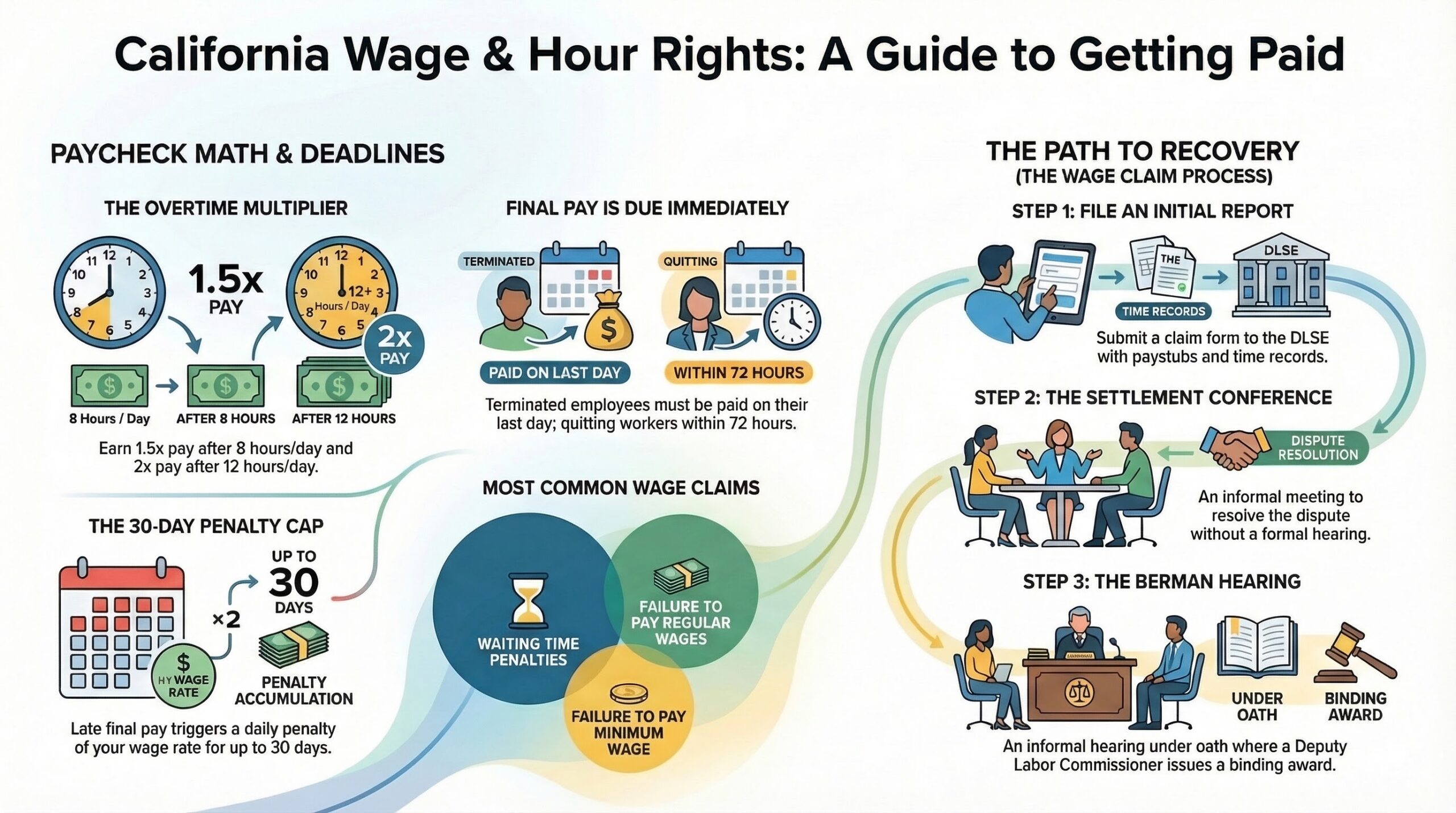
    Infographic showing the California wage claim recovery process including overtime multiplier math, final pay deadlines, the 30-day penalty cap, and the 3-step Berman hearing process through the DLSE
    The wage claim recovery process: from filing with the DLSE through the Berman hearing.
     

    What’s the Deadline to File an Overtime Claim?

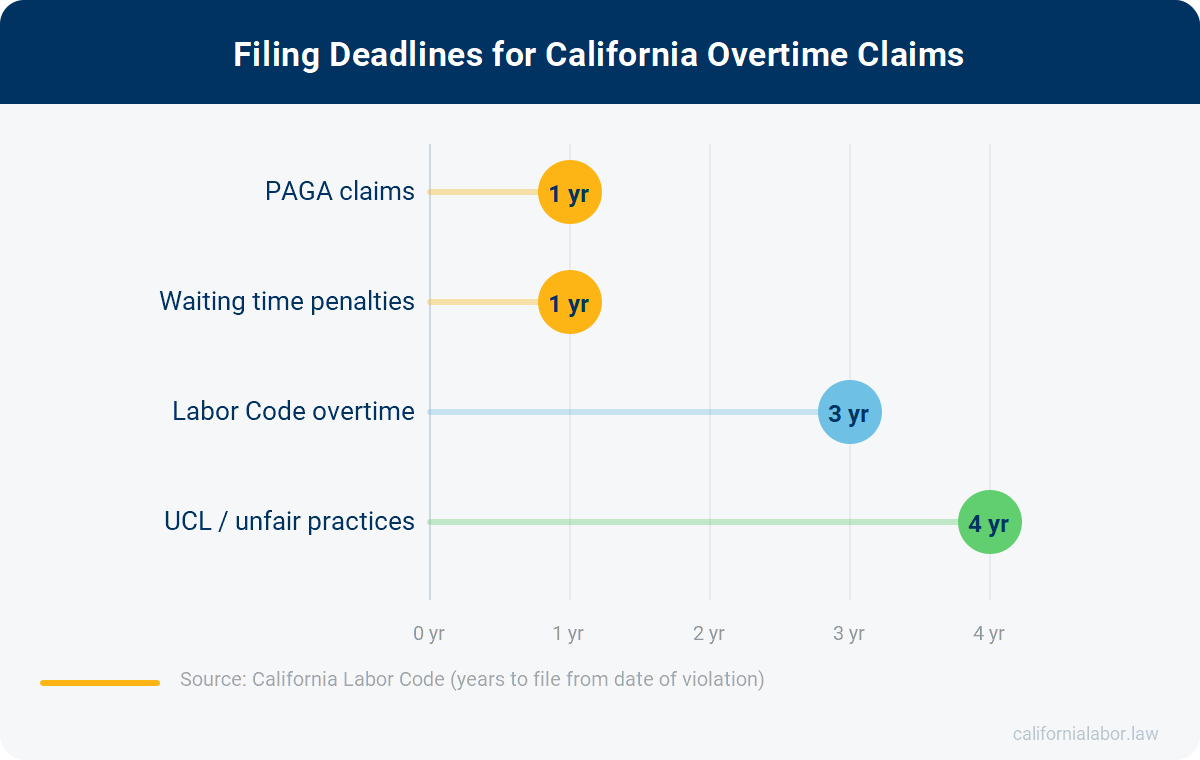
    Miss your deadline and you lose your claim entirely, no matter how strong it is. California has different statutes of limitations depending on the type of claim:

    • 3 years for unpaid overtime based on a state statute violation (Labor Code Section 510)
    • 4 years if you add an Unfair Competition Law claim under Business and Professions Code Section 17200
    • 1 year for PAGA claims (from the date of the most recent violation you experienced)
    • 1 year for waiting time penalties under Labor Code Section 203
    Lollipop chart showing California overtime claim filing deadlines: PAGA claims and waiting time penalties at 1 year, Labor Code overtime claims at 3 years, UCL unfair business practices claims at 4 years
    An experienced attorney can extend your recovery window to 4 years by adding a UCL claim.
     

    Here’s what matters practically. An experienced California employment lawyer will often file under both the Labor Code and the UCL, stretching the recovery window to 4 years. On a claim worth $5,200 per year, that extra year of back pay adds up fast.

    The clock starts running from the date of each individual violation, not the date you discovered it. So every week that passes without filing is a week of unpaid overtime that falls off the back end of your claim.

    How Much Can You Recover in an Overtime Case?

    Settlement amounts vary widely based on the violation’s scope and duration. Based on 2024-2025 case data, here’s what California workers have recovered:

    • Individual claims: $25,000 to $100,000 for multi-year violations with a single employer
    • Small-scale violations: $6,000 to $50,000 for shorter-term or less severe underpayment
    • Systematic wage theft: $50,000 to $300,000 when violations are company-wide over extended periods
    • Class actions: $300,000 to hundreds of millions in large-scale cases

    To put those numbers in context: Disney agreed to a $233 million settlement in late 2024 for wage theft affecting Disneyland Resort workers, the largest wage-and-hour payout in California history. G4S Secure Solutions paid $130 million on behalf of 13,500 security guards for unpaid breaks.

    According to the Rutgers Workplace Justice Lab, California workers affected by wage theft lost roughly 20% of their total paychecks, with full-time workers losing an average of $4,000 per year (Rutgers, 2023). Combined with penalties under Labor Code Section 203 (up to 30 days of wages for late final paychecks) and attorney’s fees, total recoveries often exceed the unpaid wages themselves.

    Your recovery typically includes unpaid overtime, interest, waiting time penalties, liquidated damages (which can double your award in certain cases), and attorney’s fees paid by the employer.

    How Does Working with an Overtime Lawyer Actually Work?

    If you’ve never hired a lawyer, the process is more straightforward than you’d expect. Here’s the typical timeline:

    Step 1: Free consultation. You describe your situation. The lawyer reviews your pay stubs, work schedule, and job duties to determine if you have a claim. This costs nothing.

    Step 2: Document gathering. Your lawyer collects evidence: timesheets, pay stubs, employment contracts, emails, and any communications about overtime. Start saving these now if you haven’t already.

    Step 3: Demand letter. Many cases settle here. Your lawyer sends a formal demand to your employer outlining the violations and the amount owed. Employers often prefer settling quietly over litigation.

    Step 4: Filing a claim or lawsuit. If the employer doesn’t cooperate, your lawyer files with the Labor Commissioner or in Superior Court. The choice depends on the claim size and complexity.

    Step 5: Negotiation or trial. Most overtime cases settle before trial. Your lawyer handles all negotiations, and you’re kept informed throughout.

    What should you do right now if you suspect unpaid overtime? Start a personal log of your actual hours worked. Save every pay stub. Screenshot any texts or emails where your employer asks you to work off the clock. This evidence is gold for your case.

    Frequently Asked Questions About California Overtime

    Is overtime pay mandatory in California?

    Yes. California Labor Code Section 510 requires all employers to pay non-exempt employees overtime for hours worked beyond 8 in a single workday or 40 in a workweek. The overtime rate is 1.5 times the employee’s regular rate. Double time (2x) applies after 12 hours in a day. There are no exceptions based on employer size.

    How do I know if I’m exempt from overtime in California?

    To qualify as exempt from overtime in California, you must earn at least $70,304 annually (as of 2026), perform executive, administrative, or professional duties, and regularly exercise independent judgment. A job title alone doesn’t determine exemption status. If your employer simply changed your title to “manager” without changing your duties or salary, you may be misclassified.

    How is overtime calculated in California?

    Your overtime rate is based on your “regular rate of pay,” which includes your hourly wage plus non-discretionary bonuses, commissions, and certain other compensation. Overtime is calculated at 1.5x your regular rate for hours 9 through 12 in a workday, and 2x your regular rate for hours beyond 12. On the 7th consecutive workday, the first 8 hours are paid at 1.5x and hours beyond 8 at 2x.

    Can my employer retaliate against me for filing an overtime claim?

    No. California Labor Code Section 98.6 makes it illegal for employers to retaliate against workers who file wage claims. Retaliation includes termination, demotion, reduced hours, or any other adverse action. If retaliation occurs, you may be entitled to additional damages including reinstatement, back pay, and a penalty of up to $10,000. Document any changes in treatment immediately and consult an attorney.

    What’s the difference between a PAGA claim and an individual overtime lawsuit?

    An individual overtime lawsuit recovers your personal unpaid wages, penalties, and interest. A PAGA claim lets you act as a “private attorney general” to enforce labor laws on behalf of all affected employees. Under 2024 PAGA reforms, employees receive 35% of civil penalties. PAGA has a shorter 1-year statute of limitations but can produce larger total recoveries when violations are widespread.

    How long do I have to file an overtime claim in California?

    You have 3 years from the date of each violation to file an unpaid overtime claim under California Labor Code. If your attorney adds an Unfair Competition Law claim (Business and Professions Code Section 17200), the window extends to 4 years. PAGA claims have a 1-year deadline. Because each missed paycheck is a separate violation, the clock is always running. Filing sooner means recovering more.

    Do California overtime lawyers charge upfront fees?

    Most California overtime lawyers work on a contingency fee basis. You pay nothing upfront and no fees unless they win your case. The attorney’s percentage typically ranges from 25% to 40% of the total recovery. Many also advance litigation costs. This arrangement means there’s no financial barrier to pursuing your claim, and your lawyer is directly motivated to maximize your recovery.

    Take Action to Protect Your Wages

    California’s overtime laws are strong, but they only protect you if you enforce them. With nearly half of hourly workers experiencing wage violations and only 23% reporting them, billions in earned wages go uncollected every year.

    If you suspect your employer owes you overtime, don’t wait. Start documenting your hours, save your pay stubs, and talk to a California overtime lawyer. The consultation is free, most attorneys work on contingency, and you have a limited window to file your claim.

    Contact California Labor Law for a free employment law consultation by calling us at 1-866-355-9991.

  • 7 Expert Tips on Finding a California Employment Lawyer

    7 Expert Tips on Finding a California Employment Lawyer

    Key Takeaways: The EEOC received 88,531 new discrimination charges in FY 2024, a 9.2% increase over the prior year (EEOC, 2024). Retaliation claims topped the list at 47.8% of all charges. Choosing the right California employment lawyer matters — workers with legal representation receive an average wrongful termination settlement of $48,800 compared to $19,200 without a lawyer (LawLinq, 2025). Most employment attorneys work on contingency fees of 30%–40%, meaning you pay nothing upfront.

    Finding the right California employment lawyer can feel overwhelming when you’re already dealing with a stressful workplace situation. With over 203,000 active attorneys licensed through the State Bar of California (State Bar of California, 2024), narrowing down the right fit for your specific case requires a focused approach.

    This guide walks you through seven research-backed steps to find an employment lawyer who has the specialization, track record, and fee structure that match your needs. Every recommendation is supported by data from the EEOC, the California State Bar, and industry research.

    What Does a California Employment Lawyer Do?

    California employment lawyers handled cases contributing to the EEOC’s recovery of nearly $700 million in monetary benefits for workers in fiscal year 2024 alone (EEOC, 2024). These attorneys specialize in disputes between employees and employers, covering everything from wage theft to workplace discrimination under both federal law and California’s own labor code.

    Their core work includes evaluating whether you have a viable legal claim, negotiating settlements with employers or their insurance carriers, and representing you in court or mediation if negotiations break down. The EEOC achieved a 71% success rate in private sector mediations during FY 2024, a 14% increase from the prior year (EEOC, 2024) — showing that skilled legal advocacy during negotiations often resolves cases without a trial.

    A California employment lawyer typically handles:

    • Evaluating your case and advising on its legal standing
    • Representing you in court, arbitration, or mediation
    • Negotiating settlements and compensation packages
    • Filing complaints with the California Civil Rights Department (CRD) or the EEOC
    • Reviewing employment contracts, severance agreements, and non-compete clauses

    Attorney and client meeting in an office to discuss an employment law case

    California’s labor laws offer stronger worker protections than federal standards in many areas, including overtime rules, meal and rest break requirements, and anti-retaliation provisions. An attorney who practices specifically in California employment law understands these state-level differences and how to use them to your advantage.

    What Type of Employment Claim Do You Have?

    Retaliation is the most common employment claim in the United States, accounting for 47.8% of all EEOC charges in FY 2024, followed by harassment at 40.4%, disability discrimination at 38.0%, race discrimination at 34.2%, and sex discrimination at 30.4% (CWC, 2025). Since many charges allege multiple bases, these percentages total more than 100%.

    Before contacting any lawyer, identify which category your situation falls into. Different employment issues require different legal specializations, and the right match can significantly affect your outcome.

    Horizontal bar chart showing the most common EEOC charge types in FY 2024: retaliation at 47.8 percent, harassment at 40.4 percent, disability at 38.0 percent, race at 34.2 percent, and sex at 30.4 percent. Source: EEOC FY 2024 Annual Performance Report.

    Common California employment claims include:

    Each claim type carries different settlement ranges. Age discrimination cases in California average $150,000–$1,000,000, while retaliation claims typically settle for $20,000–$40,000 (LawLinq, 2025). Understanding your claim type helps you set realistic expectations and find a lawyer whose experience aligns with your needs.

    Why Does Specialization Matter in Employment Law?

    Workers who hire an attorney for wrongful termination cases receive an average settlement of $48,800 — more than 2.5 times the $19,200 average for those who represent themselves (LawLinq, 2025). Beyond having any lawyer, finding one who specializes in your specific claim type can further improve your outcome.

    Employment law is broad. A lawyer who focuses on wage-and-hour disputes may not have the same depth of experience handling a complex disability discrimination case. When evaluating attorneys, ask how many cases similar to yours they’ve handled in the past two to three years.

    Look for specialization in areas such as:

    Whistleblower retaliation cases, for example, carry an average settlement value of approximately $447,830 — but only when handled by attorneys experienced in this niche area (LawLinq, 2025). A general practice attorney is unlikely to achieve the same result.

    How Do You Verify a Lawyer’s Credentials in California?

    The State Bar of California received 21,205 complaints against attorneys in FY 2025 and ultimately disciplined 154 of them — including 69 disbarments and 58 suspensions (State Bar of California, 2025). Checking your potential lawyer’s standing before hiring them takes five minutes and can prevent serious problems.

    Start with the State Bar of California’s online lookup tool. You can verify that the attorney holds an active license, check for any past disciplinary actions, and confirm how long they’ve been practicing. An attorney with a clean record and 5+ years of employment law experience is generally a solid starting point.

    Professional associations that indicate specialization include:

    • California Employment Lawyers Association (CELA)
    • National Employment Lawyers Association (NELA)
    • American Bar Association (ABA) — Labor and Employment Law Section
    • Local county bar associations with employment law committees

    Membership in CELA or NELA is particularly meaningful because these organizations focus exclusively on representing employees in workplace disputes. Members must meet ongoing education requirements, which keeps them current on evolving California labor laws.

    How Can You Assess a Lawyer’s Track Record?

    Hiring a lawyer with a strong track record matters measurably: workers with legal representation have a 64% likelihood of receiving compensation in wrongful termination cases, compared to just 30% for those without an attorney (LawLinq, 2025). Past results don’t guarantee future outcomes, but they reveal whether an attorney can successfully navigate cases like yours.

    Ask potential lawyers about the number of employment cases they’ve handled, their settlement success rate, and whether they’ve taken similar cases to trial. Attorneys who only settle and never go to trial may have less leverage during negotiations.

    When reviewing an attorney’s track record, focus on:

    • Number of employment cases handled in the past 3–5 years
    • Settlement success rates and average amounts recovered
    • Trial experience (even if most cases settle, trial readiness adds leverage)
    • Experience with your specific claim type

    Client reviews on platforms like Google, Avvo, and Martindale-Hubbell provide real-world feedback. Look for patterns rather than individual reviews — consistent praise for responsiveness and clear communication usually indicates a well-run practice. Consistent complaints about delays or poor communication are red flags to take seriously.

    Employment lawyer reviewing a contract with legal documents on desk

    What Questions Should You Ask During a Free Consultation?

    Most California employment lawyers offer free initial consultations, especially those who work on contingency — meaning they only get paid if you win. The EEOC secured $469.6 million for 13,516 workers through settlements in FY 2024 (EEOC, 2024), and a strong consultation helps you determine whether your case has similar potential.

    Treat the consultation as a two-way interview. You’re evaluating the lawyer’s expertise and communication style just as much as they’re evaluating your case. Come prepared with documents and specific questions.

    Questions to ask during your consultation:

    • How many cases like mine have you handled, and what were the outcomes?
    • What is your strategy for my specific situation?
    • What are the potential challenges or weaknesses in my case?
    • How will you communicate updates — email, phone, client portal?
    • What is your fee structure, and are there any costs I’ll owe regardless of outcome?
    • How long do cases like mine typically take to resolve?
    • Will you personally handle my case, or will it be assigned to a junior associate?

    Pay attention to how they answer. Vague responses or guarantees of specific outcomes are warning signs. A good employment lawyer explains the strengths and risks of your case honestly, without overpromising.

    How Much Does a California Employment Lawyer Cost?

    Most California employment lawyers who represent employees work on contingency fees ranging from 30% to 40% of the settlement or judgment, meaning you pay nothing out of pocket unless you win (Novian & Novian, 2025). Hourly rates, used less commonly for plaintiff-side employment cases, range from $200 to $600 per hour in California (Kramer Brown Hui, 2025).

    Understanding the fee structure before signing a retainer agreement prevents surprises. Always ask about additional costs beyond the attorney’s fee.

    Comparison chart of three California employment lawyer fee structures: contingency fees at 30 to 40 percent of recovery with no upfront cost, hourly rates at 200 to 600 dollars per hour with retainer required, and flat fees that vary by service. Sources: Kramer Brown Hui LLP and Novian and Novian LLP, 2025.

    Common fee structures for California employment lawyers:

    Fee Type Typical Range Best For
    Contingency 30%–40% of recovery Wrongful termination, discrimination, harassment
    Hourly $200–$600/hr Contract reviews, legal advice, employer defense
    Flat fee Varies by service Demand letters, document review, EEOC charge filing

    With contingency arrangements, the lawyer absorbs the risk: if you don’t recover compensation, you don’t owe legal fees. However, some agreements still require you to cover court filing fees, expert witness costs, or administrative expenses — which can range from a few hundred to several thousand dollars. Read the fee agreement carefully before signing.

    How Do You Know If a Lawyer Is the Right Fit?

    The EEOC handled 553,000 calls and 248,255 in-person inquiries from workers in FY 2024 (EEOC, 2024) — illustrating how many employees face workplace issues and need clear, responsive legal guidance. When you’re one of those workers, your lawyer’s communication style and accessibility directly affect your experience.

    Employment cases often involve sensitive topics: harassment, discrimination, retaliation. You need to feel comfortable sharing details that may be difficult to discuss. If the attorney feels dismissive, rushed, or unclear during the initial consultation, that dynamic is unlikely to improve once you’re a client.

    Evaluate these fit factors:

    • Responsiveness: Do they return calls and emails within 24–48 hours?
    • Clarity: Can they explain legal concepts in plain language?
    • Honesty: Do they address weaknesses in your case, not just strengths?
    • Availability: Who handles your case day-to-day — the attorney or support staff?
    • Respect: Do they listen to your concerns and answer your questions fully?

    Trust your instincts during the evaluation. If something feels off, it’s worth consulting one or two additional attorneys before committing. Most offer free consultations, so there’s no financial cost to meeting with multiple lawyers before making a decision.

    What Red Flags Should You Watch For?

    With 21,205 complaints filed against California attorneys in a single year and 154 resulting in discipline (State Bar of California, 2025), problematic lawyers do exist. Knowing the warning signs before you hire helps you avoid becoming one of those complainants.

    The most common red flags fall into three categories: transparency problems, communication failures, and unrealistic promises.

    Warning signs to watch for:

    • Guaranteed outcomes: No ethical lawyer can promise a specific result. If they guarantee you’ll win or quote a specific dollar amount before investigating your case, walk away.
    • Vague fee discussions: Unwillingness to put fee terms in writing or explain exactly what you’ll owe is a serious red flag.
    • Poor responsiveness: If they take days to return calls during the consultation phase — when they’re trying to win your business — expect worse once you’re a client.
    • Pressure tactics: Lawyers who push you to sign immediately or claim your case is “time-sensitive” without explaining the actual statute of limitations may not have your best interests in mind.
    • Disciplinary history: Always check the State Bar’s public records for past actions.

    The average disciplinary case takes 131 days to process through the State Bar system (State Bar of California, 2025). If a lawyer has active complaints pending, that information may not yet be reflected in public records — another reason to rely on multiple evaluation methods, including reviews and professional references.

    How Should You Prepare for Your First Meeting?

    The EEOC filed 111 lawsuits on behalf of workers in FY 2024, achieving a 97% success rate in resolved merits cases (EEOC, 2024). While most employment disputes don’t reach that level, thorough preparation from the very first meeting gives your case the strongest possible foundation — whether it settles early or goes to trial.

    Organize your materials before the consultation. The more complete your documentation, the faster your attorney can evaluate your case and develop a strategy.

    Bring these documents to your first meeting:

    • Employment contract, offer letter, and any amendments
    • Recent pay stubs and records of hours worked
    • Written communications (emails, texts, Slack messages) related to your complaint
    • Performance reviews from the past 2–3 years
    • Any written complaints you’ve filed with HR, along with HR’s responses
    • Notes on key events with dates, names, and locations
    • Contact information for potential witnesses

    Write a brief timeline of events before the meeting — what happened, when, and who was involved. This helps your attorney quickly understand the sequence and identify the strongest legal claims. Keep it factual and chronological rather than emotional.

    Frequently Asked Questions

    What types of cases do California employment lawyers handle?

    California employment lawyers handle workplace discrimination, harassment, wrongful termination, retaliation, wage theft, overtime violations, and FMLA/CFRA leave disputes. Retaliation is the most common claim nationally, representing 47.8% of all EEOC charges in FY 2024 (CWC, 2025). Many California cases also involve state-specific protections under the Fair Employment and Housing Act (FEHA).

    How much does it cost to hire an employment lawyer in California?

    Most employment lawyers representing employees work on contingency fees of 30%–40% of the recovery, so you pay nothing unless you win (Novian & Novian, 2025). Hourly rates for California employment attorneys range from $200 to $600 per hour when hourly billing applies (Kramer Brown Hui, 2025). Some attorneys charge flat fees for discrete tasks like demand letters or contract reviews.

    How do I know if I need an employment lawyer?

    Consider hiring a lawyer if you’ve experienced illegal treatment at work — such as discrimination, harassment, wrongful termination, or wage theft — and your employer hasn’t resolved it through internal channels. Workers with legal representation have a 64% chance of receiving compensation in wrongful termination cases, compared to 30% without a lawyer (LawLinq, 2025). Free consultations let you evaluate your case without financial commitment.

    How long does a California employment lawsuit take?

    Most California employment cases resolve in 6 to 18 months, though complex litigation can take 2–3 years. Cases that settle during mediation — which had a 71% success rate through the EEOC in FY 2024 (EEOC, 2024) — typically resolve faster than those that go to trial. Your attorney can provide a more specific timeline based on your claim type and jurisdiction.

    What is the average settlement for an employment case in California?

    Average settlements vary widely by claim type. Wrongful termination cases with legal representation average $48,800, while whistleblower retaliation cases average approximately $447,830 (LawLinq, 2025). Disability discrimination settlements range from $25,000 to $500,000, and age discrimination cases from $150,000 to $1,000,000, depending on the facts and damages involved.

    Take the Next Step

    The EEOC received over 88,500 workplace discrimination charges in FY 2024 — and recovered nearly $700 million for workers (EEOC, 2024). If you’re facing an employment dispute in California, having the right lawyer significantly improves your chances of a fair outcome.

    Start by identifying your claim type, researching attorneys who specialize in that area, and scheduling free consultations with two or three candidates. Verify credentials through the State Bar, compare fee structures, and choose the lawyer who combines relevant experience with clear, responsive communication.

    If you are having legal issues with your employer, reach out to California Labor Law by calling us at 1-866-355-9991 for a free employment law consultation.

    Last updated: February 2026