Category: Misclasification

  • 1099 Employee vs W2: Know Your California Rights

    1099 Employee vs W2: Know Your California Rights

    California 1099 vs W2: What Workers Need to Know About Their Rights

    Getting paid what you deserve in California can depend entirely on whether you are a 1099 independent contractor or a W2 employee.

    For gig workers and freelancers, this difference impacts every paycheck, the taxes you owe, and whether you receive legal protections if your employer underpays you.

    Understanding your classification is the first step toward safeguarding your rights under California law, especially when wage theft or misclassification enters the picture.

    Defining 1099 Employee and W2 Status

    The difference between being classified as a 1099 independent contractor and a W2 employee shapes nearly every aspect of your work life in California. These two classifications determine how you pay taxes, what protections you receive, whether you get benefits, and crucially, what happens if your employer fails to pay you correctly.

    Understanding which category applies to you isn’t just about paperwork. It’s about knowing your actual rights under California law.

    A 1099 worker is classified as an independent contractor who typically receives income reported on Forms 1099-MISC, 1099-K, or 1099-NEC. These workers maintain control over how and when they complete their work, set their own schedules, and handle their own payroll taxes without employer withholdings.

    You’re responsible for paying both the employee and employer portions of Social Security and Medicare taxes, which can add up to roughly 15.3 percent of your earnings.

    As an independent contractor, you also bear the cost of your own equipment, workspace, and any training required for the job. The appeal for many gig workers is flexibility, but that freedom comes with significant financial responsibility and fewer legal protections.

    Many delivery drivers, rideshare drivers, and freelance service providers fall into this category, though California has specific rules about which gig economy drivers qualify as independent contractors under certain conditions.

    In contrast, a W2 employee works under your employer’s control and supervision, with wages reported on Form W-2. Your employer withholds federal and state income taxes, Social Security, and Medicare from your paycheck automatically. This means you don’t need to pay those taxes yourself when you file your return.

    W2 employees receive mandatory benefits including workers’ compensation insurance, unemployment insurance eligibility, and access to minimum wage protections under California labor laws. Your employer covers equipment costs, provides a workspace, and typically handles training expenses.

    The trade-off is less schedule flexibility, though California law gives you significant protections around rest breaks, meal periods, overtime pay, and other working conditions.

    How income is reported federally and on state tax returns directly affects your tax filing and what deductions you can claim.

    Supervisor directs employee at cubicle desk

    The fundamental difference comes down to control and relationship structure. When determining if you’re an employee or contractor, California focuses on whether the hiring entity controls how, when, and where work gets done.

    If your employer dictates your hours, provides tools and training, supervises your work closely, and integrates you into the company’s operations, you’re likely an employee regardless of what your contract says.

    If you truly control your work methods, set your own schedule, work for multiple clients, and maintain an independent business, contractor status may apply. But California courts lean heavily toward employee classification when facts are unclear, which benefits workers significantly.

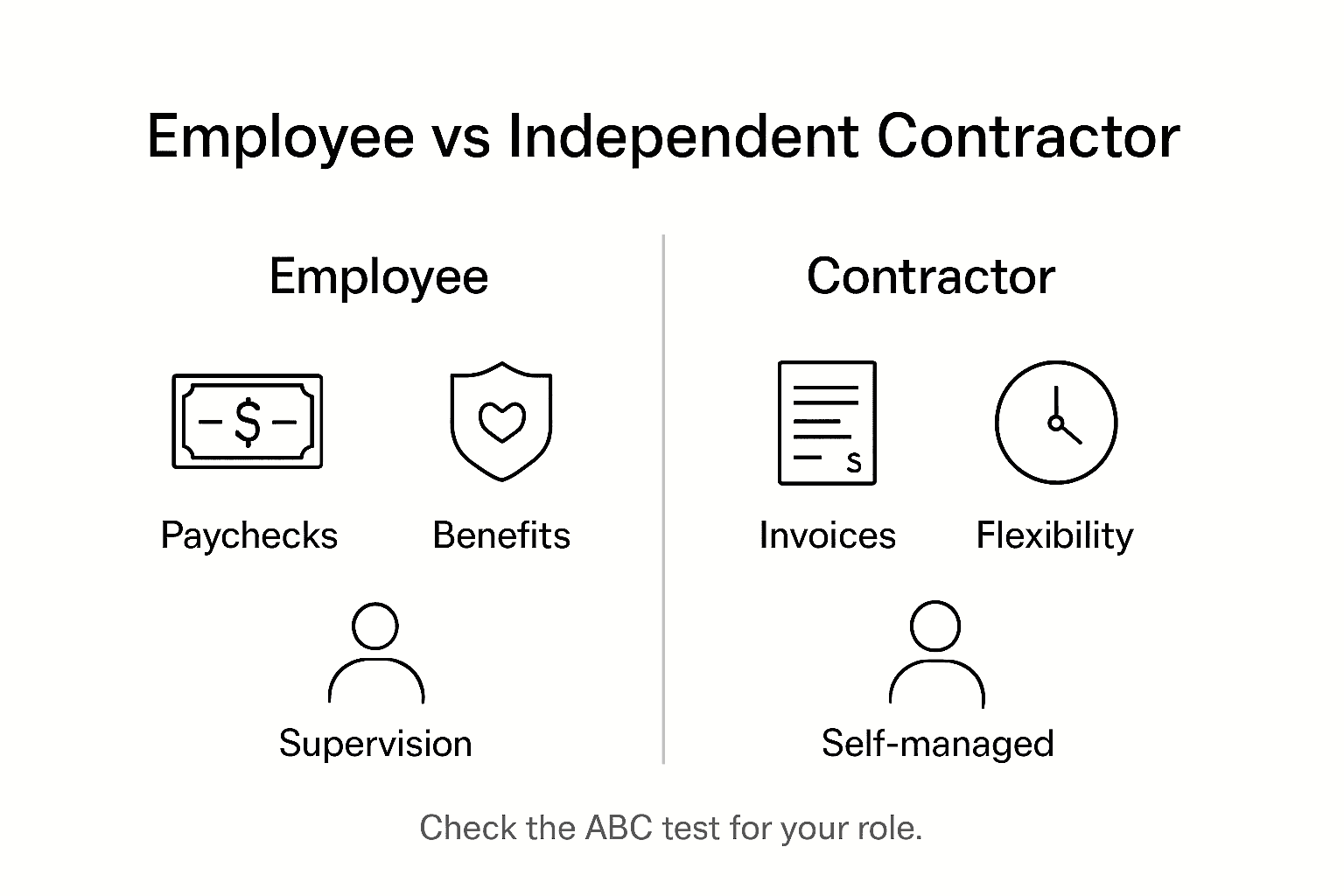
    Here’s a side-by-side comparison of core differences between 1099 independent contractors and W2 employees in California:

    Aspect 1099 Contractor W2 Employee
    Tax Withholding No employer withholding Taxes withheld automatically
    Benefit Eligibility No legal guarantee Access to statutory benefits
    Work Flexibility Sets own hours and methods Follows employer schedules
    Legal Protections Limited, mostly contract-based Extensive under labor laws

    Pro tip: Request a written classification statement from your employer and verify it matches how you actually work, then contact a California labor advocate if discrepancies exist between your classification and your real working conditions.

    California doesn’t rely on what your contract says or what tax forms get filed. The state uses a specific legal test to determine whether you’re actually an employee or independent contractor, and this test overrides almost everything else. This is critical because misclassification can cost employers significant money in penalties, back wages, and damages, which means they have strong incentives to fight your classification claims.

    Understanding how California evaluates your status gives you the power to recognize when you’re being wrongly classified and what steps to take.
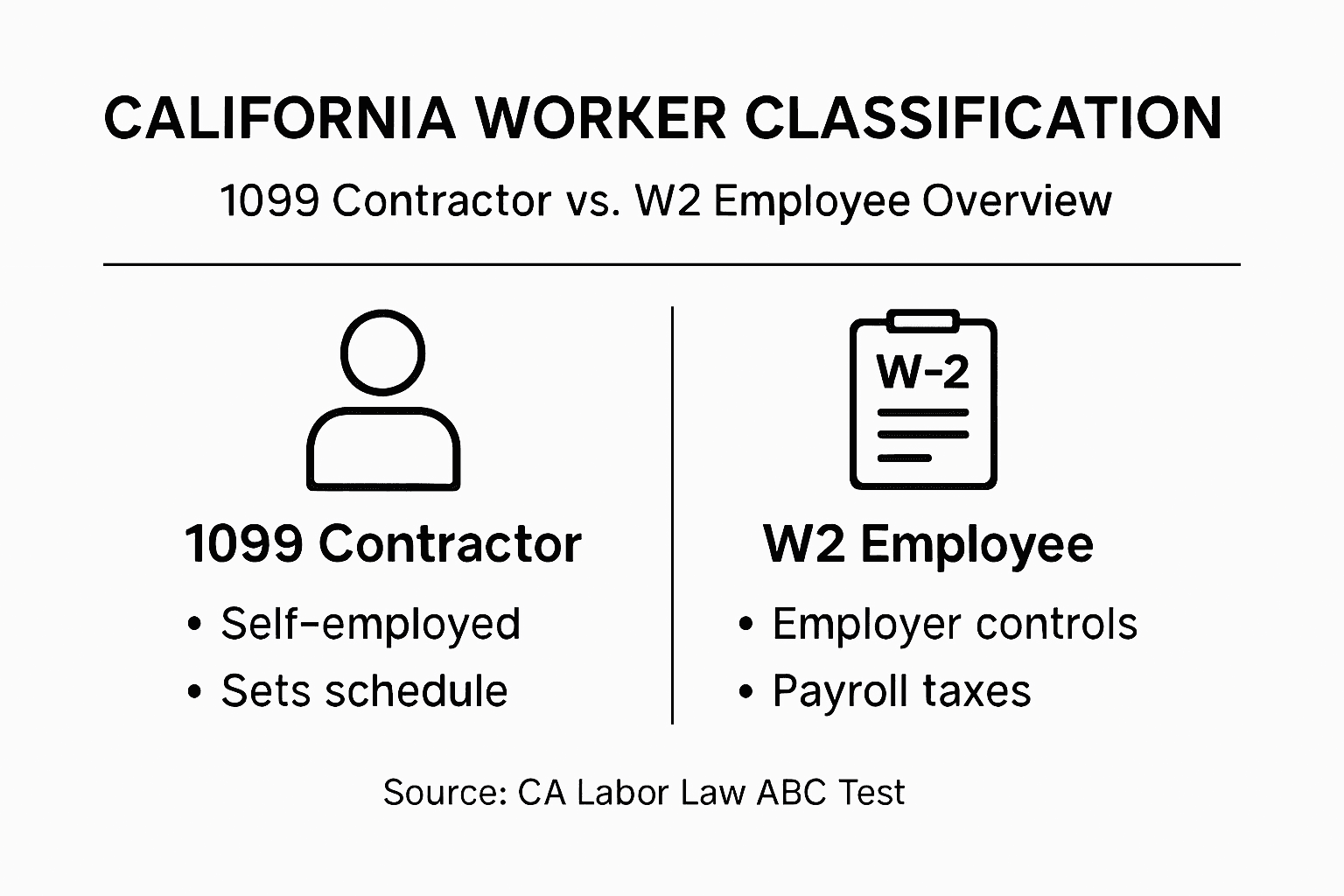
    Infographic comparing 1099 vs W2 classification

    The ABC Test is California’s primary legal standard for classifying workers, and it comes from Assembly Bill 5. Here’s how it works: for you to qualify as an independent contractor, all three conditions must be true simultaneously.

    First, the hiring entity must have no control over how you perform your work, including the methods you use and the hours you work.

    Second, you must perform work that falls outside the usual business of the company hiring you. Third, you must be independently established in your own trade or business.

    Think of it this way: if you’re a freelance accountant working for multiple clients and setting your own hours, you might pass the test. But if you’re working set hours for one company doing exactly what employees do there, you fail the test.

    California’s ABC Test framework clarifies that signed agreements and tax forms alone cannot override these requirements, no matter what language your contract contains.

    What makes the ABC Test so powerful for workers is that it’s extremely strict. You don’t need to prove you’re misclassified according to some vague standard. California has spelled out exactly what needs to happen, and employers must meet every single criterion.

    Many companies try to get around this by having workers sign agreements claiming independent contractor status, but those contracts mean almost nothing if the actual working relationship doesn’t fit the legal test. Courts consistently rule that the reality of how you work matters far more than paperwork.

    If you work regular hours, get directions from a manager, use company equipment, and perform core business functions, you’re likely an employee regardless of your contract language or the 1099 forms you receive.

    The consequences for misclassification are substantial. Employers who wrongly classify employees face significant legal consequences and misclassification risks including unpaid wages, overtime violations, benefits liability, and civil penalties.

    California’s Department of Industrial Relations actively investigates wage theft cases, and misclassification often leads to wage theft claims because misclassified workers typically earn less than they legally deserve. You also lose access to workers’ compensation if injured, unemployment insurance if laid off, and minimum wage protections while working.

    These aren’t theoretical risks for many gig workers who discover too late that they should have been classified as employees all along.

    Pro tip: Document how you actually work for at least two weeks, noting who controls your schedule, what tools you use, who supervises you, and whether you work for other companies, then compare your real working conditions against the three ABC Test requirements to identify potential misclassification.

    Major Distinctions: Pay, Benefits, and Control

    The gap between 1099 and W2 status extends far beyond tax forms. Your classification determines whether you receive a steady paycheck, health insurance, workplace protections, or whether you’re left covering every cost yourself.

    For gig workers juggling multiple income sources or those misclassified in their current role, understanding these distinctions can reveal thousands of dollars in missing wages and benefits you should have received.

    Payroll and tax withholding work completely differently depending on your status. When you’re a W2 employee, your employer deducts federal income tax, Social Security, Medicare, and state income tax directly from each paycheck before you see the money. This means you don’t face a tax surprise when April arrives.

    Independent contractors receive the full amount owed with no withholdings, then must set aside money themselves to pay federal and state taxes quarterly, plus both the employee and employer shares of Social Security and Medicare taxes.

    The self-employment tax alone adds up to approximately 15.3 percent of your net earnings that you must pay out of pocket. Many 1099 workers underestimate this burden and find themselves short when tax time arrives.

    Beyond payroll taxes, W2 employees receive regular wages with payroll taxes withheld and legal protections including minimum wage, while contractors pay their own taxes and receive no minimum wage guarantee if work slows down.

    The benefits gap creates significant financial vulnerability for misclassified workers. W2 employees in California have access to workers’ compensation insurance, which covers medical expenses and lost wages if you’re injured on the job. You’re also eligible for unemployment insurance if your employer lays you off or fires you without cause.

    Many employers offer health insurance, retirement plans, and paid time off to W2 employees. Contractors get none of this. If you get hurt while working as a 1099 contractor, you’re responsible for your own medical bills and lost income. If work dries up, you receive nothing. If you need a break for illness or personal reasons, you lose income with no safety net.

    You also bear the cost of equipment, vehicles, workspace, and any training required for your work. The financial pressure to keep working despite illness or exhaustion is intense for contractors without these protections.

    Control over your work schedule and methods represents the final major distinction. W2 employees work under employer direction, with managers assigning tasks, setting schedules, and determining work methods. This means less flexibility but also clear boundaries on expectations. Independent contractors theoretically control when and how they work, choosing their own hours and methods. This sounds appealing until you realize that less control can actually mean more pressure.

    When you’re classified as a 1099 contractor, companies often demand faster work, tighter deadlines, and higher quality without adjusting pay. The lack of formal employment relationship means fewer protections against arbitrary demands or payment disputes.

    Pro tip: Calculate your actual hourly earnings as a 1099 contractor by subtracting all business expenses and self-employment taxes from gross income, then divide by actual hours worked to see whether you’re earning less than minimum wage, which could indicate misclassification.

    Rights, Protections, and Obligations for Each Type

    Your employment classification determines not just your paycheck, but whether California law actively protects you from exploitation. W2 employees operate under a comprehensive framework of legal protections built into California’s labor code, while independent contractors largely operate outside this system.

    Understanding what protections you should have versus what you’ve actually been given is the first step toward recognizing wage theft or misclassification in your situation.

    W2 employees in California enjoy extensive legal protections that contractors simply do not have. You have the right to earn at least minimum wage, currently 16 dollars per hour in most of the state. You’re protected by overtime laws requiring time-and-a-half pay for hours over 8 in a day or 40 in a week. You must receive paid meal and rest breaks.

    Your employer cannot retaliate against you for reporting labor violations, demanding unpaid wages, or participating in union activities. You have the right to file wage claims with the California Labor Commissioner if your employer fails to pay you correctly. If injured at work, you’re covered by workers’ compensation insurance without needing to prove fault. If laid off, you can file for unemployment benefits.

    These protections exist because California recognizes that employees have less bargaining power than employers and need legal guardrails. Independent contractors receive virtually none of these protections. Employees receive legal protections such as wage and hour laws and protections from retaliation, while independent contractors operate in a largely unregulated space where these laws do not apply.

    The flip side of this protection gap is the obligation structure. Independent contractors must handle their own tax obligations, including quarterly estimated tax payments to avoid penalties. You’re responsible for maintaining business records, obtaining any required licenses, carrying liability insurance if necessary, and managing your own retirement savings with no employer contribution.

    You cannot claim unemployment benefits during slow periods. You must negotiate your own rates and payment terms, and you have limited recourse if a client refuses to pay beyond small claims court or hiring an attorney.

    W2 employees, by contrast, have straightforward obligations: show up for scheduled work, follow company policies, and perform your job duties. Your employer handles tax withholding, insurance, benefits administration, and legal compliance. This sounds simpler until you realize that contractors often work longer hours for less total compensation because they absorb all business costs and risks.

    Misclassification creates a dangerous gray zone where workers receive neither the protections of employees nor the genuine independence of contractors. You might be classified as 1099 while working set hours, receiving employer direction, and performing core business functions. This means you lose wage and hour protections, overtime rights, meal break guarantees, and unemployment eligibility without gaining the autonomy or rate-setting power of true contractors.

    Misclassification can lead to penalties and worker claims against the employer, but you need to recognize it first and understand your options for challenging it.

    Pro tip: Create a detailed list comparing your actual working conditions against California’s employee protections, then contact a labor advocate if you’re classified as 1099 but receive employer direction, set schedules, or lack meaningful independent business operations.

    Misclassification Risks and Filing a Wage Claim

    Misclassification isn’t a victimless paperwork error. It’s wage theft. When employers knowingly or carelessly classify employees as independent contractors, they avoid paying payroll taxes, providing benefits, and following wage and hour laws. The financial impact on workers accumulates silently until someone does the math and realizes they’ve been underpaid by thousands of dollars.

    But here’s what matters for your situation: California law gives you a pathway to recover what you’re owed, and employers face serious consequences for getting this wrong.

    The risks employers face for misclassification are substantial enough that they should be incentivizing correct classification, yet many still gamble with workers’ livelihoods.

    An employer who misclassifies employees as independent contractors faces back wage claims covering unpaid minimum wage and overtime, plus penalties and interest that can double or triple the original wage theft amount. They become liable for unpaid payroll taxes with penalties from the IRS and California Franchise Tax Board.

    Workers’ compensation insurance penalties apply retroactively. If the misclassification was intentional or reckless, California law allows for civil penalties and attorney’s fees, which means you can potentially recover not just your lost wages but also the cost of fighting for them legally.

    The Department of Industrial Relations actively investigates misclassification complaints, which can trigger comprehensive audits of a company’s entire workforce. Many employers don’t realize that one worker’s wage claim can unravel their entire contractor classification scheme, exposing similar misclassification across their business.

    Filing a wage claim is your formal mechanism for recovering stolen wages, and California makes the process accessible even without an attorney. You file with the California Labor Commissioner’s office, which operates free of charge.

    Your claim documents the hours you worked, the wages you should have earned under minimum wage and overtime laws, and the wages actually paid. You need pay stubs if available, text messages or emails showing work instructions, photos of you working, witness statements, and any written communications about your job duties.

    The Labor Commissioner investigates your claim and holds a hearing where both you and your employer present evidence. If the Commissioner finds in your favor, your employer must pay you the full amount owed plus penalties. The entire process typically takes several months.

    Importantly, protections against retaliation for complaining about misclassification exist under California law, meaning your employer cannot legally fire you, reduce your hours, cut your pay, or otherwise punish you for filing a wage claim. If they retaliate, that becomes a separate illegal act with its own remedies.

    Below is a summary of key steps in filing a wage claim for misclassification in California:

    Step Purpose Evidence Needed
    Prepare Documentation Build a strong case Pay stubs, emails, work logs
    File with Labor Commissioner Initiate official claim process Claim form and supporting docs
    Attend Hearing Present case to Commissioner Witness statements, photos
    Receive Determination Get formal decision for wage recovery Proof of payment or violation

    Timing matters because California has statute of limitations rules. You generally have four years to file a wage claim for unpaid wages, though three years is more common for certain violations. Don’t assume the clock keeps running indefinitely.

    Additionally, California’s wage theft laws include penalties and interest that grow over time, so acting sooner typically means recovering more.

    Many workers hesitate to file because they fear retaliation or believe the process is too complicated. Both concerns are understandable but shouldn’t stop you. Retaliation is illegal and provable.

    The process, while bureaucratic, is designed for workers without legal expertise. Thousands of California workers successfully recover wage theft through the Labor Commissioner each year.

    Pro tip: Begin collecting documentation now by photographing your workspace, saving all text messages and emails from your employer, recording your actual hours and work duties, and noting the dates of any conversations about your job responsibilities to build a strong wage claim foundation.

    Understand Your Worker Classification and Protect Your Rights Today

    If you are trying to navigate the complex distinctions between being classified as a 1099 independent contractor or a W2 employee in California you are facing a crucial challenge that affects your taxes paychecks and legal protections. You may be worried about misclassification losing out on wages overtime benefits or workplace safeguards that every worker deserves.

    The strict ABC Test California uses means the reality of your work situation counts more than what your contract states. This can be confusing and scary especially if your employer controls your schedule or tasks yet labels you as a contractor.

    At California Labor Law we understand these pains and we provide clear legal guides, helpful calculators, and advocacy support designed specifically for California workers like you.

    Call us at 1-866-355-9991 for a free employee misclassification consultation to learn how we can help you recover your owed wages and stand up against unfair labor practices. Your rights under California law matter and immediate steps can make a big difference in protecting your income and future.

    Frequently Asked Questions

    What is the difference between a 1099 employee and a W2 employee in California?

    A 1099 employee (independent contractor) has control over their work schedule, methods, and is responsible for their own taxes, whereas a W2 employee works under employer supervision with taxes withheld automatically and receives benefits and legal protections.

    How does the classification of 1099 vs W2 affect tax responsibilities?

    1099 contractors must pay their own self-employment taxes and manage their own tax payments, while W2 employees have federal and state taxes withheld from their paychecks automatically, making tax filing simpler for them.

    What legal protections do W2 employees have that 1099 contractors do not?

    W2 employees are entitled to legal protections like minimum wage, overtime, workers’ compensation, and unemployment insurance; independent contractors typically lack these protections and are responsible for their own business-related expenses.

    How can I file a wage claim if I believe I have been misclassified?

    To file a wage claim, gather necessary documentation, such as pay stubs and work logs, then file with the California Labor Commissioner’s office. The process includes a hearing to present your case and may result in recovering unpaid wages and penalties.

  • Independent Contractor vs Employee: Rights in California

    Independent Contractor vs Employee: Rights in California

    California Worker Rights: Independent Contractor vs Employee Explained

    Gig work offers freedom and flexibility, but many in California are left guessing about their true status on the job. The difference between being classified as an employee or an independent contractor shapes access to pay protections, benefits, and recourse against wage theft.

    This overview breaks down the critical differences—including the ABC Test and legal updates like AB 5—so you can understand your rights and protect your income.

    Defining Employees And Independent Contractors

    Understanding the distinction between employees and independent contractors is critical in California, where legal definitions can significantly impact worker rights and employer responsibilities. California’s legal framework provides clear guidelines for distinguishing these worker classifications based on multiple factors.

    The primary differentiator between employees and independent contractors lies in the level of control and independence within the working relationship.

    Employees are typically under direct supervision, receive consistent wages, have taxes withheld, and are provided workplace benefits like health insurance and retirement plans.

    Independent contractors, conversely, operate with significant autonomy, use their own tools, set their own schedules, work for multiple clients, and are responsible for their own taxes and business expenses.

    California applies the ABC Test to determine worker classification, which requires three key conditions to be met for a worker to be considered an independent contractor:

    • The worker is free from the control and direction of the hiring entity
    • The worker performs work outside the usual course of the hiring entity’s business
    • The worker is customarily engaged in an independently established trade, occupation, or business

    Pro tip: Always document your working relationship in writing and maintain clear records of your work arrangement to protect your legal classification and rights.

    Here’s a direct comparison of employees and independent contractors in California:

    Aspect Employee Status Independent Contractor Status
    Tax Withholding Employer handles taxes Worker manages and pays own taxes
    Benefits Access to health, retirement No employer-provided benefits
    Work Schedule Fixed and directed by employer Chosen independently by contractor
    Legal Protections Covered by labor laws Limited legal safeguards
    Financial Stability Predictable income, paychecks Variable income, project-based pay

    Worker Classification Tests In California

    California employs rigorous legal tests to determine worker classification, with the ABC Test emerging as the primary standard for distinguishing between employees and independent contractors.

    Introduced through the landmark Dynamex Operations West, Inc. v. Superior Court decision and subsequently codified in Assembly Bill 5 (AB 5), this test shifts the burden of proof onto employers to demonstrate that a worker is truly an independent contractor.

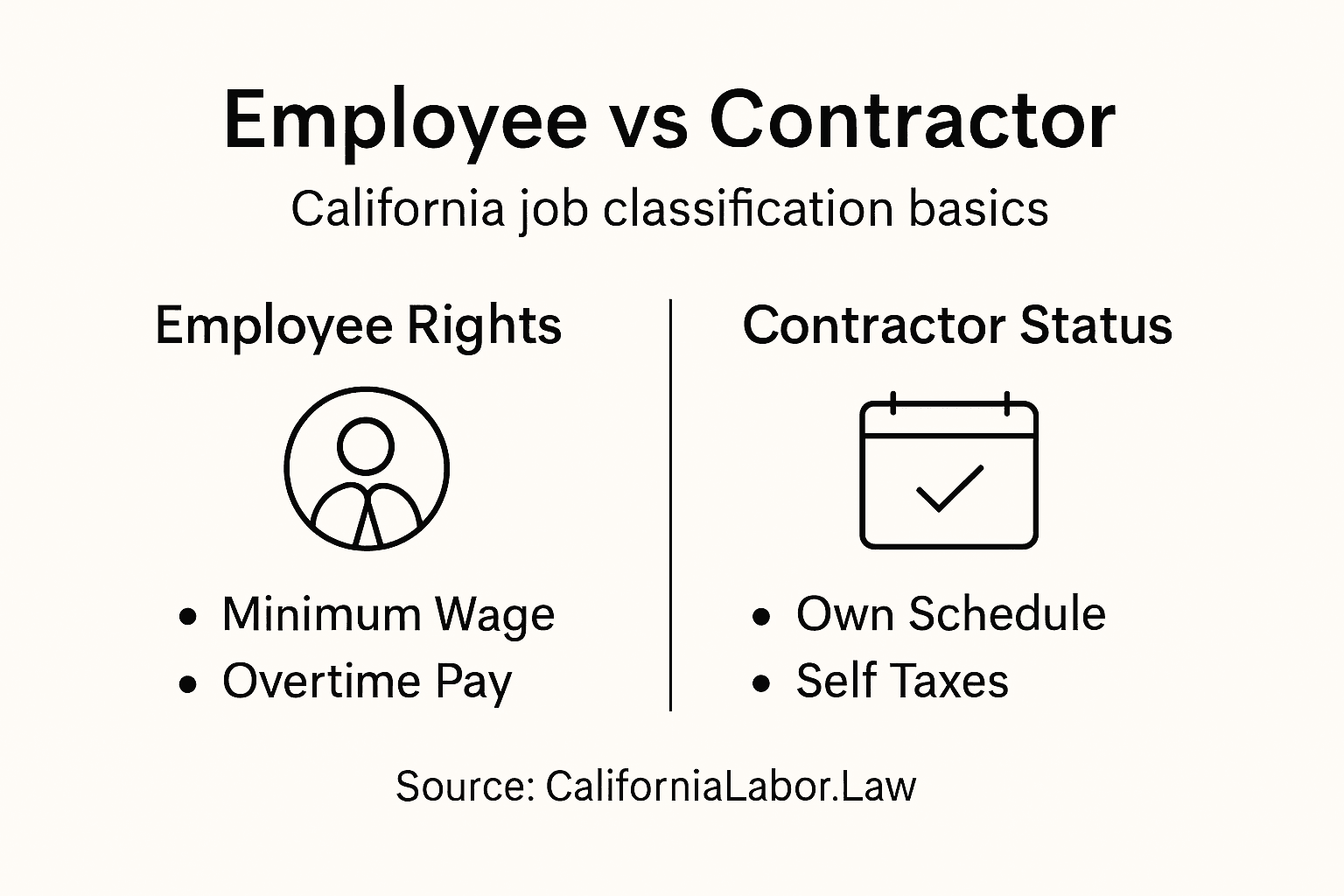
    Infographic comparing employee and contractor key points

    The ABC Test requires employers to prove three critical conditions simultaneously. First, the worker must be free from the company’s control and direction in performing work. Second, the worker must perform work outside the usual course of the hiring entity’s business.

    Third, the worker must be customarily engaged in an independently established trade, occupation, or business of the same nature as the work performed. These stringent requirements make it challenging for businesses to classify workers as independent contractors, effectively providing stronger protections for workers.

    Before the ABC Test, California utilized the Borello Test, a more flexible multifactor approach that considered various aspects of the working relationship.

    While the Borello Test remains applicable in certain situations, such as specific industry exceptions, the ABC Test has become the predominant method for worker classification.

    Factors examined under the Borello Test included the degree of control, whether the worker could work for multiple employers, who provided tools and equipment, the skill required, and the method of payment.

    Pro tip: Consult with a California employment lawyer to thoroughly review your specific work arrangement and understand the nuanced application of worker classification tests in your particular industry.

    Below is an overview of major worker classification tests used in California:

    Test Name Key Criteria Focus Where Applied
    ABC Test Control, business type, independence Most industries since 2020
    Borello Test Level of control, payment method Industry exemptions, select fields
    Prop 22 Test Work app platform status App-based gig economy workers

    Assembly Bill 5 (AB 5) fundamentally transformed worker classification in California, introducing stringent requirements that dramatically narrowed the definition of independent contractors. California’s landmark legislation effective January 1, 2020, codified the ABC test and created significant challenges for businesses relying on contract workers across multiple industries.

    The bill established three critical criteria for classifying workers as independent contractors. Employers must prove that workers are free from company control, perform work outside the company’s primary business, and are independently established in their trade.

    Numerous professional categories received specific exemptions, including:

    • doctors,
    • lawyers,
    • real estate agents,
    • architects,
    • and certain creative professionals.

    These exemptions acknowledged the unique nature of professional services that did not fit neatly into traditional employment models.

    In a subsequent legal development, California’s Supreme Court upheld Proposition 22, which specifically addressed gig economy workers. This ruling preserved app-based drivers’ ability to maintain independent contractor status, creating a nuanced exception to AB 5’s broad restrictions.

    The decision highlighted the ongoing tension between protecting worker rights and maintaining flexibility for emerging business models in the digital economy.

    Pro tip: Consult an employment law specialist to understand how AB 5 specifically applies to your industry and work arrangement, as exemptions and interpretations can be complex and evolving.

    Rights And Protections For Employees

    California provides comprehensive legal protections for employees that create a robust safety net far beyond the limited rights afforded to independent contractors.

    California labor standards ensure workers receive critical safeguards including minimum wage guarantees, overtime compensation, meal and rest breaks, and protection from workplace discrimination and harassment.

    Employee reviewing pay stub in law office setting

    Employees are entitled to a wide range of statutory benefits that independent contractors cannot access. These protections include:

    • mandatory workers’ compensation insurance,
    • unemployment benefits,
    • disability insurance,
    • and comprehensive anti-discrimination laws.

    Employers must provide a safe working environment, pay appropriate wages, and comply with state and federal regulations regarding workplace conditions. The legal framework also protects employees from retaliation when reporting workplace violations, ensuring workers can speak up without fear of losing their employment.

    The financial and legal advantages of employee status extend beyond immediate compensation. Employees receive consistent paycheck withholdings for social security and Medicare, access to employer-sponsored health insurance, retirement plans like 401(k) matching, and predictable work schedules.

    Independent contractors, by contrast, must manage their own tax obligations, healthcare costs, and retirement planning without employer support. These fundamental differences underscore the significant value of proper employee classification in protecting workers’ long-term economic stability.

    Pro tip: Document and track all workplace interactions, pay stubs, and employment agreements to protect your rights and create a clear record in case of potential disputes.

    Risks And Challenges For Independent Contractors

    Workplace challenges for independent contractors in California extend far beyond the immediate lack of traditional employment benefits, creating a complex landscape of financial and legal vulnerabilities. Independent contractors must navigate a significantly different professional environment that demands greater personal responsibility and financial risk management.

    Financial instability represents one of the most significant risks for independent contractors. Unlike employees, they bear complete responsibility for their tax obligations, including self-employment taxes that can reach up to 15.3% of their income.

    They must independently secure health insurance, retirement planning, and disability coverage without employer contributions. This financial burden means contractors often spend considerable time and resources managing administrative tasks that would typically be handled by an employer.

    Legal protections for independent contractors are markedly limited compared to traditional employees. They lack critical safeguards such as minimum wage guarantees, overtime compensation, unemployment insurance, and protection from workplace discrimination.

    Without formal employment status, contractors have fewer mechanisms to challenge unfair treatment or recover unpaid wages. Their contractual relationships rely primarily on negotiated agreements, which can be challenging to enforce and often favor the hiring entity.

    Pro tip: Maintain detailed financial records, negotiate comprehensive contracts with clear payment terms, and consider forming an LLC to provide additional personal liability protection.

    Understand Your Rights and Protect Your Work Status in California

    Navigating the complex distinctions between an independent contractor and an employee can feel overwhelming. The ABC Test, AB 5 legislation, and recent legal updates demand a clear understanding of your worker classification.

    Many California workers face challenges like wage theft, lack of benefits, and the risk of misclassification that threaten their financial stability and legal protections. If you are uncertain about your status or worried about unfair treatment, it is crucial to get informed and act confidently.

    At California Labor Law, we provide easy-to-understand legal guides, up-to-date labor law information, and practical tools that empower you to assert your rights under state statutes. Whether you need assistance determining if you qualify for employee protections, calculating owed wages, or seeking help against wrongful termination, our resources are here for you. Don’t wait until your rights have been violated.

    Visit California Labor Law now to explore your options, use our calculators, and connect with legal advocates ready to support your case. Take control today and safeguard your livelihood from misclassification and workplace injustices by calling 1-866-355-9991 to schedule a free employee classification consultation.

    Frequently Asked Questions

    What is the primary difference between an employee and an independent contractor in California?

    The primary difference lies in the level of control and independence. Employees work under supervision, receive regular wages and benefits, while independent contractors operate autonomously and manage their own taxes and work schedules.

    What is the ABC Test for classifying workers in California?

    The ABC Test is a legal framework that requires employers to prove three conditions for a worker to be classified as an independent contractor: the worker must be free from control, perform work outside the hiring entity’s business, and be engaged in an independently established trade.

    What are the rights and protections available to employees in California?

    Employees in California enjoy comprehensive protections, including minimum wage, overtime compensation, workplace safety, access to benefits like health insurance, and legal safeguards against discrimination and retaliation.

    What risks do independent contractors face compared to employees?

    Independent contractors face financial instability due to self-managed taxes and lack of benefits. They also have limited legal protections and fewer ways to address unfair treatment or recover unpaid wages.

  • California Employee Misclassification: Hidden Risks and How It Affects Workers

    California Employee Misclassification: Hidden Risks and How It Affects Workers

    The Risks of Employee Misclassification in California: Protecting Your Rights

    Most workers in California do not realize that a single error in how they are classified can cost them the right to minimum wage, overtime pay, and vital safety nets.

    Misclassification is not just a paperwork issue, it means losing protections many workers depend on every day.

    If you are unsure about your employee status, uncovering the truth could mean gaining access to rights and benefits that can directly impact your financial stability and workplace security.

    Misclassification of Employees in California Law

    Employee misclassification represents a serious legal issue where workers are improperly labeled as independent contractors instead of employees.

    In California, this practice is considered a form of wage fraud that systematically strips workers of critical legal protections and benefits.

    California law focuses intensely on the actual work performed, not just the contractual language used to define a worker’s status.

    Under California statutes, employers cannot simply declare a worker an independent contractor through paperwork. The state applies specific legal tests to determine a worker’s true employment classification, examining factors like control over work performance, integration into business operations, and economic dependency.

    Workers misclassified as independent contractors lose essential rights including minimum wage guarantees, overtime compensation, unemployment insurance, workers’ compensation coverage, and collective bargaining protections.

    Legal Consequences for misclassification can be severe. Businesses found deliberately misclassifying workers may face significant financial penalties, back wage requirements, and potential civil litigation.

    State enforcement agencies like the Bureau of Field Enforcement actively investigate and prosecute such violations, ensuring workers receive appropriate legal protections and compensation.

    Pro tip: If you suspect misclassification, document all work details, hours worked, and communication with your employer to build a strong potential legal case.

    Employee vs. Independent Contractor: Key Distinctions

    In California, the legal classification of workers is far more complex than a simple contract designation. California law applies rigorous criteria to determine worker status, focusing on the actual nature of the working relationship rather than just paperwork labels.

    The ABC test provides the primary framework for distinguishing between employees and independent contractors, placing a significant burden of proof on employers to demonstrate that a worker is truly an independent contractor.

    Under the ABC test, three critical conditions must be met for a worker to be classified as an independent contractor.

    First, the worker must be free from the company’s control and direction in performing work.

    Second, the work performed must be outside the usual course of the company’s business.

    Third, the worker must be independently established in the same type of work they are performing.

    Employees, in contrast, are typically integrated into the company’s core operations, receive regular wages, have taxes withheld, and are subject to direct supervision.

    Here’s a side-by-side summary of employee versus independent contractor status in California law:

    Aspect Employee Status Independent Contractor Status
    Tax Withholding Handled by employer Managed by worker
    Legal Protections Extensive; labor laws Limited; few safeguards
    Control Over Work Direct employer control Worker sets own methods
    Eligibility for Benefits Health, unemployment, workers’ comp Typically not eligible

    The consequences of misclassification can be substantial. Employers face significant legal and financial risks when incorrectly categorizing workers, including potential back wage payments, tax penalties, and civil litigation.

    Workers misclassified as independent contractors lose critical protections such as minimum wage guarantees, overtime compensation, unemployment insurance, workers’ compensation, and the right to join unions.

    This makes understanding the nuanced distinctions between employee and contractor status crucial for both workers and businesses operating in California.

    Infographic comparing employee and independent contractor roles

    Pro tip: Request a detailed written description of your work arrangement and compare it against the ABC test criteria to determine your potential employment classification.

    California Assembly Bill 5 (AB 5) transformed worker classification standards by establishing the ABC test as the primary legal mechanism for determining employee status.

    This landmark legislation shifted the burden of proof squarely onto employers, creating a presumption that workers are employees unless specific conditions are definitively met.

    The test requires employers to demonstrate three critical elements: the worker’s freedom from company control, performance of work outside the company’s core business operations, and active engagement in an independently established professional trade.

    The ABC test represents a fundamental shift in how California evaluates employment relationships. Under this framework, employers must satisfy all three prongs of the test to classify a worker as an independent contractor.

    The first prong examines the employer’s direct control over work performance, the second evaluates whether the work falls outside the company’s typical business model, and the third requires evidence that the worker operates an independently established business in the same domain.

    State labor authorities provide extensive guidance on interpreting and applying these complex legal standards, recognizing the nuanced nature of modern workplace relationships.

    While the ABC test provides a comprehensive framework, California law acknowledges that certain professional categories may require alternative classification approaches.

    Specific industries and professions can qualify for exemptions, potentially reverting to older multi-factor tests like the Borello test.

    These exceptions underscore the complexity of worker classification and highlight the importance of understanding industry-specific legal nuances.

    Employers who misclassify workers face significant financial penalties, including potential back wage payments, tax liabilities, and legal sanctions.

    Pro tip: Consult with an employment law specialist to thoroughly review your specific work arrangement and verify proper classification under California’s intricate legal standards.

    Rights and Protections Lost Through Misclassification

    Workers misclassified as independent contractors forfeit numerous critical legal protections that employees automatically receive under California labor laws.

    Workplace rights can be dramatically compromised by improper classification, creating substantial financial and professional vulnerabilities for workers who lack fundamental employment safeguards. These lost protections extend across multiple dimensions of workplace safety, compensation, and legal recourse.

    The most significant rights eliminated through misclassification include essential wage and hour protections. Independent contractors lose guaranteed minimum wage standards, overtime compensation, meal and rest break requirements, and protection against wage theft.

    They become ineligible for critical benefits such as health insurance, workers’ compensation, unemployment insurance, and disability coverage.

    Additionally, misclassified workers surrender important legal protections like protection from workplace discrimination, sexual harassment safeguards, and the right to collectively bargain or join unions.

    Beyond immediate financial implications, misclassification creates long-term professional risks. Workers classified as independent contractors bear full responsibility for tax withholdings, lack structured career advancement opportunities, and have minimal legal recourse in disputes with hiring entities.

    The financial burden of self-employment taxes, absence of employer-sponsored retirement plans, and increased personal liability can create significant economic instability.

    These systemic disadvantages disproportionately impact workers in vulnerable industries, transforming what appears to be flexible work into a precarious employment arrangement.

    The table below highlights which workplace rights are lost when a worker is misclassified in California:

    Lost Protection Impact on Worker Long-term Consequence
    Overtime Pay No extra compensation Lower annual income
    Unemployment Insurance Ineligible for support Financial instability after job loss
    Collective Bargaining Cannot join a union Weakened negotiating power
    Employer-sponsored Retirement No retirement plan access Higher retirement planning burden

    Pro tip: Document all work-related communications, hours worked, and job responsibilities to build evidence supporting your potential employee classification.

    Employer Liability and How Workers Can Take Action

    California’s labor regulations establish comprehensive employer liability for worker misclassification, creating multiple avenues for workers to seek justice and compensation. The state’s legal framework provides robust protections that enable employees to challenge improper classification without fear of retaliation.

    Workers retain critical rights to pursue claims regardless of their immigration status, ensuring a level playing field for all workers subjected to potential workplace violations.

    Employers face significant legal and financial consequences for misclassification. Potential penalties include substantial fines, mandatory back wage payments, and potential civil litigation.

    Workers can initiate action through several official channels, including filing complaints with the California Bureau of Field Enforcement, the Labor Commissioner’s Office, or through direct legal action.

    The state offers multilingual support and explicit protections against employer retaliation, empowering workers to assert their rights without risking their professional standing or future employment opportunities.

    The process of challenging misclassification involves gathering comprehensive documentation of work performance, hours, responsibilities, and communication with the employer.

    Workers should collect critical evidence such as:

    • work contracts,
    • communication records,
    • payment documentation,
    • and detailed accounts of job duties.

    An employment attorney can provide strategic guidance in navigating the complex legal landscape, helping workers understand their specific rights and the most effective approach to addressing potential misclassification.

    Collective actions may also be available for groups of workers experiencing systematic misclassification, multiplying the potential impact of legal challenges.

    Pro tip: Maintain a detailed, contemporaneous record of all work-related activities and communications to strengthen your potential legal claim.

    Protect Your Rights Against Employee Misclassification in California

    If you feel your work arrangement might not meet the strict legal standards under the ABC test or if you suspect wage theft due to improper classification, it is critical to understand your rights and act quickly.

    At California Labor Law, we provide trusted resources and clear guidance to help you identify if you have been misclassified. Our site offers detailed legal information, wage calculators, and direct access to advocates ready to assist you.

    Don’t let misclassification cost you what you deserve. Take the first step toward recovering unpaid wages and protecting your future by calling 1-866-355-9991 for a free California employee misclassification consultation.

    Frequently Asked Questions

    What is employee misclassification?

    Employee misclassification occurs when a worker is incorrectly labeled as an independent contractor rather than as an employee, stripping them of essential legal protections and benefits.

    What are the risks of being misclassified as an independent contractor?

    Workers misclassified as independent contractors lose key rights, such as minimum wage guarantees, overtime pay, unemployment insurance, workers’ compensation, and the ability to collectively bargain.

    How can I determine if I am misclassified as an independent contractor?

    To determine if you are misclassified, compare your work arrangement against the ABC test criteria, which assess your control over work, the nature of the work in relation to the business, and whether you operate an independently established trade.

    What should I do if I suspect I am misclassified?

    If you suspect misclassification, document your work details, hours, and communications with your employer. Consult with an employment law specialist for guidance on addressing your classification status.

  • Independent Contractor Rights in California

    Independent Contractor Rights in California

    California Independent Contractor Laws: Rights and Protections

    Up to 2.1 million workers in the United States face misclassification issues each year, making California’s strict laws around independent contractor status especially relevant.

    For both workers and employers, understanding these rules is vital because the difference impacts not only wages and job security but also access to legal protections.

    This article brings clarity to the confusing standards, offering guidance that helps every American navigate California’s tough approach to worker classification.

    Defining Independent Contractor Status in California

    Understanding independent contractor status in California requires navigating complex legal criteria that determine whether a worker is classified as an employee or an independent contractor.

    The state uses a stringent three-part test known as the ABC test to make this critical determination, which shifts the burden of proof to the hiring entity to demonstrate that a worker is truly an independent contractor.

    California’s approach to independent contractor classification is notably strict, prioritizing worker protections. The California Department of Industrial Relations emphasizes that workers are presumed to be employees unless the hiring entity can definitively prove all three conditions of the ABC test are met.

    These conditions require demonstrating that the worker:

    • Is free from the control and direction of the hiring entity
    • Performs work outside the usual course of the hiring entity’s business
    • Is customarily engaged in an independently established trade, occupation, or business

    The implications of this test are significant. Workers misclassified as independent contractors can lose critical protections like minimum wage guarantees, overtime pay, meal and rest breaks, and workers’ compensation coverage.

    California Labor and Workforce Development Agency provides comprehensive guidance on navigating these complex employment status regulations.

    Pro tip: Always request a written contract that explicitly outlines your work arrangement, specifying your independence, control over your work process, and the specific services you’ll provide to help establish your independent contractor status.

    Defining Independent Contractor Status in California

    California’s worker classification system represents a complex legal framework designed to protect workers and ensure fair employment practices. The state relies primarily on the ABC test, a rigorous method of determining whether a worker qualifies as an independent contractor or an employee.

    The California Department of Industrial Relations provides comprehensive guidelines that make worker misclassification challenging and legally consequential.

    The ABC test establishes three critical criteria that must be simultaneously satisfied for a worker to be considered an independent contractor:

    • Autonomy Test: The worker must be free from the hiring entity’s control and direction in performing work
    • Business Scope Test: The worker’s tasks must fall outside the usual course of the hiring entity’s business operations
    • Independent Business Test: The worker must be customarily engaged in an independently established trade or business similar to the work being performed

    The California Franchise Tax Board further emphasizes that these standards extend beyond simple contractual agreements, focusing on the actual working relationship’s substantive characteristics. Companies cannot circumvent these requirements through contractual language alone, as the practical implementation of the working relationship takes precedence.

    The legal implications of misclassification are substantial. Businesses found incorrectly categorizing workers can face significant financial penalties, including back taxes, retroactive benefits, and potential legal damages.

    Workers improperly classified as independent contractors may lose critical protections like minimum wage guarantees, overtime compensation, workers’ compensation, and unemployment insurance.

    Pro tip: Maintain comprehensive documentation of your working relationship, including contracts, scope of work, payment terms, and evidence of your independent business status to strengthen your classification argument.

    Distinct Rights Versus Employee Protections

    The landscape of worker rights in California presents a stark contrast between independent contractors and traditional employees, with significant legal and financial implications for both parties. The California Department of Industrial Relations emphasizes the critical differences in legal protections and benefits that separate these two worker classifications.

    Independent contractors fundamentally lack many standard workplace protections afforded to employees, including:

    • No guaranteed minimum wage requirements
    • No overtime compensation
    • No workers’ compensation coverage
    • No unemployment insurance benefits
    • No protection against workplace discrimination
    • No mandatory meal or rest breaks
    • No employer-sponsored health insurance
    • No paid sick leave or vacation time

    The California Labor and Workforce Development Agency highlights that these differences extend beyond immediate financial considerations.

    Independent contractors essentially operate as small business owners, assuming significantly more personal and financial risk compared to traditional employees. This means they are responsible for their own tax withholdings, business expenses, professional insurance, and retirement planning.

    The trade-off for these reduced protections includes greater flexibility and potential tax advantages. Independent contractors can often deduct business-related expenses, set their own schedules, work for multiple clients, and negotiate their compensation rates. However, these benefits come with increased personal responsibility and less job security.

    Pro tip: Carefully document all work agreements, negotiate clear contract terms, and consider consulting a tax professional to understand the full financial implications of independent contractor status.

    Understanding these distinctions is crucial for making informed career decisions. Workers must carefully evaluate their specific working conditions, potential risks, and long-term financial strategies when determining whether independent contractor status aligns with their professional goals and personal financial needs.

    Here’s a summary comparing independent contractors and employees in California:

    Aspect Independent Contractor Employee
    Work Schedule Control Sets own hours and project timeline Follows employer’s set schedule
    Tax Responsibilities Pays self-employment taxes and handles deductions Employer withholds and pays payroll taxes
    Access to Benefits No employer-provided benefits Eligible for employer-sponsored benefits
    Job Security Project-based or freelance work only Ongoing employment relationship
    Legal Protections Not covered by most labor laws Covered by wage, hour, and safety laws
    Business Expense Deductions May deduct qualifying business expenses Limited to unreimbursed employee expenses

    Wage Rights, Contract Terms, and Benefits

    Independent contractors in California face a unique set of challenges when it comes to wage rights and contractual protections.

    The California Department of Industrial Relations clearly outlines that these workers operate outside traditional employment frameworks, fundamentally altering their financial and legal landscape.

    The critical differences in wage rights for independent contractors include:

    • Complete responsibility for personal tax calculations and payments
    • No guaranteed hourly minimum wage
    • No mandatory overtime compensation
    • No automatic access to standard employment benefits
    • Personal liability for business expenses and equipment
    • Self-funded healthcare and retirement planning
    • No unemployment insurance eligibility
    • No workers’ compensation protection

    California Labor and Workforce Development Agency emphasizes that independent contractors must negotiate every aspect of their compensation and working conditions. This means crafting detailed contracts that explicitly outline payment terms, project scope, deliverables, and compensation structures becomes critically important.

    Successful independent contractors treat these agreements as comprehensive business contracts rather than traditional employment documents.

    The financial landscape for independent contractors demands sophisticated financial management. While they sacrifice standard employee protections, they gain significant tax advantages through business expense deductions, the ability to set competitive rates, and flexibility in choosing projects. However, these benefits come with increased personal risk and the requirement for meticulous financial planning.

    Pro tip: Always draft comprehensive written contracts that clearly define payment schedules, scope of work, termination conditions, and dispute resolution mechanisms to protect your professional interests.

    Independent Contractor Wage Rights, Contract Terms, and Benefits

    Worker misclassification represents a serious legal and financial risk for businesses operating in California. The California Department of Industrial Relations highlights the substantial consequences that can arise from incorrectly categorizing workers as independent contractors instead of employees.

    The potential risks and penalties for misclassification are extensive and can include:

    • Significant financial penalties and fines
    • Retroactive payment of unpaid wages and benefits
    • Mandatory payment of back taxes and social security contributions
    • Potential criminal charges for intentional misclassification
    • Mandatory compensation for denied employee benefits
    • Legal costs associated with defending against misclassification claims
    • Potential loss of business licenses
    • Substantial state and federal tax penalties

    California Labor and Workforce Development Agency emphasizes that workers have multiple legal avenues to challenge misclassification. Employees can file claims with state labor boards, pursue civil lawsuits, and seek retroactive compensation for denied benefits. The burden of proof typically falls on the employer to demonstrate that the worker truly meets the independent contractor criteria.

    The financial implications of misclassification can be devastating for businesses. Penalties can accumulate quickly, potentially resulting in hundreds of thousands of dollars in fines, back wages, and legal expenses. Small businesses are particularly vulnerable, as a single misclassification case can potentially bankrupt the entire organization.

    Pro tip: Maintain meticulous documentation of worker classifications, work agreements, and job descriptions to create a robust defense against potential misclassification claims.

    Understanding the legal landscape of worker classification is crucial for protecting both businesses and workers. Proactive compliance and careful evaluation of worker status can help prevent costly legal challenges and ensure fair treatment for all parties involved.

    To better understand the impact of misclassification, see this comparison of consequences for both workers and businesses:

    Consequence Impact on Worker Impact on Business
    Loss of Benefits No health insurance or paid leave Must pay retroactive benefits if found liable
    Wage Protections Cannot claim minimum wage or overtime Subject to wage and hour claims and penalties
    Tax Implications Responsible for full self-employment tax May owe back payroll taxes and penalties
    Legal Remedies Can file claims or lawsuits for misclassification Exposed to lawsuits, fines, and government investigations
    Business Viability Less financial predictability Fines may threaten continued operation

    Protect Your Independent Contractor Rights with Expert Guidance

    Navigating California’s stringent ABC test and understanding your worker classification can be overwhelming. If you suspect you are misclassified or want to ensure your status reflects your true work relationship, it is critical to know your rights and legal protections. Misclassification can lead to loss of essential benefits and leave you vulnerable to financial and legal risks.

    At California Labor Law, we provide clear legal guides, up-to-date resources, and tools designed to empower you to assert your independent contractor rights effectively.

    Protect Your Independent Contractor Rights with Expert Guidance

    Take control of your work status today. Call 1-866-355-9991 for a free California employment law consultation and explore how California laws apply to your situation by speaking with advocates ready to help you secure your rightful compensation and protections now.

    Frequently Asked Questions

    What is the ABC test for independent contractors in California?

    The ABC test is a three-part legal standard used in California to determine whether a worker is classified as an independent contractor or an employee. The test requires demonstrating that the worker is free from control by the hiring entity, performs work outside the usual course of the hiring entity’s business, and is engaged in an independently established trade or business.

    What rights do independent contractors have in California?

    Independent contractors in California do not have the same rights as employees, such as minimum wage guarantees, overtime pay, or workers’ compensation. However, they have the freedom to negotiate their terms of work, set their own hours, and are able to deduct business expenses from their taxes.

    What are the consequences of misclassification for workers?

    Workers misclassified as independent contractors may lose essential benefits such as minimum wage, overtime compensation, workers’ compensation, and unemployment insurance. They also may face difficulties in asserting their rights and receiving fair treatment under labor laws.

    How can independent contractors protect their rights in California?

    Independent contractors can protect their rights by maintaining comprehensive documentation of their work arrangements, negotiating clear and detailed contracts, and consulting with legal or tax professionals to understand the implications of their classification.