Category: Overtime

  • Overtime Pay in California: What Every Worker Should Know

    Overtime Pay in California: What Every Worker Should Know

    California Overtime Rules 2026: Rates, Exemptions & What You’re Owed

    Working extra hours at a California retail store or hospitality venue should come with reliable pay, but many employees face confusion over the rules.

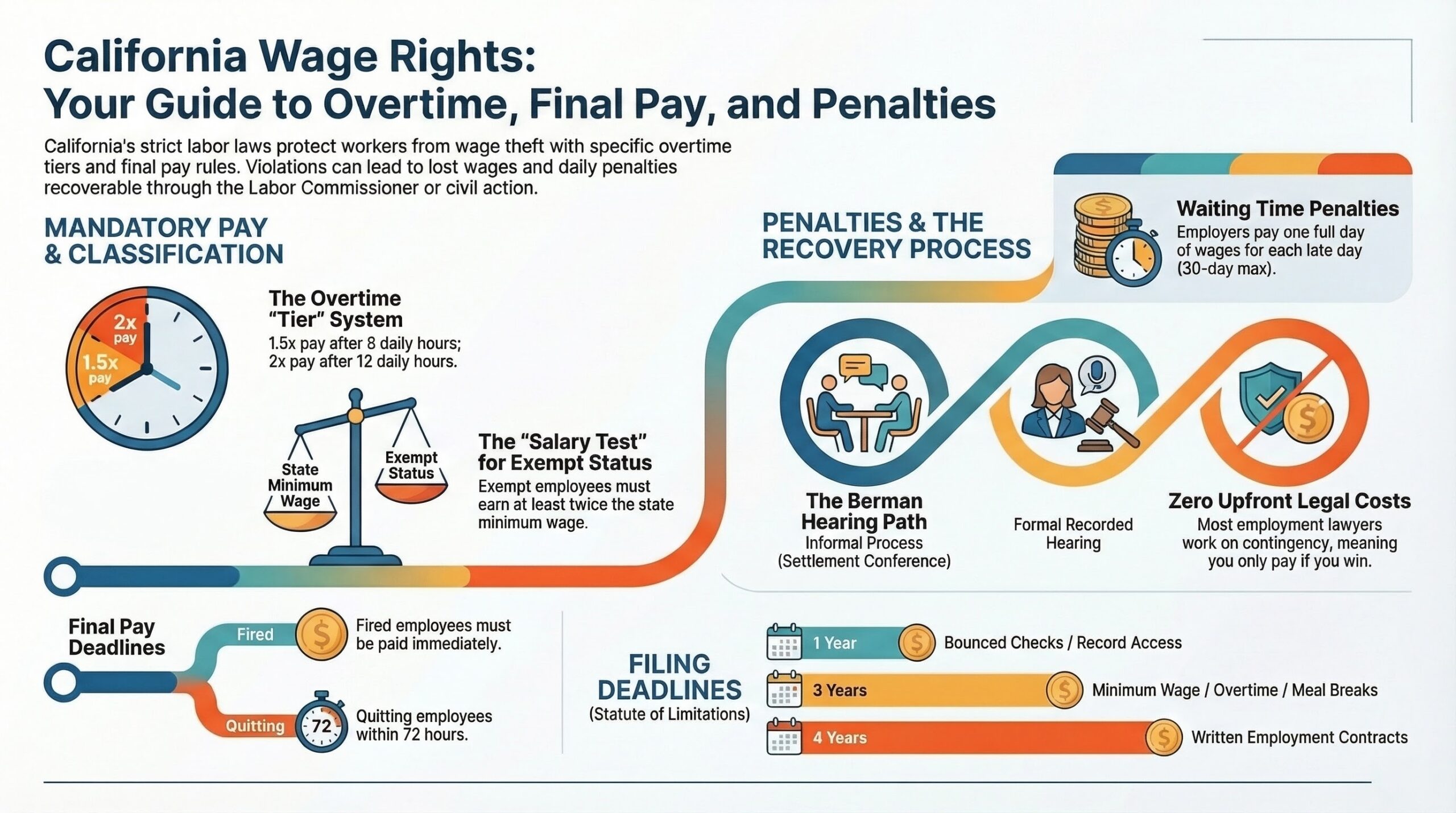
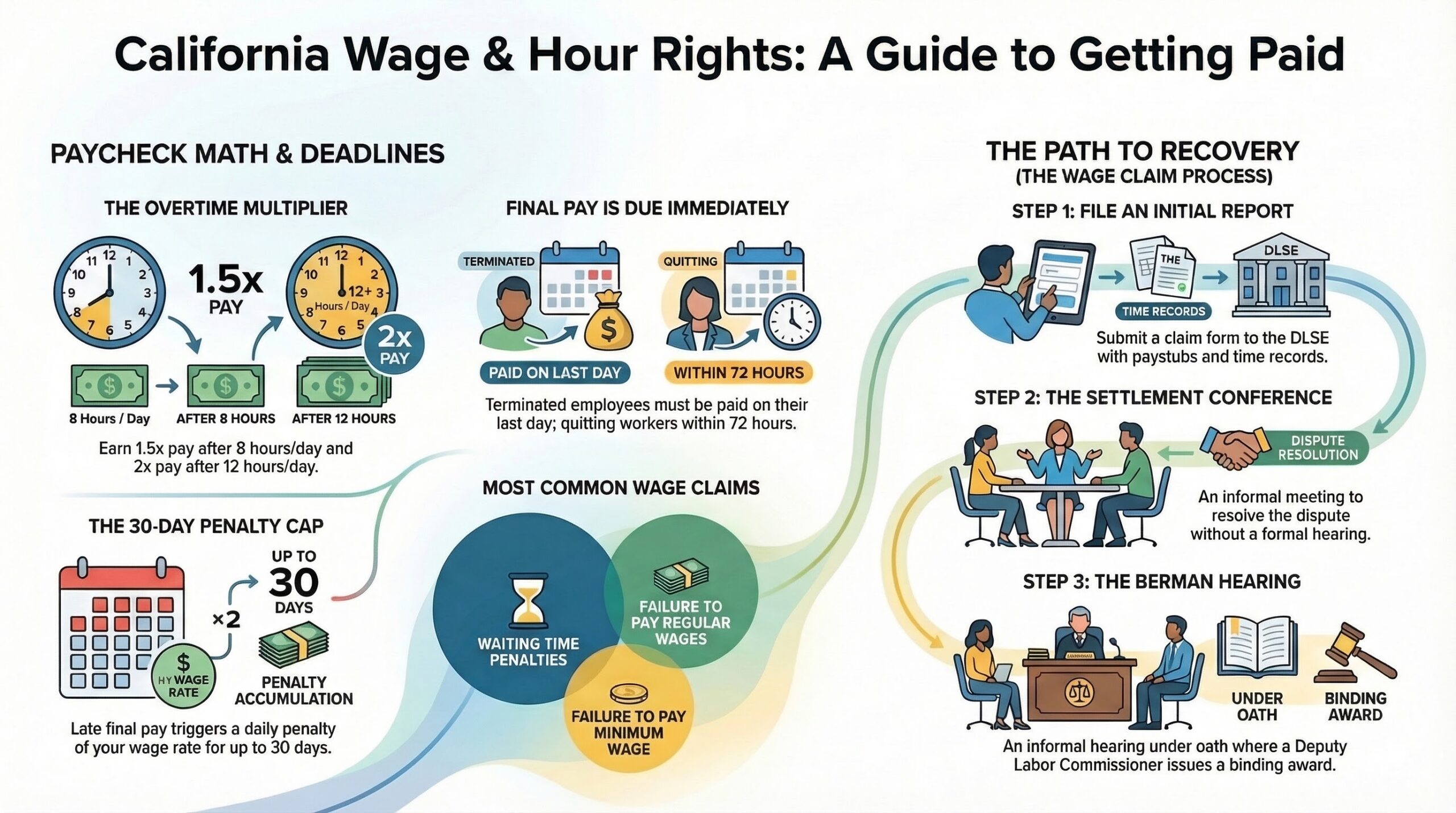
    California law requires most nonexempt workers to receive overtime pay for any hours beyond eight in a day or forty in a week, and double pay for shifts lasting over twelve hours.

    If paychecks do not reflect these hard-earned hours, understanding your correct rights and classifications can be the key to protecting your income.

    California Overtime Pay: Core Definitions

    Understanding overtime pay in California requires knowing precise legal definitions that protect workers’ rights. California Labor Code establishes clear guidelines for compensating employees beyond standard work hours, creating a robust framework for wage protection.

    At its core, California overtime law mandates specific compensation rates for nonexempt employees who work extended hours. The key overtime definitions include:

    • Regular Rate: Total compensation including base wage, commissions, and certain bonuses
    • Overtime Threshold: Hours worked beyond 8 per day or 40 per week
    • Overtime Rates:
      • 1.5x regular pay for hours worked over 8 in a single day
      • 1.5x regular pay for hours worked over 40 in a workweek
      • 2x regular pay for hours worked over 12 in a single day

    Important exemptions exist for certain professional categories, including executive, administrative, and professional employees who meet specific salary and job duty requirements. Overtime calculation rules can vary depending on an employee’s specific job classification and industry.

    Pro tip: Always track your hours meticulously and understand your specific employment classification to ensure you receive proper overtime compensation.

    Eligibility Rules for Overtime Pay

    Determining overtime pay eligibility is crucial for workers in California, as not all employees qualify for additional compensation. Employee classification rules create a complex framework that defines who receives overtime pay and under what circumstances.

    California’s overtime eligibility typically depends on several key factors:

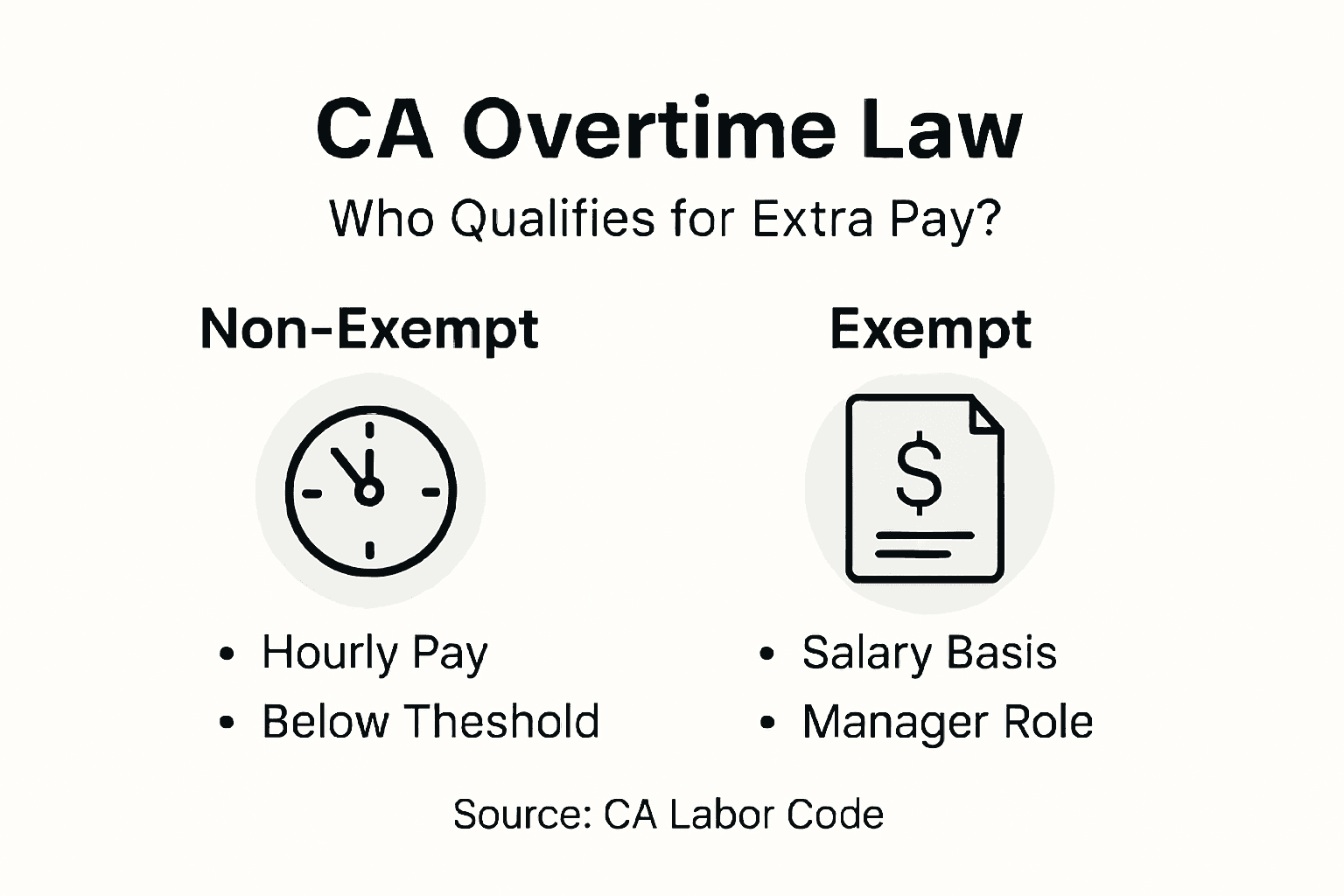
    • Wage Threshold: Employees must earn less than twice the state minimum wage
    • Job Classification: Nonexempt employees in most industries are eligible
    • Work Hours: Hours worked beyond 8 per day or 40 per week qualify for overtime

    Specific exemption categories include:

    1. Executive employees with significant management responsibilities
    2. Administrative professionals performing specialized office work
    3. Professional workers in specialized fields
    4. Computer professionals meeting specific salary requirements
    5. Outside salespersons with mobile work arrangements

    Unique rules apply to certain worker categories. Agricultural workers, domestic employees, and union members might have different overtime standards compared to standard industry workers.

    Independent contractors are typically not eligible for overtime pay, making proper job classification critical.

    Here’s a quick reference comparing common employee categories and their overtime eligibility in California:

    Employee Category Overtime Eligible Key Determining Factor
    Nonexempt Employees Yes Paid hourly or salary under threshold
    Executive Employees No, usually exempt Management duties, salary requirements
    Computer Professionals Sometimes exempt Salary plus specialized job duties
    Independent Contractors No Not classified as employees

    California’s overtime laws aim to protect workers by ensuring fair compensation for extended work hours.

    Pro tip: Carefully review your job classification and employment contract to understand your specific overtime eligibility and potential compensation.

    How Overtime Wages Are Calculated

    Calculating overtime wages in California involves a precise method that goes beyond simple hourly multiplication. Overtime calculation rules require employers to consider multiple components of an employee’s compensation when determining overtime pay.

    The basic overtime calculation relies on the employee’s regular rate of pay, which encompasses more than just standard hourly wages. This comprehensive rate includes:

    • Base hourly wage
    • Commissions
    • Piece-rate earnings
    • Non-discretionary bonuses
    • Other forms of compensation

    Overtime rates in California follow these specific multipliers:

    1. 1.5x regular rate for hours worked over 8 in a single day
    2. 1.5x regular rate for hours exceeding 40 in a workweek
    3. 2x regular rate for hours worked beyond 12 in a single day
    4. 2x regular rate for the eighth hour worked on a seventh consecutive workday

    Complex scenarios can arise with varied pay structures, particularly for employees with multiple compensation types. Workers with commission-based or variable earnings must have their regular rate calculated carefully to ensure accurate overtime compensation.

    Pro tip: Keep detailed records of all hours worked and different compensation types to ensure accurate overtime calculation and protect your wage rights.
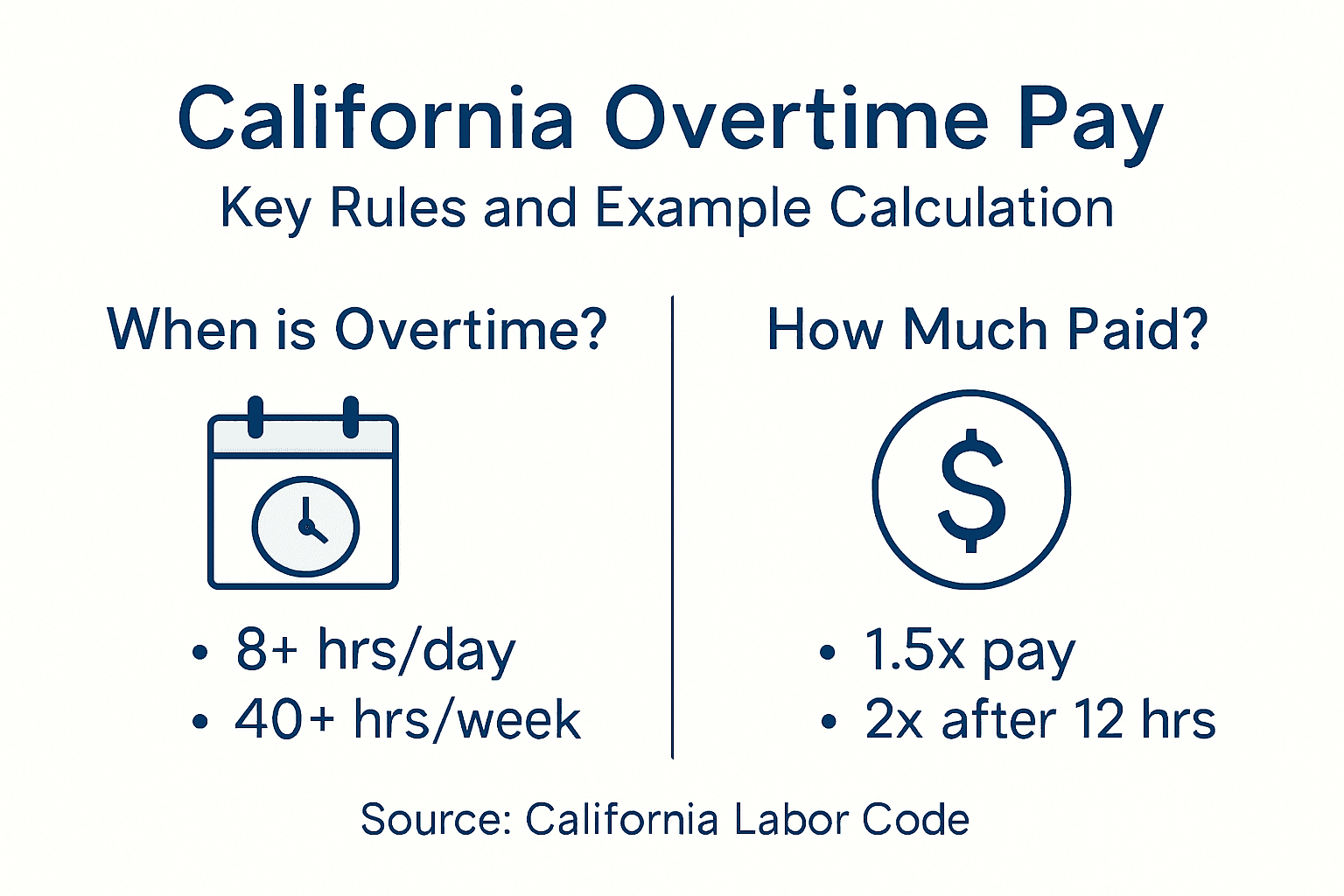
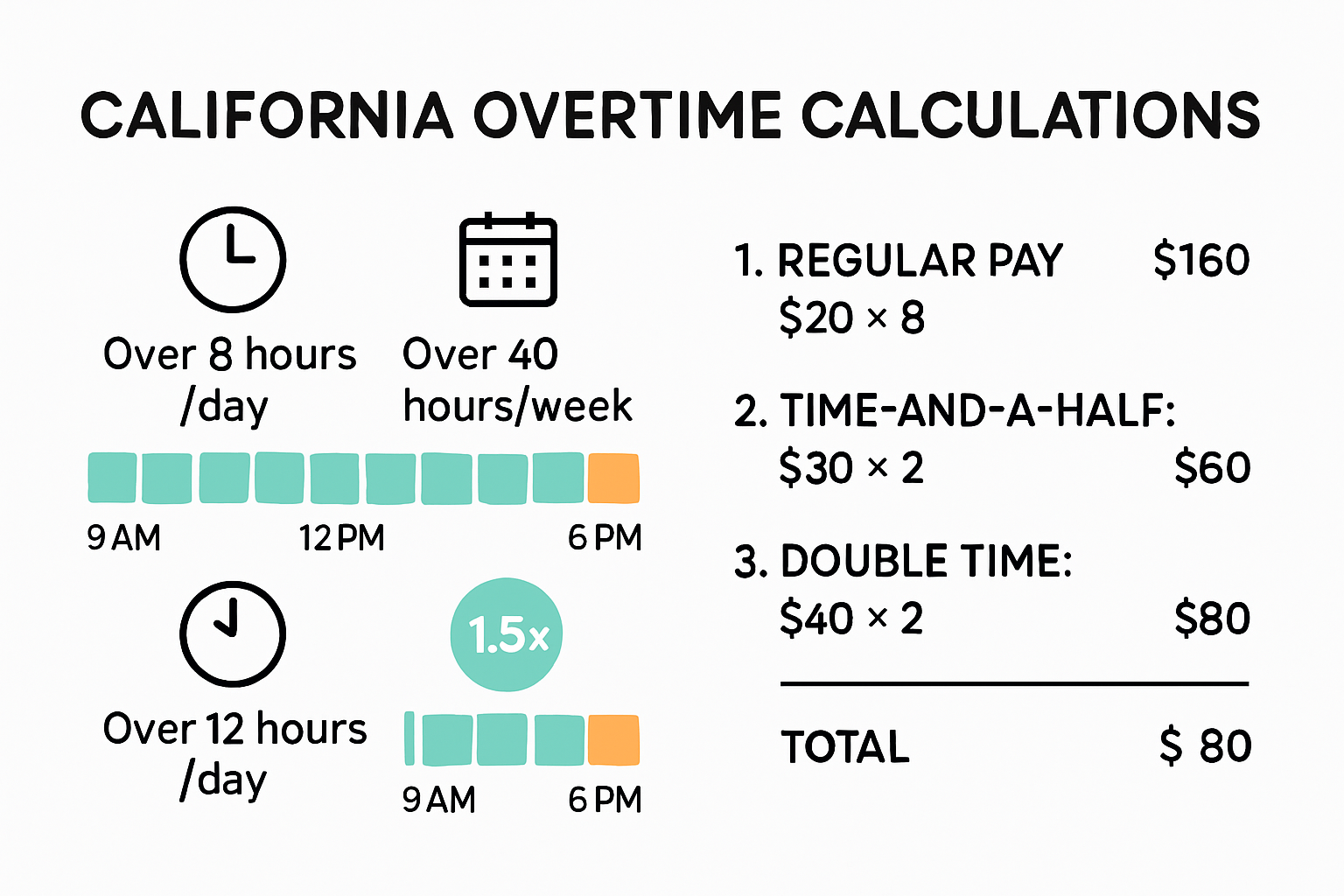
    Infographic with overtime pay rules and calculation example

    Understanding overtime exemptions in California requires careful examination of specific legal criteria. Exemption rules create a complex framework that determines which employees are not entitled to overtime compensation.

    The primary categories of overtime exemptions include:

    • Executive Employees: Those with significant management responsibilities
    • Administrative Professionals: Performing specialized office work
    • Professional Workers: Requiring advanced specialized knowledge
    • Computer Professionals: Meeting specific salary and job duty requirements
    • Outside Salespersons: With mobile work arrangements

    Key requirements for exempt status typically involve:

    1. Earning at least twice the state minimum wage
    2. Performing primarily intellectual or creative work
    3. Exercising independent judgment
    4. Spending more than 50% of work time on exempt duties

    Special considerations apply to unique worker categories. Agricultural workers, domestic employees, and union members often have different overtime standards. Some industries have specific exceptions that modify standard overtime rules, making it crucial for workers to understand their specific classification.

    Not all employees who receive a salary are automatically exempt from overtime pay.

    Pro tip: Carefully review your job description and actual job duties, as your official title may not always determine your overtime eligibility.

    Employer Responsibilities and Penalties

    Employers in California face substantial legal obligations when it comes to overtime compensation. Overtime compliance requirements create a strict framework of responsibilities that can result in significant financial consequences for violations.

    Key employer responsibilities include:

    • Accurately tracking employee work hours
    • Calculating overtime rates correctly
    • Maintaining comprehensive payroll records
    • Providing clear overtime pay on regular pay schedules
    • Compensating employees for all overtime worked

    Potential penalties for overtime violations can be severe and may include:

    1. Payment of back wages with interest
    2. Civil penalties up to $100 per pay period
    3. Additional damages equal to the unpaid overtime
    4. Potential criminal prosecution for repeated violations
    5. Legal costs and attorney fees

    The complexity of overtime regulations means employers must be vigilant. Small mistakes in record-keeping or payment calculations can quickly escalate into costly legal challenges. Workers have multiple avenues to report violations, including filing complaints with the California Labor Commissioner’s Office or pursuing private lawsuits.

    This table summarizes selected employer mistakes and the associated legal risks regarding overtime:

    Employer Mistake Possible Consequence Legal Risk Level
    Inaccurate hour tracking Back pay, penalties High
    Misclassifying employees Owed overtime, lawsuits High
    Late overtime payment Interest, extra damages Medium
    Incomplete payroll records Civil fines, compliance issues Medium to High

    Consistent and accurate overtime compliance is not optional – it’s a legal requirement.

    Pro tip: Implement robust time-tracking systems and regularly audit payroll practices to minimize the risk of unintentional overtime violations.

    Know Your Rights and Secure Every Overtime Dollar You Deserve

    California workers often face confusion and frustration when it comes to understanding overtime pay eligibility and proper calculation. If you have ever worried about whether your hours are tracked correctly or questioned if your job classification affects your overtime pay your concerns are valid.

    Misclassification and inaccurate pay calculations can lead to lost wages and missed opportunities to claim what you rightfully earned under California labor law.

    Explore our detailed guides and use our calculators to determine if your employer is meeting legal obligations. Don’t let improper overtime pay go unchecked take immediate action to protect your rights and claim the wages owed to you.

    Call 1-866-355-9991 now for a free overtime pay consultation and get connected to legal advocates ready to support your case. Your fair pay matters and now is the time to stand up for it.

    Frequently Asked Questions

    What is the overtime threshold in California?

    The overtime threshold in California is defined as hours worked beyond 8 hours in a single day or 40 hours in a workweek. Any hours over these limits are eligible for overtime pay.

    How is overtime pay calculated in California?

    Overtime pay in California is calculated by taking the employee’s regular rate of pay, which includes base wage, commissions, and certain bonuses, and multiplying it by 1.5 for hours worked over 8 hours in a day or 40 hours in a week. For hours worked over 12 in a day, the rate is doubled.

    Who is eligible for overtime pay in California?

    Eligibility for overtime pay in California generally applies to nonexempt employees who earn less than twice the state minimum wage, work in most industries, and work beyond 8 hours in a day or 40 hours in a week. Certain exemptions apply to executive, administrative, and professional employees.

    What are the penalties for employers who violate overtime pay laws?

    Employers who violate overtime pay laws may face severe penalties, including the payment of back wages with interest, civil penalties up to $100 per pay period, additional damages equal to unpaid overtime, and potential criminal prosecution for repeated violations.

  • Salary Overtime Law: Protecting California Workers

    Salary Overtime Law: Protecting California Workers

    California Overtime Pay Requirements: Protecting Salaried & Hourly Workers

    Working extra shifts at a California restaurant or retail store can quickly rack up long hours, yet understanding your rights to overtime compensation is often unclear. Wage theft remains a serious problem for many frontline workers, with complex rules and exemptions making fair pay harder to claim.

    This article breaks down the bold differences between state and federal protections, explores employee classifications, and shows you how to spot unpaid wages and take action for your earned overtime.

    Defining Salary Overtime Law in California

    Salary overtime law in California represents a critical framework designed to protect workers’ rights and ensure fair compensation for extended working hours. These regulations go beyond federal standards, providing more robust protections for employees across various industries. California overtime pay rules establish clear guidelines for how and when workers must receive additional compensation.

    Under California law, overtime compensation is mandated for nonexempt employees who work beyond specific hourly thresholds. The state requires employers to pay one and one-half times an employee’s regular rate of pay in these key scenarios:

    • More than 8 hours worked in a single workday
    • More than 40 hours worked in a single workweek
    • First 8 hours worked on the seventh consecutive day of work

    Moreover, employees are entitled to double time pay for:

    • Hours worked beyond 12 in a single day
    • Hours worked beyond 8 on the seventh consecutive day of work

    The complexity of overtime calculations extends beyond simple hourly rates. Regular rate of pay includes not just base wages, but also encompasses commissions, non-discretionary bonuses, and other forms of compensation. This comprehensive approach ensures workers receive fair remuneration for their entire earnings spectrum.

    Exemptions do exist within these regulations. Certain employees, such as executive, administrative, and professional workers who meet specific salary and duty requirements, may be exempt from overtime pay. Understanding these nuanced classifications is crucial for both employers and employees.

    Infographic explaining California overtime worker eligibility

    Eligibility Standards for Overtime Pay

    Determining overtime pay eligibility in California involves understanding a complex set of regulations that protect workers’ rights across various industries. Overtime eligibility rules distinguish between exempt and nonexempt employees, creating a nuanced framework for compensation.

    To qualify for overtime pay, workers must typically meet these fundamental criteria:

    • Be classified as a nonexempt employee
    • Work more than 8 hours in a single workday
    • Work more than 40 hours in a single workweek
    • Be 18 years or older (with some exceptions for minors)

    Certain employee categories are exempt from overtime regulations, including:

    • Executive employees with significant management responsibilities
    • Administrative professionals performing specialized office work
    • Professional employees with advanced educational backgrounds
    • Outside sales representatives
    • Some computer and technology professionals

    The exemption status depends on multiple factors, including:

    • Annual salary level
    • Specific job duties and responsibilities
    • Level of independent decision-making authority
    • Complexity of job functions

    California’s overtime laws provide more comprehensive worker protections than federal standards, ensuring fair compensation across diverse employment sectors.

    Salary thresholds play a critical role in determining overtime eligibility. Employees earning below a specific annual income are generally guaranteed overtime pay, regardless of their job responsibilities. These thresholds are periodically adjusted to reflect economic changes and cost of living increases.

    Worker checking pay statement at office desk

    Agricultural workers have unique considerations, with phased overtime requirements that have been gradually implemented since 2019. This reflects the state’s commitment to protecting workers in all industries, including those with traditionally lower wage structures.

    Pro tip: Carefully review your employment classification and maintain detailed work records to ensure you receive proper overtime compensation.

    Exempt vs. Non-Exempt Employee Distinctions

    Understanding the critical differences between exempt and non-exempt employees is essential for workers navigating California’s complex labor landscape. Employee classification rules establish fundamental distinctions that significantly impact wage and overtime entitlements.

    Key characteristics of exempt employees include:

    • Paid a fixed salary rather than hourly wages
    • Earn above a specific annual income threshold
    • Perform advanced professional, administrative, or executive duties
    • Exercise significant independent judgment
    • Not eligible for overtime compensation

    In contrast, non-exempt employees are characterized by:

    Here’s a summary comparing exempt and non-exempt employees in California:

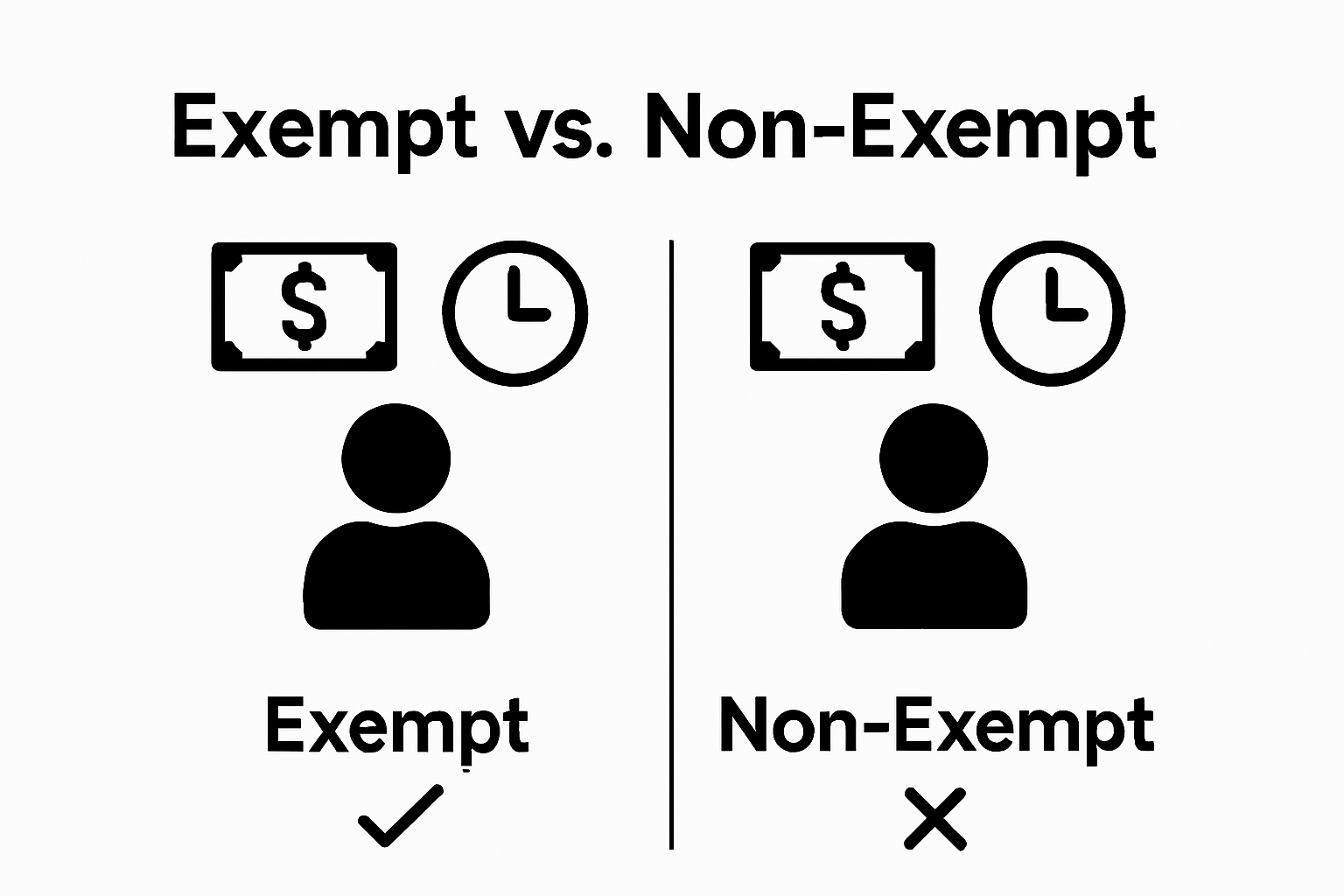
    Criteria Exempt Employees Non-Exempt Employees
    Pay Structure Salaried, fixed amount Hourly wage based
    Overtime Eligibility Not eligible for overtime Entitled to overtime pay
    Job Duties Advanced, specialized responsibilities Routine or standardized tasks
    Decision-Making Significant independence Limited authority
    Record-Keeping Required No mandatory tracking of hours Must log all work hours
    • Hourly wage compensation
    • Earnings below the established salary threshold
    • Limited decision-making authority
    • Entitled to overtime pay
    • Required to track and report hours worked

    California labor laws provide more stringent worker protections compared to federal standards, ensuring comprehensive employee classification guidelines.

    The determination of exempt status relies on three primary tests:

    1. Salary Basis Test: Must receive a predetermined, fixed salary
    2. Salary Level Test: Minimum annual earnings threshold
    3. Duties Test: Specific job responsibilities and decision-making capabilities

    Employers must carefully evaluate multiple factors when classifying workers, including job complexity, autonomy, and compensation structure. Misclassification can result in significant legal and financial consequences.

    Pro tip: Review your job description, compensation structure, and actual work responsibilities to verify your correct employment classification.

    Calculating Overtime Rates and Payments

    Navigating overtime compensation in California requires a nuanced understanding of complex wage calculation methods. Overtime payment regulations establish precise guidelines for determining an employee’s additional compensation beyond standard work hours.

    Overtime rates in California are structured as follows:

    Below is a quick reference for California overtime pay rates and when they apply:

    Overtime Scenario Pay Rate (Multiplier) When It Applies
    Standard daily overtime 1.5 × regular rate Over 8 hours in a workday
    Weekly overtime 1.5 × regular rate Over 40 hours in a workweek
    Seventh consecutive workday (first 8) 1.5 × regular rate First 8 hours on day seven in a workweek
    Daily double time 2 × regular rate Over 12 hours in a workday
    Seventh workday double time 2 × regular rate Over 8 hours on seventh consecutive workday
    • Regular Overtime: 1.5 times standard hourly rate
      • Hours worked over 8 in a single day
      • Hours worked over 40 in a single workweek
    • Double Time: 2 times standard hourly rate
      • Hours worked over 12 in a single day
      • Hours worked over 8 on the seventh consecutive workday

    The regular rate of pay includes multiple compensation components:

    • Base hourly wage
    • Salary
    • Commissions
    • Piece-rate earnings
    • Non-discretionary bonuses
    • Performance incentives

    California’s overtime calculations provide more comprehensive worker protections compared to federal minimum standards.

    Calculating overtime involves several critical steps:

    1. Determine the employee’s regular hourly rate
    2. Identify total hours worked beyond standard thresholds
    3. Multiply excess hours by appropriate overtime multiplier
    4. Add overtime compensation to standard wages

    Employers must maintain meticulous records and accurately track work hours to ensure proper compensation. Alternative workweek schedules can introduce additional complexity, requiring careful interpretation of labor regulations.

    Pro tip: Keep detailed personal work logs and pay stubs to verify your overtime calculations and detect potential wage discrepancies.

    Employer Liabilities and Common Violations

    Employers in California face significant legal risks when failing to comply with overtime regulations. Workplace wage violations can result in substantial financial penalties and potential legal action.

    Common overtime violation categories include:

    Misclassification of Employees

    • Incorrectly labeling workers as exempt
    • Denying legitimate overtime compensation
    • Avoiding proper wage calculations

    Record-Keeping Violations

    • Failing to maintain accurate time records
    • Manipulating employee work hour documentation
    • Inadequate tracking of overtime hours

    Compensation Violations

    • Underreporting total hours worked
    • Miscalculating overtime rates
    • Refusing to pay required overtime wages

    California labor laws impose strict requirements on employers to ensure workers receive fair compensation for extended work hours.

    Legal consequences for overtime violations can be extensive:

    1. Payment of back wages
    2. Liquidated damages
    3. Civil penalties
    4. Potential criminal prosecution
    5. Mandatory business corrections

    The Labor Commissioner’s Office actively investigates complaints and can impose significant financial sanctions against non-compliant employers. Workers have multiple avenues to report violations, including direct complaints, legal actions, and third-party investigations.

    Pro tip: Document every work hour meticulously and retain copies of pay stubs and time records to protect your wage rights.

    Take Control of Your Rights Under California Salary Overtime Law

    Navigating the complexities of overtime eligibility and correct compensation can feel overwhelming. If you are struggling with understanding whether your job classification is exempt or non-exempt, or if you suspect your employer is miscalculating your overtime pay, you are not alone.

    Many California workers face challenges like misclassification, improper wage calculations, and denied overtime wages despite working beyond legal limits.

    At California Labor Law, we empower you with clear, trustworthy information about your rights under the state’s salary overtime laws. From detailed legal guides and explanations about exemption criteria to tools that help calculate your owed wages, we provide the resources you need to protect yourself.

    Don’t wait to claim the compensation you deserve. Call 1-866-355-9991 now for a free overtime pay consultation to understand your true eligibility for overtime pay and learn how to take action.

    Frequently Asked Questions

    What are the key overtime pay requirements in California?

    In California, employers must pay one and one-half times an employee’s regular rate of pay for working more than 8 hours in a single workday, more than 40 hours in a single workweek, and for the first 8 hours worked on the seventh consecutive day of work.

    Who is eligible for overtime pay in California?

    To qualify for overtime pay in California, workers must be classified as nonexempt employees, work more than 8 hours in a workday or 40 hours in a workweek, and be 18 years or older, with some exceptions for minors.

    What distinguishes exempt employees from non-exempt employees?

    Exempt employees are paid a fixed salary and perform advanced professional, administrative, or executive duties, making them ineligible for overtime pay. Non-exempt employees are typically paid hourly, earn less than the salary threshold, and are entitled to overtime pay.

    How is overtime pay calculated in California?

    Overtime pay in California is calculated by multiplying the employee’s regular hourly rate by 1.5 for standard overtime (over 8 hours in a day or 40 hours in a week) and by 2 for double time (over 12 hours in a day or over 8 hours on the seventh consecutive workday).

  • FLSA Overtime Employee Rights in California

    FLSA Overtime Employee Rights in California

    California Overtime Pay Rules: Your Rights Under the FLSA and California Law

    Working extra hours without proper pay is a reality for thousands of hourly employees, especially in California retail and service jobs. With overtime violations so common, many workers miss out on compensation the law guarantees.

    Understanding the Fair Labor Standards Act and how California laws provide even greater overtime protection helps you spot wage theft early and learn the steps to get the pay you deserve.

    What Is Fair Labor Standards Act Overtime?

    The Fair Labor Standards Act (FLSA) establishes crucial overtime regulations that protect workers across the United States, including employees in California. At its core, the FLSA mandates that eligible employees receive additional compensation when they work more than 40 hours in a single workweek.

    Overtime provisions require employers to pay workers at least one and a half times their standard hourly rate for any hours worked beyond the standard 40-hour threshold.

    Under the FLSA, overtime calculations are based on a specific workweek definition, which is a fixed and recurring period of 168 hours (seven consecutive 24-hour periods). This means overtime is not automatically triggered by working on weekends or holidays, but specifically when an employee exceeds 40 hours within their designated workweek. The Act applies to most hourly workers and some salaried employees, though certain job classifications and industries may have specific exemptions from these overtime requirements.

    California workers should understand that while the FLSA provides a federal baseline for overtime pay, the state often has additional protections that can be more generous to employees. For instance, California law requires overtime pay for work beyond 8 hours in a single day, which provides more comprehensive coverage than the federal standard. Employers must comply with whichever law (federal or state) provides the greatest benefit to the employee.

    Pro tip: Keep detailed records of all hours worked, including any overtime, to ensure you can accurately verify your compensation and protect your wage rights.

    California vs. Federal Overtime Regulations

    California has established some of the most worker-friendly overtime regulations in the United States, significantly expanding upon the federal Fair Labor Standards Act (FLSA) protections.

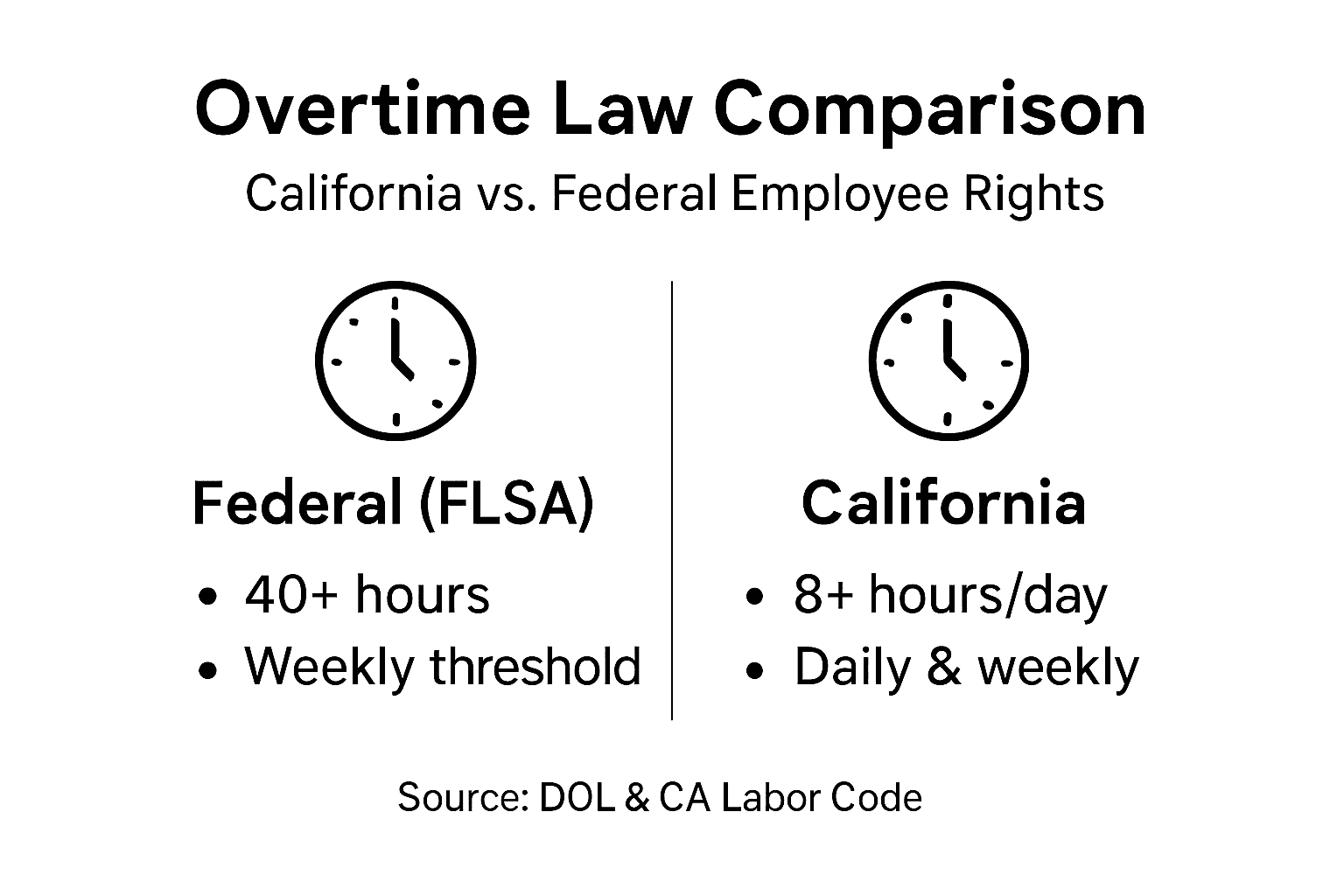
    Overtime laws in California go far beyond federal requirements, providing more comprehensive compensation for workers across various industries. While the federal standard only mandates overtime pay for hours worked beyond 40 in a workweek, California requires overtime compensation for hours worked beyond 8 in a single day.

    The key differences between federal and California overtime regulations are substantial. Under federal FLSA guidelines, employees receive one and a half times their regular pay rate for hours exceeding 40 in a workweek. California, however, introduces additional protections: workers earn overtime for daily hours over 8, with double time for hours worked beyond 12 in a single day. This means California workers can potentially earn significantly more overtime compensation compared to the federal baseline, especially during extended work shifts or consecutive workdays.

    Employers operating in California must carefully navigate these complex regulations. When federal and state laws differ, employers are legally required to follow the standard that provides the greatest benefit to employees. This typically means applying California’s more stringent overtime rules, which offer more robust worker protections. Specific industries and job classifications may have unique exemptions, making it crucial for both employers and employees to understand the nuanced differences between federal and state overtime regulations.

    Pro tip: Always document your work hours meticulously and understand your specific industry’s overtime classifications to ensure you receive proper compensation.

    Infographic comparison overtime laws California vs federal

    Here’s a side-by-side comparison of federal and California overtime rules:

    Aspect Federal (FLSA) Requirement California State Requirement
    Overtime Weekly Trigger Over 40 hours in a workweek Over 40 hours in a workweek
    Overtime Daily Trigger No daily overtime Over 8 hours in a single day
    Double Time Provision Not required Over 12 hours in a day, or 7th day in week
    Exemptions Broader, based on job duties/salary More limited, stricter job duty standards
    Rate for Overtime Hours 1.5× regular hourly rate 1.5× after 8 hrs, 2× after 12 hrs/day

    Eligibility and Exemption from Overtime Pay

    Understanding overtime eligibility is crucial for California workers seeking fair compensation. Overtime exemption rules are complex, with specific criteria determining whether an employee qualifies for additional pay. Most employees are eligible for overtime, but certain job classifications are exempt based on salary level, job duties, and specific industry standards. The primary categories of exempt employees typically include executive, administrative, professional, outside sales, and some computer professionals.

    To qualify for an overtime exemption, employees must meet stringent tests beyond their job title. The key requirements include receiving a predetermined salary above a specific threshold and performing primarily executive, administrative, or professional duties that require independent judgment.

    For instance, a manager must not only have a supervisory title but also spend a majority of their time making significant company decisions and directly managing other employees. Commissioned sales representatives and certain specialized technology workers may also fall under exemption categories, provided they meet specific salary and responsibility criteria.

    California employers must carefully navigate these intricate regulations, as misclassifying employees can result in significant legal and financial penalties. The state often applies more stringent standards than federal guidelines, meaning an employee might be nonexempt under California law even if they appear exempt under federal regulations.

    Factors such as the nature of work, level of independent decision-making, and specific job responsibilities play critical roles in determining overtime eligibility. Workers who believe they have been improperly classified should document their job duties and consult with employment law professionals.

    Pro tip: Review your job description carefully and track your actual daily responsibilities to determine whether you might have been incorrectly classified as exempt from overtime pay.

    How Overtime Is Calculated in California

    California’s overtime calculation rules are significantly more complex and employee-friendly compared to federal standards. California overtime laws establish a comprehensive framework that protects workers by mandating premium pay rates for extended work hours. Unlike the federal standard which only requires overtime after 40 hours in a workweek, California requires overtime compensation for hours worked beyond 8 in a single day and calculates overtime on both daily and weekly work periods.

    Clerk calculating California overtime on timesheet

    The specific overtime calculation methods in California involve multiple rate tiers. Employees receive 1.5 times their regular hourly rate for hours worked beyond 8 in a day or 40 in a week. In more demanding work scenarios, workers are entitled to double their regular rate for hours exceeding 12 in a single day or for work performed on the seventh consecutive day of a workweek. This means an employee working a 10-hour shift would receive their standard rate for the first 8 hours, 1.5 times their rate for the next 2 hours, and double their rate for the final hour.

    Employers must carefully track and calculate these nuanced overtime provisions, considering both daily and weekly thresholds. The calculations require precise record-keeping of actual hours worked, including start and end times for each shift.

    Factors such as meal breaks, rest periods, and total hours in a workweek can significantly impact overtime calculations. Workers should maintain their own detailed time records to verify that employers are correctly applying California’s stringent overtime regulations, which often provide more substantial compensation than federal guidelines.

    Pro tip: Maintain a personal log of your daily work hours, including start and end times, to cross-reference against your paycheck and ensure accurate overtime calculations.

    Common Overtime Violations and Worker Rights

    Overtime violations remain a persistent problem for California workers, with employers frequently attempting to circumvent fair compensation regulations. Labor law enforcement reveals several critical patterns of wage theft that employees should vigilantly watch for. The most common violations include misclassifying employees as exempt to avoid overtime payments, failing to compensate for all hours worked, and deliberately undercalculating overtime rates.

    Employees face numerous specific overtime violation scenarios that compromise their wage rights. These include managers pressuring workers to work off the clock, deliberately manipulating time records, refusing to pay overtime rates for work performed beyond standard hours, and incorrectly classifying workers as independent contractors to sidestep overtime requirements. Some employers strategically create policies that discourage workers from reporting overtime hours or create complex scheduling systems designed to obscure actual worked time.

    California provides robust legal protections for workers facing overtime violations. Employees have the right to file complaints with the Labor Commissioner’s Office, seek wage recovery for unpaid overtime, and pursue legal action against employers who violate overtime regulations.

    The state’s laws are intentionally structured to protect workers, allowing recovery of unpaid wages, penalties, and potential additional compensation for willful violations. Workers should document all work hours meticulously, understand their classification, and be prepared to assert their legal rights when confronted with potential overtime violations.

    Pro tip: Photograph or digitally screenshot your work time records and keep a contemporaneous personal log of all hours worked to provide concrete evidence if you need to challenge overtime violations.

    Seeking Help for Unpaid Overtime Issues

    Workers confronting unpaid overtime face multiple avenues for seeking justice and recovering lost wages. Workers’ rights resources provide comprehensive guidance for employees navigating wage theft complaints. The California Labor Commissioner’s Office offers a structured process for filing wage claims, with multilingual support to ensure accessibility for diverse worker populations. Employees can initiate formal complaints detailing specific instances of unpaid overtime, including documentation of hours worked and compensation records.

    The legal recourse for unpaid overtime involves several strategic steps. Workers can file administrative wage claims directly with the Labor Commissioner’s Office, which investigates wage violations and can order employers to pay owed compensation.

    Alternatively, employees may choose to pursue civil lawsuits, potentially recovering not just unpaid wages but also additional penalties and legal costs. Some workers opt to seek assistance from employment law attorneys who specialize in wage and hour disputes, providing expert guidance through complex legal proceedings.

    Documentation serves as the critical foundation for successful overtime claims. Workers should meticulously preserve time sheets, pay stubs, work schedules, email communications, and any other evidence demonstrating hours worked and compensation discrepancies.

    Legal aid organizations and worker advocacy groups can provide free consultations and guidance, helping employees understand their rights and the most effective strategies for recovering unpaid overtime. The law protects workers from employer retaliation, ensuring that employees can assert their wage rights without fear of professional consequences.

    Pro tip: Create a comprehensive digital and physical file containing all employment documentation, including time records, pay stubs, and correspondence, to strengthen your potential overtime claim.

    The table below summarizes key steps to address unpaid overtime issues:

    Action Step Purpose Recommended Documentation
    Track all work hours Ensure accurate overtime claim Time sheets, logs, clock records
    Preserve payment records Prove underpayment or wage theft Pay stubs, direct deposit statements
    File complaint with Labor Office Start official recovery process Complaint form, supporting evidence
    Seek legal advice Navigate complex disputes Consultation notes, legal letters

    Protect Your Right to Fair Overtime Pay in California

    Navigating the complex landscape of Fair Labor Standards Act overtime rules alongside California’s stricter state regulations can be overwhelming. If you’ve experienced unpaid or miscalculated overtime, been misclassified as exempt, or just want to understand your rights better, you are not alone. The pain of working extra hours without fair compensation is a reality for many California workers, but you do not have to accept it silently.

    At California Labor Law, we provide clear, trusted guidance on your overtime rights under both federal and California laws. Our free legal resources help you track your hours properly, recognize potential violations, and empower you to take confident action.

    Don’t wait until your wage loss grows. Learn how to use overtime pay rules to your advantage and get direct access to legal support tailored specifically for California employees. Protect what you have earned today by calling 1-866-355-9991 to schedule a free overtime pay consultation and start asserting your rights now.

    Frequently Asked Questions

    What is the Fair Labor Standards Act (FLSA) overtime rule?

    The FLSA mandates that eligible employees receive overtime pay of at least one and a half times their regular hourly rate for any hours worked over 40 in a single workweek.

    How does California’s overtime law differ from federal law?

    California law requires overtime pay for hours worked beyond 8 in a single day, in addition to the federal requirement of overtime for hours over 40 in a week, making it more beneficial for workers.

    Who is exempt from overtime pay under California law?

    Exempt employees typically include those in executive, administrative, professional roles, and some outside sales positions. They must meet specific salary thresholds and job duties to qualify for exemption.

    How is overtime calculated in California?

    Overtime in California is calculated at 1.5 times the regular pay rate for hours worked over 8 in a day or 40 in a week, and workers receive double time for hours exceeding 12 in a day or for working the seventh consecutive day.

  • Understanding Overtime for Salaried Employees: Key Insights

    Understanding Overtime for Salaried Employees: Key Insights

    Can Salaried Employees Get Overtime?

    Overtime pay is usually seen as a perk only for hourly workers, but salaried employees in the US still rack up thousands of extra work hours every year. Turns out, the lines are much blurrier than people think. Federal law says millions of salaried workers are actually eligible for overtime, depending on their job duties and salary level. Most people miss out simply because they do not know the rules.

    What Is Overtime for Salaried Employees?

    Overtime for salaried employees represents additional compensation paid for work performed beyond standard working hours. Unlike hourly workers who automatically receive overtime, salaried employees navigate a more complex compensation landscape governed by specific legal regulations. Understanding overtime rules requires examining multiple factors that determine whether an employee qualifies for extra wages.

    Defining Overtime for Salary Workers

    At its core, overtime refers to compensation for hours worked beyond a standard 40-hour workweek. For salaried employees, this definition becomes nuanced based on their job classification and exemption status. The Fair Labor Standards Act (FLSA) establishes critical guidelines determining which salaried workers receive overtime pay.

    According to the U.S. Department of Labor, overtime eligibility depends on several key factors:

    • Employee’s salary level
    • Job responsibilities and duties
    • Specific industry regulations
    • Exemption status under federal labor laws

    Exemption and Compensation Rules

    Not all salaried employees qualify for overtime compensation. The Department of Labor classifies certain employees as “exempt” based on their job duties, salary level, and professional responsibilities. Exempt employees typically include:

    • Executive managers with significant supervisory responsibilities
    • Professional workers requiring advanced degrees
    • Administrative personnel performing specialized, non-manual work
    • Outside sales representatives
    • Certain computer and technology professionals

    These exempt employees do not receive additional compensation for hours worked beyond 40 per week.

    The following table summarizes the key differences between exempt and non-exempt salaried employees as discussed in the article.

    Employee Type Overtime Eligibility Typical Roles/Examples Basis for Classification
    Exempt Not entitled to overtime pay Executive managers, professionals, Salary level, job duties, exemption status
    administrative staff, outside sales, under federal and state labor laws
    certain computer professionals
    Non-Exempt Entitled to overtime pay Salaried workers not meeting exemption Do not meet exemption criteria
    (1.5x or 2x regular rate for hours threshold, general salaried employees
    over set limits)

    Infographic comparing exempt vs. non-exempt salaried employees and overtime eligibility For non-exempt salaried workers, employers must calculate overtime pay at one and a half times their regular hourly rate for extra hours worked.


    Why Overtime Matters for Salaried Workers

    Overtime compensation represents more than just additional financial recognition for salaried workers. It serves as a critical mechanism protecting employee rights, ensuring fair labor practices, and maintaining healthy workplace boundaries. Exploring wage protection strategies reveals the complex dynamics between employee contributions and appropriate compensation.

    Financial and Professional Implications

    For salaried employees, overtime matters significantly because it directly impacts their economic well-being and professional respect. When workers consistently perform beyond standard work hours without proper compensation, they effectively subsidize their employer’s operational costs. According to research from the National Institutes of Health, excessive work hours correlate with several critical workplace challenges:

    • Increased employee stress levels
    • Higher risk of burnout
    • Reduced overall job satisfaction
    • Potential negative health outcomes
    • Decreased long-term productivity

    Protecting Worker Rights and Workplace Equity

    Overtime regulations function as a fundamental safeguard against labor exploitation. By establishing clear guidelines for compensation beyond standard work hours, these rules prevent employers from demanding unreasonable work commitments without appropriate financial recognition. Key protections include preventing unpaid extended work hours, ensuring fair compensation for additional labor, and maintaining transparent employment standards.

    For salaried workers, understanding and advocating for proper overtime compensation represents an essential aspect of professional self-advocacy. While not all salaried positions qualify for overtime, those that do provide critical financial protections that acknowledge the true value of an employee’s time and contributions.

    How Overtime Regulations Work in California

    California overtime regulations represent some of the most comprehensive worker protection laws in the United States, offering robust safeguards beyond federal standards. Learn precise overtime calculation methods to understand how these critical protections function for employees across various industries.

    California Overtime Calculation Rules

    Under California law, overtime compensation is calculated differently compared to federal guidelines. The state mandates overtime pay not just for hours worked beyond 40 per week, but also for daily work exceeding specific thresholds. According to the California Department of Industrial Relations, employees are entitled to overtime compensation under two primary scenarios:

    • One and a half times the regular rate for hours worked beyond 8 in a single workday
    • One and a half times the regular rate for the first 8 hours worked on the seventh consecutive day of work in a workweek
    • Double the regular rate for hours worked beyond 12 in a single workday
    • Double the regular rate for hours worked beyond 8 on the seventh consecutive day of work

    Exemptions and Special Considerations

    While California provides extensive overtime protections, certain employee classifications remain exempt from these regulations. Exempt employees typically include executive, administrative, and professional workers who meet specific salary and job duty requirements. These exemptions depend on multiple factors:

    • Employee’s monthly salary
    • Primary job responsibilities
    • Level of independent decision making
    • Professional skill requirements

    Employers must carefully evaluate each position to determine overtime eligibility, ensuring compliance with both state and federal labor regulations. Workers who believe their overtime rights have been violated can seek legal recourse through state labor board complaints or civil litigation.

    This table outlines the major differences between federal and California overtime regulations as they apply to salaried employees.

    Regulation Area Federal Law (FLSA) California Law
    Standard Workweek 40 hours per week 8 hours per day / 40 hours per week
    Overtime Rate 1.5x regular hourly rate for hours > 40/week 1.5x for >8/day or >40/week; 2x for >12/day
    Seventh Workday Not specifically addressed 1.5x for first 8 hours, 2x after 8 hours
    Exemptions Based on FLSA salary and duty tests Based on state salary/duties, sometimes stricter
    Worker Protection Meets federal minimum standards Offers broader coverage and greater employee rights

    California overtime discussion office

    Key Concepts Surrounding Overtime for Salaried Employees

    Understanding overtime for salaried employees requires navigating complex legal and professional frameworks that define compensation beyond standard working hours. Explore comprehensive overtime compensation strategies to gain deeper insight into these nuanced workplace regulations.

    Fundamental Overtime Definitions

    Overtime compensation represents more than simple monetary calculation. According to the U.S. Department of Labor, key concepts include differentiating between exempt and non-exempt employee classifications, which fundamentally determine overtime eligibility. Critical distinctions emerge through several core principles:

    • Salary threshold determining overtime qualification
    • Job responsibility classifications
    • Professional role complexity
    • Level of independent decision making authority
    • Specific industry regulatory requirements

    Compensation Calculation Frameworks

    Salaried employee overtime calculations involve multiple considerations beyond straightforward hourly rate multiplications. Employers must evaluate several intricate factors when determining appropriate compensation:

    • Base salary amount
    • Regular hourly equivalent rate
    • Total hours worked beyond standard workweek
    • Specific state and federal regulatory guidelines
    • Potential additional compensation structures

    The complexity of overtime regulations underscores the importance of understanding individual employment contracts, workplace policies, and legal protections. Employees should carefully review their specific job classifications and compensation structures to fully comprehend their potential overtime entitlements and rights.

    Uncover Your True Overtime Rights Today

    Many salaried employees wonder if they are truly receiving the overtime pay they deserve. This article highlights how confusing exemption status, complex overtime calculation methods, and unclear job classifications can leave you unpaid for extra hours worked. If you have ever questioned your eligibility or felt uncertain about California’s overtime rules, you are not alone. Your financial well-being and workplace fairness depend on understanding these regulations and ensuring your rights are enforced.

    Now is the time to take control, avoid wage theft, and secure the compensation the law guarantees you. Visit California Labor Law for easy-to-read guides, legal tools, and free resources. Use our overtime pay calculators or contact a real advocate for immediate answers. Protect your rights, get the payment you earned, and feel confident at work. Take the first step and connect with our experts now by calling us anywhere in California at 1-866-355-9991 for a free overtime rights consultation.

    Frequently Asked Questions

    What is overtime for salaried employees?

    Overtime for salaried employees refers to additional compensation paid for hours worked beyond the standard 40-hour workweek. It varies based on job classification and exemption status under the Fair Labor Standards Act (FLSA).

    How is overtime calculated for salaried employees?

    For non-exempt salaried employees, overtime is typically calculated at one and a half times their regular hourly rate for hours worked over 40 in a workweek. Employers need to evaluate base salary and total hours worked to determine the correct compensation.

    Who qualifies for overtime pay under federal law?

    Under federal law, non-exempt salaried workers qualify for overtime pay, while exempt employees—such as executive managers or certain professionals—do not receive additional compensation for hours worked beyond 40 per week.

    How do California overtime regulations differ from federal standards?

    California overtime laws are more comprehensive, mandating overtime pay for work beyond 8 hours in a single day and additional rules for the seventh consecutive workday, while federal law only requires overtime pay for work exceeding 40 hours in a week.

  • Holidays and Overtime Pay: Complete California Guide

    Holidays and Overtime Pay: Complete California Guide

    Holidays and Overtime Pay In California

    More than half of California workers misunderstand their rights when it comes to holiday and overtime pay. The state’s unique laws create plenty of confusion about who is paid extra for working holidays and when overtime kicks in. Knowing the real rules matters because your paycheck, work schedule, and job satisfaction are directly at stake.

    This guide breaks down exactly what counts as paid holidays and overtime in California so you can avoid the most common wage mistakes.

    Defining Holidays and Overtime Pay in California

    Navigating holiday pay and overtime regulations in California can feel like walking through a legal maze. According to the California Department of Industrial Relations, the state has unique guidelines that protect workers while giving employers flexibility in holiday compensation.

    Under California law, employers are not legally required to provide paid holidays or close their businesses on holidays. This means your employer can choose whether to offer holiday pay or keep operations running normally. Paid holidays are typically determined by individual employer policies, employment contracts, or collective bargaining agreements.

    When it comes to overtime compensation, California has clear and worker-friendly regulations. California Department of Industrial Relations specifies that non-exempt employees aged 18 or older must receive overtime pay at one and one-half times their regular rate for:

    • Hours worked over eight in a single workday
    • Hours worked over 40 in a workweek
    • The first eight hours worked on the seventh consecutive day of work in a workweek

    Interestingly, California goes a step further and mandates double time for hours worked over 12 in a single workday. This means workers are compensated at twice their standard hourly rate for those extended hours, providing significant financial protection for employees working long shifts.

    Understanding these nuanced regulations is crucial for both employees and employers. While the rules might seem complex, they’re designed to ensure fair compensation and prevent workplace exploitation. If you’re unsure about your specific situation, consulting with a local employment lawyer or the California Labor Commissioner’s Office can provide personalized guidance.

    California Law on Paid Holidays and Overtime

    California’s employment laws provide a nuanced framework for holiday and overtime compensation that prioritizes worker protection while maintaining employer flexibility.

    Here’s a structured comparison of paid holidays and overtime pay rules in California:

    Feature Paid Holidays Overtime Pay
    Legally Required? No
    At employer discretion
    Yes
    Mandated by law
    Determined By Employer policy
    Contracts
    Bargaining agreements
    California Labor Code
    When Applies Specific holidays
    If employer offers
    Over 8 hrs/day
    Over 40 hrs/week
    Over 12 hrs/day (double time)
    Rate of Pay Regular or enhanced
    per policy
    1.5x or 2x regular rate
    Applies to All? Only if employer offers Non-exempt employees only

    The state’s approach to holiday pay is straightforward. Paid holidays are entirely at the discretion of employers, determined by individual workplace policies, employment contracts, or collective bargaining agreements. This means your holiday compensation depends on your specific employment terms, not state-wide regulations.

    These regulations ensure workers are fairly compensated for extended shifts and lengthy work weeks. Employers must carefully track hours and apply the appropriate overtime rates to maintain compliance.

    Navigating holiday and overtime laws can be complex. While the state provides a framework, individual employment agreements can introduce additional nuances. Workers unsure about their specific situation should consult their employment contracts, HR departments, or seek legal advice to fully understand their compensation rights.

    California Law on Paid Holidays and Overtime

    Eligibility Criteria for Holiday and Overtime Pay

    Understanding who qualifies for holiday and overtime pay in California requires navigating a complex landscape of employment regulations.

    Overtime Pay Eligibility is primarily determined by an employee’s classification. Non-exempt employees are the primary recipients of overtime compensation, which includes most hourly workers and some salaried employees who do not meet specific exemption criteria. These workers are entitled to enhanced pay rates when working beyond standard hours:

    • 1.5x regular rate for hours worked over 8 in a day
    • 1.5x regular rate for hours exceeding 40 in a workweek
    • Double time for hours worked beyond 12 in a single day

    Certain professional categories are automatically exempt from overtime requirements. These typically include:

    • Executives with management responsibilities
    • Administrative professionals in high-level roles
    • Licensed professionals like doctors and lawyers
    • Outside sales representatives
    • Some computer technology professionals

    Holiday pay follows a different set of rules. Holiday compensation depends entirely on individual employer policies, employment contracts, or collective bargaining agreements.

    For workers seeking clarity on their specific situation, understanding overtime pay rules becomes crucial. Each employment scenario is unique, and while these guidelines provide a general framework, consulting with HR or a labor law professional can offer personalized insights into your specific eligibility for holiday and overtime compensation.

    How Overtime Is Calculated on Holidays

    Calculating overtime during holidays in California involves understanding some nuanced regulations that might surprise many workers. California Department of Industrial Relations clarifies that holiday work is fundamentally treated the same as work on any other day, with overtime calculations based purely on hours worked, not the date on the calendar.

    The overtime calculation process remains consistent regardless of whether you’re working on a holiday or a regular workday. Employees are entitled to enhanced compensation when their total hours exceed specific thresholds:

    • 1.5x regular pay for hours worked over 8 in a single day
    • 1.5x regular pay for hours exceeding 40 in a workweek
    • Double time for hours worked beyond 12 in a single day

    Workplace scenarios can get complex. For instance, if you work a 10-hour shift on a holiday, you’d receive your standard hourly rate for the first 8 hours, then 1.5x rate for the next 2 hours. Some employers might offer additional holiday pay as a benefit, but this is not legally required.

    For workers looking to understand the intricacies of overtime calculation, tracking your hours meticulously is crucial. Each hour worked potentially impacts your total compensation, so maintaining accurate records protects your wage rights and ensures you’re fairly compensated for every minute of work.

    Understand and Protect Your Rights on Holidays and Overtime in California

    The complexities of holiday pay and overtime law can leave many workers unsure if they are receiving the compensation they deserve. If you have ever wondered whether your employer is correctly applying overtime rules or offering holiday pay according to California labor laws, you are not alone. Issues like misclassification, unpaid overtime, and unclear holiday pay policies create stress and financial uncertainty for countless employees.

    Take control of your wage rights today by visiting California Labor Law, a trusted resource designed to clarify these confusing regulations. Discover clear legal guides, use practical calculators to estimate your owed wages, and get expert advice tailored to California employment law. Don’t wait until unpaid hours turn into a costly mistake.

    Understand and Protect Your Rights on Holidays and Overtime in California

    Learn more about your rights and get immediate support by calling 1-866-355-9991 or fill out our free holidays and overtime pay consultation form. Empower yourself to secure the pay you have rightfully earned starting now.

    Frequently Asked Questions

    What are the laws regarding paid holidays in California?

    Employers in California are not legally required to provide paid holidays. Holiday pay is determined by individual employer policies, employment contracts, or collective bargaining agreements.

    Who is eligible for overtime pay in California?

    Non-exempt employees aged 18 or older are eligible for overtime pay in California. This includes most hourly workers and some salaried staff who do not meet specific exemption criteria.

    How is overtime calculated during holidays in California?

    Overtime is calculated the same way on holidays as on regular days. Employees earn 1.5 times their regular pay for hours worked over eight in a day or over 40 in a week, and double time for hours worked beyond 12 in a day.

    What are common mistakes employers make regarding holiday pay?

    Common mistakes include assuming holiday pay is mandated by law, misclassifying employees as exempt when they are non-exempt, and failing to accurately track overtime hours during holiday periods.

  • How to Calculate Overtime Pay Effectively in California

    How to Calculate Overtime Pay Effectively in California

    Calculating Overtime Pay in California

    Many California workers end up shortchanged simply because they do not know how their overtime pay is really calculated.

    Most people assume it is just about staying late a few nights, but the details are loaded with hidden rules. California law kicks in as soon as you pass 8 hours in a day or 40 in a week and requires overtime pay at 1.5 times your regular rate and double time for some hours. Lots of employees miss out on major compensation by skipping small work tasks or forgetting prep time. The surprising part? Even just a few undocumented minutes can add up to hundreds in lost wages you never knew you earned.

    Step 1: Gather Your Work Hours and Pay Rate

    Calculating overtime pay in California starts with meticulous documentation of your work hours and understanding your precise pay rate. This foundational step is crucial for determining whether you are entitled to additional compensation beyond your standard wages.

    Begin by collecting comprehensive records of all hours worked during the pay period. This means tracking every minute of work time, including regular shifts, additional assignments, and any time spent performing job duties outside your standard schedule. Many workers overlook critical work hours such as pre-shift preparations, post-shift cleanup, or work completed remotely, which can significantly impact overtime calculations.

    For hourly employees, your pay rate is straightforward – it’s the base wage you earn per hour. Salaried workers have a slightly more complex calculation. According to the California Department of Industrial Relations, your regular rate is determined by dividing your total weekly salary by 40 hours. This becomes the baseline for computing overtime rates.

    Important documentation you’ll need includes:

    • Timesheets or digital time tracking records
    • Pay stubs showing your base hourly or salary rate
    • Employment contract specifying your wage structure
    • Any additional compensation like shift differentials or bonuses

    For maximum accuracy, cross-reference multiple sources of work hour documentation. Digital time tracking systems, manual timesheets, supervisor logs, and your personal work records can help ensure no billable hours are missed. California labor laws are precise, and even small discrepancies can impact your overtime compensation.

    Verify that you have captured all compensable work time. This includes travel between job sites, mandatory training sessions, and work performed outside standard shift hours. Learn more about your wage rights with our comprehensive worker’s guide.

    By meticulously gathering and documenting your work hours and pay rate, you create a solid foundation for calculating potential overtime earnings. The next step will involve understanding how California’s specific overtime regulations apply to your unique work situation.

    The following table summarizes the main tasks in the California overtime pay calculation process, including the goal of each step and the key tools or records needed. This overview helps you understand and prepare for each stage of the process.

    Step Main Objective Key Tools/Records Needed
    1. Gather Work Hours & Pay Rate Collect all compensable work hours and confirm base pay Timesheets, pay stubs, and employment contracts
    2. Identify Eligibility Determine if you qualify for overtime pay Job description, HR communications, employment contract
    3. Calculate Rates Compute your regular and overtime pay rates Pay stubs, wage statements, calculator
    4. Compute Overtime Hours Track qualifying overtime and double-time hours Daily work logs, clock-in/out records
    5. Calculate Overtime Pay Apply correct pay multipliers and sum total earnings Calculation worksheet, pay records
    6. Verify & Keep Records Confirm accuracy and preserve supporting documents Personal and employer records backups

    Step 2: Identify Your Overtime Eligibility Criteria

    Identifying your overtime eligibility is a critical step in understanding your potential compensation rights. Not all workers qualify for overtime pay, and California has specific rules that determine who can receive additional compensation for extended work hours.

    The first consideration is your employment classification. Nonexempt employees are eligible for overtime, while exempt employees typically do not receive overtime pay. Nonexempt status generally applies to hourly workers and some salaried employees who earn below a certain threshold. According to the California Department of Industrial Relations, workers classified as nonexempt must receive overtime compensation for hours worked beyond 8 in a day or 40 in a week.

    Some key exemption categories include executive, administrative, and professional employees who meet specific salary and job duty requirements. These typically include management positions, professionals with advanced degrees, and certain creative roles. However, job titles alone do not determine exemption – the actual job responsibilities and compensation structure are crucial factors.

    Important factors to evaluate your overtime eligibility include:

    • Your specific job duties and responsibilities
    • Your method of compensation (hourly vs. salary)
    • Your total compensation level
    • Your industry and specific job classification

    Certain industries have unique overtime rules. For instance, healthcare workers, agricultural employees, and workers in specific technical fields may have alternative overtime calculations. Some employees might be subject to alternative workweek schedules that modify standard overtime rules.

    To definitively determine your eligibility, review your employment contract, consult your human resources department, or seek guidance from a professional. Explore our comprehensive guide to understanding worker classifications for more detailed information about your specific situation.

    Carefully documenting your job responsibilities, reviewing your pay structure, and understanding California’s nuanced overtime regulations will help you accurately assess your eligibility. Remember that misclassification is common, and many workers may be entitled to overtime pay without realizing it. The next step involves calculating your specific overtime rates based on your determined eligibility status.

    Step 3: Calculate Your Regular and Overtime Rates

    Calculating your regular and overtime rates is a precise process that requires careful attention to detail. This step transforms your work hours into potential additional compensation, breaking down the complex mathematics of overtime pay in California.

    Hourly employees have a straightforward calculation. Your regular rate is your standard hourly wage. For overtime, California law mandates payment at one and one-half times your regular rate for hours worked beyond 8 in a day or 40 in a week. Double time applies for hours worked beyond 12 in a single day. According to the California Department of Industrial Relations, these calculations include all compensation, not just base hourly wages.

    For salaried workers, the process is more complex. Calculate your regular hourly rate by dividing your weekly salary by 40 hours. This becomes your baseline for overtime computations. If you work additional hours, you’ll receive one and one-half times this calculated rate for overtime hours.

    Key calculation components include:

    • Base hourly or weekly wage
    • All additional compensation (bonuses, commissions, shift differentials)
    • Total hours worked beyond standard work periods
    • Specific overtime multipliers (1.5x or 2x)

    Workers with variable compensation structures face additional challenges. Commission-based and piece-rate employees must calculate their regular rate by dividing total weekly earnings by total hours worked. This comprehensive approach ensures all forms of compensation are considered when determining overtime rates.

    Special considerations apply for unique work arrangements. Some industries have alternative workweek schedules that modify standard overtime calculations. Certain employees might have different overtime thresholds based on their specific job duties or industry regulations.

    Check out our detailed overtime calculation tool to verify your computations and ensure accuracy. Double-checking your math is crucial – even small errors can result in significant differences in your final compensation.

    Verify your calculations by confirming each component: base rate, total hours worked, applicable overtime multipliers, and any additional compensation. The goal is a precise, comprehensive breakdown of your potential overtime earnings that leaves no room for miscalculation.

    California overtime calculation step-by-step infographic with example figures

    Step 4: Compute Total Overtime Hours Worked

    Computing total overtime hours is a critical step that requires meticulous attention to detail and a comprehensive understanding of California’s unique overtime regulations. This process goes beyond simply counting hours worked, demanding a nuanced approach to tracking and categorizing your work time.

    Daily and weekly overtime thresholds are the cornerstone of accurate calculations. In California, overtime begins after 8 hours in a single workday or 40 hours in a workweek. Any hours worked beyond these points qualify for overtime compensation. This means tracking not just total hours, but specifically identifying which hours exceed the standard work periods.

    According to the California Department of Industrial Relations, overtime calculations involve distinguishing between different hour categories. You’ll need to separate standard hours from overtime hours, paying special attention to hours worked beyond 8 daily and 40 weekly, as well as hours worked on the seventh consecutive day of a workweek.

    Critical documentation for accurate overtime hour computation includes:

    • Detailed daily time logs
    • Precise work schedules
    • Clock-in and clock-out records
    • Supplemental documentation for off-site or remote work
    • Records of any additional compensable work activities

    Potential complications arise with irregular work schedules, split shifts, or multiple job assignments. Workers with variable hours must be especially diligent in documenting every minute worked. This includes time spent on job-related tasks outside traditional work hours, such as preparing equipment, completing paperwork, or responding to work communications.

    Explore our comprehensive guide to understanding complex overtime scenarios to navigate challenging tracking situations. Some employees might have alternative workweek schedules that modify standard overtime calculations, requiring even more precise documentation.

    Verification involves cross-referencing multiple sources: your personal time tracking, employer-provided records, and any supplemental documentation. Discrepancies of even a few minutes can significantly impact your total overtime compensation. Careful, consistent tracking is your most powerful tool in ensuring you receive fair compensation for all hours worked.

    Step 5: Calculate Total Overtime Pay

    Calculating total overtime pay represents the culmination of your previous documentation and computation efforts. This final step transforms your carefully tracked work hours into tangible additional compensation, applying California’s specific overtime regulations with precision.

    Overtime multipliers are the key to accurate calculations. For hours worked beyond 8 in a day or 40 in a week, you’ll receive one and one-half times your regular rate. Hours worked beyond 12 in a single day escalate to double time, providing maximum compensation for extended work periods. According to the California Department of Industrial Relations, these multipliers apply across various compensation structures, ensuring fair payment for nonexempt employees.

    The calculation process requires breaking down your overtime hours into different rate categories. Begin by separating hours worked at standard overtime (1.5x) from those qualifying for double time (2x). This granular approach ensures you capture every dollar of potential compensation. Multiply each hour category by its respective rate, then sum the total to determine your complete overtime earnings.

    Key considerations for comprehensive overtime pay calculation include:

    • Precise tracking of hours in each overtime category
    • Inclusion of all compensable earnings (base wage, commissions, bonuses)
    • Accurate application of 1.5x and 2x multipliers
    • Verification of total hours against work records
    • Consideration of seventh consecutive workday rules

    Workers with complex compensation structures face additional challenges. Commission-based and piece-rate employees must carefully integrate all earnings into their overtime calculations. This might involve converting piece rates or commissions into hourly equivalents to ensure accurate compensation.

    Explore our detailed overtime calculation resources to navigate complex scenarios. Some industries have unique overtime provisions that require specialized understanding.

    Verification is crucial. Cross-reference your calculations with employer records, review each computational step, and ensure all work hours are accounted for. Your meticulous approach protects your right to fair compensation and provides a clear record of your overtime earnings.

    Step 6: Verify Your Calculations and Keep Records

    Verifying your overtime calculations and maintaining comprehensive records is the final critical step in protecting your wage rights. This process transforms your computational work into a legal shield that safeguards your potential claims and ensures transparent wage documentation.

    Accurate record preservation is your strongest defense against potential wage disputes. Create multiple backup copies of all relevant documentation, including time sheets, pay stubs, work schedules, and detailed overtime calculations. Digital and physical copies provide redundancy, ensuring you have proof of your worked hours and computed overtime, even if one set of records becomes unavailable.

    According to the California Department of Industrial Relations, workers should retain records for at least three years. This timeframe allows sufficient opportunity to address any potential wage discrepancies or file claims if necessary. Your documentation should include precise details: exact work hours, shift start and end times, break periods, and a clear breakdown of standard and overtime hours.

    Key components of comprehensive overtime documentation include:

    • Original time cards or digital time tracking records
    • Pay stubs showing hourly rates and overtime calculations
    • Employment contracts specifying wage agreements
    • Contemporaneous personal work logs
    • Communication records about work assignments

    Cross-referencing is crucial for verification. Compare your personal calculations with employer-provided documentation, looking for any discrepancies. Subtle differences in hour tracking or rate application can significantly impact your total overtime compensation. Pay special attention to additional compensation like bonuses or commissions that might influence your regular rate of pay.

    Learn more about protecting your wage documentation rights to understand the nuances of record maintenance. Professional documentation can be instrumental if you need to pursue wage claims or resolve payment disputes.

    Final verification involves a methodical review. Confirm each calculation step, validate total hours against work records, and ensure all overtime categories are correctly applied. Your meticulous approach transforms overtime calculation from a complex process into a clear, defensible record of your earned compensation.

    To ensure you meet California’s standards for overtime pay, use this checklist to verify your documentation and calculations. Completing all criteria below helps protect your wage rights and supports potential claims.

    Verification Item Description Completed?
    Accurate Daily Records Detailed work hours for each day are tracked
    Overtime Hours Identified All daily/weekly overtime hours are noted
    Pay Rates Confirmed Regular and overtime rates calculated correctly
    Overtime Pay Calculated Multipliers (1.5x/2x) are properly applied
    Records Retained All documents kept for at least 3 years
    Cross-checked with Employer Personal and employer records compared
    Additional Compensation Included Bonuses/commissions factored into calculations

    verify overtime calculations

    Protect Your Overtime Pay Rights in California

    Still feeling uncertain about whether your overtime calculations are accurate? Many California workers struggle with confusing laws, mistakes in paychecks, and lack of clear documentation. The steps you learned in this article are designed to help you spot potential wage violations and avoid being shortchanged.

    Now is your chance to get real answers and safeguard every dollar you have earned. Use our free overtime calculation tool for immediate clarity, or explore our comprehensive worker’s guide to uncover your full labor rights. If you need personalized support or suspect wage theft, get a free overtime pay consultation today by calling 1-866-355-9991 to get in touch with our experienced team at California Labor Law. Take control of your pay before time runs out.

    Frequently Asked Questions

    How do I gather my work hours for overtime calculations in California?

    To gather your work hours, track every minute worked during the pay period, including regular hours, pre-shift preparations, and any off-the-clock tasks. Maintain comprehensive records such as timesheets, pay stubs, and employment contracts to ensure accuracy.

    What qualifies as overtime in California?

    In California, overtime pay kicks in after working more than 8 hours in a single day or 40 hours in a workweek for nonexempt employees. Any hours worked over these thresholds will be compensated at a rate of 1.5 times the regular hourly wage, with double time applicable for hours beyond 12 in a single day.

    How do I calculate my overtime pay rate if I am a salaried employee?

    To calculate your overtime pay rate as a salaried employee, divide your total weekly salary by 40 hours to determine your regular hourly rate. For overtime hours, you will receive 1.5 times this calculated rate.

    How long should I keep records of my work hours and pay?

    You should keep your work hour records and pay documentation for at least three years, as recommended by the California Department of Industrial Relations. This duration allows ample time to address any discrepancies in wage claims or to resolve payment disputes.

  • Understanding Overtime Exemptions in California

    Understanding Overtime Exemptions in California

    California’s overtime laws shape how millions of paychecks are calculated, yet most people outside HR departments have no idea what separates an exempt employee from a non-exempt one. It turns out that just having a job title like ‘manager’ or earning a salary does not guarantee overtime exemption. The real decision depends on a mix of salary, actual job duties, and even how much of the workday is spent on specific tasks. Surprised? The truth is that small missteps in these definitions can cost companies thousands in fines and land workers either big payouts or frustrating losses.

    Defining Overtime Exemptions and Employee Categories

    Overtime exemptions in California represent a complex legal landscape where specific employee classifications determine wage and compensation rights. According to the California Department of Industrial Relations, not all workers are entitled to overtime pay, creating nuanced categories that significantly impact employee compensation.

    Understanding Exempt vs Non-Exempt Status

    In California, employee classifications fundamentally divide workers into two primary categories: exempt and non-exempt employees. Non-exempt employees receive overtime compensation when working beyond standard hours, typically 8 hours per day or 40 hours per week. Exempt employees, however, are not entitled to overtime pay regardless of hours worked.

    Key Characteristics of Exempt Employees:

    • Must earn a monthly salary equivalent to at least twice the state minimum wage for full-time employment
    • Perform primarily intellectual, managerial, or creative work with significant independent judgment
    • Hold professional roles requiring advanced educational degrees or specialized training

    Professional Exemption Categories

    California recognizes several professional exemption categories that determine overtime status. These typically include:

    • Executive Exemption: Managers who spend more than 50% of their time supervising two or more employees and have genuine input into hiring and firing decisions
    • Administrative Exemption: Employees performing office or non-manual work directly related to business management or operations
    • Professional Exemption: Workers in learned or creative professions requiring advanced specialized knowledge

    Understanding these nuanced overtime exemption rules require

    Infographic showing executive, administrative, and professional overtime exemption categories

    s careful analysis of job duties, salary levels, and specific legal definitions. Employers must meticulously evaluate each position to ensure proper classification and compliance with California labor regulations.

    The following table outlines the main professional exemption categories recognized by California law, along with their qualifying criteria as discussed in the article:

    Exemption Category Typical Roles Key Criteria for Exemption
    Executive Managers, Directors Supervise 2+ employees, input on hiring/firing, 50%+ time managing
    Administrative Office Managers, Analysts Non-manual office work related to management or business ops
    Professional Doctors, Lawyers, Artists Advanced education or creative skill, specialized knowledge

    The Importance of Understanding Overtime Exemptions

    Understanding overtime exemptions is crucial for both employees and employers in California, as misclassification can lead to significant financial and legal consequences. The complexity of wage laws means that workers must be vigilant about their employment classification and compensation rights.

    Financial Implications of Misclassification

    Misclassifying employees as exempt can result in substantial financial penalties for employers. When workers are incorrectly denied overtime pay, they may be entitled to back wages, interest, and additional compensation. The California Labor Code provides robust protections for workers, allowing them to recover unpaid overtime wages for up to three years retroactively.

    Key Financial Risks for Employers:

    • Potential wage theft claims
    • Mandatory payment of back overtime wages
    • Substantial legal fees and court costs
    • Potential civil penalties and fines
    • Damage to company reputation

    Employees have critical legal protections under California law. The California Department of Industrial Relations provides clear guidelines about overtime exemptions, ensuring workers understand their rights. Employees who are incorrectly classified can file claims to recover unpaid wages, with the state providing robust mechanisms to protect workers from retaliation.

    Some workers might need additional guidance navigating these complex regulations. Understanding when to seek legal support can be crucial in protecting one’s employment rights and ensuring fair compensation.

    The stakes are high for both employers and employees.

    workers rights overtime california

    Accurate classification requires a detailed understanding of job duties, salary levels, and specific legal definitions. Employers must carefully evaluate each position to ensure compliance, while employees must be proactive in understanding their rights and potential overtime compensation.

    Key Factors Determining Overtime Exemptions

    Determining overtime exemptions in California involves a complex evaluation of multiple interconnected factors. Employers and employees must carefully assess specific criteria to establish whether a worker qualifies for exempt status, considering salary, job duties, and professional responsibilities.

    Salary Threshold Requirements

    The salary threshold represents a critical initial test for overtime exemption. In California, exempt employees must earn a monthly salary at least twice the state minimum wage for full-time employment. This means the salary must be sufficiently high to qualify for exemption, ensuring that lower-wage workers receive overtime protections.

    Key Salary Threshold Considerations:

    • Monthly salary must exceed twice the state minimum wage
    • Salary must be consistent and predetermined
    • Paid on a monthly basis, regardless of hours worked
    • Not subject to reduction based on work quality or quantity

    Duties and Responsibility Analysis

    Beyond salary, the specific job duties and level of professional responsibility play a crucial role in determining overtime exemption. California law requires exempt employees to spend more than 50% of their time performing intellectual, managerial, or creative work that involves significant independent judgment.

    Employers must conduct a detailed analysis of an employee’s actual job functions, not just their job title. California overtime rules provide nuanced guidelines for evaluating these complex classifications.

    According to the California Department of Industrial Relations, different professional categories have unique criteria. Executive exemptions require management responsibilities, administrative exemptions involve specialized office work, and professional exemptions demand advanced specialized knowledge or creative skills.

    The intricate nature of these classifications means that employers must carefully document and evaluate each position to ensure proper compliance with California labor regulations.

    Common Misconceptions About Overtime Exemptions

    Overtime exemption laws in California are complex, and numerous misconceptions can lead workers and employers astray. Understanding these myths is crucial for protecting employee rights and ensuring proper workplace compensation.

    Job Title Does Not Equal Exemption

    One of the most prevalent misconceptions is that a job title automatically determines overtime exemption status. Simply having a professional-sounding title like “manager” or “director” does not guarantee exempt status. The California Department of Industrial Relations emphasizes that job duties, salary levels, and specific responsibilities are the true determinants of exemption.

    Critical Misunderstandings About Job Titles:

    • A manager’s title does not automatically mean overtime exemption
    • Job descriptions must involve genuine management responsibilities
    • Salary must meet specific state thresholds
    • Actual job duties matter more than official titles

    Salary Alone Does Not Guarantee Exemption

    Another common myth is that being paid a salary automatically disqualifies an employee from overtime compensation. While salary is a factor, it is not the sole criteria. Workers must meet both salary threshold and duties tests to be considered truly exempt.

    California overtime rules provide nuanced guidelines that go beyond simple salary considerations. According to the California Department of Industrial Relations, exempt employees must spend more than 50% of their time performing intellectual, managerial, or creative work that involves significant independent judgment.

    Independent Contractors Are Not Automatically Exempt

    Many workers mistakenly believe that being classified as an independent contractor means they are exempt from overtime regulations. This is fundamentally incorrect. Independent contractor status does not inherently determine overtime eligibility, and misclassification can result in significant legal consequences for employers.

    Workers facing uncertainty about their classification should carefully review their job responsibilities, compensation structure, and level of workplace autonomy to understand their true employment status and potential overtime rights.

    Below is a summary table highlighting common misconceptions about overtime exemptions versus the realities, helping readers avoid frequent mistakes in classification:

    Misconception Reality
    Job title alone determines exemption Actual duties and salary must meet exemption criteria
    Salary alone means exempt status Must meet both salary threshold and duties test
    Independent contractors are always exempt Contractor status does not automatically determine overtime rights
    All salaried employees are exempt Some salaried employees are still non-exempt under state law

    The Impact of Overtime Exemptions on Workers’ Rights

    Overtime exemptions significantly shape the employment landscape, creating complex dynamics that directly influence worker compensation, workplace autonomy, and economic opportunities. These legal classifications can profoundly impact an employee’s financial security and professional development.

    Economic Consequences of Exemption Status

    Overtime exemptions create substantial economic disparities between workers classified as exempt and non-exempt. Exempt employees often lose their right to additional compensation for extra hours worked, effectively subsidizing their employer’s labor costs through unpaid time.

    Key Economic Implications:

    • Potential reduction in effective hourly wage rates
    • Increased risk of workplace exploitation
    • Limited financial compensation for extended work hours
    • Potential suppression of total earning potential

    Professional Autonomy and Workplace Dynamics

    Contrary to popular belief, overtime exemptions do not always correlate with increased professional status. Many exempt employees experience higher work expectations without corresponding financial recognition. The presumed trade-off of professional responsibility for potential career advancement can often result in uncompensated labor.

    California overtime rules provide critical insights into these complex employment classifications. According to the California Department of Industrial Relations, exemption status fundamentally alters an employee’s legal rights and compensation structure.

    Overtime exemptions create nuanced legal landscapes where workers may have reduced protections. Employees classified as exempt surrender specific legal rights, including guaranteed overtime compensation and certain workplace protections. This classification can potentially expose workers to extended work hours without additional financial compensation.

    Workers must carefully evaluate their employment classification, understanding that exemption status represents a significant legal and financial determination with long-term professional implications.

    Are You Sure You Are Properly Classified Under California Overtime Laws?

    Understanding if you are correctly classified as exempt or non-exempt under California overtime law can be overwhelming. A single mistake by your employer can mean years of unpaid wages and missed compensation. Don’t let myths about occupational titles or salary thresholds keep you from the earnings you deserve. If you suspect you may have been misclassified or have questions about your actual job duties and compensation, immediate action can protect your finances.

    Thousands of employees rely on California Labor Law for trusted answers and resources. Visit our California overtime rules resource to clarify how exemptions really work or contact our team for fast, confidential help.

    Take the first step now to secure your unpaid overtime and preserve your rights. Call 1-866-355-9991 today and empower yourself with a free overtime dispute consultation.

    Frequently Asked Questions

    What are the differences between exempt and non-exempt employees in California?

    Exempt employees are not entitled to overtime pay regardless of the hours they work, while non-exempt employees receive overtime compensation for hours worked beyond 8 hours per day or 40 hours per week. Exempt employees typically earn a salary above a specific threshold and perform specific job duties that meet legal requirements.

    To help clarify the main differences between exempt and non-exempt employees as discussed in the guide, the following comparison table summarizes their key characteristics in California:

    Category Exempt Employees Non-Exempt Employees
    Overtime Eligibility Not entitled to overtime pay Receive overtime pay over 8/day or 40/week
    Salary Requirement Must earn at least twice state minimum wage Can earn any wage level
    Job Duties Managerial, intellectual, or creative work Can perform any type of work
    Independent Judgment Significant independent judgment required Not required
    Legal Protections Certain protections may be limited Robust wage and hour protections
    Common Professions Executives, administrators, professionals Most hourly and some salaried workers

    How is the salary threshold for exempt employees determined in California?

    In California, exempt employees must earn a monthly salary that is at least twice the state minimum wage for full-time employment. This ensures that lower-wage workers still qualify for overtime protections, reflecting the importance of fair compensation.

    What job duties determine whether an employee is exempt or non-exempt?

    To qualify as exempt, employees must spend more than 50% of their time performing work that is intellectual, managerial, or creative and involves significant independent judgment. Specific categories, such as executive or administrative exemptions, require distinct job responsibilities.

    What are the legal protections for employees classified as non-exempt in California?

    Non-exempt employees are protected under California labor laws, which ensure they are entitled to overtime pay and other wage protections. If misclassified, workers can file claims to recover unpaid overtime wages and are protected from retaliation for asserting their rights.

  • Overtime Calculation California: Know Your Wage Rights

    Overtime Calculation California: Know Your Wage Rights

    Overtime Calculation in California

    California’s overtime pay laws offer more worker protection than almost anywhere else in the country. Some employees can earn double pay for hours worked beyond 12 in a day or after 8 hours on the seventh workday in a row. Most people think it’s just about tracking 40 hours each week and calling it a day. The real surprise is California calculates overtime every single day, not just by the week, which means you could be owed much more than you realize.

    Understanding Overtime Laws in California

    California’s overtime laws are among the most comprehensive and worker-friendly in the United States, providing robust protections for employees across various industries. These regulations go far beyond federal standards, ensuring workers receive fair compensation for their additional hours and effort.

    Daily and Weekly Overtime Calculations

    Understanding overtime calculation in California requires knowing the unique daily and weekly overtime rules. Unlike many states that only calculate overtime based on weekly hours, California mandates overtime pay for specific daily work scenarios. Learn more about detailed overtime regulations.

    According to the California Department of Industrial Relations, nonexempt employees are entitled to overtime compensation under two primary scenarios:

    Here’s a summary table outlining the main overtime pay rules in California, helping you quickly compare daily, weekly, and double time overtime scenarios.

    Overtime Scenario When It Applies Pay Rate
    Daily Overtime Hours worked beyond 8 in a single workday 1.5 times regular rate
    Weekly Overtime Hours worked over 40 in a workweek 1.5 times regular rate
    Double Time Hours worked beyond 12 in a day OR 8+ hours on the 7th consecutive day 2 times regular rate
    • Daily Overtime: Employees receive one and one-half times their regular pay rate for hours worked beyond 8 in a single workday.
    • Weekly Overtime: One and one-half times regular pay for hours worked over 40 in a workweek.

    Additionally, California law mandates double time for specific work conditions. Employees earn double their standard rate for:

    • Hours worked beyond 12 in a single workday
    • Hours worked beyond 8 on the seventh consecutive workday

    Complex Overtime Scenarios and Worker Protections

    California’s overtime laws recognize the complexity of modern work environments. The U.S. Department of Labor highlights that California’s regulations provide more extensive protections compared to federal standards. This means workers have additional safeguards against potential wage theft and unfair compensation practices.

    Key considerations for overtime calculations include:

    • Different rules apply for different industries and job classifications
    • Overtime rates can vary based on an employee’s regular hourly rate
    • Some employees might be exempt from overtime regulations based on their job duties and salary level

    Workers facing challenges with overtime calculations or suspected wage violations should understand their rights. Find expert guidance on seeking legal support if you believe your employer is not correctly compensating you for overtime work.

    Navigating overtime laws can be complex, but knowing your rights is the first step in ensuring fair compensation. Always document your work hours, understand your employment classification, and don’t hesitate to seek clarification or legal advice when necessary.

    Step-by-Step Overtime Calculation Process

    Calculating overtime in California requires a systematic approach that goes beyond simple hourly multiplication. Workers and employers must understand the nuanced process of determining accurate overtime compensation based on specific legal guidelines.

    Determining Your Regular Rate of Pay

    The foundation of overtime calculation starts with establishing your correct regular rate of pay. According to the California Department of Industrial Relations, this involves more than just your base hourly wage. Your regular rate includes all compensation received, such as hourly earnings, non-discretionary bonuses, commissions, and piece-rate earnings.

    Calculation steps for regular rate include:

    Below is a step-by-step process table to help you calculate your regular rate of pay for accurate overtime calculations in California.

    Step Action Description
    1 Add all compensation earned during the workweek Include base hourly wage, non-discretionary bonuses, commissions, and piece-rate earnings
    2 Determine total hours worked Sum all hours worked in the workweek
    3 Divide total compensation by total hours worked This gives your regular rate of pay
    4 Use this rate to calculate applicable overtime pay Apply 1.5x or 2x as per overtime rule
    • Add all compensation earned during the workweek
    • Divide total compensation by total hours worked
    • This resulting figure becomes your base rate for overtime calculations

    Explore detailed overtime regulations to understand how different compensation types impact your overtime rate.

    Calculating Overtime Rates and Hours

    California law mandates specific overtime calculation methods. The California Code of Regulations outlines two primary overtime scenarios:

    California daily and weekly overtime infographic

    • Daily Overtime: 1.5 times regular rate for hours worked beyond 8 in a single workday
    • Weekly Overtime: 1.5 times regular rate for hours worked over 40 in a workweek
    • Double Time: 2 times regular rate for hours worked beyond 12 in a day or after 8 hours on the seventh consecutive workday

    Documenting and Verifying Overtime Calculations

    Accurate documentation is crucial in overtime calculations. The California Department of Human Resources recommends maintaining detailed records of:

    • Total hours worked each day
    • Specific hours worked beyond standard 8-hour shifts
    • Precise calculation of overtime rates
    • Documentation of all compensation components

    Workers facing complex overtime scenarios or suspecting miscalculations should consult with an overtime legal expert to ensure proper compensation.

    Remember, overtime calculations can be intricate. Always verify your calculations, keep thorough records, and don’t hesitate to seek professional guidance if you’re unsure about your overtime compensation.

    Common Wage Theft Issues and Solutions

    Wage theft remains a persistent problem for California workers, with numerous tactics employers use to underpay or illegally withhold compensation. Understanding these issues is crucial for protecting your hard-earned money and workplace rights.

    Identifying Wage Theft Tactics

    Employers often engage in sophisticated methods of wage theft that can be challenging to detect. Learn about protecting yourself from employer wage violations to recognize these common problematic practices:

    Here’s a checklist table listing common wage theft tactics in California workplaces, so you can identify and monitor potential violations.

    Wage Theft Tactic Description Have You Experienced This?
    Unpaid Overtime Not paying overtime for hours worked beyond standard shifts
    Misclassification Labeling employees as independent contractors wrongfully
    Meal and Rest Break Violations Denying or limiting mandated meal and rest breaks
    Off-the-Clock Work Requiring work before/after official working hours
    Minimum Wage Violations Paying below the state-required minimum wage
    • Unpaid Overtime: Refusing to compensate employees for hours worked beyond standard shifts
    • Misclassification: Incorrectly labeling employees as independent contractors to avoid paying overtime
    • Meal and Rest Break Violations: Denying mandated breaks or preventing employees from taking full break periods
    • Off-the-Clock Work: Requiring employees to work before clocking in or after clocking out
    • Minimum Wage Violations: Paying less than the legally required minimum wage

    According to the California Department of Industrial Relations, workers have specific legal protections against these unethical practices. Employers who engage in these tactics can face significant penalties and legal consequences.

    Filing Wage Theft Claims

    California provides robust mechanisms for workers to address wage theft. Victims of wage theft have multiple options for seeking justice, including:

    1. Filing a wage claim with the Labor Commissioner’s Office
    2. Pursuing legal action through civil lawsuits
    3. Reporting violations to state labor enforcement agencies

    The California Labor Commissioner’s Office has committed significant resources to combating wage theft, allocating $8.55 million to public prosecutors specifically for enforcing labor laws and protecting worker rights.

    Protecting Yourself from Wage Theft

    Prevention is the best defense against wage theft. Key strategies include:

    • Maintaining detailed records of all hours worked
    • Understanding your employment classification
    • Reviewing pay stubs carefully for discrepancies
    • Knowing your rights under California labor laws
    • Consulting with employment law experts if you suspect violations

    Workers should never feel intimidated about asserting their rights. Wage theft is a serious violation that can result in substantial financial penalties for employers. If you believe you’ve been a victim of wage theft, document everything and seek professional guidance.

    wage theft california

    Remember, California’s labor laws are designed to protect workers. Don’t let employers take advantage of your hard work and dedication. Stay informed, be vigilant, and don’t hesitate to take action if you suspect wage theft is occurring.

    Navigating overtime and wage disputes requires a comprehensive understanding of the legal resources available to California workers. Knowing where to find help and how to protect your rights can make a significant difference in resolving workplace compensation challenges.

    California provides multiple official channels for workers seeking legal assistance and information about their wage rights. The California Department of Industrial Relations offers extensive resources, including detailed guides on overtime laws and mechanisms for filing wage claims.

    Key government resources include:

    • Labor Commissioner’s Office wage claim procedures
    • Online complaint filing systems
    • Free consultations about labor law violations
    • Comprehensive guides explaining worker rights

    The California Labor Code Section 510 provides the legal framework for overtime regulations, serving as a critical reference for understanding your workplace compensation rights.

    When government resources aren’t sufficient, professional legal representation becomes crucial. Discover expert tips for selecting the right employment lawyer to ensure you have effective advocacy for your wage dispute.

    Consider these factors when seeking legal help:

    • Specialization in California labor law
    • Experience with overtime and wage theft cases
    • Track record of successful worker representation
    • Willingness to provide initial consultations
    • Understanding of complex wage calculation scenarios

    Filing Wage Claims and Seeking Justice

    Workers have multiple pathways to address wage violations. Learn about the process of filing wage theft claims to understand your options for seeking compensation.

    Potential legal actions include:

    • Administrative wage claims through state agencies
    • Civil lawsuits for unpaid wages
    • Collective actions representing groups of workers
    • Complaints to the Labor Commissioner’s Office

    Remember that time is often critical in wage dispute cases. Statutes of limitations can restrict your ability to recover unpaid wages, so prompt action is essential. Document all work hours, collect pay stubs, and be prepared to provide detailed information about your employment and compensation history.

    Workers should never feel intimidated about asserting their rights. California’s robust labor laws are designed to protect employees from unfair compensation practices. Whether you’re dealing with overtime calculation errors, misclassification, or outright wage theft, legal resources are available to support you.

    Stay informed, be proactive, and don’t hesitate to seek help when you believe your workplace compensation rights have been violated.

    Struggling With Overtime Pay or Wage Theft in California?

    If you have ever wondered whether your overtime pay was calculated fairly, or felt uneasy seeing unexplained errors on your paycheck, you are not alone. Many workers in California grapple with complicated overtime laws and hidden wage theft tactics. This article breaks down the overtime pay rules, highlights daily and weekly calculations, and exposes common ways employers shortchange employees like you. Knowing your rights is essential, but applying them and recovering lost wages are the real challenges.

    Take control of your paycheck and peace of mind right now. Use free wage calculators and up-to-date guides at California Labor Law to check if your employer owes you money. If you suspect wage theft or overtime miscalculation, get fast answers and personalized support by calling 1-866-355-9991 for a free wage theft consultation. Every day you wait could mean losing hard-earned wages. Do not let unfair pay continue.

    Frequently Asked Questions

    What are the overtime pay laws in California?

    California mandates that nonexempt employees receive 1.5 times their regular pay for hours worked beyond 8 in a single day and over 40 in a workweek. Employees also earn double pay for hours worked beyond 12 in a day or after 8 hours on the seventh consecutive workday.

    How is the regular rate of pay determined for overtime calculations?

    The regular rate of pay includes not only the base hourly wage but also any non-discretionary bonuses, commissions, or piece-rate earnings received during the workweek. This total compensation is then divided by the total hours worked that week.

    What should I do if I suspect my employer is committing wage theft?

    If you suspect wage theft, it’s crucial to document all hours worked and any discrepancies in pay. You can file a complaint with the Labor Commissioner’s Office or consult a legal expert who specializes in labor law for guidance.

    How can I calculate my overtime pay?

    To calculate overtime pay, determine your regular rate of pay, then multiply it by 1.5 for time worked beyond 8 hours in a day or 40 hours in a week, and by 2 for hours worked beyond 12 in a day or after 8 hours on the seventh consecutive workday.

  • Overtime Pay Rules for California Employees Explained

    Overtime Pay Rules for California Employees Explained

    Knowing when you should get overtime pay in California sounds simple, right? More than 80 percent of workers in the state are technically eligible for overtime, yet countless people miss out on money they have already earned and do not even realize it. Turns out, the strictest rules in the country still leave room for big mistakes and not always just from employers. Many employees are actually sabotaging themselves by misunderstanding paperwork, tracking hours wrong, or letting deadlines slip, so the biggest risk might come from what you do not know.

    Understanding Overtime Pay Rules in California

    Overtime pay represents a critical protection for workers in California, ensuring employees receive fair compensation for extended work hours. California’s overtime regulations provide some of the most robust worker protections in the United States, establishing clear guidelines about when and how employees must be compensated beyond their standard work schedule.

    [elementor-template id=”734″]

    Defining Overtime Eligibility

    Understanding who qualifies for overtime pay is fundamental to protecting worker rights. According to the California Department of Industrial Relations, most non-exempt employees are entitled to overtime compensation. Typically, this includes hourly workers and some salaried employees who earn less than a specific threshold or do not meet certain executive, administrative, or professional exemption criteria.

    Non-exempt employees become eligible for overtime pay under specific conditions. These conditions include working more than eight hours in a single workday, more than 40 hours in a workweek, or working seven consecutive days in a workweek. The complexity of these rules underscores the importance of workers understanding their rights and employers adhering to legal standards.

    Calculating Overtime Rates

    California labor laws mandate precise overtime compensation rates that go beyond federal standards. According to California Labor Code Section 510, employees are entitled to one and one-half times their regular hourly rate for hours worked beyond eight in a day or 40 in a week. Even more notably, workers receive double their standard rate for hours worked beyond 12 in a single day.

    The calculation of overtime pay is not always straightforward. It involves considering an employee’s regular rate of pay, which can include not just base wages but also certain non-discretionary bonuses, commissions, and other compensation. This comprehensive approach ensures workers are fairly compensated for all components of their earnings when calculating overtime rates.

    To help you understand when you are entitled to overtime and how much you should be paid, the following table summarizes California’s overtime pay rules, including rates and eligibility conditions.

    Condition Overtime Rate
    More than 8 hours worked in a single workday 1.5x regular hourly rate
    Over 40 hours worked in a single workweek 1.5x regular hourly rate
    More than 12 hours worked in a single workday 2x regular hourly rate
    More than 8 hours on the 7th consecutive workday 2x regular hourly rate
    Regular (non-overtime) hours Standard hourly rate

    Visual guide to California overtime rate calculation

    Employers who fail to comply with these overtime regulations may face significant legal consequences. Workers who believe their overtime rights have been violated should document their hours carefully and consider consulting with an overtime lawyer to understand their potential recourse.

    Ultimately, California’s overtime pay rules represent a critical worker protection mechanism. By mandating higher compensation for extended work hours, these regulations discourage excessive overtime and ensure employees are justly compensated for their additional time and effort. Understanding these rules empowers workers to recognize and assert their rights in the workplace.

    Common Wage Violations and Employee Rights

    Wage violations represent a significant challenge for workers in California, undermining employee rights and financial stability. Combatting employer wage theft requires understanding the most prevalent forms of compensation violations and knowing how to protect oneself.

    Identifying Overtime and Compensation Violations

    Employers frequently commit wage violations that directly impact worker earnings. According to the California Department of Industrial Relations, common violations include failing to pay proper overtime rates, misclassifying employees as independent contractors, and manipulating work hours to avoid overtime compensation.

    Some prevalent wage violation tactics include:

    • Unpaid Overtime: Employers refusing to compensate employees for hours worked beyond standard schedules
    • Misclassification: Incorrectly categorizing workers as exempt to avoid paying overtime
    • Off-the-Clock Work: Requiring employees to perform tasks before clocking in or after clocking out

    California provides robust legal protections for workers experiencing wage violations. The Division of Labor Standards Enforcement offers workers multiple avenues for addressing compensation disputes. Employees can file wage claims to recover unpaid wages, with potential additional penalties for employers who willfully violate labor regulations.

    Workers have specific rights when confronting wage violations. They can document hours worked, retain pay stubs and work records, and file formal complaints with state labor authorities. Filing a wage theft claim provides workers a critical mechanism for recovering stolen wages and holding employers accountable.

    The consequences for employers can be significant. California law allows workers to recover unpaid wages, including potential additional damages and legal fees. Employers may face civil penalties, criminal charges for repeated violations, and mandatory compensation for affected employees.

    Employees should remain vigilant about their compensation rights. Tracking work hours, understanding legal protections, and promptly addressing potential violations are essential strategies for protecting worker interests. When in doubt, consulting with a labor law professional can provide clarity and guidance in navigating complex wage dispute scenarios.

    California workers facing wage disputes or wrongful termination have multiple legal pathways to seek justice and compensation. Understanding these options is crucial for protecting employee rights and holding employers accountable for labor law violations.

    Wage Claim Procedures

    The California Labor Commissioner’s Office provides a comprehensive mechanism for employees to recover unpaid wages. According to the California Department of Industrial Relations, workers can file formal wage claims to address various compensation issues, including unpaid overtime, minimum wage violations, and other wage-related disputes.

    The wage claim process typically involves several critical steps:

    If you need to file a wage claim for unpaid overtime or other compensation violations, here is a step-by-step overview of the process and what each stage involves.

    Step Description
    Initial Filing Submit a detailed claim with documentation of hours worked and wages owed
    Informal Conference Attempt to resolve the issue with the employer in an informal setting
    Administrative Hearing Formal proceeding before a deputy labor commissioner to examine evidence
    Final Decision Labor commissioner issues a decision; may include payment of owed wages and penalties

    Employees must act quickly, as there are strict time limitations for filing wage claims. Most wage claims must be filed within three years of the violation, making timely documentation and action essential.

    Employees who have been terminated for reporting wage violations or asserting their legal rights have powerful protections under California law. Wrongful termination cases can provide significant remedies for workers who have been illegally dismissed.

    The Division of Labor Standards Enforcement recognizes several types of illegal termination, including:

    • Retaliation for filing wage claims
    • Discrimination based on protected characteristics
    • Termination for refusing to perform illegal activities
    • Dismissal in violation of employment contracts

    Workers considering legal action should carefully document all interactions, preserve evidence of workplace communications, and be prepared to demonstrate the connection between their protected activities and subsequent termination.

    Navigating wage and termination disputes can be complex, making professional legal guidance critical. Employment attorneys specializing in labor law can provide invaluable assistance in evaluating and pursuing legal claims.

    Legal representation can help workers:

    • Assess the strength of their potential case
    • Gather and organize necessary evidence
    • Negotiate with employers
    • Pursue litigation if settlement cannot be reached

    Many employment lawyers offer free initial consultations and work on contingency, meaning they only get paid if the case is successful. This approach makes legal representation accessible to workers who might otherwise be unable to afford representation.

    Ultimately, California’s robust worker protection laws provide multiple avenues for addressing wage violations and wrongful termination. By understanding their rights and taking prompt, strategic action, employees can effectively challenge workplace injustices and seek the compensation they deserve.

    Steps to Protect Yourself from Wage Theft

    Wage theft remains a pervasive issue for California workers, requiring proactive strategies to safeguard their hard-earned compensation. Combatting employer wage theft demands vigilance, documentation, and a clear understanding of worker rights.

    Documenting Your Work Hours

    Maintaining accurate and comprehensive records is the first line of defense against wage theft. According to the California Department of Industrial Relations, employees should create a detailed log of all hours worked, including:

    • Start and end times for each work shift
    • Meal and rest break times
    • Overtime hours
    • Any off-the-clock work performed

    Employees should keep independent records that corroborate employer-provided time sheets. This documentation can prove critical if wage disputes arise, providing concrete evidence of hours worked and potential violations.

    Understanding Your Pay Statements

    Careful examination of pay statements can reveal potential wage theft attempts. Workers should scrutinize each pay stub for:

    • Accurate hourly rates
    • Correct overtime calculations
    • Proper classification of work hours
    • Inclusion of all compensation, including bonuses and commissions

    Discrepancies between actual hours worked and compensation should be immediately addressed with employers. Filing a wage theft claim becomes essential when employers refuse to correct identified issues.

    Taking Formal Action

    Protecting yourself from wage theft requires knowing when and how to escalate concerns. Workers should follow a strategic approach:

    1. Communicate concerns in writing with employers
    2. Gather and preserve all relevant documentation
    3. Contact the Labor Commissioner’s Office for guidance
    4. Consider consulting with an employment law attorney

    California law provides robust protections against retaliation for reporting wage violations. Employees who face negative consequences for asserting their rights can file additional claims for workplace discrimination.

    Ultimately, preventing wage theft requires a combination of knowledge, documentation, and proactive communication. By understanding their rights, maintaining detailed records, and being willing to challenge improper compensation practices, California workers can effectively protect themselves from financial exploitation in the workplace.

    wage theft protection employees

    Take Control of Your Overtime Rights Today

    Are you frustrated by missed wages or uncertainty about your overtime pay? Many California workers unknowingly lose hundreds or even thousands of dollars each year due to misunderstandings or wage violations.

    If you are unsure whether your overtime calculations are correct or if your employer has failed to pay what you are owed, you deserve clarity and protection.

    Call 1-866-355-9991 to schedule a free overtime rights consultation or use our California overtime calculator to find out how much you may be owed.

    Unlock support from real legal advocates who understand California labor law. Visit California Labor Law now for free tools or get immediate answers by exploring our guide on combatting employer wage theft. Do not wait until valuable evidence or deadlines slip away. Assert your rights today and move closer to the fair pay you have earned.

    Frequently Asked Questions

    What are the overtime pay rules for California employees?

    In California, most non-exempt employees are entitled to overtime pay for hours worked beyond eight in a day or 40 in a week. Overtime is paid at 1.5 times the regular rate after eight hours and at 2 times the regular rate for hours worked beyond 12 hours in a single day.

    How can I calculate my overtime pay in California?

    To calculate overtime pay in California, multiply your regular hourly rate by 1.5 for each hour worked over eight in a day or 40 in a week. For hours worked beyond 12 in a single day, multiply your regular rate by 2.

    What should I do if my employer doesn’t pay me overtime?

    If your employer fails to pay you overtime, it’s crucial to document your hours worked and wages earned, then consider filing a wage claim with the California Labor Commissioner’s Office. You may also want to consult with an employment attorney for legal advice.

    What is considered as non-exempt employee status in California?

    Non-exempt employees in California include most hourly workers and some salaried employees who do not meet the criteria for executive, administrative, or professional exemptions. These employees are entitled to overtime pay under California law.

  • When Should You Hire a California Overtime Lawyer

    When Should You Hire a California Overtime Lawyer

    A 2024 study by Harvard Kennedy School and UC San Francisco found that 46% of hourly workers in California experienced at least one serious employment violation in the prior year, including unpaid overtime (Harvard Kennedy School/UCSF, 2024). If your employer isn’t paying you correctly for hours worked beyond eight in a day or 40 in a week, you likely need a California overtime lawyer.

    Most workers don’t realize they’re being shortchanged until the losses add up to thousands. Here’s how to tell whether it’s time to call a lawyer, what California overtime law actually requires, and how much you could recover.

    Key Takeaways

    • California overtime kicks in after 8 hours/day (not just 40/week like federal law), and the 2026 minimum overtime rate is $25.35/hour (DIR, 2026).
    • Workers in California’s four largest metro areas lose $2.3 to $4.6 billion annually to wage theft (Rutgers Workplace Justice Lab, 2023).
    • You have 3 years to file an overtime claim (4 years if it involves unfair business practices).
    • Average individual overtime settlements range from $25,000 to $100,000, with class actions reaching millions.
    • Most California overtime lawyers work on contingency, so you pay nothing unless you win.

    What Are the Warning Signs You Need an Overtime Lawyer?

    Only 23% of California workers who experienced wage violations actually reported them, according to the Harvard/UCSF survey. Over 50% of those who did report faced retaliation. That gap between violations happening and workers taking action is exactly why overtime lawyers exist.

    You should talk to an overtime lawyer if any of these situations sound familiar:

    • You work more than 8 hours a day without extra pay. California’s daily overtime threshold catches violations that federal law misses entirely.
    • Your employer labels you “exempt” or “salary” but you don’t manage anyone. In 2023, 37% of the 12,000 wage violation cases filed with the California Labor Commissioner involved employee misclassification (CA Labor Commissioner, 2023).
    • You’re asked to work off the clock. Checking emails before your shift, staying late to close up, or working through lunch all count as compensable time.
    • Your employer changed your time records. Altering timesheets is illegal under California Labor Code Section 1174.
    • You experienced retaliation after asking about overtime. Employers who punish workers for raising overtime questions violate Labor Code Section 98.6.
    • You’re an independent contractor who works set hours at one company. Under California’s AB 5 and related laws, you may actually be an employee entitled to overtime.

    Don’t wait for the situation to resolve itself. The longer you delay, the more wages you lose and the closer you get to the statute of limitations.

    Bar chart showing California wage theft statistics: 50 percent faced retaliation, 46 percent experienced violations, 37 percent involved misclassification, only 23 percent reported violations. Source Harvard Kennedy School UCSF 2024
    Nearly half of California hourly workers experience wage violations, but less than a quarter report them.
     

    What Does California Overtime Law Require in 2026?

    California’s overtime protections are among the strongest in the country. As of January 1, 2026, the state minimum wage is $16.90 per hour, which sets the minimum overtime rate at $25.35/hour (1.5x) and double time at $33.80/hour (2x) (California DIR, 2025).

    Under Labor Code Section 510, here’s when overtime and double time apply:

    California vs. Federal Overtime Rules
    Rule California (2026) Federal (FLSA)
    Daily overtime trigger After 8 hours (1.5x rate) No daily overtime requirement
    Weekly overtime trigger After 40 hours (1.5x rate) After 40 hours (1.5x rate)
    Double time After 12 hours/day (2x rate) No double time requirement
    7th consecutive day First 8 hrs at 1.5x, then 2x No 7th-day rule
    Exempt salary threshold $70,304/year ($5,858.67/month) $35,568/year ($684/week)
    Statute of limitations 3 years (4 with UCL claims) 2 years (3 if willful)
    Infographic showing California wage rights including the overtime tier system, exempt salary test, Berman hearing process, filing deadlines of 1 to 4 years, and zero upfront legal costs on contingency
    California overtime tiers, exemption tests, and filing deadline overview.
     

    Notice the differences? A worker putting in 10-hour days but staying under 40 hours a week would get zero overtime under federal law. Under California law, they’d earn 1.5x pay for those extra 2 hours every single day. That’s why California-specific legal expertise matters.

    How Much Could You Be Owed? A 2026 Overtime Calculation

    The Rutgers Workplace Justice Lab found that affected workers lost roughly 20% of their total paychecks to wage theft on average, with full-time workers losing about $4,000 per year (Rutgers, 2023). Here’s what a real-world scenario looks like with 2026 numbers.

    Example: Maria earns $20/hour and works 10-hour shifts, 5 days a week.

    Weekly Overtime Calculation at $20/Hour
    Hours Rate Pay
    First 8 hrs/day x 5 days = 40 hrs $20.00 (regular) $800.00
    Extra 2 hrs/day x 5 days = 10 hrs OT $30.00 (1.5x) $300.00
    Total correct weekly pay $1,100.00
    What employer pays without OT $20.00 x 50 hrs $1,000.00
    Weekly underpayment $100.00

    That’s $100 per week. Over a year, Maria loses $5,200. Over the 3-year statute of limitations, she’s owed $15,600 in unpaid overtime alone, before penalties and interest.

    And that’s a modest scenario. Workers earning more than minimum wage or pulling 12-hour shifts (triggering double time) can be owed significantly more. Have you run the numbers on your own situation?

    What Are the Most Common Overtime Violations?

    California employers owe workers billions in stolen wages every year. The Rutgers Workplace Justice Lab documented that workers across California’s four largest metro areas lost between $2.3 billion and $4.6 billion annually to wage theft between 2014 and 2023, with minimum wage violations nearly doubling over that period (Rutgers, 2023).

    The violations that an overtime lawyer sees most often include:

    Misclassification as exempt. Your employer calls you “salaried” or “manager” to avoid paying overtime. In 2026, an exempt employee must earn at least $70,304 per year and perform specific executive, administrative, or professional duties (DIR, 2026). A title alone doesn’t make you exempt.

    Off-the-clock work. Employers who expect you to answer emails, set up equipment, or attend meetings before clocking in owe you for that time. Period.

    Altered time records. Some employers shave minutes or round hours down. If your paystub doesn’t match your actual hours, that’s wage theft under Labor Code Section 1174.

    Denied meal and rest breaks. Missed breaks trigger premium pay of one additional hour at your regular rate. These premiums often stack on top of overtime violations.

    Independent contractor misclassification. Under California’s ABC test, you’re likely an employee unless your employer can prove otherwise. Workers who set their own schedules, use their own tools, and perform work outside the company’s core business may qualify as independent contractors. Most don’t.

    Los Angeles has the highest rate of wage theft nationally, with workers losing an estimated $1.6 to $2.5 billion annually in that metro area alone.

    Should You File a Claim Yourself or Hire a Lawyer?

    You actually have three options for recovering unpaid overtime in California, and the right choice depends on how much you’re owed and the complexity of your situation.

    Option 1: File a wage claim with the Labor Commissioner (DLSE). This is free, doesn’t require a lawyer, and works well for straightforward claims. You file a claim, attend a settlement conference, and if that fails, go to a hearing. The state invested $18 million through its Workers’ Rights Enforcement Grant Program to boost enforcement capacity in 2024-2026 (DIR, 2024).

    Option 2: File a lawsuit with a private attorney. Better for larger claims, systemic violations, or when you need stronger legal firepower. Attorneys can pursue additional penalties, interest, and attorney’s fees that boost your recovery.

    Option 3: File a PAGA claim. The Private Attorneys General Act lets you sue on behalf of yourself and other employees. As of the 2024 PAGA reforms, employees receive 35% of penalties (up from 25%), with the state getting 65% (Cal Employment Law Report, 2026). PAGA claims have a 1-year statute of limitations and require you to have personally experienced the violations.

    When does hiring a lawyer make the most sense? If your claim involves misclassification, retaliation, multiple violation types, or amounts exceeding the $10,000 small claims limit, an attorney’s expertise typically delivers a better outcome. Most California overtime lawyers take cases on contingency, meaning you pay nothing upfront and they collect a percentage only if you win.

    Infographic showing the California wage claim recovery process including overtime multiplier math, final pay deadlines, the 30-day penalty cap, and the 3-step Berman hearing process through the DLSE
    The wage claim recovery process: from filing with the DLSE through the Berman hearing.
     

    What’s the Deadline to File an Overtime Claim?

    Miss your deadline and you lose your claim entirely, no matter how strong it is. California has different statutes of limitations depending on the type of claim:

    • 3 years for unpaid overtime based on a state statute violation (Labor Code Section 510)
    • 4 years if you add an Unfair Competition Law claim under Business and Professions Code Section 17200
    • 1 year for PAGA claims (from the date of the most recent violation you experienced)
    • 1 year for waiting time penalties under Labor Code Section 203
    Lollipop chart showing California overtime claim filing deadlines: PAGA claims and waiting time penalties at 1 year, Labor Code overtime claims at 3 years, UCL unfair business practices claims at 4 years
    An experienced attorney can extend your recovery window to 4 years by adding a UCL claim.
     

    Here’s what matters practically. An experienced California employment lawyer will often file under both the Labor Code and the UCL, stretching the recovery window to 4 years. On a claim worth $5,200 per year, that extra year of back pay adds up fast.

    The clock starts running from the date of each individual violation, not the date you discovered it. So every week that passes without filing is a week of unpaid overtime that falls off the back end of your claim.

    How Much Can You Recover in an Overtime Case?

    Settlement amounts vary widely based on the violation’s scope and duration. Based on 2024-2025 case data, here’s what California workers have recovered:

    • Individual claims: $25,000 to $100,000 for multi-year violations with a single employer
    • Small-scale violations: $6,000 to $50,000 for shorter-term or less severe underpayment
    • Systematic wage theft: $50,000 to $300,000 when violations are company-wide over extended periods
    • Class actions: $300,000 to hundreds of millions in large-scale cases

    To put those numbers in context: Disney agreed to a $233 million settlement in late 2024 for wage theft affecting Disneyland Resort workers, the largest wage-and-hour payout in California history. G4S Secure Solutions paid $130 million on behalf of 13,500 security guards for unpaid breaks.

    According to the Rutgers Workplace Justice Lab, California workers affected by wage theft lost roughly 20% of their total paychecks, with full-time workers losing an average of $4,000 per year (Rutgers, 2023). Combined with penalties under Labor Code Section 203 (up to 30 days of wages for late final paychecks) and attorney’s fees, total recoveries often exceed the unpaid wages themselves.

    Your recovery typically includes unpaid overtime, interest, waiting time penalties, liquidated damages (which can double your award in certain cases), and attorney’s fees paid by the employer.

    How Does Working with an Overtime Lawyer Actually Work?

    If you’ve never hired a lawyer, the process is more straightforward than you’d expect. Here’s the typical timeline:

    Step 1: Free consultation. You describe your situation. The lawyer reviews your pay stubs, work schedule, and job duties to determine if you have a claim. This costs nothing.

    Step 2: Document gathering. Your lawyer collects evidence: timesheets, pay stubs, employment contracts, emails, and any communications about overtime. Start saving these now if you haven’t already.

    Step 3: Demand letter. Many cases settle here. Your lawyer sends a formal demand to your employer outlining the violations and the amount owed. Employers often prefer settling quietly over litigation.

    Step 4: Filing a claim or lawsuit. If the employer doesn’t cooperate, your lawyer files with the Labor Commissioner or in Superior Court. The choice depends on the claim size and complexity.

    Step 5: Negotiation or trial. Most overtime cases settle before trial. Your lawyer handles all negotiations, and you’re kept informed throughout.

    What should you do right now if you suspect unpaid overtime? Start a personal log of your actual hours worked. Save every pay stub. Screenshot any texts or emails where your employer asks you to work off the clock. This evidence is gold for your case.

    Frequently Asked Questions About California Overtime

    Is overtime pay mandatory in California?

    Yes. California Labor Code Section 510 requires all employers to pay non-exempt employees overtime for hours worked beyond 8 in a single workday or 40 in a workweek. The overtime rate is 1.5 times the employee’s regular rate. Double time (2x) applies after 12 hours in a day. There are no exceptions based on employer size.

    How do I know if I’m exempt from overtime in California?

    To qualify as exempt from overtime in California, you must earn at least $70,304 annually (as of 2026), perform executive, administrative, or professional duties, and regularly exercise independent judgment. A job title alone doesn’t determine exemption status. If your employer simply changed your title to “manager” without changing your duties or salary, you may be misclassified.

    How is overtime calculated in California?

    Your overtime rate is based on your “regular rate of pay,” which includes your hourly wage plus non-discretionary bonuses, commissions, and certain other compensation. Overtime is calculated at 1.5x your regular rate for hours 9 through 12 in a workday, and 2x your regular rate for hours beyond 12. On the 7th consecutive workday, the first 8 hours are paid at 1.5x and hours beyond 8 at 2x.

    Can my employer retaliate against me for filing an overtime claim?

    No. California Labor Code Section 98.6 makes it illegal for employers to retaliate against workers who file wage claims. Retaliation includes termination, demotion, reduced hours, or any other adverse action. If retaliation occurs, you may be entitled to additional damages including reinstatement, back pay, and a penalty of up to $10,000. Document any changes in treatment immediately and consult an attorney.

    What’s the difference between a PAGA claim and an individual overtime lawsuit?

    An individual overtime lawsuit recovers your personal unpaid wages, penalties, and interest. A PAGA claim lets you act as a “private attorney general” to enforce labor laws on behalf of all affected employees. Under 2024 PAGA reforms, employees receive 35% of civil penalties. PAGA has a shorter 1-year statute of limitations but can produce larger total recoveries when violations are widespread.

    How long do I have to file an overtime claim in California?

    You have 3 years from the date of each violation to file an unpaid overtime claim under California Labor Code. If your attorney adds an Unfair Competition Law claim (Business and Professions Code Section 17200), the window extends to 4 years. PAGA claims have a 1-year deadline. Because each missed paycheck is a separate violation, the clock is always running. Filing sooner means recovering more.

    Do California overtime lawyers charge upfront fees?

    Most California overtime lawyers work on a contingency fee basis. You pay nothing upfront and no fees unless they win your case. The attorney’s percentage typically ranges from 25% to 40% of the total recovery. Many also advance litigation costs. This arrangement means there’s no financial barrier to pursuing your claim, and your lawyer is directly motivated to maximize your recovery.

    Take Action to Protect Your Wages

    California’s overtime laws are strong, but they only protect you if you enforce them. With nearly half of hourly workers experiencing wage violations and only 23% reporting them, billions in earned wages go uncollected every year.

    If you suspect your employer owes you overtime, don’t wait. Start documenting your hours, save your pay stubs, and talk to a California overtime lawyer. The consultation is free, most attorneys work on contingency, and you have a limited window to file your claim.

    Contact California Labor Law for a free employment law consultation by calling us at 1-866-355-9991.