Category: Retaliation

  • Retaliation in California Healthcare: Employee Rights Now

    Retaliation in California Healthcare: Employee Rights Now

    Retaliation Among Medical Provider Employers

    More than one in five healthcare workers have reported experiencing some form of workplace retaliation after speaking up about unsafe conditions or unfair pay. Raising your voice should not put your future at risk, yet many face sudden schedule changes or negative reviews simply for doing what’s right. Understanding your legal protections empowers you to stand up for fairness and safety without fear.

    What Constitutes Retaliation at Work

    Retaliation in healthcare workplaces represents a serious legal violation where employers punish employees for engaging in legally protected activities. Workplace retaliation laws protect healthcare workers who report unsafe conditions, discrimination, wage issues, or participate in workplace investigations.

    Specifically, retaliation occurs when an employer takes adverse actions against an employee because they exercised their legal rights. These adverse actions can include termination, demotion, reduced work hours, negative performance reviews, exclusion from professional opportunities, or creating a hostile work environment. In the healthcare sector, this might manifest as scheduling unfavorable shifts, denying training opportunities, cutting compensation, or strategically isolating an employee after they’ve raised legitimate workplace concerns.

    Doctor at hospital meeting table with memo

    Critical examples of legally protected activities in healthcare settings include reporting patient safety violations, documenting workplace harassment, filing wage complaints, participating in equal employment opportunity investigations, whistleblowing about fraudulent medical practices, or refusing to engage in unethical workplace behaviors. The law recognizes that employees should feel safe speaking up without fear of professional repercussions.

    The legal standard requires demonstrating a clear connection between the protected activity and the subsequent adverse employment action. This means proving that the employer’s negative response was directly motivated by the employee’s legally protected conduct, rather than legitimate performance issues or business needs.

    Pro tip: Document every interaction and communication related to your protected workplace activity to build a strong potential retaliation case if needed.

    Common Types of Retaliation in Healthcare

    Retaliation in healthcare takes multiple forms, ranging from overt actions to subtle professional sabotage. Physician retaliation strategies often involve systematic attempts to undermine an employee’s professional standing and career trajectory.

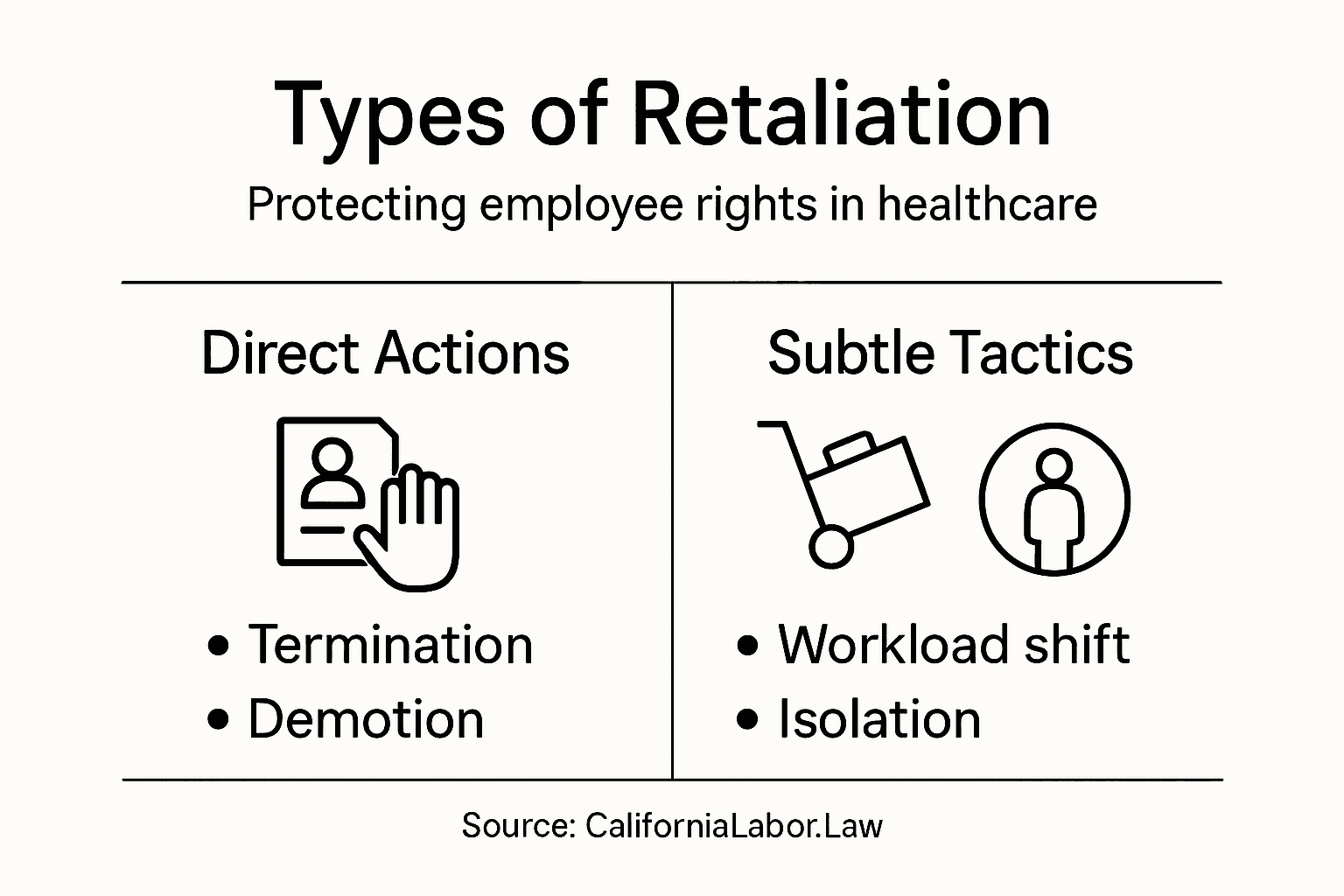
    Professional retaliation can manifest through several strategic approaches. Direct methods include termination, demotion, or reducing work hours after an employee reports misconduct. More nuanced tactics involve professional isolation, such as excluding staff from critical meetings, training opportunities, or important communication channels.

    In some cases, healthcare employers might manipulate performance evaluations, create impossible work conditions, or strategically assign unfavorable shifts to discourage future reporting of concerns.

    Specific retaliation types in healthcare settings frequently target whistleblowers and advocates. These can include blocking promotions, spreading professional rumors, creating hostile work environments, denying continuing education opportunities, or implementing punitive scheduling practices. Long-term care retaliation tactics may even extend to psychological intimidation designed to prevent future reporting of safety or ethical violations.
    Infographic on California healthcare retaliation types

    Here’s a summary of common employer retaliation tactics and their potential impact on healthcare professionals:

    Retaliation Tactic Typical Impact on Employee Examples in Healthcare
    Professional Isolation Limits access to resources Exclusion from meetings
    Manipulated Evaluations Damaged career reputation Negative performance reviews
    Unfavorable Scheduling Increased workplace stress Night or weekend shifts
    Denied Opportunities Stalled professional growth No training or promotion

    Independent contractors and temporary healthcare workers face unique vulnerabilities, often experiencing more subtle forms of professional retaliation that can significantly impact future employment opportunities. These might include negative recommendation letters, professional blacklisting, or strategic non-renewal of contracts after raising workplace concerns.

    Pro tip: Maintain comprehensive, dated documentation of all workplace interactions and incidents to build a robust defense against potential retaliatory actions.

    California’s 2026 Anti-Retaliation Laws

    California continues to strengthen legal protections for healthcare workers through comprehensive anti-retaliation legislation. The Equal Pay & Anti-Retaliation Act represents a significant advancement in protecting employees from workplace discrimination and punitive actions.

    The 2026 legal framework introduces robust presumptive protections for workers who report workplace misconduct. Under the new statute, if an employer takes adverse employment action within 90 days of an employee’s protected activity, the law presumes retaliation. The burden of proof shifts to the employer to demonstrate a legitimate, non-retaliatory reason for the action, effectively creating a stronger shield against potential workplace victimization.

    Specifically, these laws expand protection for healthcare professionals across multiple dimensions. California health care laws aim to reduce administrative interference and reinforce independent professional judgment. This includes safeguarding physicians and healthcare workers who report safety concerns, ethical violations, or potential patient risks, ensuring they can speak up without fear of professional consequences.

    The legislative changes also address unique vulnerabilities in healthcare settings, recognizing that retaliation can manifest through subtle professional sabotage. Independent contractors, temporary workers, and full-time employees now have enhanced legal recourse against tactics designed to suppress reporting of workplace issues, from blocking promotions to creating hostile work environments.

    Pro tip: Familiarize yourself with the specific protected activities under the 2026 anti-retaliation laws to understand the full extent of your workplace rights.

    Reporting Retaliation and Employer Duties

    Healthcare employees facing workplace retaliation have specific legal pathways to protect their rights and hold employers accountable. Labor Standards Enforcement provides a critical mechanism for investigating and addressing workplace violations that compromise employee protections.

    The reporting process involves multiple strategic steps designed to document and substantiate potential retaliation claims. Employees should first compile comprehensive evidence, including dated communications, performance reviews, witness statements, and a detailed chronology of events demonstrating the retaliatory actions.

    Written documentation should explicitly outline the protected activity that triggered the potential retaliation and the subsequent adverse employment actions taken by the employer.

    Employers in California have explicit legal duties when responding to potential retaliation claims. They must maintain transparent workplace policies, conduct impartial investigations, and provide clear explanations for any employment actions that could be perceived as retaliatory. The burden increasingly falls on employers to demonstrate that adverse actions were based on legitimate, non-discriminatory business reasons rather than punitive motivations against employees exercising their legal rights.

    The reporting mechanism typically involves filing a formal complaint with the California Labor Commissioner’s office, which will initiate an investigation into the alleged retaliation. This process includes potential mediation, detailed fact-finding, and potential enforcement actions that can result in reinstatement, monetary compensation, and penalties against employers who violate anti-retaliation statutes.

    Pro tip: Create a confidential, contemporaneous log of all workplace interactions and potential retaliatory actions, including dates, specific incidents, and any supporting documentation.

    Common Pitfalls and How to Protect Rights

    Healthcare workers frequently encounter complex challenges when navigating potential workplace retaliation, often misunderstanding the nuanced legal landscape. Workplace retaliation challenges require strategic understanding to effectively protect professional rights and prevent potential legal missteps.

    One critical pitfall involves misinterpreting routine management actions as retaliatory conduct. Not every negative employment interaction constitutes illegal retaliation. Legitimate performance management, such as performance improvement plans or constructive feedback, is distinct from retaliatory actions. Employees must carefully distinguish between acceptable management practices and intentional punitive measures designed to discourage legally protected workplace activities.

    The following table contrasts routine management actions with illegal retaliation, helping clarify when legal protections apply:

    Type of Action Description Legal Status
    Performance Improvement Plan Targeted at skill gaps Generally lawful
    Constructive Feedback Aimed at employee development Generally lawful
    Adverse Action for Reporting Punishes protected disclosures Unlawful retaliation
    Professional Sabotage Undermines standing after the complaint Unlawful retaliation

    Successful rights protection demands meticulous documentation and proactive communication. Healthcare workers should maintain comprehensive records of workplace interactions, including emails, performance reviews, and detailed incident reports. Contemporaneous documentation creates a robust evidentiary trail that can substantiate potential retaliation claims, demonstrating the direct connection between protected activities and subsequent adverse employment actions.

    Navigating power dynamics requires strategic awareness and understanding of legal protections. Despite strong California labor laws, enforcement gaps and complex legal processes can create significant challenges for workers seeking justice. Employees should seek support from labor organizations, understand their workplace rights comprehensively, and utilize formal complaint mechanisms promptly to challenge potential retaliatory behaviors.

    Pro tip: Create a secure, confidential digital and physical archive of all workplace communications and interactions to build a comprehensive evidence portfolio.

    Protect Your Rights Against Retaliation in California Healthcare

    Facing retaliation for speaking up about workplace concerns can be overwhelming and risky. This article highlights the challenges healthcare employees encounter, such as termination, demotion, and professional isolation, after reporting safety violations or unethical conduct. Understanding your rights under California’s evolving laws is crucial to safeguarding your career and well-being.

    At California Labor Law, we empower healthcare workers with clear legal guidance and tools designed specifically for California employees dealing with retaliation and other labor issues.

    Take control of your workplace situation today by calling California Labor Law at 1-866-355-9991. Your voice matters, and you deserve to work without fear. Get informed, document carefully, and explore how we can help you stand up for your rights.

    Frequently Asked Questions

    What constitutes retaliation in California healthcare workplaces?

    Retaliation in California healthcare occurs when employers punish employees for legally protected activities, such as reporting unsafe conditions or engaging in workplace investigations. Adverse actions can include termination, demotion, or negative performance reviews.

    How can healthcare employees document potential retaliation?

    Employees should maintain comprehensive, dated documentation of all workplace interactions related to their protected activity. This includes emails, performance reviews, and witness statements that demonstrate a connection between the protected action and any adverse employment actions.

    What should I do if I believe I am experiencing retaliation at work?

    If you suspect retaliation, compile evidence and consider filing a formal complaint with the appropriate labor authority. It’s important to gather documentation of the retaliatory actions and the protected activities that triggered them.

    What are the protections under California’s new anti-retaliation laws?

    California’s 2026 anti-retaliation laws strengthen protections for employees by presuming retaliation if adverse actions occur within 90 days of reporting misconduct. Employers must prove that their actions were based on legitimate reasons, not retaliatory motives.


  • How to Prove Retaliation: A Step-by-Step Guide

    How to Prove Retaliation: A Step-by-Step Guide

    Proving Retaliation in the Workplace

    Proving workplace retaliation can sound overwhelming. Most people expect the process to be complicated and risky. The real surprise is how much collecting the right records and mapping a detailed timeline can swing a case in your favor faster than most realize.

    Step 1: Gather Documentation of Your Employment History

    Building a strong retaliation case starts with meticulous documentation of your employment history. This crucial first step involves collecting comprehensive evidence that demonstrates your work performance, interactions with management, and the sequence of events leading to potential retaliatory actions.

    Identifying Critical Employment Records

    Start by assembling a complete set of employment documents that will serve as the foundation of your case. Your collection should include original copies of performance evaluations, employment contracts, emails, text messages, and any written communication with supervisors or human resources.

    According to the California Department of Industrial Relations, workers should specifically focus on documents that show changes in employment conditions after exercising labor rights.

    Pay special attention to chronological details. Create a timeline that maps out key events, including dates of performance reviews, any complaints or grievances filed, and subsequent workplace interactions.

    Your documents should include the following:

    • Original employment contract
    • Performance review documents
    • Email communications
    • Text message records
    • Internal complaint or grievance submissions
    • Workplace policy handbooks
    • Scheduling and assignment records

    Organize these documents systematically, preferably in both digital and physical formats. Make high-quality scans or copies of original documents, ensuring that dates, names, and content are clearly legible.

    Maintaining an organized and comprehensive record will significantly strengthen your ability to demonstrate a pattern of potential retaliation and provide your legal representatives with the necessary evidence to support your case.

    Gather Documentation of Your Employment History

    Step 2: Identify Instances of Protected Activity

    Identifying protected activities is a critical step in proving workplace retaliation. Protected activities are specific actions employees take that are legally safeguarded from employer retaliation, serving as the foundation for building a strong legal case against potential workplace misconduct.

    Understanding Protected Activities

    According to the Centers for Disease Control and Prevention (CDC), key protected activities that could support a retaliation claim include:

    • Filing an official complaint about workplace discrimination
    • Reporting safety violations to regulatory agencies
    • Participating in workplace investigations
    • Refusing to engage in illegal or unethical workplace practices
    • Requesting reasonable accommodations for disabilities
    • Whistleblowing about potential legal or ethical violations

    Preserve all documentation related to these interactions, including dates, names of individuals involved, and specific details of the communication. The strength of a retaliation claim often depends on the clarity and comprehensiveness of these records.

    Step 3: Collect Evidence of Adverse Actions

    Collecting robust evidence of adverse actions is a pivotal moment in proving workplace retaliation. This step transforms your suspicions into a compelling narrative that demonstrates how your employer responded negatively after you engaged in protected activities.

    Adverse actions represent any significant workplace changes that would discourage a reasonable employee from exercising their legal rights. According to the U.S. Department of Labor, these actions can range from subtle workplace manipulations to direct professional consequences.

    Documenting workplace negative actions requires a systematic and comprehensive approach. Begin by creating a detailed chronological record that connects your protected activities with subsequent workplace changes.

    This timeline should capture every professional modification that occurred after you raised concerns or participated in workplace investigations.

    Compile evidence through multiple channels, ensuring you have tangible proof of each adverse action.

    Key adverse actions to document include:

    • Unexpected negative performance evaluations
    • Sudden demotion or reduction in job responsibilities
    • Reduction in work hours or pay
    • Professional isolation or exclusion from team activities
    • Unwarranted disciplinary actions
    • Denial of promotion or professional development opportunities

    Prepare digital and physical copies of all supporting documents. Take careful notes about dates, specific interactions, and the context surrounding each adverse action. The more detailed and objective your documentation, the stronger your potential legal case becomes.

    Collect Evidence of Adverse Actions

    Remember that consistency and comprehensiveness are your greatest allies in proving workplace retaliation.

    Step 4: Establish a Causal Connection

    Establishing a causal connection is the critical bridge that transforms your collection of evidence into a compelling narrative of workplace retaliation. This step involves demonstrating a direct link between your protected activity and the adverse actions taken against you.

    Causal connection means proving that your employer’s negative actions were directly motivated by your previous protected activities.

    According to the U.S. Department of Justice, this requires showing that your protected activity was the likely reason for subsequent workplace consequences.

    Analyze the temporal proximity between your protected activity and the adverse actions. A close timeline can be powerful evidence. For instance, if you filed a workplace harassment complaint and received a negative performance review shortly afterward, this rapid sequence suggests a potential retaliatory motive.

    Look for patterns that demonstrate a clear cause-and-effect relationship, such as sudden changes in workplace treatment immediately following your protected activity.

    Gather comparative evidence that highlights differential treatment. Identify colleagues in similar roles who have not engaged in protected activities and compare their workplace experiences with yours. Document any discrepancies in performance evaluations, promotion opportunities, or professional assignments that suggest targeted retaliation.

    Key strategies for establishing causal connection include:

    • Documenting the exact dates of protected activities and subsequent adverse actions
    • Collecting witness statements about changes in workplace dynamics
    • Preserving communication records that demonstrate shifting workplace attitudes
    • Identifying inconsistencies in employer explanations for negative actions
    • Tracking patterns of behavior that suggest retaliatory intent

    Carefully construct a narrative that connects your protected activity to the adverse actions. Look beyond surface-level explanations and gather evidence that reveals the underlying motivations.

    Remember that a strong causal connection often requires multiple pieces of evidence that collectively paint a clear picture of workplace retaliation.

    Consulting with legal professionals transforms your documented evidence into a strategic legal approach. This critical step involves connecting with attorneys who specialize in employment law and workplace retaliation cases, turning your carefully gathered documentation into a potential legal action.

    According to the U.S. Department of Labor, selecting the right legal representation can significantly impact the trajectory of your retaliation claim. Specialized employment attorneys understand the nuanced legal landscape and can provide expert guidance on the strength of your case, potential strategies, and likely outcomes.

    Prepare comprehensive documentation before your initial consultation. Organize all collected evidence chronologically, including employment records, communication logs, performance evaluations, and detailed timelines of events.

    This preparation demonstrates your seriousness and helps attorneys quickly assess the merits of your case. During the initial meeting, be prepared to discuss every detail meticulously, allowing the attorney to identify potential legal strategies and potential challenges.

    Research potential attorneys through multiple channels. Seek recommendations from professional networks, bar associations, and employment rights organizations.

    Look for lawyers with specific experience in workplace retaliation cases, preferably those familiar with California employment laws. Many attorneys offer free initial consultations, allowing you to evaluate their expertise and approach without immediate financial commitment.

    Key considerations when selecting a legal professional include:

    • Specialized experience in workplace retaliation cases
    • Proven track record of successful employment law outcomes
    • Clear communication and transparency about potential case strategies
    • Understanding of specific California employment regulations
    • Willingness to provide detailed case assessment during initial consultation

    Remember that a strong attorney-client relationship requires mutual trust and open communication. Be honest about all aspects of your case, including potential weaknesses. The right legal professional will provide an objective assessment, helping you understand the realistic potential of your retaliation claim and guiding you through the complex legal process ahead.

    Consult with Legal Professionals

    Step 6: File the Appropriate Claims or Complaints

    Filing the appropriate claims or complaints is the pivotal moment where your documented evidence transforms into official legal action. This step requires precision, careful timing, and a strategic approach to navigating complex administrative processes.

    According to the U.S. Department of Labor, different types of workplace retaliation require filing with specific agencies. Carefully identify the correct agency based on the nature of your retaliation claim.

    For discrimination-related retaliation, you’ll typically file with the Equal Employment Opportunity Commission (EEOC). Wage and hour violations require complaints through the Wage and Hour Division, while workplace safety retaliation demands filing with the Occupational Safety and Health Administration (OSHA).

    Prepare a comprehensive and detailed complaint that clearly outlines the sequence of events. Your documentation from previous steps becomes crucial here. Craft a narrative that demonstrates a clear connection between your protected activity and the subsequent retaliatory actions. Include specific dates, names of individuals involved, and a chronological account of events that support your claim.

    Be mindful of strict filing deadlines, which vary depending on the type of complaint. Most retaliation claims have limited windows for submission, typically ranging from 30 to 180 days from the date of the alleged retaliatory action. Missing these deadlines can permanently eliminate your ability to pursue legal recourse.

    Key considerations when filing a complaint include:

    • Identifying the correct federal or state agency for your specific type of retaliation
    • Gathering all supporting documentation before filing
    • Maintaining copies of all submitted materials
    • Understanding and meeting specific filing deadlines
    • Preparing a clear, concise, and factual narrative of events

    After filing, maintain meticulous records of your submission, including confirmation numbers, dates of filing, and copies of all submitted documents. Follow up regularly with the agency handling your complaint, and be prepared to provide additional information if requested.

    Remember that filing a complaint is a formal process that requires patience, attention to detail, and persistent documentation.

    Ready to Protect Your Workplace Rights? Get Expert Help on Proving Retaliation in California

    If you are worried that your employer retaliated against you after you spoke up, this guide is the first step. You already know how difficult it can feel to gather documentation, prove a causal connection, and face legal deadlines. Your career, reputation, and peace of mind are on the line. But you do not have to fight alone.

    Find out your legal options in minutes. Connect with a legal advocate who understands California retaliation claims and can guide you step-by-step. Visit California Labor Law today, review our expert legal guides, use our wage and penalty calculators, or call us at 1-866-355-9991 for a free workplace rights consultation.

    Frequently Asked Questions

    What documentation do I need to prove retaliation?

    To prove retaliation, you should gather comprehensive documentation of your employment history, including performance evaluations, emails, text messages, complaint submissions, and any changes in workplace interactions or conditions after exercising your labor rights.

    What are considered protected activities in a workplace?

    Protected activities include actions such as filing formal complaints about workplace discrimination, reporting safety violations, participating in investigations, requesting accommodations for disabilities, and whistleblowing on illegal practices.

    How do I establish a causal connection between my protected activity and adverse actions?

    To establish a causal connection, you should document the timeline between your protected activities and any negative workplace actions taken against you. Look for direct links, such as a sudden negative performance review following a complaint, and gather comparative evidence showing differential treatment between you and colleagues who did not engage in protected activities.

    What steps should I take after gathering evidence of retaliation?

    After gathering evidence, consult with legal professionals specializing in employment law. Prepare your documentation, research potential attorneys, and discuss the specifics of your case to understand your options for filing appropriate claims or complaints based on the type of retaliation experienced.

  • Understanding Employer Retaliation Laws: Know Your Rights

    Understanding Employer Retaliation Laws: Know Your Rights

    Employer retaliation laws decide whether workers feel safe standing up for their rights or stay silent out of fear. Some might think reporting workplace problems is a rare move, but about 38 percent of California workers have faced violations, with many too afraid to speak up. What most people miss is these laws do more than protect individuals—they are the backbone of honest and fair workplaces for everyone.

    What Are Employer Retaliation Laws and Why Do They Matter?

    Employer retaliation laws are critical legal protections designed to shield workers from punitive actions taken by employers in response to an employee’s legitimate workplace rights activities. These laws ensure that workers can report misconduct, discrimination, or labor violations without fear of professional consequences.

    Understanding the Core Definition

    Employer retaliation occurs when a company takes adverse action against an employee who has engaged in a legally protected activity. According to the U.S. Equal Employment Opportunity Commission, these protected activities can include:

    • Filing a discrimination complaint
    • Participating in workplace investigations
    • Reporting safety violations
    • Requesting reasonable workplace accommodations
    • Asserting wage and hour rights

    Adverse actions might encompass termination, demotion, reduced work hours, pay cuts, harassment, or creating a hostile work environment. The fundamental purpose of these laws is to prevent employers from silencing workers who exercise their legal rights.

    Why Employer Retaliation Laws Are Essential

    Retaliation laws serve multiple critical functions in protecting worker rights. Research from the Congressional Research Service highlights that these protections are crucial for maintaining workplace accountability and ensuring employees can safely challenge unlawful practices. By creating legal mechanisms that discourage punitive employer behaviors, these laws promote transparency, fairness, and ethical conduct in professional environments.

    Moreover, employer retaliation laws empower workers to speak up about critical issues without risking their professional standing or economic stability. For workers seeking more guidance on protecting themselves, our comprehensive guide on workplace rights provides additional insights into navigating complex employment scenarios.

    Ultimately, employer retaliation laws represent a fundamental safeguard in modern labor regulations, ensuring that workers can assert their rights without fear of unjust professional consequences.

    Key Concepts in Employer Retaliation: Definitions and Examples

    Employer retaliation represents a complex legal landscape where workers’ rights intersect with organizational power dynamics. Understanding the nuanced definitions and practical manifestations of retaliation is crucial for protecting oneself in the workplace.

    Defining Protected Activities

    According to Cornell Law School, protected activities are specific actions employees can take without fear of workplace punishment. These activities encompass a broad range of legitimate workplace conduct:

    • Reporting discrimination or harassment
    • Participating in official workplace investigations
    • Whistleblowing about safety or legal violations
    • Filing wage and hour claims
    • Requesting reasonable workplace accommodations

    The legal framework recognizes that employees must feel safe exercising these fundamental rights without experiencing professional consequences. Protection extends beyond formal complaint processes and includes informal discussions about workplace conditions.

    Below is a table summarizing the main types of protected employee activities and the corresponding examples referenced in California employer retaliation law.

    Protected Activity Description/Example
    Reporting discrimination or harassment Notifying management or HR about unfair treatment
    Participating in workplace investigations Providing testimony or evidence in an internal review
    Whistleblowing about safety or legal violations Informing authorities about unsafe work conditions
    Filing wage and hour claims Complaining about unpaid wages or overtime discrepancies
    Requesting reasonable workplace accommodations Asking for medical leave or adjustments for disabilities

    Recognizing Retaliatory Actions

    Retaliatory actions are not always obvious and can manifest in subtle or dramatic ways. Employers might attempt to disguise punitive measures through seemingly legitimate workplace decisions. Common retaliatory actions include:

    • Unexpected performance improvement plans
    • Sudden scheduling changes
    • Exclusion from professional opportunities
    • Unwarranted negative performance evaluations
    • Reduction in work hours or responsibilities

    These actions become legally problematic when they can be directly linked to an employee’s protected activity. For workers concerned about potential wage theft or employment violations, understanding these nuanced forms of retaliation is critical.

    Employer retaliation laws provide robust mechanisms for workers to challenge inappropriate workplace conduct. When an employer engages in retaliatory behavior, potential legal consequences can include financial penalties, mandatory workplace policy changes, and potential civil litigation. The goal is not just individual protection but systemic accountability in professional environments.

    This table highlights common forms of employer retaliation and the associated legal consequences employers can face if found guilty under California law.

    Retaliatory Action Example in the Workplace Legal Consequence for Employer
    Termination Firing after employee reports a violation Reinstatement, back pay, penalties
    Demotion or pay cut Lowering job rank or cutting wages Financial compensation, policy changes
    Negative performance evaluation Undeserved negative review after complaint Court-ordered removal from personnel file
    Exclusion from opportunities Denying promotions or assignments Policy reforms, possible punitive damages
    Reduction of hours or responsibilities Cutting scheduled hours Back pay, reinstatement of original hours
    Hostile work environment Creating an intimidating atmosphere Mandated training and workplace reforms

    The Importance of Employer Retaliation Laws in California

    California stands at the forefront of worker protection, with employer retaliation laws that provide some of the most comprehensive safeguards in the United States. These robust legal mechanisms are designed to shield employees from unfair workplace practices and ensure fundamental rights are consistently upheld.

    California’s Progressive Worker Protection Framework

    According to the California Labor Commissioner’s Office, the state enforces over 45 specific labor laws that prohibit workplace discrimination and retaliation. California’s legal framework goes beyond federal standards, offering workers more extensive protections and clearer paths for addressing workplace misconduct.

    To help readers compare California’s worker retaliation protections with broader standards, use this table outlining distinctive features and enforcement measures.

    Feature or Characteristic California Law Federal Law/General Standard
    Number of enforced retaliation statutes Over 45 specific statutes Fewer, broader statutes
    Types of protected activities Broad, includes informal complaints More limited, formal complaints emphasized
    Penalties for employer violations Stricter, more severe financial and legal penalties Variable, often less stringent
    Recourse mechanisms for workers Multiple: complaints, lawsuits, financial remedies Fewer, sometimes only administrative
    Sector coverage Broad, covers more employment sectors May exclude some worker categories

    Key characteristics of California’s approach include:

    • Broader definitions of protected activities
    • More stringent penalties for employer violations
    • Enhanced legal mechanisms for worker recourse
    • Proactive workplace anti-retaliation policies
    • Comprehensive coverage across diverse employment sectors

    Economic and Social Impact of Retaliation Laws

    Retaliation laws in California serve critical economic and social functions. Research reveals that approximately 38% of workers have experienced workplace violations, yet historically, fear of retaliation prevented many from reporting misconduct.

    By establishing clear legal protections, these laws accomplish multiple objectives:

    • Encourage workplace transparency
    • Reduce systemic workplace abuse
    • Provide economic security for workers
    • Create accountability mechanisms for employers
    • Support employees in challenging unethical practices

    Employer retaliation laws in California are not merely theoretical protections but actively enforced legal standards. Workers can file claims and seek legal remedies when experiencing workplace retaliation. The legal system provides multiple avenues for addressing violations, including administrative complaints, civil lawsuits, and potential financial compensation.

    Ultimately, these laws represent a fundamental commitment to workplace fairness, ensuring that employees can assert their rights without fear of professional or economic reprisal.

    california worker retaliation law

    How Employer Retaliation Laws Protect Employees’ Rights

    Employer retaliation laws serve as a critical shield, protecting workers from punitive actions that could compromise their professional integrity and economic stability. These legal safeguards ensure employees can exercise their fundamental workplace rights without experiencing professional consequences.

    According to the U.S. Equal Employment Opportunity Commission, legal protections extend far beyond simple discrimination claims. Employees are legally protected when participating in a wide range of workplace activities, including:

    • Filing formal discrimination complaints
    • Participating in workplace investigations
    • Reporting safety violations
    • Requesting reasonable workplace accommodations
    • Whistleblowing about unethical or illegal practices

    These protections create a comprehensive framework that empowers workers to speak up without fear of professional repercussions. The legal mechanism ensures that employers cannot take adverse actions against employees who are exercising their fundamental rights.

    Workplace Retaliation

    Mechanisms of Employee Protection

    Retaliation laws operate through multiple strategic mechanisms designed to discourage workplace misconduct. When an employer attempts to punish an employee for a protected activity, the legal system provides robust remedies:

    • Mandatory reinstatement of wrongfully terminated employees
    • Financial compensation for lost wages and damages
    • Potential punitive damages against the employer
    • Court-ordered policy changes within the organization
    • Protection from future discriminatory actions

    For workers seeking detailed guidance on navigating these complex legal protections, our comprehensive wrongful termination guide offers additional insights into understanding and asserting workplace rights.

    Practical Impact of Protective Legislation

    Employer retaliation laws fundamentally transform workplace dynamics by creating accountability. These laws do more than just provide legal recourse they actively discourage systemic workplace abuse by establishing clear consequences for employers who violate employee rights. The legislative framework ensures that workers can challenge unethical practices without risking their professional standing, ultimately promoting more transparent and equitable work environments.

    Real-World Implications of Employer Retaliation: Case Studies

    Employer retaliation is not a theoretical concept but a tangible workplace challenge with significant consequences for workers and organizations. Real-world case studies reveal the complex dynamics of workplace power, legal protections, and employee rights.

    Revealing Patterns of Workplace Misconduct

    According to the U.S. Department of Labor, workplace retaliation takes multiple forms that extend beyond obvious termination. Retaliation can be subtle yet profoundly damaging to an employee’s professional trajectory. Consider the case of Neil, a restaurant cook who was fired after inquiring about overtime pay an example of direct economic retaliation.

    Common retaliation patterns include:

    • Systematic professional isolation
    • Unexplained performance review downgrades
    • Sudden reduction in work hours
    • Assignment to less desirable job responsibilities
    • Creating hostile work environments

    Case studies demonstrate that employer retaliation can result in significant legal and financial consequences. A University of Massachusetts Amherst study analyzed 46,210 sexual harassment charges and discovered that 68% included retaliation allegations, highlighting the pervasive nature of workplace misconduct.

    Typical legal consequences for employers include:

    • Substantial monetary settlements
    • Mandatory workplace policy reforms
    • Court-ordered employee reinstatement
    • Potential punitive damages
    • Reputational damage and public scrutiny

    Broader Societal Impact

    These case studies reveal more than individual workplace disputes they expose systemic challenges in professional environments. Our comprehensive guide on filing retaliation claims provides workers with critical resources for understanding their legal options.

    Ultimately, each retaliation case represents a critical moment of accountability. By challenging retaliatory practices, employees not only protect their individual rights but also contribute to creating more equitable and transparent workplace cultures.

    Take Action Against Employer Retaliation in California

    Have you ever worried that speaking up at work could mean losing your job or facing unfair treatment? This article explores the serious problem of employer retaliation and how it threatens your right to a fair workplace. If you have faced sudden demotions, reduced hours, or termination for asserting your rights, you are not alone. Many California workers struggle with the fear of retaliation after reporting discrimination, unpaid wages, or other workplace violations. Knowing your rights is just the first step, protecting them is where it counts most.

    If you have been retaliated against then give California Labor Law a call at 1-866-355-9991 for a free employer retaliation consultation. We would be happy to point you in the right direction.

    Frequently Asked Questions

    What is employer retaliation?

    Employer retaliation occurs when an employer takes adverse action against an employee for engaging in legally protected activities, such as filing a discrimination complaint or reporting safety violations.

    What actions are considered protected activities under employer retaliation laws?

    Protected activities include filing discrimination complaints, participating in workplace investigations, reporting safety violations, requesting reasonable accommodations, and asserting wage and hour rights.

    How can I recognize if I am experiencing retaliation at work?

    Signs of retaliation may include sudden changes in job responsibilities, unexpected negative performance evaluations, exclusion from opportunities, or any unwarranted disciplinary actions linked to your protected activities.

    What legal protections do I have if I experience retaliation?

    Employees are protected by laws that provide remedies such as reinstatement, financial compensation for lost wages, and possible court-ordered changes in workplace policies when retaliation is proven.