Category: Wrongful Termination

  • Can I Be Fired for No Reason in California?

    Can I Be Fired for No Reason in California?

    Being Fired for No Reason in California, Can That Even Happen?

    Every worker in California faces a unique risk. Under state law, more than 16 million California employees are subject to at-will rules that allow employers to terminate workers for almost any reason. This often leaves people uncertain about their job security and workplace protections. Understanding how California defines fair versus wrongful firing can help you recognize your rights and avoid illegal or discriminatory terminations.

    At-Will Employment in California Explained

    California operates under a robust at-will employment system that provides significant flexibility for both employers and employees. According to state labor guidelines, this means an employer can terminate an employee for any reason or no reason at all, provided the reason is not discriminatory or illegal. State labor regulations confirm that at-will employment allows either party to end the working relationship without advanced notice or specific justification.

    The at-will doctrine fundamentally means that your employment can be terminated without warning, even if you have performed your job effectively. While this might sound alarming, California law still protects workers from unjust dismissals. Employers cannot fire employees for reasons that violate public policy, such as discrimination based on race, gender, age, disability, or as retaliation for reporting workplace violations. These protections ensure that while the employment relationship can be terminated freely, it cannot be ended through illegal or unethical means.

    There are several important exceptions to the at-will employment rule in California. Written employment contracts that specify terms of termination, union agreements, and public sector jobs often provide additional job protections. Some employers also establish implied contracts through employee handbooks, performance reviews, or verbal promises that could limit their ability to terminate employment arbitrarily. Employment contract details can significantly impact your workplace rights and potential recourse if terminated.

    Pro tip: Always request and carefully review your employment documentation, including offer letters and employee handbooks, to understand the specific terms of your employment and potential termination conditions.

    Here’s a summary of how California’s at-will employment compares with other job protection systems:

    Employment Type Termination Flexibility Employee Protections
    At-will (California) Employer can terminate anytime Protected from illegal or discriminatory firing
    Contract-based Termination limited by contract terms Contract spells out additional safeguards
    Union/Collective Bargaining Termination governed by union rules Enhanced grievance and appeals process
    Public Sector Termination follows statutory procedures Protections based on civil service laws

    Key Exceptions to At-Will Termination

    While at-will employment provides broad termination flexibility, California law recognizes several critical exceptions that protect employees from arbitrary dismissal. Judicial interpretations of employment law have established important safeguards that limit an employer’s ability to terminate workers without legitimate cause. These exceptions fundamentally balance employer discretion with employee rights, ensuring workers cannot be fired for discriminatory, retaliatory, or fundamentally unfair reasons.

    Three primary exceptions exist in California’s at-will employment framework. First, written employment contracts that specify termination conditions can override standard at-will provisions. Second, employees are protected by federal and state anti-discrimination laws that prohibit firing based on protected characteristics like race, gender, age, disability, national origin, or sexual orientation. Third, workers cannot be terminated for exercising legal rights, such as filing workplace safety complaints, requesting medical leave, or reporting illegal business practices. These protections ensure that employment decisions remain fundamentally fair and legally compliant.
    Employment Contract

    Additional nuanced exceptions further protect California workers. Public policy exceptions prevent employers from firing employees who refuse to commit illegal acts, report legal violations, or participate in investigations. Union agreements and collective bargaining contracts often provide additional job security provisions that modify at-will employment standards. Wrongful termination guidelines highlight that employees have multiple legal avenues to challenge inappropriate dismissals, including filing complaints with state labor departments or pursuing civil litigation when their termination violates established legal protections.

    Pro tip: Document every interaction and communication related to potential termination, as contemporaneous records can provide critical evidence if you need to challenge an illegal dismissal.

    Illegal Reasons for Firing Employees

    California law provides robust protections against discriminatory and retaliatory terminations, establishing clear boundaries for what constitutes an illegal firing. State employment regulations define multiple protected categories and scenarios where employee dismissal becomes unlawful. These protections ensure workers cannot be fired based on characteristics beyond their job performance or for exercising fundamental workplace rights.

    Employee receives termination notice in office meeting

    Discrimination remains the most prevalent form of illegal termination. Employers are strictly prohibited from firing employees based on protected characteristics such as race, color, national origin, religion, sex, sexual orientation, gender identity, age, disability, genetic information, or marital status. This means an employer cannot terminate someone simply because they belong to a specific group or possess a particular personal characteristic. For instance, firing a qualified employee because of their disability, religious practices, or pregnancy status represents clear violations of California’s anti-discrimination statutes.

    Retaliation represents another critical category of illegal termination. Workers are legally protected when reporting workplace violations, participating in investigations, or exercising their legal rights. This includes scenarios like reporting sexual harassment, documenting unsafe working conditions, requesting reasonable accommodations, or filing wage and hour complaints. Wrongful termination settlements demonstrate that employees who experience retaliation can seek significant legal remedies, including reinstatement, back pay, and additional compensatory damages. The California Department of Fair Employment and Housing actively investigates and prosecutes employers who violate these fundamental employee protections.

    Pro tip: Maintain detailed contemporaneous documentation of any workplace interactions, communications, and incidents that might suggest discriminatory treatment or potential retaliation.

    Recent Changes to Worker Protections in 2026

    California continues to lead the nation in expanding worker protections, with significant legal updates scheduled to take effect in 2026. New labor standards will introduce comprehensive reforms designed to strengthen employee rights and provide additional safeguards against workplace discrimination and unfair treatment. These changes represent a substantial commitment to protecting workers across diverse industries and employment classifications.

    Key modifications include enhanced protections for workers regardless of immigration status, more robust mechanisms for addressing wage theft, and stricter enforcement of anti-retaliation provisions. Employers will face increased scrutiny and potential penalties for violations, signaling a more aggressive approach to workplace compliance. The updated regulations aim to close existing legal loopholes and provide workers with more comprehensive tools to challenge unfair employment practices, including expanded documentation requirements and clearer reporting mechanisms for workplace violations.

    The California Labor Commissioner has emphasized that these changes represent more than technical legal updates. They reflect a fundamental shift in approach to worker protections, prioritizing transparency, accountability, and fundamental fairness in workplace interactions. Critical areas of focus include strengthening protections for vulnerable worker populations, expanding definitions of workplace discrimination, and creating more accessible pathways for employees to challenge potential violations. Minimum wage laws will also see significant updates, complementing these broader worker protection initiatives and ensuring more comprehensive economic safeguards for California employees.

    Pro tip: Stay informed about these legal changes by reviewing official state labor resources and consulting with employment law professionals to understand how they specifically impact your workplace rights.

    What to Do If You’re Wrongfully Terminated

    If you suspect you have been wrongfully terminated, taking immediate and strategic action is crucial to protecting your legal rights. Official state guidelines recommend a systematic approach to documenting and addressing potential workplace violations. Your first priority should be gathering comprehensive evidence about the circumstances surrounding your termination, including all relevant communications, performance reviews, and potential discriminatory or retaliatory indicators.

    The next critical step involves filing formal complaints with appropriate state agencies. California offers multiple channels for challenging wrongful termination, including the Department of Industrial Relations and the Department of Fair Employment and Housing. Understanding workplace discrimination can help you identify whether your termination potentially violated legal protections. Workers should be prepared to provide detailed documentation demonstrating that their firing resulted from illegal motivations such as discrimination, retaliation, or violation of public policy rather than legitimate business reasons.

    Consulting with an employment law attorney represents the most strategic approach to addressing potential wrongful termination. These legal professionals can conduct a comprehensive evaluation of your case, advise you on the strength of your potential claims, and guide you through complex legal processes. They can help you understand potential remedies, which might include reinstatement, back pay, compensation for emotional distress, or negotiated settlement agreements. Your attorney can also help determine whether filing an administrative complaint or pursuing civil litigation represents the most effective strategy for your specific situation.

    Pro tip: Create a comprehensive file containing all employment-related documents, including emails, performance reviews, and termination correspondence, which can serve as critical evidence if you pursue legal action.

    Use this table as a reference for key steps and agency options if you suspect wrongful termination:

    Step Purpose Recommended Resource
    Gather evidence Build a case with documentation Personal records, emails
    File formal complaint Officially challenge termination Department of Fair Employment
    Seek legal counsel Get professional legal guidance Employment law attorney
    Explore remedies Learn about compensation options Labor agency, attorney

    Protect Your Rights When Facing At-Will Termination in California

    If you wonder “Can I be fired for no reason in California” you are not alone. At California Labor Law we provide free consultations for anyone who believes they may have been the victim of a contract violation or a wrongful termination. Contact our California employment lawyers today for a free case review by calling 1-866-355-9991.

    Frequently Asked Questions

    Can my employer fire me for any reason in California?

    Yes, California is an at-will employment state, meaning employers can terminate employees for any reason or no reason at all, as long as the reason is not illegal or discriminatory.

    What protections do I have against wrongful termination in California?

    Employees in California are protected from wrongful termination, including firings based on discrimination, retaliation for exercising legal rights, or violations of public policy.

    Are there exceptions to the at-will employment rule in California?

    Yes, exceptions include written employment contracts, union agreements, and potential implied contracts that may limit an employer’s ability to terminate employment arbitrarily.

    What should I do if I believe I was wrongfully terminated in California?

    If you suspect wrongful termination, gather relevant evidence regarding your termination, file a formal complaint with state agencies, and consult with an employment law attorney for guidance.

  • Understanding Wrongful Termination Statute of Limitations

    Understanding Wrongful Termination Statute of Limitations

    What are the Statute of Limitations for California Wrongful Termination?

    Getting fired unfairly is tough, and knowing your rights matters even more when time is ticking. There is something most people miss: the window to take legal action can disappear fast. In some states you might have only 180 days to file a claim or you could have up to 3 years, depending on a few key details. That countdown can run out before you even know it began, and waiting too long means you could lose your shot at justice for good.

    What is the Wrongful Termination Statute of Limitations?

    A wrongful termination statute of limitations represents the legal time frame within which an employee can file a lawsuit against their employer for unlawful job dismissal. This critical legal concept determines how long workers have to take legal action after experiencing potentially illegal termination.

    The statute of limitations varies depending on the specific type of wrongful termination claim and applicable state or federal laws. According to Cornell Law School, these time limits are designed to ensure fair legal proceedings and prevent stale claims from surfacing years after an incident.

    Typical time frames for wrongful termination claims can range from 180 days to 3 years, depending on several factors:

    • Federal discrimination claims through the Equal Employment Opportunity Commission (EEOC)
    • State level employment law violations
    • Specific types of workplace misconduct

    Factors Influencing Statute of Limitations

    Multiple elements impact the precise duration for filing a wrongful termination lawsuit. Key considerations include:

    • The nature of the termination (discriminatory, retaliatory, contractual breach)
    • Whether the claim involves state or federal law
    • The specific employment sector and type of violation

    Employees should understand their complete rights in wrongful termination cases to ensure they do not miss critical filing deadlines. Waiting too long can permanently forfeit your ability to seek legal remedy for an unjust job loss.

    To help you understand the factors that impact the wrongful termination statute of limitations, the following table summarizes key variables and their effects on filing deadlines.

    Factor Impact on Statute of Limitations Example
    Type of Claim Different claims have unique time frames Discrimination vs. Retaliation
    Applicable Law (State vs. Federal) State and federal laws set varying limitations EEOC (federal) vs. state law claims
    Nature of Termination The reason behind the firing can affect deadlines Contract breach vs. discrimination
    Discovery of Wrongful Action Time may start when employee learns of the action Hidden vs. obvious violations
    Employment Sector Special rules may apply in some industries Private vs. public sector

    Comprehending these time limitations is crucial because once the statute of limitations expires, courts will typically dismiss the case without considering its merits. This underscores the importance of prompt legal action and consultation with employment law professionals who can guide you through the complex process of challenging an unlawful termination.

    Why Does the Statute of Limitations Matter in Employment Disputes?

    Statutes of limitations serve as critical legal safeguards that protect both employees and employers by establishing clear boundaries and time frames for resolving workplace disputes. These legal time constraints are not merely procedural technicalities but fundamental mechanisms ensuring fairness and preventing potential long-term legal uncertainties.

    Preserving Evidence and Ensuring Timely Resolution

    The statute of limitations plays a crucial role in maintaining the integrity of legal proceedings. As the Fair Labor Standards Act indicates, time-bound legal claims help preserve critical evidence and witness testimonies that might otherwise become unreliable or disappear over extended periods.

    Key reasons why statutes of limitations are essential include:

    • Protecting employers from indefinite legal vulnerability
    • Ensuring evidence remains fresh and credible
    • Encouraging prompt resolution of workplace conflicts

    Beyond procedural requirements, statutes of limitations have significant practical implications for employment disputes. When employees delay filing claims, they risk permanently losing their legal recourse. This potential forfeiture underscores the importance of understanding and respecting these time limitations.

    Moreover, these legal time frames serve multiple purposes:

    • Preventing stale claims with potentially degraded evidence
    • Promoting workplace stability and legal predictability
    • Balancing the interests of both employees and employers

    Employees seeking legal representation in California wrongful termination cases must recognize that timing is everything. Missing a critical deadline can mean the difference between obtaining justice and having a valid claim completely dismissed.

    Ultimately, statutes of limitations are not obstacles but essential mechanisms that ensure fair, timely, and effective resolution of workplace disputes. They compel both parties to address potential legal issues promptly and systematically, thereby maintaining a balanced and responsive employment legal framework.

    How the Wrongful Termination Statute of Limitations Works

    The wrongful termination statute of limitations operates as a complex legal mechanism that defines the precise window during which an employee can pursue legal action against an employer for unlawful job dismissal. Understanding its operational framework requires examining the intricate details of claim initiation, calculation, and potential exceptions.

    Calculating the Time Frame

    Statute of limitations calculation begins from a specific triggering event, typically the date of termination or the moment the employee becomes aware of the wrongful action. According to 29 U.S. Code 255, these time limits are not arbitrary but strategically designed to balance fairness between employees and employers.

    Key elements in calculating the time frame include:

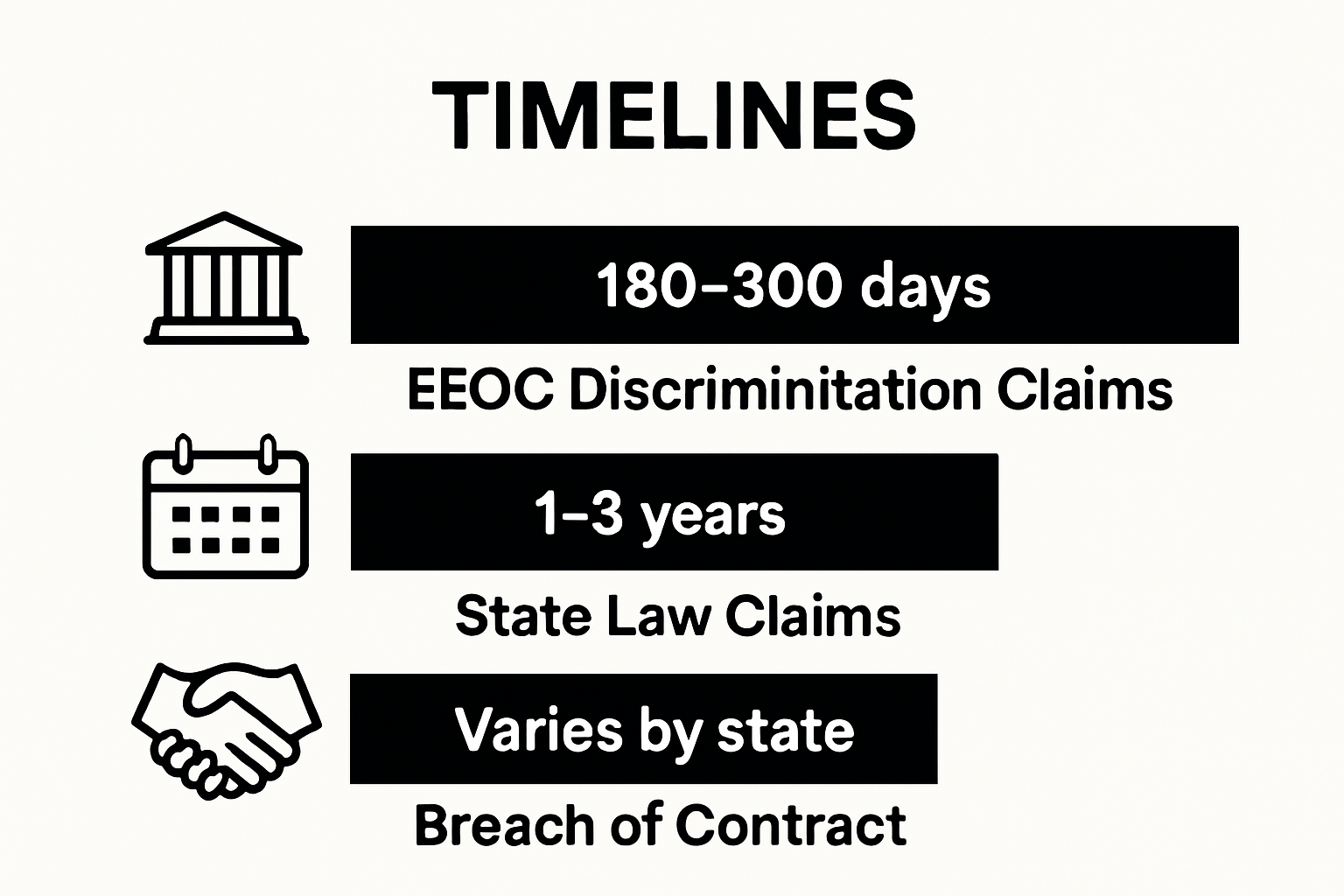
    Simple bar chart compares common wrongful termination claim deadlines

    • The specific type of employment violation
    • Whether the claim involves state or federal law
    • The intentionality of the employer’s actions

    Variations in Limitation Periods

    Different types of wrongful termination claims have distinct limitation periods. Some claims might have shorter windows, while others provide more extended periods for legal action. Critical variations exist based on:

    • Discrimination claims (typically 180 to 300 days)
    • Retaliation claims
    • Breach of employment contract disputes

    Employees should check their wait time penalty options to understand how timing impacts their potential legal remedies. The complexity of these time frames underscores the importance of prompt and strategic legal consultation.

    Below is a comparison table outlining common types of wrongful termination claims and their typical statute of limitations, helping you quickly see how your situation might be categorized.

    Type of Claim Typical Statute of Limitations Triggering Event
    Discrimination (Federal) 180-300 days Date of termination or discovery
    Retaliation 180 days to 3 years Date of adverse action
    Breach of Contract 2-3 years (varies by state) Date of contract breach/termination
    State Law Violations 1-3 years Date of incident/termination/discovery
    Wage/Hour (FLSA) 2-3 years Date of wage violation or termination

    The statute of limitations is not just a procedural hurdle but a critical legal safeguard. It ensures that evidence remains fresh, witnesses are available, and both parties can effectively address workplace disputes within a reasonable timeframe. Employees must act swiftly and precisely, recognizing that delays can permanently extinguish their right to seek justice for wrongful termination.

    Key Concepts in Wrongful Termination and Statute of Limitations

    Wrongful termination and its associated legal time constraints represent a complex intersection of employment law that requires nuanced understanding. These legal principles protect employee rights while establishing clear boundaries for potential legal recourse against employers who violate workplace regulations.

    Defining Wrongful Termination

    Wrongful termination occurs when an employee is fired for illegal reasons that violate established employment laws or public policy. According to 29 U.S. Code 255, legal frameworks recognize several critical scenarios constituting wrongful termination:

    • Discrimination based on protected characteristics
    • Retaliation for reporting workplace violations
    • Termination that breaches explicit employment contracts
    • Firing an employee for exercising legal rights

    Statute of limitations fundamentally serves as a legal time barrier that defines the window during which an employee can pursue legal action. The critical aspects include:

    • Precise calculation of the legal time frame
    • Recognition of different limitation periods for various claim types
    • Understanding triggering events that initiate the limitation period

    Employees seeking comprehensive insights can explore our California employment law blog for deeper understanding of these complex legal nuances. The interplay between wrongful termination claims and their associated time limitations requires careful navigation and strategic legal planning.

    employment law office

    Ultimately, understanding these key concepts empowers employees to recognize potential workplace violations and take timely, informed action. The statute of limitations is not merely a procedural technicality but a crucial mechanism ensuring fair resolution of employment disputes while protecting both employee rights and employer interests.

    Do Not Lose Your Chance to Act on Wrongful Termination

    Are you worried about missing the tight deadlines explained in this article? The statute of limitations can rob you of your chance for justice if you wait too long. Many California workers struggle with the fear and confusion of when and how to file a claim for wrongful termination. Missing the filing window can mean permanent loss of your rights, as this article highlights.

    Do not let uncertainty hold you back. Find real answers and tools that put you in control. Our website, California Labor Law, offers quick guides, legal calculators, and current law updates to help you understand your options right now. If you think you are owed lost wages or wait time penalties after being let go, start with our California wait time penalty resource for potential claims. Confused about your broader legal protections? Call us at 1-866-355-9991 to discuss your options today with a free wrongful termination consultation.

    Frequently Asked Questions

    What is the statute of limitations for wrongful termination claims?

    The statute of limitations for wrongful termination claims can range from 180 days to 3 years, depending on the nature of the claim and applicable state or federal laws.

    Why is the statute of limitations important in wrongful termination cases?

    The statute of limitations is essential because it sets a deadline for filing claims, ensuring timely legal action and preserving evidence, which helps maintain the fairness of the legal process.

    How do I calculate the time frame for filing a wrongful termination lawsuit?

    The time frame typically begins from the date of termination or the moment the employee becomes aware of the wrongful action, influenced by the specific type of violation and applicable laws.

    What happens if I miss the statute of limitations deadline?

    If you miss the statute of limitations deadline, you may permanently lose your right to pursue legal action for wrongful termination, and the court will likely dismiss your case without considering its merits.

  • Wrongful Termination Settlement Amounts

    Wrongful Termination Settlement Amounts

    California Wrongful Termination Settlements

    Wrongful termination settlement amounts are making headlines for a reason, and workers are paying close attention. Most people are shocked to see just how wide the gap can be, with settlements ranging from $10,000 to $250,000 or more, depending on the case details. Many assume these payouts are just about lost paychecks, but the real story goes deeper. These numbers reflect the emotional harm, damaged reputations, and even the larger fight for workplace justice that every employee should know about.

    What Are Wrongful Termination Settlement Amounts?

    Wrongful termination settlement amounts represent financial compensation employees receive when they have been illegally dismissed from their job. These settlements are designed to provide monetary relief for the economic and emotional damages suffered due to an unlawful employment termination.

    Understanding Settlement Range and Factors

    Settlement amounts can vary dramatically based on multiple interconnected factors. Typically, wrongful termination settlements range from $10,000 to $250,000, with some exceptional cases reaching significantly higher amounts. The specific settlement depends on several critical elements:

    • Economic Damages: Lost wages, lost benefits, potential future earnings
    • Emotional Distress: Psychological impact of improper job loss
    • Legal Costs: Attorney fees and litigation expenses
    • Severity of Violation: Degree of employer misconduct

    The legal landscape for wrongful termination claims suggests that compensation aims to make the employee whole, addressing both financial losses and professional disruption.

    Calculating Potential Settlement Value

    Determining a precise wrongful termination settlement involves a comprehensive evaluation. Factors like employment duration, salary history, documented discrimination, and potential future career impact all play significant roles. Legal experts recommend considering these key calculation components:

    • Documented lost income
    • Potential future earning capacity
    • Cost of job search and retraining
    • Emotional distress damages
    • Punitive damages in cases of extreme misconduct

    Employees seeking to understand their potential settlement should consult specialized employment attorneys who can provide personalized case assessment and strategic guidance through complex legal proceedings.

    Why Understanding Settlement Amounts Matters for Employees

    Understanding wrongful termination settlement amounts is crucial for employees navigating complex employment disputes. These settlements represent more than financial compensation; they are a critical mechanism for protecting workers’ rights and ensuring fair treatment in the workplace.

    Financial and Professional Protection

    Knowledge of potential settlement amounts provides employees with strategic advantages during legal proceedings. Financial awareness empowers workers to make informed decisions about pursuing legal action. By understanding the potential compensation range, employees can:

    • Assess the economic viability of litigation
    • Evaluate the true cost of workplace discrimination
    • Recognize the value of their professional experience and potential lost opportunities
    • Understand the comprehensive impact of wrongful termination

    Research from Ohio State University indicates that employees who understand their rights are significantly more likely to challenge unfair employment practices, highlighting the importance of settlement knowledge.

    Emotional and Professional Healing

    Beyond financial compensation, understanding settlement amounts helps employees process the emotional trauma of wrongful termination. Settlements acknowledge workplace injustice and provide a form of validation for employees who have experienced discrimination or unfair treatment. This understanding can support:

    • Psychological recovery from workplace trauma
    • Rebuilding professional confidence
    • Recognizing the legal system’s role in protecting worker rights
    • Creating a pathway for future employment opportunities

    Employees can learn more about navigating workplace legal challenges with professional guidance, ensuring they make well-informed decisions throughout their legal journey.

    Key Factors Affecting Wrongful Termination Settlement Amounts

    Wrongful termination settlement amounts are not arbitrary but result from a complex evaluation of multiple interconnected factors. Understanding these elements helps employees and legal professionals accurately assess potential compensation.

    legal consultation wrongful termination

    Employment Context and Violation Severity

    The nature and circumstances of termination dramatically influence settlement value. Settlements are significantly impacted by factors such as:

    • Documented evidence of discrimination
    • Violation of specific employment laws
    • Company size and financial resources
    • Duration of employment
    • Position and salary level of the terminated employee

    Research from Ohio State University highlights that employees who receive no explanation for termination are substantially more likely to pursue legal action, which can increase potential settlement amounts.

    Economic and Emotional Damage Calculations

    Settlement amounts reflect both tangible and intangible losses experienced by the employee. Key economic considerations include:

    • Total lost wages and potential future earnings
    • Lost benefits and retirement contributions
    • Cost of healthcare and job search expenses
    • Professional reputation damage
    • Emotional distress and psychological impact

    Employees seeking comprehensive insights can explore detailed guidance on employment rights to better understand their potential settlement landscape.

    The legal process itself plays a crucial role in determining settlement amounts. Factors like evidentiary strength, potential litigation costs, and employer misconduct severity can significantly alter potential compensation. Successful settlements often depend on the ability to demonstrate clear workplace violations and substantive economic harm.

    The following table summarizes the primary factors that influence wrongful termination settlement amounts, helping readers quickly compare each type of impact and its description.

    Factor Category Example Elements Description
    Economic Damages Lost wages, lost benefits, future earnings Compensation for direct financial losses from wrongful termination
    Emotional Distress Psychological impact, trauma, anxiety Accounts for non-economic harm due to emotional suffering
    Legal Costs Attorney fees, litigation expenses Covers expenses incurred in pursuing legal claims
    Violation Severity Degree of employer misconduct Reflects seriousness of employer’s action or intent
    Employment Context Duration, position, salary, company size Considers job specifics and organizational factors

    Theoretical and Practical Implications of Settlement Amounts

    Wrongful termination settlement amounts represent more than financial compensation they are complex legal mechanisms that balance individual employee rights with broader workplace accountability and systemic fairness.

    Settlement amounts serve as powerful systemic deterrents against workplace misconduct. By imposing financial consequences, these settlements create tangible economic incentives for organizations to maintain ethical employment practices. The potential financial burden encourages companies to:

    • Implement robust anti-discrimination policies
    • Develop comprehensive employee training programs
    • Create transparent workplace communication channels
    • Establish fair performance evaluation systems
    • Proactively address potential workplace conflicts

    Research from the University of Minnesota Law Review suggests that damage calculations in wrongful termination cases fundamentally reshape organizational behavior by introducing economic consequences for systemic workplace failures.

    Psychological and Organizational Dynamics

    Settlement amounts carry profound psychological implications beyond monetary compensation. They represent a formal acknowledgment of workplace injustice, providing employees with a sense of validation and organizational accountability. These settlements impact workplace dynamics by:

    • Restoring professional dignity
    • Signaling organizational commitment to fair treatment
    • Creating precedents for addressing workplace misconduct
    • Encouraging transparent employment practices
    • Promoting a culture of mutual respect

    Employees seeking deeper insights can explore comprehensive employment rights guidance to understand the broader context of workplace legal protections.

    Economic and Social Transformation

    Wrongful termination settlements are not isolated incidents but part of a broader social mechanism for workplace justice. They represent a critical tool for addressing systemic inequalities, challenging discriminatory practices, and promoting inclusive organizational cultures. By introducing economic consequences for unethical behavior, these settlements contribute to gradual but meaningful social transformation in employment landscapes.

    Real-World Examples of Wrongful Termination Settlements

    Real-world wrongful termination settlements demonstrate the complex legal landscape where employee rights intersect with organizational accountability. These cases provide critical insights into how settlements function and the potential financial implications for both employees and employers.

    Discrimination and Retaliation Settlements

    High-profile discrimination cases reveal substantial settlement amounts that underscore the serious financial consequences of workplace misconduct. In several documented instances, employees have received significant compensation for:

    • Race-based discrimination
    • Gender harassment
    • Age-related employment violations
    • Disability discrimination
    • Retaliation for reporting workplace misconduct

    Settlement agreements filed with the SEC demonstrate how organizations manage legal risks through structured financial resolutions that address employee grievances while protecting corporate interests.

    Compensation Range and Complexity

    Settlement amounts vary dramatically based on specific circumstances.

    Below is a table organizing typical wrongful termination settlement ranges according to job type or circumstances, providing a visual reference to understand potential payout differences.

    Position/Circumstance Typical Settlement Range Notes
    Entry-level positions $10,000 to $50,000 Lower wage and benefit profile
    Mid-level professional roles $50,000 to $150,000 Reflects experience and higher earnings
    Executive/specialized positions $150,000 to $500,000 Complex, high-value cases
    Extreme systemic discrimination $500,000 to $1 million Rare, involves severe violations
    Typical settlement ranges illustrate the nuanced nature of these legal resolutions:

    Settlement amount ranges for job levels visualized

    • Entry-level positions: $10,000 to $50,000
    • Mid-level professional roles: $50,000 to $150,000
    • Executive and specialized positions: $150,000 to $500,000
    • Extreme cases of systemic discrimination: $500,000 to $1 million

    Employees seeking a comprehensive understanding can explore detailed employment rights guidance to better navigate potential legal strategies.

    Systemic Impact of Settlement Transparency

    These real-world examples demonstrate that wrongful termination settlements are more than individual financial transactions. They represent crucial mechanisms for:

    • Exposing systemic workplace inequalities
    • Creating legal precedents
    • Encouraging organizational accountability
    • Protecting employee fundamental rights
    • Promoting transparent workplace cultures

    Protect the Settlement You Deserve After Wrongful Termination

    Feeling uncertain about your rights after an unfair job loss? You are not alone. The journey through wrongful termination is filled with questions about lost wages, emotional suffering, and the true value of your claim. Many workers in California face the same frustration when trying to understand settlement options and how to take back control. If you are struggling to calculate your potential compensation or determine if your employer violated your rights, you need trustworthy answers right now.

    Do not let confusion hold you back from full recovery. Discover step-by-step employment guidance and tools at California Labor Law that explain wrongful termination settlements in clear, simple terms. Our advocacy platform offers detailed legal guides and wage calculators designed for California workers, free of charge. Reach out today by calling 1-866-355-9991 for a free wrongful termination consultation from real legal advocates.

    Frequently Asked Questions

    What are wrongful termination settlement amounts?

    Wrongful termination settlement amounts are financial compensations awarded to employees who have been illegally dismissed from their jobs, addressing economic losses and emotional damages.

    How are wrongful termination settlement amounts calculated?

    Settlement amounts are calculated based on several factors, including lost wages, emotional distress, legal costs, and the severity of the employer’s misconduct, among others.

    What factors influence the value of a wrongful termination settlement?

    Key factors include economic damages, emotional impact, length of employment, company size, and the nature of the wrongful termination, such as discrimination or retaliation.

    Why is it important for employees to understand wrongful termination settlement amounts?

    Understanding these amounts empowers employees to make informed decisions about their cases, assess the viability of litigation, and recognize the true cost of workplace discrimination.

  • Wrongful Termination California: Know Your Employee Rights

    Wrongful Termination California: Know Your Employee Rights

    California Wrongful Termination Rights

    Wrongful termination happens when an employer fires an employee for an illegal reason, such as discrimination, retaliation, or violating employment laws.

    Losing your job in California can feel sudden and overwhelming, especially when you suspect something just is not right about the way it happened. Over 45 percent of wrongful termination claims filed in California involve allegations of discrimination or retaliation. Most people assume their employer can fire them at will with no questions asked. The reality is California law gives employees some of the strongest job protections in the country and missing the warning signs or key deadlines could mean your rights slip away fast.

    What Counts as Wrongful Termination in California

    Understanding wrongful termination in California requires a nuanced look at the complex legal landscape protecting employee rights. Not every firing is considered illegal, but certain circumstances cross the line into unlawful employment practices that give workers legal recourse.

    Protected Classes and Discriminatory Terminations

    California law provides robust protections against discriminatory firings. According to the California Civil Rights Department, employers cannot terminate employees based on protected characteristics such as race, color, religion, sex, gender identity, sexual orientation, marital status, medical condition, military status, national origin, ancestry, disability, or age (for workers 40 and older).

    For example, if an employer fires a qualified employee solely because of their race or gender, this constitutes wrongful termination. The law ensures that employment decisions must be based on job performance and qualifications, not personal characteristics. Workers who experience such discrimination have the right to file complaints and seek legal remedies.

    Retaliation and Whistleblower Protections

    Another critical aspect of wrongful termination involves retaliation. California law explicitly protects employees who engage in legally protected activities. This means an employer cannot fire you for:

    • Reporting workplace harassment or discrimination
    • Filing a workers compensation claim
    • Reporting safety violations
    • Participating in workplace investigations

    If an employer terminates an employee after they’ve raised legitimate concerns about workplace misconduct, this could be considered retaliatory wrongful termination. Legal experts at the California Employment Lawyers Association emphasize that workers have strong protections against such punitive actions.

    Breach of Employment Contract Scenarios

    Wrongful termination can also occur when an employer violates the terms of an employment contract. This might involve firing an employee before the contract’s specified duration or terminating them without following agreed-upon procedures. In such cases, employees may have grounds for legal action if they can demonstrate that the termination directly contradicts the explicit or implied terms of their employment agreement.

    Here is a summary table highlighting the key differences among the three main types of wrongful termination covered under California law.

    Type of Wrongful Termination What It Involves Example Scenario
    Discriminatory Termination Firing based on protected characteristics like race or gender Letting go of an employee due to their religion
    Retaliatory Termination Dismissing an employee for engaging in protected activities Firing after reporting illegal activity or harassment
    Breach of Employment Contract Violating explicit or implied employment agreement terms Terminating before contract end without cause

    Navigating wrongful termination claims requires understanding these nuanced legal protections. Learn more about your comprehensive rights in wrongful termination cases to ensure you can effectively protect your professional interests and hold employers accountable for illegal employment practices.

    Common Examples and Warning Signs for Employees

    Recognizing potential wrongful termination requires vigilance and understanding of subtle workplace dynamics. Employees must be aware of red flags that might indicate an unlawful firing is imminent or has occurred.

    Suspicious Timing and Patterns of Termination

    Timing can be a critical indicator of potential wrongful termination. The US Equal Employment Opportunity Commission highlights that suspicious termination patterns often emerge when an employee is fired shortly after engaging in protected activities. For instance, if you file a harassment complaint and are terminated within weeks or months, this could signal retaliatory action.

    Warning signs include sudden performance criticisms that never existed before, unexplained negative performance reviews after a history of positive evaluations, or being replaced by someone outside your protected class immediately after reporting workplace misconduct. These patterns suggest the termination might be pretext for discriminatory or retaliatory actions.

    Documentation and Communication Red Flags

    Careful documentation can reveal potential wrongful termination. Employees should pay attention to:

    • Inconsistent or vague termination explanations
    • Lack of clear performance improvement plans
    • Sudden changes in communication tone from management
    • Verbal statements that contradict written documentation

    Research from the National Employment Lawyers Association indicates that employers attempting wrongful termination often create paper trails designed to justify their actions retrospectively. If communication becomes hostile, aggressive, or dramatically shifts after you assert your workplace rights, this could signal potential legal issues.

    Comparative Treatment and Workplace Dynamics

    Comparing your treatment with colleagues can reveal discriminatory practices. If you notice systematic differences in how management treats employees within different protected classes, this might indicate systemic wrongful termination risks. For example, younger employees consistently receiving more favorable treatment or certain demographic groups facing disproportionate disciplinary actions could suggest underlying discriminatory practices.

    Learn more about protecting yourself from workplace discrimination to understand the nuanced strategies for identifying and addressing potential wrongful termination scenarios. Recognizing these warning signs early can help you take proactive steps to protect your professional rights and career trajectory.

    Steps to Take If You Were Wrongfully Terminated

    Confronting wrongful termination demands strategic and methodical action. Understanding the precise steps to protect your legal rights can significantly impact the potential success of your case and future employment prospects.

    Documenting and Preserving Evidence

    Immediate and comprehensive documentation is crucial when challenging a wrongful termination. The California Labor Commissioner’s Office recommends creating a detailed record of all relevant employment interactions. This includes collecting performance reviews, email communications, workplace correspondence, and any documentation that demonstrates discriminatory or retaliatory treatment.

    Ensure you preserve digital and physical evidence. Take screenshots of electronic communications, retain copies of performance evaluations, and maintain a chronological timeline of events leading to your termination. These records can serve as critical evidence when building a legal case or filing a complaint with appropriate state agencies.

    The following table outlines the essential steps employees should take if they believe they’ve been wrongfully terminated in California.

    Step What to Do Why It Matters
    Document Everything Collect performance reviews, emails, communication records Builds a strong case with factual evidence
    Preserve Physical & Digital Evidence Save digital files, screenshots, and paper documents Prevents loss of crucial proof for your claim
    File Administrative Complaint Report to Civil Rights Department or EEOC within deadlines Protects your right to legal remedies
    Seek Legal Consultation Contact employment attorney or legal clinic for review Receive expert guidance tailored to your case
    Track Key Deadlines Be aware of 180-300 day filing window for most agencies Missing deadlines can forfeit your claim

    Formal Complaint and Administrative Procedures

    Navigating the legal landscape requires filing appropriate administrative complaints. Employees have multiple avenues for addressing wrongful termination:

    • File a complaint with the California Civil Rights Department
    • Submit a charge with the Equal Employment Opportunity Commission
    • Request an initial consultation with the Labor Commissioner’s Office

    Research from the National Employment Lawyers Association indicates that timing is critical when filing these complaints. Most administrative agencies have strict deadlines for submitting claims, typically ranging from 180 to 300 days after the termination event. Missing these windows can significantly compromise your ability to seek legal remedies.

    Wrongful termination complaint process and deadlines infographic

    Navigating wrongful termination claims requires specialized legal expertise. An employment attorney can provide comprehensive guidance on evaluating the strength of your case, identifying potential legal strategies, and determining the most appropriate course of action. Find experienced legal support for your wrongful termination case to ensure you understand all potential legal pathways.

    Professional lawyers can help you assess potential damages, including lost wages, emotional distress compensation, and potential reinstatement. They will also guide you through complex legal procedures, negotiate with employers, and represent your interests in administrative hearings or court proceedings.

    Remember that each wrongful termination case is unique. Professional legal consultation can provide personalized insights into your specific situation, helping you make informed decisions about pursuing your employment rights.

    wrongful termination steps

    Navigating workplace legal challenges requires understanding the comprehensive support systems available to California workers facing potential employment rights violations. Employees have multiple avenues for seeking assistance and protecting their professional interests.

    Government Agency Support and Reporting Channels

    The U.S. Equal Employment Opportunity Commission provides critical resources for workers experiencing workplace discrimination or wrongful termination. California workers can file official charges through several key government agencies, each offering unique support mechanisms.

    The California Civil Rights Department plays a pivotal role in investigating workplace discrimination claims. Workers can submit formal complaints detailing potential violations, with investigators thoroughly examining the circumstances surrounding employment disputes. These agencies offer free initial consultations and can help workers understand their legal rights without requiring immediate financial investment.

    California provides robust legal protections for employees who report workplace misconduct. California Labor Code Section 1102.5 specifically prohibits employers from retaliating against employees who disclose information to government or law enforcement agencies. This statute ensures workers can report violations without fear of professional retaliation.

    Key whistleblower protections cover various scenarios, including:

    • Reporting safety violations
    • Disclosing potential legal infractions
    • Documenting workplace discrimination
    • Alerting authorities to potential fraud

    Professional legal support can significantly enhance your ability to navigate complex employment disputes. Learn about finding the right employment lawyer to ensure you have comprehensive representation tailored to your specific situation.

    Many nonprofit organizations and legal aid centers in California offer free or low-cost consultations for workers facing employment challenges. These resources can provide initial guidance, help workers understand their rights, and recommend potential next steps for addressing workplace issues.

    Additionally, professional legal networks can connect workers with attorneys specializing in employment law, ensuring access to expert advice and representation. Many lawyers offer contingency-based representation, meaning they only collect fees if they successfully resolve your case.

    Remember that timely action and thorough documentation are crucial when pursuing legal remedies. Each resource offers unique advantages, and combining multiple support channels can provide the most comprehensive approach to protecting your professional rights.

    Stand Up for Your Employee Rights in California

    Being wrongfully terminated can leave you feeling powerless and uncertain about your future. If reading this article made you recognize unfair treatment, sudden termination after speaking up, or discrimination based on your protected status, remember that you have rights under California law. From retaliation risks to the struggle of documenting your case, these challenges can feel overwhelming, especially when deadlines to assert your claim are running out.

    You do not have to face wrongful termination alone. Explore clear legal guides, real success stories, and immediate legal help at California Labor Law. Whether you need to learn more about wrongful termination and your rights or are ready to connect directly with advocates who understand California employment law, the resources you need are just a click away. Act now to protect your job, your reputation, and your future — your free help starts by calling 1-866-355-9991 for a free wrongful termination consultation.

    Frequently Asked Questions

    What constitutes wrongful termination in California?

    Wrongful termination in California refers to a situation where an employee is fired in violation of state laws or employment agreements. This includes terminations based on discrimination against protected characteristics, retaliation for reporting misconduct, or breach of an employment contract.

    How can I prove that my termination was wrongful?

    To prove wrongful termination, you should gather evidence such as performance reviews, emails, documentation of workplace communications, and any records demonstrating discrimination or retaliation. This evidence supports your case when pursuing legal action.

    What should I do immediately after being wrongfully terminated?

    After wrongful termination, document everything related to your employment and termination. Then, file a complaint with the appropriate government agency, such as the California Civil Rights Department or the EEOC, and consider consulting with an employment attorney for professional guidance.

    What are my rights as an employee in California regarding wrongful termination?

    Employees in California have strong rights against wrongful termination. These include protections against being fired for discrimination, retaliatory actions after reporting workplace issues, and violations of employment contracts. Workers are encouraged to understand their rights and seek legal recourse when necessary.

  • The Role of Employment Attorneys in California Wrongful Termination Cases

    The Role of Employment Attorneys in California Wrongful Termination Cases

    Quick Answer: Employment attorneys are essential in California wrongful termination cases because they help employees identify illegal firing, gather evidence, navigate filing deadlines, and negotiate settlements. In fiscal year 2024, the EEOC received 88,531 discrimination charges nationwide and recovered $700 million for victims. Employees who hire a wrongful termination lawyer recover an average of $48,800 — more than double the $19,200 average for those without legal representation.

    What Is Wrongful Termination in California?

    Wrongful termination occurs when an employer fires an employee for reasons that violate state or federal law. In fiscal year 2024, the EEOC received 88,531 new charges of employment discrimination — a 9% increase over the previous year (EEOC, 2024). Many of these charges involved employees who were illegally dismissed based on protected characteristics or retaliatory motives.

    California is an at-will employment state, which means employers can generally terminate employees at any time without providing a reason. However, this principle has significant exceptions. Employers cannot fire workers for reasons that violate anti-discrimination laws, public policy, or the terms of an employment contract.

    Understanding these exceptions is critical if you believe you were fired for no legitimate reason. The key exceptions to at-will employment in California include:

    • Discrimination: Firing based on race, gender, age, disability, sexual orientation, religion, or other protected characteristics under the Fair Employment and Housing Act (FEHA)
    • Retaliation: Terminating an employee for reporting illegal activity, filing a workers’ compensation claim, or exercising legal rights
    • Public policy violations: Firing someone for refusing to commit illegal acts, serving on a jury, or voting
    • Breach of contract: Violating the terms of a written, oral, or implied employment agreement
    • Constructive discharge: Creating conditions so intolerable that an employee is forced to resign

    When courts evaluate wrongful termination claims, they focus on the employee’s actual reason for being fired — not the explanation the employer provides. Learn more in our complete wrongful termination guide.

    What Are the Most Common Grounds for Wrongful Termination Claims?

    Retaliation is the single most common basis for wrongful termination claims, accounting for 43% of all charges filed with the EEOC in fiscal year 2024 (EEOC, 2024). Discrimination and breach of contract round out the most frequent claim types in California.

    Employee holding termination notice representing wrongful dismissal in California workplace

    Discrimination

    California’s FEHA prohibits termination based on protected characteristics including race, gender, age, religion, disability, national origin, and sexual orientation. Proving discrimination often requires showing that the employer’s stated reason for firing was a pretext for bias.

    Warning signs of discriminatory termination include sudden negative performance reviews after disclosing a protected characteristic, exclusion from meetings or projects, and being replaced by someone outside your protected class. Settlement amounts for discrimination-based termination vary significantly by type — age discrimination claims average $150,000 to $1 million, while disability discrimination settlements range from $25,000 to $500,000 (LawLinq, 2025).

    Retaliation

    Employers cannot fire employees for engaging in legally protected activities. This includes reporting workplace safety violations, filing wage claims, requesting medical leave under the California Family Rights Act (CFRA), or participating in discrimination investigations.

    If you are terminated within 90 days of engaging in a protected activity, California’s anti-retaliation laws create a rebuttable presumption of retaliation. Retaliation settlements in California typically range from $20,000 to $40,000, though complex cases can result in significantly higher recoveries. Learn more about employer retaliation laws.

    Breach of Contract

    Wrongful termination under breach of contract occurs when an employer fires an employee in violation of a written, verbal, or implied employment agreement. Employment contracts often specify termination procedures, required notice periods, or “just cause” requirements.

    If your employer failed to follow its own termination procedures or violated promises made during hiring, you may have a breach of contract claim. Breach of contract settlements typically range from $5,000 to $80,000, with the statute of limitations set at 4 years for written contracts and 2 years for oral or implied agreements. Review your employment contract basics to understand your rights.

    Violation of Public Policy

    California law prohibits employers from firing employees for reasons that violate established public policy. Common examples include terminating workers who refuse to commit illegal acts, report safety violations, serve on a jury, or exercise voting rights.

    Public policy violation claims have a 2-year statute of limitations and can result in settlements ranging from $10,000 to over $100,000. In successful cases, courts may also award punitive damages if the employer’s conduct was especially reckless or malicious.

    How Can an Employment Attorney Help With Your Wrongful Termination Case?

    The EEOC resolved 132 merits lawsuits in fiscal year 2024 with a 97% success rate, demonstrating the value of skilled legal representation in employment cases (EEOC, 2024). An experienced employment attorney can make the difference between a dismissed claim and a successful recovery.

    Employment attorney reviewing wrongful termination case documents at office desk

    Here is what an employment attorney does in a wrongful termination case:

    Identifying wrongful termination. Attorneys evaluate whether your firing violated specific laws such as FEHA, the California Labor Code, or federal statutes like Title VII. They assess your job duties, the circumstances of your termination, and whether the employer’s stated reason holds up under legal scrutiny.

    Gathering and presenting evidence. Building a strong case requires documentation. Attorneys help collect performance evaluations, emails, witness statements, and company policies that may reveal the true reason for your dismissal. Learn how to document workplace issues effectively.

    Comparing treatment of employees. One of the most powerful forms of evidence is demonstrating that similarly situated employees were treated differently. If co-workers in a different demographic group committed the same or worse conduct without facing termination, it can indicate discriminatory motives.

    Evaluating employer justifications. Employers typically provide a business justification for every firing decision. Attorneys challenge these justifications by looking for inconsistencies, timing patterns, and evidence that the stated reason was a pretext for unlawful motives.

    Managing deadlines. California wrongful termination claims have strict filing deadlines that vary by claim type. Missing a deadline can permanently bar your claim, making timely legal consultation critical.

    What Is the Process for Filing a Wrongful Termination Claim in California?

    Filing a wrongful termination claim in California involves specific steps and strict deadlines. The EEOC recovered $700 million in monetary benefits for discrimination victims in fiscal year 2024 — but only for those who filed within the required timeframes (EEOC, 2024).

    Step 1: File a Complaint With the CRD or EEOC

    For discrimination and retaliation claims under FEHA, you must first file a complaint with the California Civil Rights Department (CRD). The CRD investigates your complaint and may attempt mediation. If the CRD does not resolve the issue, it issues a right-to-sue letter that allows you to file a lawsuit in civil court.

    For claims under federal law (Title VII, ADA, ADEA), you file with the EEOC. California has a work-sharing agreement between the CRD and EEOC, so filing with one agency typically cross-files with the other.

    Step 2: Know Your Filing Deadlines

    The statute of limitations varies by claim type:

    • FEHA claims (discrimination/retaliation): 3 years from the date of termination to file with the CRD
    • Public policy violation: 2 years from termination
    • Breach of written contract: 4 years
    • Breach of oral/implied contract: 2 years
    • Federal discrimination claims (EEOC): 300 days from the discriminatory act in California

    Step 3: Settlement Negotiations or Trial

    Most wrongful termination cases resolve through settlement negotiations or mediation before reaching trial. If settlement discussions fail, the case proceeds to court where both sides present evidence and call witnesses. Understanding the difference between a layoff and wrongful termination is important before filing your claim.

    How Much Can You Recover in a Wrongful Termination Case?

    Employees who hire a wrongful termination attorney recover an average of $48,800, compared to just $19,200 for those who pursue claims without legal representation (LawLinq, 2025). The actual amount depends on your claim type, the strength of your evidence, and the employer’s conduct.

    Manager explaining termination decision to employee in a California workplace setting

    California wrongful termination settlements vary significantly by case type:

    • Age discrimination: $150,000–$1,000,000
    • Whistleblower retaliation: ~$447,830 average
    • Disability discrimination: $25,000–$500,000
    • Racial discrimination: $25,000–$100,000+
    • Retaliation (general): $20,000–$40,000
    • Breach of contract: $5,000–$80,000

    For a deeper look at potential recoveries, review our guide on wrongful termination settlement amounts.

    Types of Damages Available

    Economic damages cover lost wages, benefits, and future earnings you would have received if not wrongfully terminated. This is typically the largest component of a recovery.

    Emotional distress damages compensate for the mental anguish, anxiety, and suffering caused by the illegal termination. These damages do not require medical proof but are stronger when supported by documentation.

    Punitive damages may be awarded when the employer’s conduct was especially malicious, fraudulent, or oppressive. While rare, punitive damages can significantly increase the total recovery and serve to deter future misconduct.

    What Special Protections Does California Offer Against Wrongful Termination?

    California provides some of the strongest employee protections in the nation. The state’s whistleblower protection law (Labor Code §1102.5) shields employees who report employer misconduct, with whistleblower wrongful termination settlements averaging approximately $447,830 (LawLinq, 2025).

    Whistleblower Protections

    Under Labor Code §1102.5, employees who report illegal activity — whether internally to supervisors or externally to government agencies — are protected from retaliation. This covers disclosures about workplace safety violations, fraud, regulatory non-compliance, and other legal violations. Whistleblowers who are wrongfully terminated may receive job reinstatement, back pay, and compensation for financial losses.

    Workers’ Compensation Retaliation

    California law prohibits employers from retaliating against employees who file workers’ compensation claims for job-related injuries. Terminating an employee for pursuing a legitimate workplace injury claim is grounds for a wrongful termination lawsuit. This protection also extends to employees who testify in workers’ compensation proceedings.

    Family and Medical Leave Protections

    The California Family Rights Act (CFRA) and federal Family and Medical Leave Act (FMLA) protect employees who take approved leave for serious health conditions, family care, or military service. Firing an employee for requesting or taking protected leave constitutes wrongful termination.

    Anti-Retaliation Protections

    California broadly prohibits employer retaliation against employees who exercise their legal rights. This includes filing wage claims, reporting employer violations, participating in workplace investigations, or complaining about unsafe working conditions. Employees cannot be fired, demoted, or otherwise punished for these protected activities.

    When Should You Hire a Wrongful Termination Lawyer?

    With the EEOC’s 97% success rate in litigated cases and the significant gap in settlement amounts — $48,800 with an attorney versus $19,200 without — hiring experienced legal representation early in the process substantially improves outcomes (EEOC, 2024).

    Consider consulting an employment attorney if:

    • You were fired shortly after reporting illegal activity, filing a complaint, or requesting protected leave
    • Your employer’s stated reason for termination doesn’t match the facts
    • You were replaced by someone outside your protected class
    • You received sudden negative performance reviews despite a history of positive evaluations
    • Your employer pressured you to resign rather than firing you outright
    • You signed a severance agreement and want to understand your rights before accepting

    Most wrongful termination attorneys in California offer free initial consultations and work on a contingency fee basis, meaning you pay nothing unless you win your case. For tips on selecting the right legal representation, see our guide on finding a California employment lawyer.

    Frequently Asked Questions

    How long do I have to file a wrongful termination claim in California?

    Filing deadlines depend on the type of claim. FEHA discrimination and retaliation claims must be filed with the California Civil Rights Department within 3 years of the termination date. Public policy violation claims have a 2-year statute of limitations. Written contract breaches allow 4 years, while oral or implied contract claims have a 2-year deadline. Federal EEOC charges must be filed within 300 days in California.

    What is the average wrongful termination settlement in California?

    The average wrongful termination settlement in California is approximately $48,800 with an attorney and $19,200 without one (LawLinq, 2025). However, amounts vary dramatically by case type. Age discrimination claims average $150,000–$1 million, whistleblower cases average ~$447,830, and disability discrimination cases range from $25,000–$500,000.

    Can I be fired for reporting my employer’s illegal activity in California?

    No. California’s whistleblower protection law (Labor Code §1102.5) prohibits employers from retaliating against employees who report illegal activity to government agencies or internally within the company. If you are fired for reporting misconduct, you may file a wrongful termination claim and seek damages including back pay, reinstatement, and compensation for emotional distress.

    Do I need a lawyer for a wrongful termination case in California?

    While not legally required, hiring an attorney significantly improves outcomes. Employees with legal representation recover an average of $48,800 — more than double the $19,200 average for unrepresented workers. The EEOC achieved a 97% success rate in litigated employment cases in FY 2024. Most California wrongful termination attorneys work on contingency, meaning you pay nothing upfront.

    What evidence do I need to prove wrongful termination in California?

    Strong wrongful termination cases typically include performance evaluations showing positive reviews before termination, emails or communications revealing the employer’s true motivation, witness statements from co-workers, documentation of protected activity (complaints, leave requests, whistleblower reports), and evidence that similarly situated employees were treated differently. Keep personal records of your hours, communications, and any incidents leading to your termination.