Category: California Labor Law

  • How Long Can Employers Delay Paychecks in California

    How Long Can Employers Delay Paychecks in California

    How Many Days Can an Employer Legally Delay Your Paycheck in California?

    Unpaid wages and wage theft are all too common for California workers in the service industry. Strict wage payment rules protect employees, but many still find themselves waiting past payday or facing sudden terminations without proper compensation.

    Understanding the exact deadlines and legal remedies can empower you to demand your rights and recover what is owed. This guide sheds light on the steps you can take and the penalties employers face for violating California wage laws.

    California wage payment deadlines and rules

    In California, employers must adhere to strict wage payment regulations designed to protect workers from delayed compensation. Wage payment guidelines mandate specific timelines that employers must follow when compensating their employees.

    The primary rules for wage payments in California include:

    • Wages must be paid at least twice per calendar month
    • Payments must occur on designated, consistent paydays
    • First half of month (1st-15th) wages must be paid by the 26th
    • Second half of month (16th-month end) wages must be paid by the 10th of the next month
    • Overtime wages require payment by the next regular payday

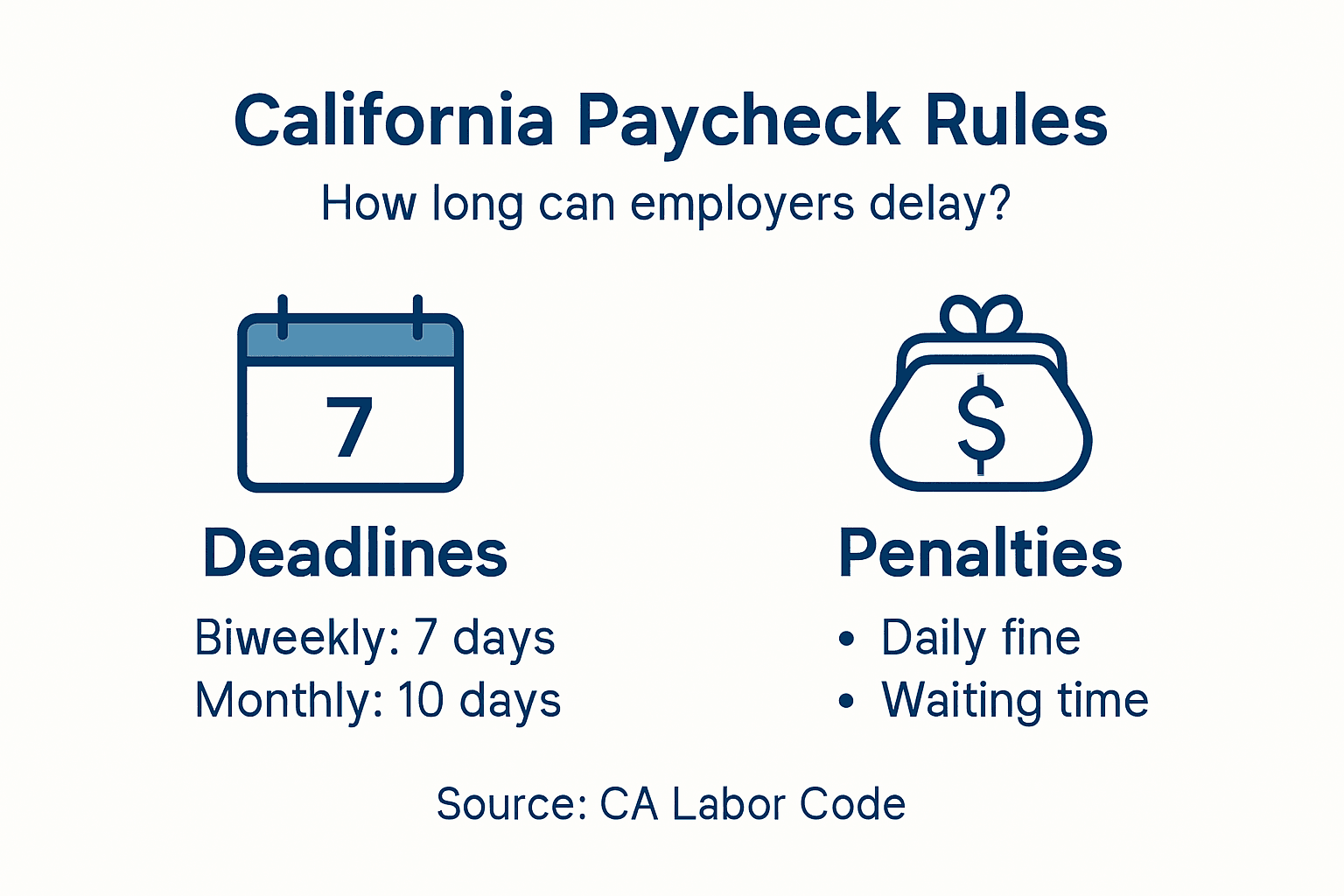
    Different pay schedules have unique requirements. For weekly or biweekly pay periods, employers must distribute wages within seven days after the pay period concludes. Immediate payment becomes mandatory when an employee is discharged or voluntarily terminates their employment.

    Employers are legally obligated to post clear notices about paydays, including specific payment times and locations. These notices help ensure transparency and give employees predictable wage expectations. Specialized industries like farm labor have additional nuanced payment regulations that require careful attention.

    Pro tip: Always keep detailed records of your work hours and verify your paystubs match the exact hours worked to protect your wage rights.

    Here’s a comparison of pay schedule rules and payment timelines for California employees:

    Pay Schedule Type Payment Deadline Applicable Circumstances Special Requirement
    Semi-monthly 1st half by 26th, 2nd by 10th next month Most workplaces Must occur regularly
    Weekly/Biweekly Within 7 days after pay period end Hourly and shift workers Include overtime in next payday
    Termination/Resignation Immediate or within 72 hours Anytime employment ends Immediate payment required

    Types of late wage payments and who is covered

    California’s labor laws provide comprehensive protections for employees across various wage payment scenarios. Late payment regulations cover multiple wage types and employment categories, ensuring workers receive timely compensation regardless of their employment status.

    The types of wage payments covered under California law include:

    • Regular hourly and salaried wages
    • Overtime compensation
    • Vacation and paid time off
    • Final wages upon employment termination
    • Commissions and performance-based payments
    • Supplemental wages like bonuses

    Employees protected by these regulations encompass a broad range of workers, including:

    • Full-time employees
    • Part-time workers
    • Temporary and seasonal employees
    • Contract workers
    • At-will employees
    • Workers in specialized industries (motion picture, oil drilling)

    Specific payment timelines vary depending on the wage type and employment circumstance. For instance, final wages must be paid immediately upon discharge or within 72 hours if an employee quits without prior notice. Overtime wages require payment by the next regular payday, while standard wages must be distributed at least twice per month on predetermined dates.

    Penalties for late payments can be significant, with employers potentially facing financial sanctions for consistently failing to meet wage payment deadlines. These regulations aim to protect workers from potential wage theft and ensure consistent, predictable compensation.

    Infographic California paycheck deadlines penalties

    Pro tip: Maintain detailed employment records and track your wage payments carefully to quickly identify and address any potential payment discrepancies.

    Penalties for missed or late paychecks

    California’s labor laws impose strict financial consequences for employers who fail to pay wages on time. Late payment penalties are designed to protect workers and ensure timely compensation across all employment sectors.

    The primary penalties for missed or late paychecks include:

    • Daily penalties for each workday wages remain unpaid
    • Waiting time penalties for involuntary terminations
    • Civil penalties payable to the state
    • Potential recovery of penalties through wage claims
    • Legal costs and potential litigation expenses
    • Penalties calculated based on employee’s daily rate

    Waiting time penalties are particularly significant. When an employee is involuntarily terminated, employers must pay all wages immediately or face escalating financial sanctions. These penalties can accumulate quickly, with employers potentially owing a full day’s wages for each day of delay, up to a maximum limit determined by the employee’s regular daily rate.

    Employees have multiple avenues to recover unpaid wages, including filing claims with the Labor Commissioner’s Office or pursuing action under the Private Attorneys General Act.

    The legal system provides robust mechanisms to ensure workers receive timely compensation and employers face meaningful consequences for wage payment violations.

    Pro tip: Document every instance of late payment meticulously, including dates and specific wage amounts, to strengthen your potential legal claim.

    Employee rights and options for recovery

    California provides robust legal mechanisms for workers to address wage payment violations and recover unpaid compensation. Wage claim procedures offer employees multiple pathways to assert their rights and seek financial recovery.

    Employees have several critical options for addressing late or missed paychecks:

    • File a wage claim with the Labor Commissioner’s Office
    • Pursue civil litigation against the employer
    • Submit a complaint through the Division of Labor Standards Enforcement
    • Request statutory penalties for continued wage violations
    • Seek recovery of unpaid wages plus potential interest
    • Challenge employer non-payment through administrative hearings

    Legal protections are comprehensive and designed to shield workers from potential retaliation. When an employee files a wage claim, the state provides safeguards to prevent employers from taking punitive actions like termination or demotion. These protections ensure workers can confidently pursue their rightful compensation without fear of workplace consequences.

    The wage recovery process typically involves submitting detailed documentation, including pay stubs, employment contracts, and records of communication with the employer.

    The Labor Commissioner’s Office investigates claims and can order employers to pay outstanding wages, penalties, and potential legal costs. This system creates a powerful deterrent against wage theft and ensures employees have meaningful recourse when their compensation rights are violated.

    Pro tip: Collect and preserve all employment documentation, including emails, pay stubs, and communication records, to build a strong case for wage recovery.

    The following table outlines common avenues for recovering unpaid wages in California and their main features:

    Recovery Method Action Required Outcome Possibilities Worker Protections
    Wage Claim (Labor Commissioner) File official claim Order for employer to pay Protection against retaliation
    Civil Litigation Hire attorney, sue employer Wage recovery, potential penalties Shielded from adverse employment
    Administrative Complaint Submit through enforcement Investigations, mandatory payment Confidential until resolved

    Steps to take if an employer does not pay wages

    California workers have multiple strategic options when confronting wage payment issues. Wage claim procedures offer comprehensive pathways for recovering unpaid compensation and addressing employer non-compliance.

    The recommended steps for addressing unpaid wages include:

    • Document all communication with the employer
    • Calculate the total amount of unpaid wages
    • Gather supporting evidence like pay stubs and work records
    • Send a formal written demand letter requesting payment
    • File a wage claim with the Labor Commissioner’s Office
    • Consider consulting with an employment law attorney
    • Prepare for potential administrative hearings

    Initial communication is crucial. Workers should first attempt to resolve the issue directly with their employer through written communication, maintaining a professional and factual tone. Detailed documentation of all interactions creates a strong foundation for potential legal action.

    If direct communication fails, employees can file a formal wage claim with the Division of Labor Standards Enforcement. The agency will investigate the claim, potentially schedule a hearing, and can order employers to pay outstanding wages, penalties, and legal costs. Employees are protected from retaliation during this process, ensuring they can confidently pursue their rightful compensation.

    Pro tip: Keep copies of all employment documents, emails, and communication records in a secure, organized system to strengthen your potential wage recovery claim.

    Protect Your Right to Timely Paychecks in California

    Delayed or missed paychecks can cause serious financial stress and uncertainty. If you are struggling with late wage payments or worried about your employer’s failure to pay, you are not alone.

    Understanding your rights and the legal tools available is critical to stopping paycheck delays and recovering the compensation you deserve.

    Visit California Labor Law to access detailed legal guides, use helpful calculators to estimate what you are owed, and discover how to confidently file a wage claim or pursue other recovery methods. Take control today by calling 1-866-355-9991 for a free paycheck delay consultation and stop employer wage violations before they escalate.

    Frequently Asked Questions

    How often must employers in California pay their employees?

    Employers in California are required to pay their employees at least twice per calendar month on designated paydays.

    What are the deadlines for paying wages in California?

    Wages for the first half of the month must be paid by the 26th, and wages for the second half must be paid by the 10th of the following month.

    What happens if an employer fails to pay wages on time in California?

    Employers may face penalties for each day wages remain unpaid, as well as waiting time penalties for involuntary terminations.

    Can employees take action if their wages are not paid on time?

    Yes, employees can file a wage claim with the Labor Commissioner’s Office or pursue civil litigation against their employer to recover unpaid wages.

  • Overtime Pay in California: What Every Worker Should Know

    Overtime Pay in California: What Every Worker Should Know

    California Overtime Rules 2026: Rates, Exemptions & What You’re Owed

    Working extra hours at a California retail store or hospitality venue should come with reliable pay, but many employees face confusion over the rules.

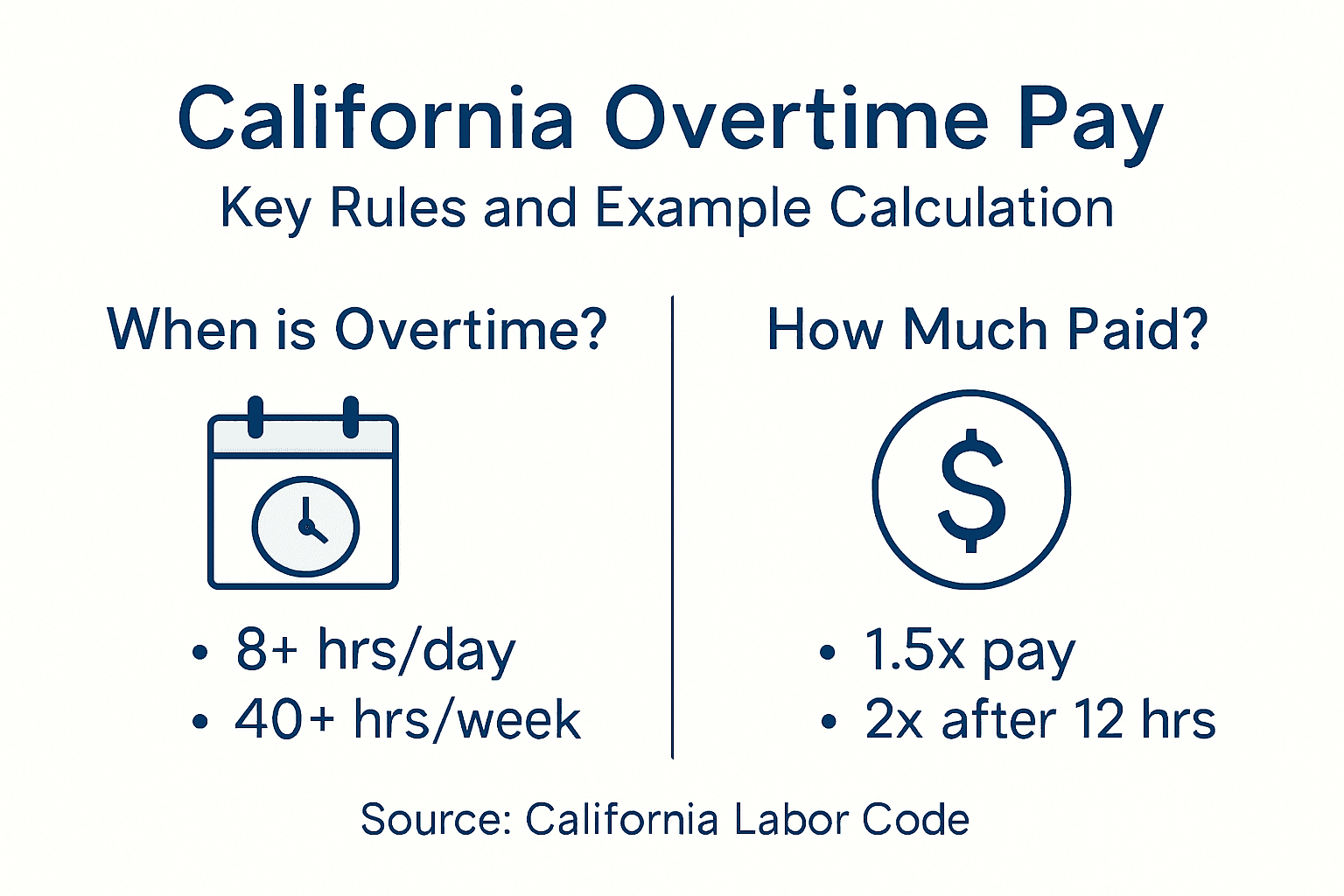
    California law requires most nonexempt workers to receive overtime pay for any hours beyond eight in a day or forty in a week, and double pay for shifts lasting over twelve hours.

    If paychecks do not reflect these hard-earned hours, understanding your correct rights and classifications can be the key to protecting your income.

    California Overtime Pay: Core Definitions

    Understanding overtime pay in California requires knowing precise legal definitions that protect workers’ rights. California Labor Code establishes clear guidelines for compensating employees beyond standard work hours, creating a robust framework for wage protection.

    At its core, California overtime law mandates specific compensation rates for nonexempt employees who work extended hours. The key overtime definitions include:

    • Regular Rate: Total compensation including base wage, commissions, and certain bonuses
    • Overtime Threshold: Hours worked beyond 8 per day or 40 per week
    • Overtime Rates:
      • 1.5x regular pay for hours worked over 8 in a single day
      • 1.5x regular pay for hours worked over 40 in a workweek
      • 2x regular pay for hours worked over 12 in a single day

    Important exemptions exist for certain professional categories, including executive, administrative, and professional employees who meet specific salary and job duty requirements. Overtime calculation rules can vary depending on an employee’s specific job classification and industry.

    Pro tip: Always track your hours meticulously and understand your specific employment classification to ensure you receive proper overtime compensation.

    Eligibility Rules for Overtime Pay

    Determining overtime pay eligibility is crucial for workers in California, as not all employees qualify for additional compensation. Employee classification rules create a complex framework that defines who receives overtime pay and under what circumstances.

    California’s overtime eligibility typically depends on several key factors:

    • Wage Threshold: Employees must earn less than twice the state minimum wage
    • Job Classification: Nonexempt employees in most industries are eligible
    • Work Hours: Hours worked beyond 8 per day or 40 per week qualify for overtime

    Specific exemption categories include:

    1. Executive employees with significant management responsibilities
    2. Administrative professionals performing specialized office work
    3. Professional workers in specialized fields
    4. Computer professionals meeting specific salary requirements
    5. Outside salespersons with mobile work arrangements

    Unique rules apply to certain worker categories. Agricultural workers, domestic employees, and union members might have different overtime standards compared to standard industry workers.

    Independent contractors are typically not eligible for overtime pay, making proper job classification critical.

    Here’s a quick reference comparing common employee categories and their overtime eligibility in California:

    Employee Category Overtime Eligible Key Determining Factor
    Nonexempt Employees Yes Paid hourly or salary under threshold
    Executive Employees No, usually exempt Management duties, salary requirements
    Computer Professionals Sometimes exempt Salary plus specialized job duties
    Independent Contractors No Not classified as employees

    California’s overtime laws aim to protect workers by ensuring fair compensation for extended work hours.

    Pro tip: Carefully review your job classification and employment contract to understand your specific overtime eligibility and potential compensation.

    How Overtime Wages Are Calculated

    Calculating overtime wages in California involves a precise method that goes beyond simple hourly multiplication. Overtime calculation rules require employers to consider multiple components of an employee’s compensation when determining overtime pay.

    The basic overtime calculation relies on the employee’s regular rate of pay, which encompasses more than just standard hourly wages. This comprehensive rate includes:

    • Base hourly wage
    • Commissions
    • Piece-rate earnings
    • Non-discretionary bonuses
    • Other forms of compensation

    Overtime rates in California follow these specific multipliers:

    1. 1.5x regular rate for hours worked over 8 in a single day
    2. 1.5x regular rate for hours exceeding 40 in a workweek
    3. 2x regular rate for hours worked beyond 12 in a single day
    4. 2x regular rate for the eighth hour worked on a seventh consecutive workday

    Complex scenarios can arise with varied pay structures, particularly for employees with multiple compensation types. Workers with commission-based or variable earnings must have their regular rate calculated carefully to ensure accurate overtime compensation.

    Pro tip: Keep detailed records of all hours worked and different compensation types to ensure accurate overtime calculation and protect your wage rights.

    Infographic with overtime pay rules and calculation example

    Understanding overtime exemptions in California requires careful examination of specific legal criteria. Exemption rules create a complex framework that determines which employees are not entitled to overtime compensation.

    The primary categories of overtime exemptions include:

    • Executive Employees: Those with significant management responsibilities
    • Administrative Professionals: Performing specialized office work
    • Professional Workers: Requiring advanced specialized knowledge
    • Computer Professionals: Meeting specific salary and job duty requirements
    • Outside Salespersons: With mobile work arrangements

    Key requirements for exempt status typically involve:

    1. Earning at least twice the state minimum wage
    2. Performing primarily intellectual or creative work
    3. Exercising independent judgment
    4. Spending more than 50% of work time on exempt duties

    Special considerations apply to unique worker categories. Agricultural workers, domestic employees, and union members often have different overtime standards. Some industries have specific exceptions that modify standard overtime rules, making it crucial for workers to understand their specific classification.

    Not all employees who receive a salary are automatically exempt from overtime pay.

    Pro tip: Carefully review your job description and actual job duties, as your official title may not always determine your overtime eligibility.

    Employer Responsibilities and Penalties

    Employers in California face substantial legal obligations when it comes to overtime compensation. Overtime compliance requirements create a strict framework of responsibilities that can result in significant financial consequences for violations.

    Key employer responsibilities include:

    • Accurately tracking employee work hours
    • Calculating overtime rates correctly
    • Maintaining comprehensive payroll records
    • Providing clear overtime pay on regular pay schedules
    • Compensating employees for all overtime worked

    Potential penalties for overtime violations can be severe and may include:

    1. Payment of back wages with interest
    2. Civil penalties up to $100 per pay period
    3. Additional damages equal to the unpaid overtime
    4. Potential criminal prosecution for repeated violations
    5. Legal costs and attorney fees

    The complexity of overtime regulations means employers must be vigilant. Small mistakes in record-keeping or payment calculations can quickly escalate into costly legal challenges. Workers have multiple avenues to report violations, including filing complaints with the California Labor Commissioner’s Office or pursuing private lawsuits.

    This table summarizes selected employer mistakes and the associated legal risks regarding overtime:

    Employer Mistake Possible Consequence Legal Risk Level
    Inaccurate hour tracking Back pay, penalties High
    Misclassifying employees Owed overtime, lawsuits High
    Late overtime payment Interest, extra damages Medium
    Incomplete payroll records Civil fines, compliance issues Medium to High

    Consistent and accurate overtime compliance is not optional – it’s a legal requirement.

    Pro tip: Implement robust time-tracking systems and regularly audit payroll practices to minimize the risk of unintentional overtime violations.

    Know Your Rights and Secure Every Overtime Dollar You Deserve

    California workers often face confusion and frustration when it comes to understanding overtime pay eligibility and proper calculation. If you have ever worried about whether your hours are tracked correctly or questioned if your job classification affects your overtime pay your concerns are valid.

    Misclassification and inaccurate pay calculations can lead to lost wages and missed opportunities to claim what you rightfully earned under California labor law.

    Explore our detailed guides and use our calculators to determine if your employer is meeting legal obligations. Don’t let improper overtime pay go unchecked take immediate action to protect your rights and claim the wages owed to you.

    Call 1-866-355-9991 now for a free overtime pay consultation and get connected to legal advocates ready to support your case. Your fair pay matters and now is the time to stand up for it.

    Frequently Asked Questions

    What is the overtime threshold in California?

    The overtime threshold in California is defined as hours worked beyond 8 hours in a single day or 40 hours in a workweek. Any hours over these limits are eligible for overtime pay.

    How is overtime pay calculated in California?

    Overtime pay in California is calculated by taking the employee’s regular rate of pay, which includes base wage, commissions, and certain bonuses, and multiplying it by 1.5 for hours worked over 8 hours in a day or 40 hours in a week. For hours worked over 12 in a day, the rate is doubled.

    Who is eligible for overtime pay in California?

    Eligibility for overtime pay in California generally applies to nonexempt employees who earn less than twice the state minimum wage, work in most industries, and work beyond 8 hours in a day or 40 hours in a week. Certain exemptions apply to executive, administrative, and professional employees.

    What are the penalties for employers who violate overtime pay laws?

    Employers who violate overtime pay laws may face severe penalties, including the payment of back wages with interest, civil penalties up to $100 per pay period, additional damages equal to unpaid overtime, and potential criminal prosecution for repeated violations.

  • Most Common Employer Violations in California

    Most Common Employer Violations in California

    Most Common Employer Violations in California (2026)

    Getting shorted on your paycheck or missing out on earned overtime is all too common for retail workers across California. When basic rights like fair wages and mandated breaks are ignored, your ability to pay bills and support your family is put at risk.

    Understanding what legally qualifies as an employer violation can help you reclaim what you are owed and put a stop to wage theft in the workplace.

    Defining Employer Violations Under California Law

    Employer violations in California represent systematic legal breaches that compromise employee rights and workplace standards. The California Labor Commissioner’s Office defines these violations as intentional or negligent actions that undermine fundamental worker protections established under state labor regulations.

    These violations can manifest in multiple forms, including:

    • Wage Theft: Failing to pay minimum wage or overtime compensation
    • Misclassification: Incorrectly categorizing employees as independent contractors
    • Break Violations: Denying mandatory meal and rest periods
    • Retaliation: Punishing employees who report workplace misconduct
    • Discrimination: Treating workers unfairly based on protected characteristics

    Under California labor regulations, employers are legally obligated to maintain specific workplace standards that protect employee rights. These standards encompass comprehensive requirements regarding compensation, working conditions, safety protocols, and fair treatment.

    The legal framework surrounding employer violations is complex and multifaceted. Employers can face significant financial penalties, including back wages, penalties, and potential civil litigation when they fail to comply with established labor standards. State agencies like the Division of Labor Standards Enforcement actively investigate and prosecute these violations to ensure economic justice.

    Pro tip: Document every workplace interaction and keep detailed records of hours worked, communications, and potential violations to strengthen your legal position if disputes arise.

    Here is a summary comparing the main types of employer violations under California law:

    Violation Type Typical Impact on Employees Common Employer Penalty
    Wage Theft Loss of earnings, financial stress Back pay, fines, civil damages
    Misclassification Denied benefits, tax issues Reclassification, penalties
    Break Violations Health risks, unpaid overtime Extra pay, penalties
    Retaliation Job loss, workplace hostility Reinstatement, emotional damages
    Discrimination Unequal opportunities, distress Fines, corrective action

    Wage Theft and Hourly Pay Infractions

    Wage theft represents a pervasive problem in California’s labor landscape, where employers systematically deny workers their legally earned compensation. Wage theft practices encompass a range of illegal actions that directly impact worker earnings and financial stability.

    The most common wage theft infractions include:

    • Minimum Wage Violations: Paying less than the mandated hourly rate
    • Overtime Compensation Denial: Refusing to pay required overtime wages
    • Off-the-Clock Work: Compelling employees to work without compensation
    • Illegal Wage Deductions: Improperly reducing employee paychecks
    • Tip Theft: Illegally appropriating employee gratuities

    In Los Angeles alone, workers lose millions weekly due to these unethical practices. Wage theft investigations reveal complex enforcement challenges, including prolonged legal processes and business closures that often prevent workers from recovering stolen wages.

    California law provides robust protections for workers, enabling them to file wage claims through the Division of Labor Standards Enforcement (DLSE). Employees can seek reimbursement for unpaid wages, penalties, and potential additional compensation for repeated or intentional violations.

    Pro tip: Maintain detailed employment records, including timesheets, pay stubs, and communication logs, to build a strong case if you suspect wage theft.

    Meal and Rest Break Violations Explained

    Meal and rest break violations represent significant legal issues for California employers, with strict regulations designed to protect worker rights and well-being. California labor regulations mandate specific requirements for meal and rest periods that employers must carefully follow to avoid penalties.

    The key meal and rest break requirements include:

    • Meal Break Mandate: 30-minute unpaid break for shifts exceeding 5 hours
    • Rest Break Requirement: 10-minute paid break for every 4 hours worked
    • Timing Restrictions: Breaks must be provided near the middle of work periods
    • Waiver Conditions: Limited options for mutually agreed break waivers
    • Penalty Provisions: One hour of additional pay for missed breaks

    Break scheduling guidelines emphasize that employers must not only provide breaks but actively authorize and permit them. Workplace circumstances matter, but legal standards remain paramount. Violations can result in significant financial penalties and potential legal action.

    Employers face substantial risks for non-compliance, including back pay, penalties, and potential wage claims. Workers have the right to report violations, and the Division of Labor Standards Enforcement actively investigates and enforces these critical worker protection standards.

    Pro tip: Keep detailed records of all work shifts and break times, documenting any instances where mandated breaks were not provided or were interrupted.

    Employee Misclassification and Its Impact

    Employee misclassification represents a serious legal and economic challenge in California, with far-reaching consequences for workers and businesses alike.

    Misclassification practices systematically deny workers critical legal protections and benefits they are legally entitled to receive.

    The key aspects of employee misclassification include:

    • Wage Protection Losses: Denial of minimum wage and overtime compensation
    • Benefit Elimination: Removal of workers’ compensation and unemployment insurance
    • Tax Revenue Reduction: Decreased government tax collection
    • Legal Rights Erosion: Circumvention of fundamental labor standards
    • Economic Inequity: Creating unfair competitive advantages for non-compliant businesses

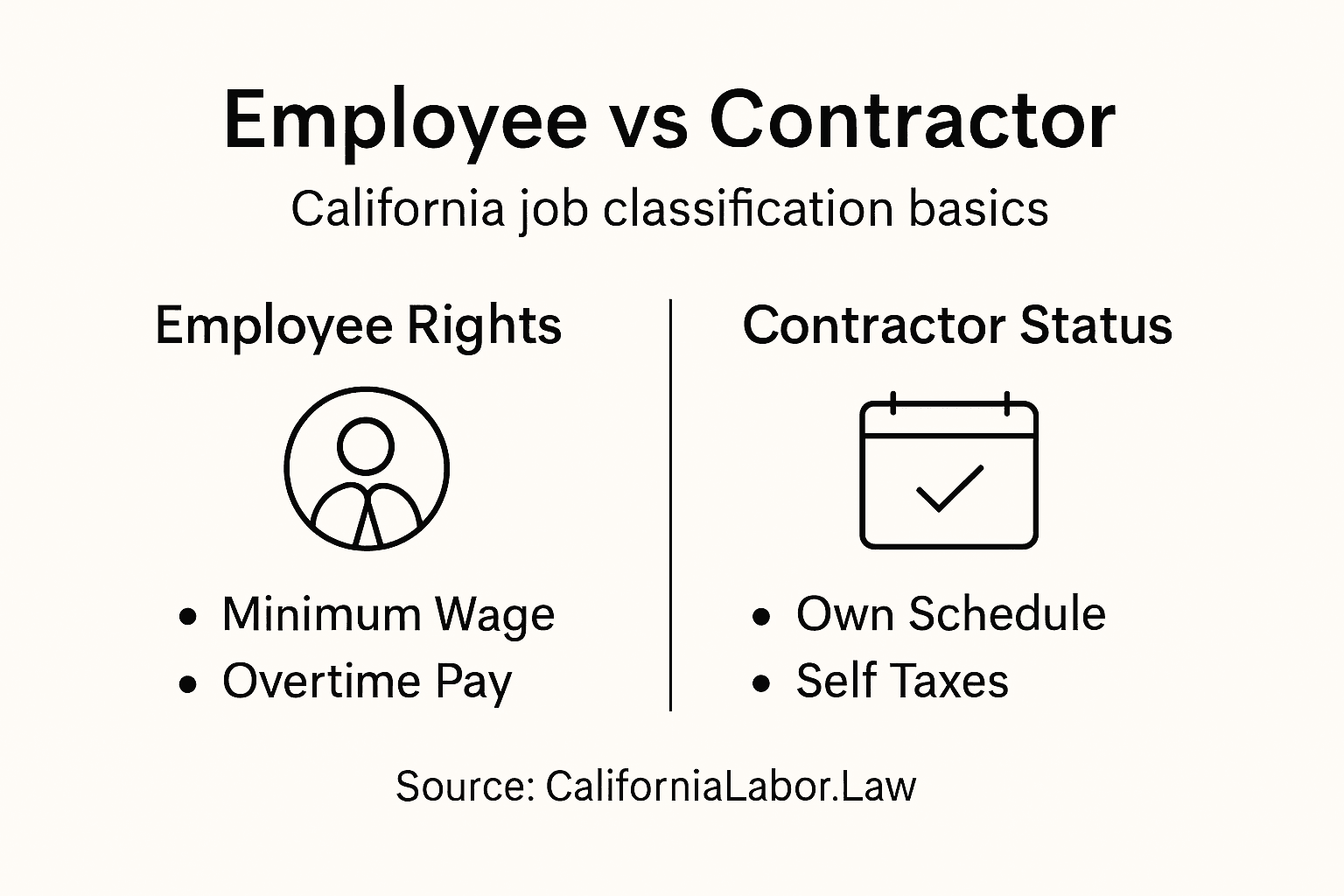
    Regulatory guidance emphasizes the importance of properly distinguishing between employees and independent contractors. The Dynamex ruling in California introduced the ABC test, which establishes stricter standards for worker classification and aims to prevent systematic worker exploitation.

    Employers who misclassify workers face significant legal risks, including potential back wage payments, penalties, and civil litigation. Workers impacted by misclassification can file claims to recover lost wages and benefits, challenging employers’ incorrect classification practices.

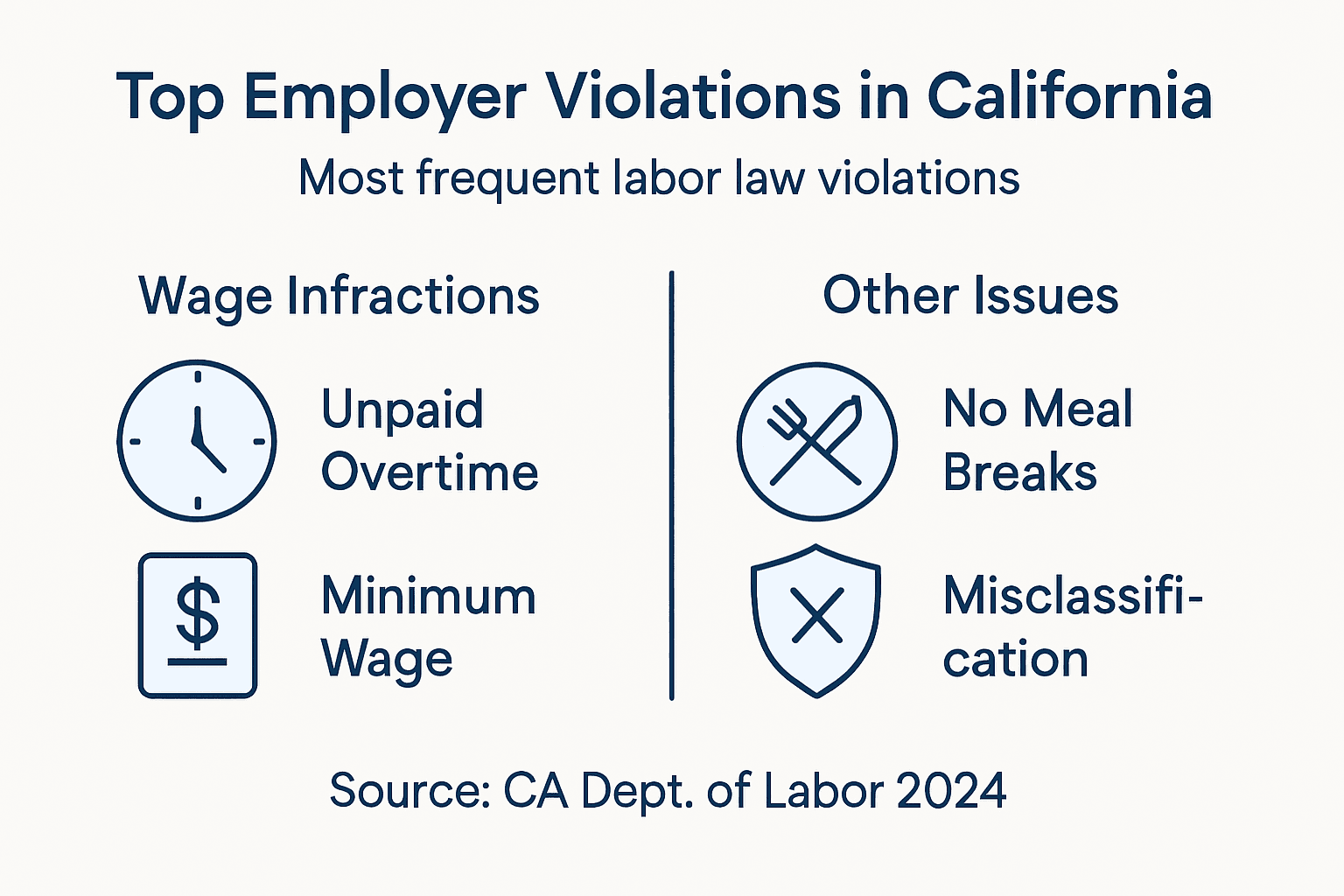
    Infographic outlining top California employer violations

    Pro tip: Always request a clear, written classification agreement and consult with an employment lawyer if you suspect improper worker classification.

    Retaliation and Wrongful Termination Risks

    California workplace protections establish critical safeguards against employer retaliation, ensuring workers can report misconduct without fear of punishment. Retaliation represents a serious violation of employee rights, encompassing any adverse action taken against workers who exercise their legal protections.

    Common forms of workplace retaliation include:

    • Termination: Firing an employee for reporting illegal activities
    • Demotion: Reducing job status after raising workplace concerns
    • Harassment: Creating hostile work environments to intimidate workers
    • Reduced Hours: Strategically cutting work schedules as punishment
    • Performance Sabotage: Manipulating evaluations to justify adverse actions

    Workplace retaliation investigations focus on proving intent and motivation behind adverse employment actions. The Fair Employment and Housing Act (FEHA) mandates that employers take reasonable steps to prevent and correct retaliatory practices, with significant legal consequences for violations.

    Employees have robust legal protections when reporting workplace issues, including discrimination, safety violations, wage disputes, and organizational misconduct. Workers who experience retaliation can file claims with state agencies, seek legal representation, and potentially recover damages for lost wages and emotional distress.

    Pro tip: Document every interaction and communication related to your workplace concern, including dates, witnesses, and specific details to strengthen potential legal claims.

    How Workers Can Report Employer Violations

    California workers have multiple channels for reporting employer violations, ensuring comprehensive protection of their workplace rights. The Labor Commissioner’s Office provides robust mechanisms for employees to address workplace misconduct and seek legal remedies.

    Key reporting methods include:

    • Online Wage Claims: Filing detailed complaints through official digital platforms
    • In-Person Filing: Submitting documentation directly at DLSE offices
    • Written Documentation: Preparing comprehensive violation reports
    • Anonymous Hotlines: Reporting concerns without direct identification
    • Legal Advocacy Channels: Seeking representation from employment attorneys

    Wage claim procedures involve a structured process that protects workers regardless of immigration status. The process typically includes initial claim filing, a settlement conference, and potential administrative hearing if necessary.

    Workers must carefully document all workplace interactions, including dates, specific violations, and supporting evidence. This documentation becomes critical during investigations, helping substantiate claims of minimum wage violations, overtime disputes, or improper workplace treatment.

    Pro tip: Preserve all employment-related communications, including emails, text messages, and pay stubs, as these can serve as crucial evidence when reporting workplace violations.

    Protect Your Rights Against Employer Violations in California

    If you are facing challenges like wage theft, meal and rest break violations, or wrongful termination as highlighted in the article Most Common Employer Violations in California your rights as an employee must be protected.

    Many workers suffer financial loss and stress from employer misclassification or retaliation without knowing the legal protections available under California law. Take control by understanding your rights to fair wages and lawful workplace treatment.

    At California Labor Law we provide legal guides and wage claim calculators that empower you to identify the compensation you may be owed. Don’t let improper unpaid wages or denied breaks go unchallenged.

    Access free legal resources today and connect directly with experienced legal advocates who can help you navigate claims for violations such as overtime denial, lost wages, or retaliation.

    Act now to secure your rightful pay and protect your future by calling 1-866-355-9991 to schedule a free employer violations consultation and learn how to assert your rights with confidence.

    Frequently Asked Questions

    What are some examples of employer violations in California?

    Employer violations in California include wage theft, misclassification of employees, break violations, retaliation against workers, and discrimination based on protected characteristics.

    How can I report wage theft in California?

    You can report wage theft by filing a claim with the Division of Labor Standards Enforcement (DLSE) either online or in person. Be sure to document all evidence related to wage violations, including pay stubs and time sheets.

    What are the consequences for employers who violate labor laws in California?

    Employers who violate labor laws can face significant penalties, including back wages owed to employees, fines, and potential civil litigation. The DLSE actively enforces these laws to ensure compliance.

    What should I do if I experience retaliation after reporting an employer violation?

    If you experience retaliation, document every interaction related to your concern and consider filing a claim with the appropriate state agency. You may also want to seek legal representation to protect your rights.

  • Salary Overtime Law: Protecting California Workers

    Salary Overtime Law: Protecting California Workers

    California Overtime Pay Requirements: Protecting Salaried & Hourly Workers

    Working extra shifts at a California restaurant or retail store can quickly rack up long hours, yet understanding your rights to overtime compensation is often unclear. Wage theft remains a serious problem for many frontline workers, with complex rules and exemptions making fair pay harder to claim.

    This article breaks down the bold differences between state and federal protections, explores employee classifications, and shows you how to spot unpaid wages and take action for your earned overtime.

    Defining Salary Overtime Law in California

    Salary overtime law in California represents a critical framework designed to protect workers’ rights and ensure fair compensation for extended working hours. These regulations go beyond federal standards, providing more robust protections for employees across various industries. California overtime pay rules establish clear guidelines for how and when workers must receive additional compensation.

    Under California law, overtime compensation is mandated for nonexempt employees who work beyond specific hourly thresholds. The state requires employers to pay one and one-half times an employee’s regular rate of pay in these key scenarios:

    • More than 8 hours worked in a single workday
    • More than 40 hours worked in a single workweek
    • First 8 hours worked on the seventh consecutive day of work

    Moreover, employees are entitled to double time pay for:

    • Hours worked beyond 12 in a single day
    • Hours worked beyond 8 on the seventh consecutive day of work

    The complexity of overtime calculations extends beyond simple hourly rates. Regular rate of pay includes not just base wages, but also encompasses commissions, non-discretionary bonuses, and other forms of compensation. This comprehensive approach ensures workers receive fair remuneration for their entire earnings spectrum.

    Exemptions do exist within these regulations. Certain employees, such as executive, administrative, and professional workers who meet specific salary and duty requirements, may be exempt from overtime pay. Understanding these nuanced classifications is crucial for both employers and employees.

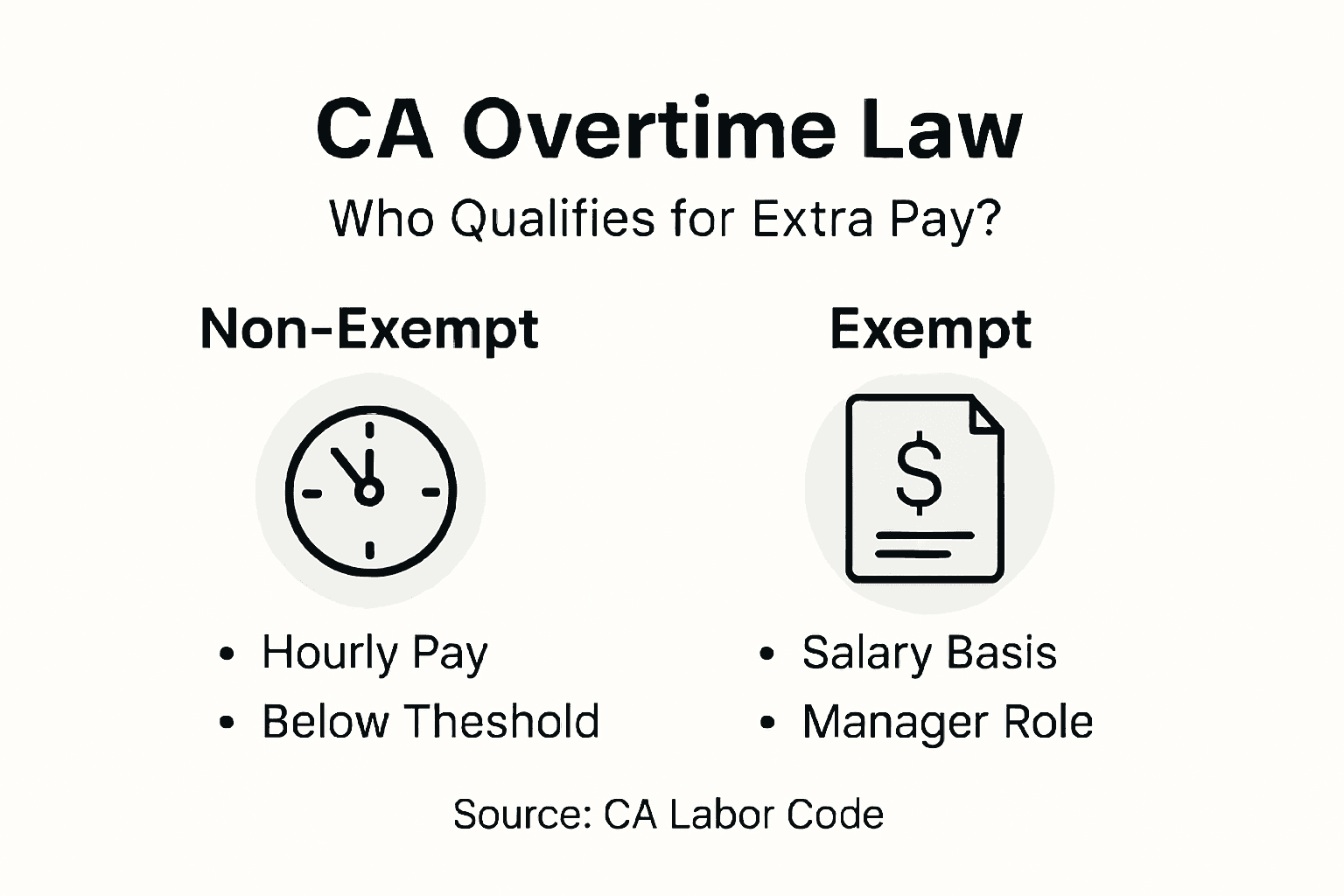
    Infographic explaining California overtime worker eligibility

    Eligibility Standards for Overtime Pay

    Determining overtime pay eligibility in California involves understanding a complex set of regulations that protect workers’ rights across various industries. Overtime eligibility rules distinguish between exempt and nonexempt employees, creating a nuanced framework for compensation.

    To qualify for overtime pay, workers must typically meet these fundamental criteria:

    • Be classified as a nonexempt employee
    • Work more than 8 hours in a single workday
    • Work more than 40 hours in a single workweek
    • Be 18 years or older (with some exceptions for minors)

    Certain employee categories are exempt from overtime regulations, including:

    • Executive employees with significant management responsibilities
    • Administrative professionals performing specialized office work
    • Professional employees with advanced educational backgrounds
    • Outside sales representatives
    • Some computer and technology professionals

    The exemption status depends on multiple factors, including:

    • Annual salary level
    • Specific job duties and responsibilities
    • Level of independent decision-making authority
    • Complexity of job functions

    California’s overtime laws provide more comprehensive worker protections than federal standards, ensuring fair compensation across diverse employment sectors.

    Salary thresholds play a critical role in determining overtime eligibility. Employees earning below a specific annual income are generally guaranteed overtime pay, regardless of their job responsibilities. These thresholds are periodically adjusted to reflect economic changes and cost of living increases.

    Worker checking pay statement at office desk

    Agricultural workers have unique considerations, with phased overtime requirements that have been gradually implemented since 2019. This reflects the state’s commitment to protecting workers in all industries, including those with traditionally lower wage structures.

    Pro tip: Carefully review your employment classification and maintain detailed work records to ensure you receive proper overtime compensation.

    Exempt vs. Non-Exempt Employee Distinctions

    Understanding the critical differences between exempt and non-exempt employees is essential for workers navigating California’s complex labor landscape. Employee classification rules establish fundamental distinctions that significantly impact wage and overtime entitlements.

    Key characteristics of exempt employees include:

    • Paid a fixed salary rather than hourly wages
    • Earn above a specific annual income threshold
    • Perform advanced professional, administrative, or executive duties
    • Exercise significant independent judgment
    • Not eligible for overtime compensation

    In contrast, non-exempt employees are characterized by:

    Here’s a summary comparing exempt and non-exempt employees in California:

    Criteria Exempt Employees Non-Exempt Employees
    Pay Structure Salaried, fixed amount Hourly wage based
    Overtime Eligibility Not eligible for overtime Entitled to overtime pay
    Job Duties Advanced, specialized responsibilities Routine or standardized tasks
    Decision-Making Significant independence Limited authority
    Record-Keeping Required No mandatory tracking of hours Must log all work hours
    • Hourly wage compensation
    • Earnings below the established salary threshold
    • Limited decision-making authority
    • Entitled to overtime pay
    • Required to track and report hours worked

    California labor laws provide more stringent worker protections compared to federal standards, ensuring comprehensive employee classification guidelines.

    The determination of exempt status relies on three primary tests:

    1. Salary Basis Test: Must receive a predetermined, fixed salary
    2. Salary Level Test: Minimum annual earnings threshold
    3. Duties Test: Specific job responsibilities and decision-making capabilities

    Employers must carefully evaluate multiple factors when classifying workers, including job complexity, autonomy, and compensation structure. Misclassification can result in significant legal and financial consequences.

    Pro tip: Review your job description, compensation structure, and actual work responsibilities to verify your correct employment classification.

    Calculating Overtime Rates and Payments

    Navigating overtime compensation in California requires a nuanced understanding of complex wage calculation methods. Overtime payment regulations establish precise guidelines for determining an employee’s additional compensation beyond standard work hours.

    Overtime rates in California are structured as follows:

    Below is a quick reference for California overtime pay rates and when they apply:

    Overtime Scenario Pay Rate (Multiplier) When It Applies
    Standard daily overtime 1.5 × regular rate Over 8 hours in a workday
    Weekly overtime 1.5 × regular rate Over 40 hours in a workweek
    Seventh consecutive workday (first 8) 1.5 × regular rate First 8 hours on day seven in a workweek
    Daily double time 2 × regular rate Over 12 hours in a workday
    Seventh workday double time 2 × regular rate Over 8 hours on seventh consecutive workday
    • Regular Overtime: 1.5 times standard hourly rate
      • Hours worked over 8 in a single day
      • Hours worked over 40 in a single workweek
    • Double Time: 2 times standard hourly rate
      • Hours worked over 12 in a single day
      • Hours worked over 8 on the seventh consecutive workday

    The regular rate of pay includes multiple compensation components:

    • Base hourly wage
    • Salary
    • Commissions
    • Piece-rate earnings
    • Non-discretionary bonuses
    • Performance incentives

    California’s overtime calculations provide more comprehensive worker protections compared to federal minimum standards.

    Calculating overtime involves several critical steps:

    1. Determine the employee’s regular hourly rate
    2. Identify total hours worked beyond standard thresholds
    3. Multiply excess hours by appropriate overtime multiplier
    4. Add overtime compensation to standard wages

    Employers must maintain meticulous records and accurately track work hours to ensure proper compensation. Alternative workweek schedules can introduce additional complexity, requiring careful interpretation of labor regulations.

    Pro tip: Keep detailed personal work logs and pay stubs to verify your overtime calculations and detect potential wage discrepancies.

    Employer Liabilities and Common Violations

    Employers in California face significant legal risks when failing to comply with overtime regulations. Workplace wage violations can result in substantial financial penalties and potential legal action.

    Common overtime violation categories include:

    Misclassification of Employees

    • Incorrectly labeling workers as exempt
    • Denying legitimate overtime compensation
    • Avoiding proper wage calculations

    Record-Keeping Violations

    • Failing to maintain accurate time records
    • Manipulating employee work hour documentation
    • Inadequate tracking of overtime hours

    Compensation Violations

    • Underreporting total hours worked
    • Miscalculating overtime rates
    • Refusing to pay required overtime wages

    California labor laws impose strict requirements on employers to ensure workers receive fair compensation for extended work hours.

    Legal consequences for overtime violations can be extensive:

    1. Payment of back wages
    2. Liquidated damages
    3. Civil penalties
    4. Potential criminal prosecution
    5. Mandatory business corrections

    The Labor Commissioner’s Office actively investigates complaints and can impose significant financial sanctions against non-compliant employers. Workers have multiple avenues to report violations, including direct complaints, legal actions, and third-party investigations.

    Pro tip: Document every work hour meticulously and retain copies of pay stubs and time records to protect your wage rights.

    Take Control of Your Rights Under California Salary Overtime Law

    Navigating the complexities of overtime eligibility and correct compensation can feel overwhelming. If you are struggling with understanding whether your job classification is exempt or non-exempt, or if you suspect your employer is miscalculating your overtime pay, you are not alone.

    Many California workers face challenges like misclassification, improper wage calculations, and denied overtime wages despite working beyond legal limits.

    At California Labor Law, we empower you with clear, trustworthy information about your rights under the state’s salary overtime laws. From detailed legal guides and explanations about exemption criteria to tools that help calculate your owed wages, we provide the resources you need to protect yourself.

    Don’t wait to claim the compensation you deserve. Call 1-866-355-9991 now for a free overtime pay consultation to understand your true eligibility for overtime pay and learn how to take action.

    Frequently Asked Questions

    What are the key overtime pay requirements in California?

    In California, employers must pay one and one-half times an employee’s regular rate of pay for working more than 8 hours in a single workday, more than 40 hours in a single workweek, and for the first 8 hours worked on the seventh consecutive day of work.

    Who is eligible for overtime pay in California?

    To qualify for overtime pay in California, workers must be classified as nonexempt employees, work more than 8 hours in a workday or 40 hours in a workweek, and be 18 years or older, with some exceptions for minors.

    What distinguishes exempt employees from non-exempt employees?

    Exempt employees are paid a fixed salary and perform advanced professional, administrative, or executive duties, making them ineligible for overtime pay. Non-exempt employees are typically paid hourly, earn less than the salary threshold, and are entitled to overtime pay.

    How is overtime pay calculated in California?

    Overtime pay in California is calculated by multiplying the employee’s regular hourly rate by 1.5 for standard overtime (over 8 hours in a day or 40 hours in a week) and by 2 for double time (over 12 hours in a day or over 8 hours on the seventh consecutive workday).

  • Are Non-Compete Contracts Legal in California?

    Are Non-Compete Contracts Legal in California?

    Non-Compete Contracts in California: Legal or Not? (Complete Guide)

    Facing a new job offer or exit in California can leave employees in technology and healthcare wondering if a non-compete agreement will limit their next career step.

    Understanding California’s strict prohibition on non-compete agreements is crucial, especially with so many contracts still including these clauses despite clear state law.

    This guide provides concise, up-to-date answers so you can approach your next move with confidence and protect your right to work.

    What Are Non-Compete Contracts?

    Non-compete contracts are legal agreements that restrict employees from working for competitors or starting similar businesses after leaving their current employment. These contractual provisions protect business interests by limiting an employee’s professional activities for a specified duration and geographic region.

    Typically, non-compete contracts contain several key components that define their scope and enforceability:

    • Duration of restrictions (usually 6-24 months)
    • Geographic limitations defining where restrictions apply
    • Specific competitive activities prohibited
    • Potential financial penalties for violation
    • Compensation considerations for the employee

    Business motivations for non-compete agreements are complex. They aim to prevent employees from immediately transferring specialized knowledge, client relationships, or proprietary strategies to direct competitors. These agreements are intended to protect employer investments in human capital, particularly in industries where intellectual property and specialized skills are critical.

    However, non-compete contracts are not universal or unconditionally enforceable. Different states have varying regulations, with California being notably strict about limiting such contractual restrictions. The primary goal is balancing legitimate business protection with an employee’s right to pursue professional opportunities.

    Pro tip: Always carefully review the specific terms of any non-compete agreement and consider consulting an employment lawyer to understand potential implications for your career trajectory.

    California Law on Non-Compete Agreements

    California stands out as a unique state with an exceptionally strict stance on non-compete agreements. California law explicitly prohibits employers from enforcing non-compete agreements, making these contracts essentially unenforceable across most industries and employment scenarios.

    The key aspects of California’s legal approach to non-compete contracts include:

    • Complete prohibition of most non-compete agreements
    • Protection of worker mobility and professional freedom
    • Rejection of geographic or time-based restrictions on employment
    • Severe penalties for employers attempting to enforce such agreements
    • Strong legal support for employees’ right to work

    Under California Business and Professions Code Section 16600, the state takes an unequivocal position that any contract restraining an individual from engaging in a lawful profession, trade, or business is void.

    This means that regardless of how an employer drafts a non-compete clause, California courts will typically invalidate such provisions, prioritizing an employee’s right to earn a living and maintain professional opportunities.

    Attorney reviewing California non-compete law

    Federal regulations are also aligning with California’s worker-friendly approach, with the Federal Trade Commission recently proposing rules that would significantly limit non-compete agreements nationwide. This trend underscores California’s long-standing commitment to protecting worker mobility and preventing anti-competitive business practices.

    Pro tip: Always request a copy of your employment contract and have it reviewed by a local employment attorney to understand your specific rights under California law.

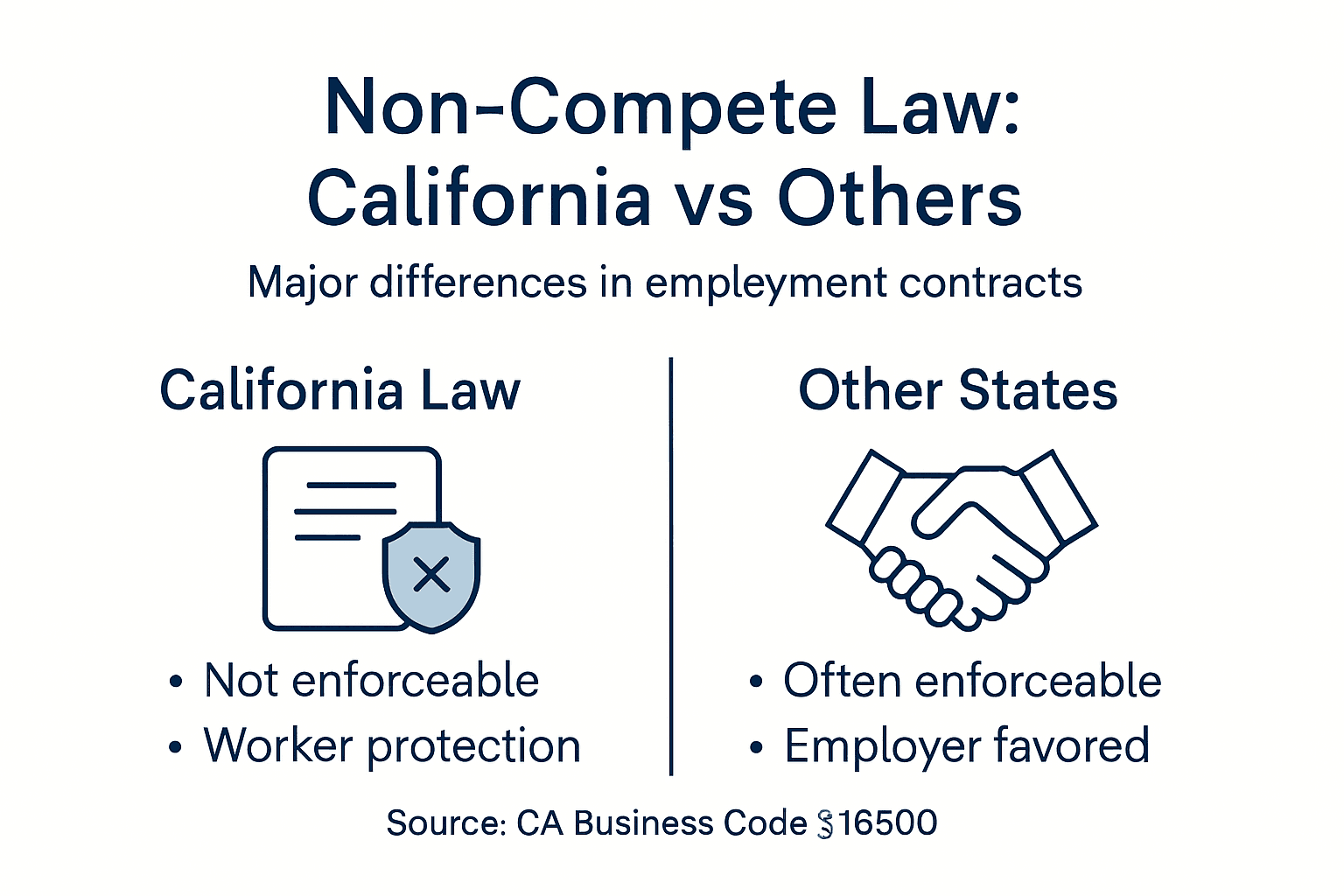
    Here’s how California’s approach to non-compete contracts compares with the general U.S. legal landscape:

    Aspect California Law Most Other States
    Enforceability Void in nearly all cases Often enforceable with limits
    Worker Mobility Fully protected Limited by contract terms
    Employer Penalties Severe sanctions possible Typically minor or none
    Use of Alternatives Focus on NDAs, IP laws Alternatives plus non-competes

    Infographic comparing non-compete laws by state

    Exceptions: Trade Secrets and Non-Solicitation

    While California’s stance against non-compete agreements remains firm, the state recognizes legitimate business interests that require protection. Employers can still safeguard critical business assets through carefully crafted legal mechanisms, specifically focusing on trade secrets and client relationships.

    The key alternative legal protections for businesses include:

    • Non-disclosure agreements (NDAs) that prevent information sharing
    • Non-solicitation clauses targeting client and employee poaching
    • Trade secret protection under state and federal laws
    • Confidentiality contracts with specific legal boundaries
    • Intellectual property safeguards that don’t restrict employment

    Trade secret protection represents the most robust exception to California’s non-compete restrictions. Businesses can take legal action if an employee misappropriates confidential information, technical processes, or proprietary strategies.

    This means while an employer cannot prevent you from working for a competitor, they can absolutely pursue legal remedies if you steal or improperly use their confidential information.

    Non-solicitation agreements provide another nuanced approach to protecting business relationships, allowing companies to prevent former employees from directly soliciting clients or other employees. These agreements must be narrowly crafted to avoid being interpreted as de facto non-compete contracts, which California courts will swiftly invalidate.

    Pro tip: Always carefully read the specific language of any confidentiality or non-solicitation agreement, and consider consulting an employment lawyer to understand your precise obligations.

    Here are the main legal alternatives California employers use instead of non-compete agreements:

    Method Primary Purpose Risk to Employee Common Use Case
    Non-Disclosure Agreement (NDA) Prevent secret info sharing Requires ongoing confidentiality Protecting client lists or formulas
    Non-Solicitation Clause Prevent poaching clients or staff Restrictions must be narrow Retaining customers or teams
    Trade Secret Protection Secure proprietary business data Legal action if misappropriated Technology or product design
    Confidentiality Contract Limit disclosure of sensitive data Clarifies information boundaries General business operations

    Employee Rights and Employer Obligations

    California workers have robust legal protections against anti-competitive employment restrictions, ensuring their fundamental right to pursue professional opportunities without undue constraints.

    The state’s legal framework prioritizes employee mobility and career freedom, placing significant responsibilities on employers to respect these rights.

    Key employee rights and employer obligations include:

    • Right to work in chosen profession without unreasonable restrictions
    • Prohibition of anti-competitive employment agreements
    • Protection against wage suppression tactics
    • Freedom to seek better employment opportunities
    • Legal recourse for workers facing unfair labor practices

    Employer obligations are comprehensive and strictly enforced. Businesses cannot create, enforce, or imply non-compete agreements that restrict an employee’s ability to work. This means employers are legally prohibited from developing contract language that could discourage or prevent workers from changing jobs, even within the same industry or with direct competitors.

    California’s Department of Justice actively monitors and enforces worker protection standards, ensuring that companies maintain fair labor practices. Employers who violate these standards can face significant legal penalties, including potential lawsuits, financial sanctions, and reputational damage.

    The state’s commitment to protecting worker mobility extends beyond merely invalidating non-compete agreements to actively preventing any practices that might limit professional opportunities.

    Pro tip: Document any suspicious contract language or employment practices that seem designed to restrict your career mobility, and consider consulting an employment lawyer if you feel your professional rights are being compromised.

    California has strengthened its legal stance against non-compete agreements with significant legislative updates effective January 1, 2024. These changes represent a comprehensive approach to protecting worker mobility and preventing anti-competitive employment practices across the state.

    The key recent legal modifications include:

    • Complete prohibition on drafting or enforcing non-compete agreements
    • Expanded worker protection mechanisms
    • Increased penalties for employers attempting to restrict employee movement
    • Retroactive invalidation of existing non-compete contracts
    • Enhanced legal recourse for workers facing contractual restrictions

    Statutory updates dramatically transform the legal landscape for employment contracts. Employers are now explicitly forbidden from not only enforcing non-compete agreements but also from attempting to create or negotiate such provisions.

    This represents a more aggressive approach compared to previous interpretations of California’s long-standing prohibitions against restricting worker mobility.

    Multistate legal coalitions are actively supporting nationwide efforts to ban non-compete agreements, signaling a broader movement toward protecting employee rights.

    California continues to lead these efforts, with Attorney General Rob Bonta playing a prominent role in supporting federal initiatives that would extend similar protections across the United States.

    Pro tip: Review any existing employment contracts with a legal professional to ensure they comply with the latest California non-compete regulations and do not contain any potentially unenforceable restrictive provisions.

    Understand Your Rights and Protect Your Future in California

    Navigating non-compete agreements in California can be confusing and stressful, especially with strict laws that often render these contracts unenforceable.

    If you are concerned about your employment contract, confidentiality clauses, or non-solicitation terms, you are not alone. Knowing your rights under California labor law is essential to safeguard your career mobility and prevent unlawful restrictions on your ability to work.

    At California Labor Law, we provide clear, reliable guidance tailored to California employees facing these challenges.

    Do not let confusing agreements limit your professional opportunities. Call 1-866-355-9991 today to schedule a free non-compete contract consultation and empower yourself with knowledge and get the support you deserve to stand up for your rights.

    Frequently Asked Questions

    Are non-compete contracts enforceable in California?

    Non-compete contracts are generally void in California, making them unenforceable across most industries and employment scenarios.

    What legal protections do employees have regarding non-compete agreements in California?

    California law protects employees’ rights to work without unreasonable restrictions, prohibiting anti-competitive agreements like non-compete contracts.

    What are the exceptions to non-compete restrictions in California?

    While non-compete agreements are typically unenforceable, businesses can protect trade secrets and client relationships through non-disclosure agreements (NDAs) and non-solicitation clauses.

    What recent changes have been made to non-compete laws in California?

    As of January 1, 2024, California has strengthened its prohibition against non-compete agreements, including increased penalties for violations and retroactive invalidation of existing contracts.

  • California Paid Sick Leave 2026: Expanded Rights and Compliance

    California Paid Sick Leave 2026: Expanded Rights and Compliance

    California Paid Sick Leave 2026: Expanded Rights, New Limits & Compliance Guide

    Missing a shift due to illness can leave many California hospitality and retail workers worried about losing wages or even their jobs. Recent legislative updates have strengthened protections, requiring most employers to provide at least five days or 40 hours of paid sick leave every year.

    Understanding these expanded rights helps workers in California safeguard both their health and paychecks, empowering them to stand up against wage theft and unfair treatment.

    Defining California Paid Sick Leave Laws

    California’s paid sick leave laws represent a comprehensive framework designed to protect workers’ health and financial stability. These regulations mandate that most employers provide employees with critical protections for personal and family medical needs.

    California’s paid sick leave requirements establish a minimum standard of care that applies across diverse industries and workplace environments.

    Under the current legislative framework, California employees are entitled to significant sick leave benefits:

    • Minimum of 5 days or 40 hours of paid sick leave annually
    • Eligibility begins after 90 days of employment
    • Accrual rate of one hour for every 30 hours worked
    • Usable for personal medical treatment, preventative care, and family member health needs

    The law’s scope extends beyond traditional illness scenarios. Employees can utilize paid sick leave for multiple critical situations, including:

    1. Personal medical treatment
    2. Medical appointments for preventative care
    3. Caring for ill family members
    4. Addressing medical emergencies
    5. Dealing with domestic violence, sexual assault, or stalking situations

    Employers have two primary methods of implementing these requirements. They can either:

    • Use an accrual method where employees earn sick time progressively
    • Provide a front-loaded approach with all sick days granted at the year’s start

    Compliance is mandatory for most California employers, with specific requirements varying based on company size and industry. The law ensures workers can address health needs without risking financial stability.

    Pro tip: Keep detailed records of your sick leave accrual and usage to protect your employment rights and ensure you receive all entitled benefits.

    Eligibility and Accrual Methods Explained

    California’s paid sick leave laws establish clear guidelines for employee eligibility and sick time accumulation. Sick leave requirements are designed to protect workers across various employment contexts, ensuring comprehensive coverage for most employees in the state.

    To be eligible for paid sick leave, employees must meet specific criteria:

    • Work at least 30 days within a year for the same employer
    • Complete a 90-day initial employment period
    • Be employed in California, regardless of full-time or part-time status
    • Cover both private and public sector workers

    Employers have two primary accrual methods for implementing sick leave:

    1. Standard Accrual Method
      • Earn one hour of sick leave for every 30 hours worked
      • Sick time accumulates progressively throughout the year
      • No immediate full allocation of sick days
    2. Front-Loading Method
      • Employers provide all 40 hours or five days upfront
      • Sick days granted at the beginning of each calendar year
      • Simplifies tracking for both employers and employees

    Employers cannot require employees to find replacement workers during sick leave, ensuring worker protection and reducing potential workplace complications.

    The law also includes important provisions regarding sick leave accrual and usage:

    • Maximum annual accrual of 80 hours or 10 days
    • Unused sick leave can be carried over to the next year
    • Employers can cap total sick leave at 40 hours or five days per year
    • Sick leave can be used for personal health, family care, and specific protective situations

    Pro tip: Maintain detailed personal records of your sick leave accrual and usage to ensure you receive all entitled benefits and can track your available time.

    Expanded Uses Under AB 2499 and AB 406

    The recent legislative updates to California’s paid sick leave laws represent a significant expansion of employee protections. Workplace sick leave regulations now encompass a broader range of personal and professional circumstances that extend far beyond traditional medical care.

    Key expanded uses under AB 2499 and AB 406 include:

    • Support for victims of crime and their family members
    • Attendance at judicial proceedings related to personal safety
    • Obtaining protective services
    • Addressing workplace environmental hazards
    • Supporting family members experiencing domestic violence

    For agricultural workers, the new laws provide critical protections:

    1. Use of sick leave during extreme heat conditions
    2. Sick leave for protection from wildfire smoke exposure
    3. Time off for workplace safety assessments
    4. Compensation during environmental risk periods

    These legislative changes recognize that workplace challenges extend beyond traditional medical needs, providing employees with comprehensive protection and support.

    Office manager reviews compliance sick leave checklist

    This quick reference summarizes expanded uses under recent legislation:

    Expanded Use Case Who Benefits Example Situation
    Crime victim support Employee, family Attending court or seeking help
    Extreme heat (agriculture) Agricultural worker Leave during wildfire or heatwave
    Environmental hazard response All employees Exposure to workplace risks
    Domestic violence protection Worker, family Time off for safety or relocation

    Pro tip: Document and communicate with your employer about the specific circumstances of your sick leave to ensure proper understanding and compliance with the new expanded regulations.

    Poster Requirements and Notice Compliance

    California employers face strict obligations regarding workplace rights notifications and paid sick leave poster requirements. Workplace rights notices represent a critical component of legal compliance for businesses across the state.

    The poster requirements for paid sick leave include several key elements:

    • Must be displayed in a conspicuous and accessible location
    • Visible to all employees during working hours
    • Posted in English and other languages spoken by workforce
    • Located in common areas like break rooms, hallways, or employee entrances

    Employers must ensure their workplace notices contain specific information:

    1. Total number of paid sick leave days available
    2. Accrual rate of sick leave hours
    3. Conditions for using sick leave
    4. Protection against retaliation for sick leave usage
    5. Employee rights under California law

    Failure to display required notices can result in significant penalties and potential legal complications for employers.

    Multilingual poster requirements are particularly important for California’s diverse workforce:

    • Notices must be available in languages spoken by 10% or more of the workforce
    • Translations provided by the California Labor Commissioner
    • Accurate representation of original English text
    • Easily understandable language for non-native speakers

    Additional compliance considerations include:

    • Annual distribution of updated workplace rights information
    • Maintaining current versions of required notices
    • Training management about poster requirements
    • Documenting poster display and distribution

    Pro tip: Take photographs of posted notices and maintain a log of display dates to protect your business in case of potential compliance audits.

    California’s paid sick leave laws impose substantial compliance requirements on employers across the state. Employer sick leave requirements create a complex legal landscape that demands proactive management and precise policy implementation.

    Key legal obligations for employers include:

    • Providing minimum 40 hours or five days of paid sick leave annually
    • Tracking and documenting sick leave accruals accurately
    • Updating workplace policies to reflect recent legislative changes
    • Maintaining transparent communication about sick leave rights
    • Avoiding retaliation against employees using sick leave

    The potential legal risks for non-compliance are significant:

    1. Financial penalties for each violation
    2. Potential wage claims by employees
    3. Litigation expenses
    4. Potential loss of business reputation
    5. State-level administrative sanctions

    Employers who fail to implement proper sick leave policies risk substantial financial and legal consequences that can far exceed the cost of compliance.

    Specific compliance requirements demand meticulous attention:

    • Accurate record-keeping of sick leave accruals
    • Providing clear written notices about sick leave policies
    • Training management on new legislative requirements
    • Implementing flexible sick leave usage protocols
    • Documenting all sick leave requests and approvals

    Employers must also address potential challenges by:

    • Developing comprehensive written sick leave policies
    • Creating standardized tracking mechanisms
    • Establishing clear communication channels
    • Regularly reviewing and updating workplace guidelines

    Best Practices for Employees and Employers

    Successful implementation of California’s paid sick leave laws requires collaborative efforts from both employers and employees. Workplace rights understanding creates a foundation for mutual respect and legal compliance.

    Best Practices for Employees:

    • Document all sick leave usage carefully
    • Communicate with employers in advance when possible
    • Understand your specific sick leave accrual rate
    • Keep personal records of sick leave hours
    • Know your rights against retaliation

    Best Practices for Employers:

    1. Develop clear, written sick leave policies
    2. Train management on new legislative requirements
    3. Create transparent tracking systems
    4. Maintain confidential employee records
    5. Establish consistent application of sick leave rules

    Effective communication and proactive policy management are the cornerstones of successful sick leave implementation.

    Key areas of focus for both parties include:

    • Understanding precise legal requirements
    • Maintaining accurate documentation
    • Protecting employee privacy
    • Ensuring fair and consistent policy application
    • Preventing potential workplace conflicts

    Strategic approaches can help minimize potential disputes:

    • Regular policy review and updates
    • Open communication channels
    • Comprehensive employee training
    • Flexible yet consistent sick leave protocols
    • Periodic compliance audits

    Pro tip: Consider scheduling quarterly reviews of sick leave policies to ensure ongoing compliance and address any emerging workplace challenges.

    Stay Informed and Protect Your Rights Under California Paid Sick Leave Laws

    The expanded California paid sick leave rights described in this article can feel overwhelming whether you are an employee striving to understand your accruals and protections or an employer working to avoid costly compliance mistakes.

    Critical terms like accrual methods, retaliation protections, and the new uses under AB 2499 and AB 406 highlight the complexity of navigating these laws on your own.

    Knowing your rights and obligations is essential to safeguarding your health, your family, and your livelihood.

    At California Labor Law we offer free easy-to-understand guides specifically built for California workers and employers dealing with labor law challenges.

    Whether you want to confirm your sick leave entitlements, track your accrued hours, or learn how to respond if your rights are violated, our resources provide clear answers. Don’t risk losing your benefits or facing retaliation when help is just a click away.

    Take action today by calling us at 1-866-355-9991 for a free paid sick leave consultation and empower yourself with the knowledge to claim every hour of paid sick leave you deserve.

    Frequently Asked Questions

    What are the minimum requirements for sick leave under California law?

    California law requires most employers to provide a minimum of 5 days or 40 hours of paid sick leave annually.

    How do employees accumulate sick leave in California?

    Employees earn sick leave at a rate of one hour for every 30 hours worked.

    Can paid sick leave be used for purposes other than personal illness?

    Yes, paid sick leave can be used for personal medical treatment, caring for ill family members, preventative care, and issues related to domestic violence, among other situations.

    What are the employer’s obligations regarding sick leave notifications?

    Employers must display clear workplace notices that outline sick leave rights, including the total number of sick leave days available and the conditions under which sick leave can be used.

  • California Wage Theft: How Employers Get Away With It

    California Wage Theft: How Employers Get Away With It

    California Wage Theft: How Employers Steal Wages and Often Get Away With It

    Missing a paycheck or seeing your hard-earned hours go unpaid can leave California retail and hospitality workers feeling frustrated and powerless. Wage theft in these industries is not just a rare mistake, but a problem deeply rooted in how some employers operate, especially across Los Angeles and other major California cities.

    This article explains what wage theft means under California law and shows clear steps you can take to protect your pay, understand your labor rights, and fight back against illegal employer practices.

    What Wage Theft Means In California Law

    Wage theft represents a serious violation of worker rights in California, encompassing multiple illegal practices where employers intentionally deny workers their legally earned compensation.

    Comprehensive wage theft research from the UCLA Labor Center reveals these violations systematically impact thousands of workers across the state, particularly in industries like hospitality, retail, and agriculture.

    In California law, wage theft specifically includes several distinct violations:

    • Paying less than minimum wage
    • Failing to pay overtime compensation
    • Forcing employees to work off-the-clock
    • Withholding final paychecks after employment termination
    • Denying required meal and rest breaks
    • Misclassifying workers as independent contractors to avoid labor protections

    The financial impact is significant. California workers collectively lose hundreds of millions of dollars annually through these illegal employer practices. While state labor laws provide robust protections, enforcement remains challenging. Many workers never recover their stolen wages due to complex legal processes and employer tactics designed to evade accountability.

    Employer strategies for avoiding wage theft accountability often include:

    • Rapidly changing business names
    • Creating shell companies
    • Declaring bankruptcy
    • Challenging wage claims through prolonged legal battles

    Pro tip: Document every hour worked, keep detailed pay stubs, and report suspected wage violations to California’s Labor Commissioner’s Office within strict statutory timelines.

    Common Wage Theft Tactics By Employers

    Employers in California deploy sophisticated strategies to illegally withhold worker compensation, targeting vulnerable populations through systematic wage theft techniques.

    Local law enforcement investigations reveal multiple calculated methods used to exploit employee labor and circumvent legal wage protections.

    Wage theft tactics commonly employed by unscrupulous employers include:

    • Misclassifying employees as independent contractors to avoid minimum wage and overtime requirements
    • Deliberately underreporting hours worked on official timesheets
    • Forcing employees to work through mandatory unpaid meal and rest breaks
    • Implementing off-the-clock work requirements without compensation
    • Withholding final paychecks after employment termination
    • Paying less than California’s mandated minimum wage

    Certain industries are more prone to these unethical practices. Hospitality, agriculture, construction, and service sectors frequently exploit immigrant and low-wage workers who may fear reporting violations due to potential retaliation. These workers often lack comprehensive understanding of their legal rights or face significant language and economic barriers to challenging wage theft.

    Diner server photographing handwritten timesheet

    The psychological and financial impact of these tactics extends far beyond immediate monetary loss. Workers experiencing consistent wage theft face increased economic instability, reduced earning potential, and significant emotional stress. Employers who consistently engage in these practices create systemic vulnerabilities that undermine worker protections and economic fairness.

    Pro tip: Maintain detailed personal work records, including dates, hours worked, and communication with employers, to build a strong case when reporting potential wage theft violations.

    Industries Most Vulnerable To Wage Theft

    Comprehensive wage theft research reveals that certain industries systematically expose workers to higher risks of compensation violations. Low-wage sectors consistently demonstrate the most significant vulnerabilities, creating a landscape of economic exploitation that disproportionately impacts workers with limited legal resources and job mobility.

    Industries with highest wage theft risks include:

    • Retail services with inconsistent hour tracking
    • Restaurant and food service with complex tip credit regulations
    • Construction involving complex subcontractor payment structures
    • Agriculture with challenging migrant worker protections
    • Janitorial and personal care services featuring fragmented employment arrangements
    • Manufacturing with complicated overtime calculation methods

    The underlying factors contributing to wage theft in these industries are complex and interconnected. Immigrant workers, part-time employees, and those with limited English proficiency face substantially higher risks. These workers often lack comprehensive understanding of their legal rights, creating environments where employers can systematically underpay or manipulate compensation structures.

    Economic research highlights that wage theft is not merely an isolated incident but a systemic problem deeply embedded in certain industry practices. Workers in these vulnerable sectors frequently experience multiple simultaneous wage violation strategies, including unauthorized deductions, misclassification, and deliberate underreporting of worked hours.

    Here’s a quick comparison of common industries and the unique factors that make them more vulnerable to wage theft:

    Industry Key Risk Factors Most Affected Worker Groups
    Agriculture Language barriers, seasonal jobs Migrant laborers, non-English speakers
    Retail Irregular shifts, understaffing Young employees, part-timers
    Construction Multiple subcontractors, paperwork gaps Day laborers, immigrants
    Food Service Tip credits, shift changes Servers, kitchen staff
    Janitorial/Personal Care Fragmented contracts, night shifts Immigrant and low-wage workers
    Manufacturing Overtime confusion, shift work Production line employees

    Pro tip: Always document your work hours independently, photograph timesheets, and maintain a personal record separate from employer documentation to protect yourself against potential wage theft.

    Workers can file wage claims through multiple legal channels designed to protect their rights and recover stolen wages, regardless of immigration status. California’s robust labor protection framework provides comprehensive safeguards for employees facing compensation violations.

    Key legal protections for California workers include:

    • The right to file wage claims with the Division of Labor Standards Enforcement (DLSE)
    • Protection against retaliation for reporting wage violations
    • Guaranteed minimum wage requirements
    • Mandatory overtime compensation
    • Prohibition of illegal paycheck deductions
    • Timely payment of all earned wages
    • Protection for workers regardless of immigration status

    Federal and state laws establish multiple layers of worker defense. The Fair Labor Standards Act (FLSA) and California Labor Code create strong foundational protections that prevent employers from systematically exploiting workers. These laws mandate specific employer responsibilities, including accurate record-keeping, proper wage classification, and transparent compensation practices.

    The legal system provides several enforcement mechanisms for workers experiencing wage theft. Employees can file claims online, by mail, or in person, with investigation timelines ranging from one to four years depending on the specific violation. Potential remedies include full wage recovery, penalties against employers, and potential additional compensation for damages.

    Pro tip: Maintain detailed personal documentation of hours worked, communications with employers, and any evidence of wage discrepancies to strengthen potential legal claims.

    How To Fight Back And Recover Wages

    Workers can recover unpaid wages through strategic legal actions designed to protect their economic rights and hold employers accountable for wage theft violations. Understanding the precise steps and resources available is crucial for successful wage recovery in California.

    Effective strategies for recovering stolen wages include:

    • Documenting all evidence of wage violations
    • Gathering pay stubs, time records, and employment communications
    • Filing formal wage claims with the Division of Labor Standards Enforcement
    • Consulting with employment rights organizations
    • Exploring potential civil lawsuit options
    • Reporting violations to state labor authorities
    • Utilizing federal and state wage recovery resources

    The legal process for wage recovery involves multiple potential pathways. Workers can file claims online, by mail, or in person with the California Labor Commissioner’s Office. These claims trigger investigations that may result in settlement conferences, administrative hearings, and potential wage reimbursement.

    Importantly, workers are protected from retaliation when pursuing legitimate wage theft claims.

    Timely action is critical in wage theft cases. California law provides strict filing deadlines that vary depending on the specific type of wage violation.

    Most wage claims must be filed within three years of the violation, though some cases might have shorter or longer statutes of limitations. Professional legal consultation can help workers understand their specific timelines and maximize their chances of successful wage recovery.

    This summary highlights key wage recovery steps alongside their primary benefits for California workers:

    Wage Recovery Action Main Benefit Who Should Use It
    Document violations Creates strong evidence All affected workers
    File claim with DLSE Triggers legal process Workers with wage loss
    Consult legal advocates Access expert support Complex or retaliatory cases
    Report to authorities Increases enforcement odds Repeated violations

    Pro tip: Preserve all employment documentation, including digital communications, and create a detailed chronological record of work hours and potential wage violations to strengthen your legal claim.

    Take Control Against Wage Theft in California

    Wage theft harms thousands of California workers every year by robbing them of their hard-earned pay through illegal practices like unpaid overtime and off-the-clock work. If you are struggling with withheld wages or employer retaliation, you are not alone.

    The challenges of navigating complex labor laws and employer tactics that hide wage violations can feel overwhelming. But you do have strong legal protections designed to help you reclaim what you deserve.

    At California Labor Law, we provide free, easy-to-understand resources and legal guidance to empower you against wage theft. Explore our detailed legal guides, use our wage calculators, and learn exactly how to document violations so you can build a compelling claim.

    Don’t wait until your lost wages disappear—take action today. Call 1-866-355-9991 now for a free confidential wage theft consultation to learn your rights and connect directly with legal advocates ready to fight for you. Your wages matter. Get the help you need now.

    Frequently Asked Questions

    What constitutes wage theft in California?

    Wage theft in California includes paying less than minimum wage, failing to pay overtime, withholding paychecks after termination, and not providing required meal and rest breaks.

    How can workers protect themselves from wage theft?

    Workers can protect themselves by documenting every hour worked, keeping detailed pay stubs, and reporting suspected violations to the Labor Commissioner’s Office within the time limits.

    What should I do if I suspect wage theft at my job?

    If you suspect wage theft, document your evidence, gather pay stubs and timesheets, and consider filing a claim with the Division of Labor Standards Enforcement (DLSE).

    How long do I have to file a wage theft claim in California?

    Most wage theft claims in California must be filed within three years of the violation, although some types of violations may have different time limits.

  • Employment Lawsuits in California: Typical Timeline and Delays

    Employment Lawsuits in California: Typical Timeline and Delays

    Employment Lawsuits in California

    Watching your paycheck fall short of what you earned stirs up real frustration. For California retail and hospitality workers, understanding the timeline of an employment lawsuit is more than curiosity, it means setting expectations and planning your next steps.

    Whether your wage theft dispute resolves quickly or turns into a lengthy battle, knowing the key factors that influence settlement timing helps you stand strong and make informed choices.

    When Will My Employment Lawsuit Settle?

    There’s no single answer because settlement timelines in California employment cases vary dramatically based on dozens of factors. Some wage theft claims settle within 6 to 12 months, while others drag on for 2 to 3 years. The honest truth: you won’t know your exact timeline until your case develops.

    Settlement depends heavily on whether your employer wants to fight or negotiate. If your company’s insurance carrier decides early that settling makes financial sense, you could reach an agreement relatively quickly.

    But if they believe they can win at trial or drag out litigation until you get exhausted, expect a much longer wait. The strength of your evidence matters too. If you have clear documentation of wage violations, unpaid overtime, or retaliatory actions, your leverage increases significantly.

    Most employment cases in California settle before trial. Courts are overwhelmed with cases, and judges actively encourage settlement through mandatory mediation. Once both sides understand their risks, many employers realize settling is cheaper than fighting. However, this only happens after months of discovery, depositions, and legal maneuvering.

    Your attorney’s strategy affects timing too. Aggressive litigation can actually speed things up by creating pressure on the other side. Conversely, attempting early settlement discussions with an employer who isn’t ready to talk wastes valuable time.

    Understanding wrongful termination settlement amounts helps you evaluate what reasonable compensation looks like in your situation.

    Attorneys negotiating at cluttered law office table

    Complexity adds months or years. Cases involving multiple violations, numerous employees, or retaliation claims require extensive investigation. A straightforward unpaid overtime dispute settles faster than a case alleging discrimination across your entire department.

    The court’s calendar also matters. If your case gets assigned to a judge handling thousands of cases, you’ll wait longer for hearing dates. Some courthouses have backlogs stretching 18 months or more.

    Pro tip: Ask your attorney for a realistic timeline estimate within your first month, including best-case and worst-case scenarios. This helps you mentally prepare and plan financially while your case develops.

    Why Employment Litigation Takes So Long

    Employment lawsuits move at a crawl compared to what most people expect. You might think a straightforward wage theft case could wrap up in months. Reality is messier. The California court system processes thousands of cases annually, and employment disputes aren’t prioritized over criminal matters or family law cases.

    Discovery is the biggest time killer. Both sides must exchange documents, emails, text messages, payroll records, and any evidence relevant to your claim. If your employer has poor record-keeping or intentionally buries documents, this phase alone can stretch 6 to 12 months. Your attorney needs time to review everything, identify inconsistencies, and build your case.

    Depositions add significant delays. These are sworn interviews where both sides question key witnesses and parties under oath. Scheduling depositions with multiple people, their attorneys, and court reporters requires coordinating calendars weeks or months in advance. A single deposition can last hours, and transcripts take weeks to prepare.

    Motions practice slows everything down further. Your employer’s legal team will file motions to dismiss, motions for summary judgment, and various procedural challenges. Each motion requires written responses from your attorney, and judges need time to rule on them. This back and forth can consume 3 to 6 months of your timeline.

    Mediation and settlement negotiations happen throughout the process but rarely resolve things quickly. Understanding California employee rights helps you negotiate from a position of knowledge, but these discussions require patience and multiple rounds of offers and counteroffers.

    Court backlogs create artificial delays. Trial dates get pushed back repeatedly. Judges get reassigned. Emergency motions from other cases bump your hearing. You could wait 18 months just to get a trial date on the calendar.

    Pro tip: Build your financial reserves now so you’re not desperate to settle quickly just because your case takes longer than expected. Financial breathing room gives your attorney leverage in negotiations.

    The Timeline for Employment Lawsuit Litigation

    A typical employment lawsuit in California follows predictable phases, though the total duration varies wildly. From initial complaint to final resolution, expect anywhere from 18 months to 4 years. Most cases cluster around the 2 to 3-year range, but outliers exist on both ends.

    Infographic showing lawsuit phases and delays

    The first phase is the pleadings stage. You file your complaint, your employer responds with an answer or motion to dismiss, and basic procedural matters get resolved. This takes 2 to 4 months. Nothing dramatic happens here, but it officially launches your case into the system.

    Discovery follows next and typically consumes 6 to 12 months. This is when both sides request and exchange documents, interrogatories, and requests for admissions. You’ll answer written questions under oath. Your employer will do the same. Depositions happen during this phase too, with schedules stretching across months as attorneys coordinate availability.

    Motions practice occurs simultaneously with discovery and afterward. Expect your employer to file a motion for summary judgment arguing there are no disputed facts and they should win without trial. You respond. The judge rules. This entire cycle takes 3 to 6 months. Your attorney’s role becomes critical here, and having skilled employment law representation directly impacts whether weak claims get dismissed early.

    Mediation typically happens after discovery concludes. Courts often require it. Both sides meet with a neutral mediator who helps facilitate settlement discussions. If you don’t settle, trial preparation begins. This includes finalizing witness lists, organizing exhibits, and preparing opening statements.

    Trial itself might last anywhere from 3 to 10 days depending on complexity. Then judges take weeks or months to issue written decisions. Add another 2 to 4 months here.

    Below is a summary of typical phases and estimated timeframes for an employment lawsuit in California:

    Lawsuit Phase Typical Duration Main Activities
    Pleadings 2–4 months Filing complaint, employer response
    Discovery 6–12 months Evidence exchange, depositions
    Motions Practice 3–6 months Motions to dismiss, summary judgment
    Mediation/Negotiation Varies, often post-discovery Settlement discussions, mediation
    Trial & Decision 3–10 days trial; 2–4 months for decision Trial presentations, verdict

    Pro tip: Request a detailed litigation roadmap from your attorney showing anticipated dates for each phase, so you understand what’s coming and can plan accordingly.

    What to Expect as a Plaintiff in California

    Being a plaintiff in an employment lawsuit means stepping into a process that’s equal parts tedious and stressful. You’ll spend months answering questions under oath, reviewing documents until your eyes blur, and waiting for developments that often don’t happen on your timeline. Understanding what lies ahead helps you prepare mentally and strategically.

    You’ll be deposed early in the discovery phase. Your employer’s attorney will ask you detailed questions about everything related to your case. Bring documents, stay composed, and answer only what you’re asked. Don’t volunteer information or get emotional, even when questions feel accusatory. This deposition becomes part of the trial record if your case goes to court.

    Document review consumes enormous amounts of time. You’ll receive thousands of pages of emails, text messages, and payroll records. Your attorney needs you to review these materials, identify relevant ones, and explain context that only you know. This isn’t glamorous work, but it’s essential for building your case.

    You’ll need to be honest about your own conduct. If you violated company policies, made mistakes at work, or behaved poorly, opposing counsel will find out and use it against you. The best plaintiffs are those who acknowledge their own imperfections while still proving their employer violated the law. Understanding workplace discrimination types and impacts helps you recognize what violations occurred and what didn’t.

    Mediation requires patience and realistic expectations. Judges won’t force settlement, but most cases resolve through negotiation. You’ll make an opening statement about why your case has value, listen to your employer’s position, and gradually work toward compromise. Settlement rarely feels fair to either side, but it ends uncertainty.

    Prepare for emotional ups and downs. Lawsuits trigger anxiety about your career, finances, and reputation. Some days you’ll feel hopeful. Other days you’ll question whether fighting is worth it. Having strong legal representation and emotional support from friends or family makes this bearable.

    Pro tip: Keep a detailed timeline of employment events from day one, noting dates, witnesses, and what happened. This document becomes invaluable during depositions and saves your attorney countless hours of investigation.

    Key Factors Impacting Resolution Time

    Not all employment lawsuits follow the same timeline. Several critical factors either accelerate your case or bog it down for years. Understanding these variables helps you anticipate delays and work with your attorney to stay on track.

    The strength of your evidence makes an enormous difference. If you have payroll records showing unpaid wages, text messages proving retaliation, or witness statements confirming violations, your case moves faster. Strong evidence encourages settlement because the other side recognizes their risk. Conversely, cases built on circumstantial evidence or inconsistent accounts drag through lengthy discovery as both sides battle over interpretation.

    The number of witnesses involved directly impacts timeline. A simple wage theft case with just you and your manager moves quicker than a case involving 50 employees across multiple locations. Each additional person requires depositions, coordination, and potential conflicts in testimony.

    Your employer’s litigation strategy shapes everything. Some companies have insurance policies that encourage settlement to protect their ratings. Others fight aggressively on principle or to avoid setting precedents. An employer with significant resources can afford prolonged litigation and will use that advantage. Cases involving workplace harassment or discrimination often take longer because they require proving intent and pattern behavior.

    Case complexity matters significantly. Straightforward wage theft claims settle faster than claims involving trade secret theft, non-compete violations, or systematic discrimination. More legal issues mean more motions, more discovery disputes, and more time before judges.

    The judge assigned to your case affects pacing too. Some judges push cases toward settlement aggressively. Others allow extensive discovery and lengthy briefing schedules. An overworked judge might delay hearings repeatedly, extending your timeline involuntarily.

    Mediation timing influences outcomes. Early mediation sometimes resolves cases before expensive discovery, but it can also waste time if either party isn’t ready. Late mediation occurs after discovery concludes, when both sides understand their positions better and settlement becomes more realistic.

    Pro tip: Ask your attorney to identify which factors in your case create delays versus accelerate resolution, then focus energy on controlling what you can to keep momentum.

    Here’s how common factors affect the timeline of California employment lawsuits:

    Factor Tends to Speed Up Case Tends to Cause Delays
    Evidence Strength Clear, direct documentation Weak, circumstantial, in dispute
    Number of Witnesses Few witnesses Multiple or hard-to-find witnesses
    Claims Complexity Simple wage or overtime case Multitude or pattern violations
    Employer’s Strategy Seeks early negotiation Fights or prolongs litigation
    Court/ Judge Assignment Efficient judge, low backlog Overloaded judge, long backlog

    Understand Your Employment Lawsuit Timeline and Take Control Today

    Facing the uncertainty of a prolonged employment lawsuit can be overwhelming. Whether you are struggling with delays caused by complex discovery, numerous depositions, or aggressive employer tactics, knowing what to expect is vital.

    At California Labor Law, we provide essential legal guides and tools to help you understand your rights and the typical timelines for employment disputes.

    Call 1-866-355-9991 now to schedule a free employment lawsuit consultation, plan strategically, and connect with legal advocates ready to assist you. Time matters—empower yourself to act today.

    Frequently Asked Questions

    How long does the typical employment lawsuit process take in California?

    A typical employment lawsuit in California can take anywhere from 18 months to 4 years, with most cases settling around the 2 to 3-year mark.

    What factors influence the timeline for an employment lawsuit?

    The timeline can be influenced by the strength of your evidence, the number of witnesses, case complexity, your employer’s litigation strategy, and the assigned judge’s workload.

    Why does the discovery process take so long in employment lawsuits?

    Discovery involves the exchange of evidence between both parties, which can be time-consuming, especially if there are many documents to review, depositions to schedule, and potential disputes over the evidence.

    What role does mediation play in the resolution of employment lawsuits?

    Mediation allows both parties to negotiate a settlement with a neutral third party. It often occurs after discovery and can lead to quicker resolutions if both sides are ready to compromise.

  • 1099 Employee vs W2: Know Your California Rights

    1099 Employee vs W2: Know Your California Rights

    California 1099 vs W2: What Workers Need to Know About Their Rights

    Getting paid what you deserve in California can depend entirely on whether you are a 1099 independent contractor or a W2 employee.

    For gig workers and freelancers, this difference impacts every paycheck, the taxes you owe, and whether you receive legal protections if your employer underpays you.

    Understanding your classification is the first step toward safeguarding your rights under California law, especially when wage theft or misclassification enters the picture.

    Defining 1099 Employee and W2 Status

    The difference between being classified as a 1099 independent contractor and a W2 employee shapes nearly every aspect of your work life in California. These two classifications determine how you pay taxes, what protections you receive, whether you get benefits, and crucially, what happens if your employer fails to pay you correctly.

    Understanding which category applies to you isn’t just about paperwork. It’s about knowing your actual rights under California law.

    A 1099 worker is classified as an independent contractor who typically receives income reported on Forms 1099-MISC, 1099-K, or 1099-NEC. These workers maintain control over how and when they complete their work, set their own schedules, and handle their own payroll taxes without employer withholdings.

    You’re responsible for paying both the employee and employer portions of Social Security and Medicare taxes, which can add up to roughly 15.3 percent of your earnings.

    As an independent contractor, you also bear the cost of your own equipment, workspace, and any training required for the job. The appeal for many gig workers is flexibility, but that freedom comes with significant financial responsibility and fewer legal protections.

    Many delivery drivers, rideshare drivers, and freelance service providers fall into this category, though California has specific rules about which gig economy drivers qualify as independent contractors under certain conditions.

    In contrast, a W2 employee works under your employer’s control and supervision, with wages reported on Form W-2. Your employer withholds federal and state income taxes, Social Security, and Medicare from your paycheck automatically. This means you don’t need to pay those taxes yourself when you file your return.

    W2 employees receive mandatory benefits including workers’ compensation insurance, unemployment insurance eligibility, and access to minimum wage protections under California labor laws. Your employer covers equipment costs, provides a workspace, and typically handles training expenses.

    The trade-off is less schedule flexibility, though California law gives you significant protections around rest breaks, meal periods, overtime pay, and other working conditions.

    How income is reported federally and on state tax returns directly affects your tax filing and what deductions you can claim.

    Supervisor directs employee at cubicle desk

    The fundamental difference comes down to control and relationship structure. When determining if you’re an employee or contractor, California focuses on whether the hiring entity controls how, when, and where work gets done.

    If your employer dictates your hours, provides tools and training, supervises your work closely, and integrates you into the company’s operations, you’re likely an employee regardless of what your contract says.

    If you truly control your work methods, set your own schedule, work for multiple clients, and maintain an independent business, contractor status may apply. But California courts lean heavily toward employee classification when facts are unclear, which benefits workers significantly.

    Here’s a side-by-side comparison of core differences between 1099 independent contractors and W2 employees in California:

    Aspect 1099 Contractor W2 Employee
    Tax Withholding No employer withholding Taxes withheld automatically
    Benefit Eligibility No legal guarantee Access to statutory benefits
    Work Flexibility Sets own hours and methods Follows employer schedules
    Legal Protections Limited, mostly contract-based Extensive under labor laws

    Pro tip: Request a written classification statement from your employer and verify it matches how you actually work, then contact a California labor advocate if discrepancies exist between your classification and your real working conditions.

    California doesn’t rely on what your contract says or what tax forms get filed. The state uses a specific legal test to determine whether you’re actually an employee or independent contractor, and this test overrides almost everything else. This is critical because misclassification can cost employers significant money in penalties, back wages, and damages, which means they have strong incentives to fight your classification claims.

    Understanding how California evaluates your status gives you the power to recognize when you’re being wrongly classified and what steps to take.
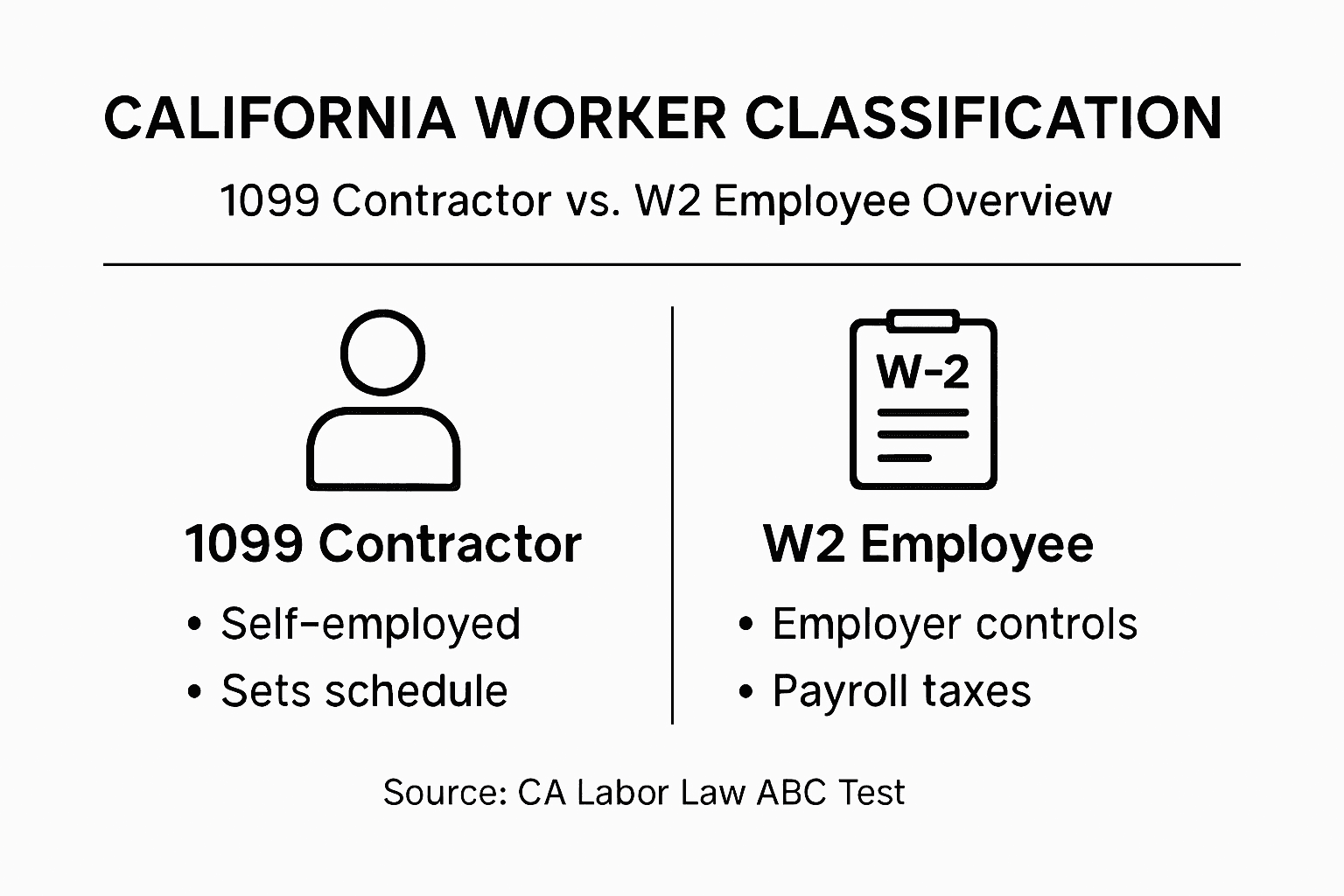
    Infographic comparing 1099 vs W2 classification

    The ABC Test is California’s primary legal standard for classifying workers, and it comes from Assembly Bill 5. Here’s how it works: for you to qualify as an independent contractor, all three conditions must be true simultaneously.

    First, the hiring entity must have no control over how you perform your work, including the methods you use and the hours you work.

    Second, you must perform work that falls outside the usual business of the company hiring you. Third, you must be independently established in your own trade or business.

    Think of it this way: if you’re a freelance accountant working for multiple clients and setting your own hours, you might pass the test. But if you’re working set hours for one company doing exactly what employees do there, you fail the test.

    California’s ABC Test framework clarifies that signed agreements and tax forms alone cannot override these requirements, no matter what language your contract contains.

    What makes the ABC Test so powerful for workers is that it’s extremely strict. You don’t need to prove you’re misclassified according to some vague standard. California has spelled out exactly what needs to happen, and employers must meet every single criterion.

    Many companies try to get around this by having workers sign agreements claiming independent contractor status, but those contracts mean almost nothing if the actual working relationship doesn’t fit the legal test. Courts consistently rule that the reality of how you work matters far more than paperwork.

    If you work regular hours, get directions from a manager, use company equipment, and perform core business functions, you’re likely an employee regardless of your contract language or the 1099 forms you receive.

    The consequences for misclassification are substantial. Employers who wrongly classify employees face significant legal consequences and misclassification risks including unpaid wages, overtime violations, benefits liability, and civil penalties.

    California’s Department of Industrial Relations actively investigates wage theft cases, and misclassification often leads to wage theft claims because misclassified workers typically earn less than they legally deserve. You also lose access to workers’ compensation if injured, unemployment insurance if laid off, and minimum wage protections while working.

    These aren’t theoretical risks for many gig workers who discover too late that they should have been classified as employees all along.

    Pro tip: Document how you actually work for at least two weeks, noting who controls your schedule, what tools you use, who supervises you, and whether you work for other companies, then compare your real working conditions against the three ABC Test requirements to identify potential misclassification.

    Major Distinctions: Pay, Benefits, and Control

    The gap between 1099 and W2 status extends far beyond tax forms. Your classification determines whether you receive a steady paycheck, health insurance, workplace protections, or whether you’re left covering every cost yourself.

    For gig workers juggling multiple income sources or those misclassified in their current role, understanding these distinctions can reveal thousands of dollars in missing wages and benefits you should have received.

    Payroll and tax withholding work completely differently depending on your status. When you’re a W2 employee, your employer deducts federal income tax, Social Security, Medicare, and state income tax directly from each paycheck before you see the money. This means you don’t face a tax surprise when April arrives.

    Independent contractors receive the full amount owed with no withholdings, then must set aside money themselves to pay federal and state taxes quarterly, plus both the employee and employer shares of Social Security and Medicare taxes.

    The self-employment tax alone adds up to approximately 15.3 percent of your net earnings that you must pay out of pocket. Many 1099 workers underestimate this burden and find themselves short when tax time arrives.

    Beyond payroll taxes, W2 employees receive regular wages with payroll taxes withheld and legal protections including minimum wage, while contractors pay their own taxes and receive no minimum wage guarantee if work slows down.

    The benefits gap creates significant financial vulnerability for misclassified workers. W2 employees in California have access to workers’ compensation insurance, which covers medical expenses and lost wages if you’re injured on the job. You’re also eligible for unemployment insurance if your employer lays you off or fires you without cause.

    Many employers offer health insurance, retirement plans, and paid time off to W2 employees. Contractors get none of this. If you get hurt while working as a 1099 contractor, you’re responsible for your own medical bills and lost income. If work dries up, you receive nothing. If you need a break for illness or personal reasons, you lose income with no safety net.

    You also bear the cost of equipment, vehicles, workspace, and any training required for your work. The financial pressure to keep working despite illness or exhaustion is intense for contractors without these protections.

    Control over your work schedule and methods represents the final major distinction. W2 employees work under employer direction, with managers assigning tasks, setting schedules, and determining work methods. This means less flexibility but also clear boundaries on expectations. Independent contractors theoretically control when and how they work, choosing their own hours and methods. This sounds appealing until you realize that less control can actually mean more pressure.

    When you’re classified as a 1099 contractor, companies often demand faster work, tighter deadlines, and higher quality without adjusting pay. The lack of formal employment relationship means fewer protections against arbitrary demands or payment disputes.

    Pro tip: Calculate your actual hourly earnings as a 1099 contractor by subtracting all business expenses and self-employment taxes from gross income, then divide by actual hours worked to see whether you’re earning less than minimum wage, which could indicate misclassification.

    Rights, Protections, and Obligations for Each Type

    Your employment classification determines not just your paycheck, but whether California law actively protects you from exploitation. W2 employees operate under a comprehensive framework of legal protections built into California’s labor code, while independent contractors largely operate outside this system.

    Understanding what protections you should have versus what you’ve actually been given is the first step toward recognizing wage theft or misclassification in your situation.

    W2 employees in California enjoy extensive legal protections that contractors simply do not have. You have the right to earn at least minimum wage, currently 16 dollars per hour in most of the state. You’re protected by overtime laws requiring time-and-a-half pay for hours over 8 in a day or 40 in a week. You must receive paid meal and rest breaks.

    Your employer cannot retaliate against you for reporting labor violations, demanding unpaid wages, or participating in union activities. You have the right to file wage claims with the California Labor Commissioner if your employer fails to pay you correctly. If injured at work, you’re covered by workers’ compensation insurance without needing to prove fault. If laid off, you can file for unemployment benefits.

    These protections exist because California recognizes that employees have less bargaining power than employers and need legal guardrails. Independent contractors receive virtually none of these protections. Employees receive legal protections such as wage and hour laws and protections from retaliation, while independent contractors operate in a largely unregulated space where these laws do not apply.

    The flip side of this protection gap is the obligation structure. Independent contractors must handle their own tax obligations, including quarterly estimated tax payments to avoid penalties. You’re responsible for maintaining business records, obtaining any required licenses, carrying liability insurance if necessary, and managing your own retirement savings with no employer contribution.

    You cannot claim unemployment benefits during slow periods. You must negotiate your own rates and payment terms, and you have limited recourse if a client refuses to pay beyond small claims court or hiring an attorney.

    W2 employees, by contrast, have straightforward obligations: show up for scheduled work, follow company policies, and perform your job duties. Your employer handles tax withholding, insurance, benefits administration, and legal compliance. This sounds simpler until you realize that contractors often work longer hours for less total compensation because they absorb all business costs and risks.

    Misclassification creates a dangerous gray zone where workers receive neither the protections of employees nor the genuine independence of contractors. You might be classified as 1099 while working set hours, receiving employer direction, and performing core business functions. This means you lose wage and hour protections, overtime rights, meal break guarantees, and unemployment eligibility without gaining the autonomy or rate-setting power of true contractors.

    Misclassification can lead to penalties and worker claims against the employer, but you need to recognize it first and understand your options for challenging it.

    Pro tip: Create a detailed list comparing your actual working conditions against California’s employee protections, then contact a labor advocate if you’re classified as 1099 but receive employer direction, set schedules, or lack meaningful independent business operations.

    Misclassification Risks and Filing a Wage Claim

    Misclassification isn’t a victimless paperwork error. It’s wage theft. When employers knowingly or carelessly classify employees as independent contractors, they avoid paying payroll taxes, providing benefits, and following wage and hour laws. The financial impact on workers accumulates silently until someone does the math and realizes they’ve been underpaid by thousands of dollars.

    But here’s what matters for your situation: California law gives you a pathway to recover what you’re owed, and employers face serious consequences for getting this wrong.

    The risks employers face for misclassification are substantial enough that they should be incentivizing correct classification, yet many still gamble with workers’ livelihoods.

    An employer who misclassifies employees as independent contractors faces back wage claims covering unpaid minimum wage and overtime, plus penalties and interest that can double or triple the original wage theft amount. They become liable for unpaid payroll taxes with penalties from the IRS and California Franchise Tax Board.

    Workers’ compensation insurance penalties apply retroactively. If the misclassification was intentional or reckless, California law allows for civil penalties and attorney’s fees, which means you can potentially recover not just your lost wages but also the cost of fighting for them legally.

    The Department of Industrial Relations actively investigates misclassification complaints, which can trigger comprehensive audits of a company’s entire workforce. Many employers don’t realize that one worker’s wage claim can unravel their entire contractor classification scheme, exposing similar misclassification across their business.

    Filing a wage claim is your formal mechanism for recovering stolen wages, and California makes the process accessible even without an attorney. You file with the California Labor Commissioner’s office, which operates free of charge.

    Your claim documents the hours you worked, the wages you should have earned under minimum wage and overtime laws, and the wages actually paid. You need pay stubs if available, text messages or emails showing work instructions, photos of you working, witness statements, and any written communications about your job duties.

    The Labor Commissioner investigates your claim and holds a hearing where both you and your employer present evidence. If the Commissioner finds in your favor, your employer must pay you the full amount owed plus penalties. The entire process typically takes several months.

    Importantly, protections against retaliation for complaining about misclassification exist under California law, meaning your employer cannot legally fire you, reduce your hours, cut your pay, or otherwise punish you for filing a wage claim. If they retaliate, that becomes a separate illegal act with its own remedies.

    Below is a summary of key steps in filing a wage claim for misclassification in California:

    Step Purpose Evidence Needed
    Prepare Documentation Build a strong case Pay stubs, emails, work logs
    File with Labor Commissioner Initiate official claim process Claim form and supporting docs
    Attend Hearing Present case to Commissioner Witness statements, photos
    Receive Determination Get formal decision for wage recovery Proof of payment or violation

    Timing matters because California has statute of limitations rules. You generally have four years to file a wage claim for unpaid wages, though three years is more common for certain violations. Don’t assume the clock keeps running indefinitely.

    Additionally, California’s wage theft laws include penalties and interest that grow over time, so acting sooner typically means recovering more.

    Many workers hesitate to file because they fear retaliation or believe the process is too complicated. Both concerns are understandable but shouldn’t stop you. Retaliation is illegal and provable.

    The process, while bureaucratic, is designed for workers without legal expertise. Thousands of California workers successfully recover wage theft through the Labor Commissioner each year.

    Pro tip: Begin collecting documentation now by photographing your workspace, saving all text messages and emails from your employer, recording your actual hours and work duties, and noting the dates of any conversations about your job responsibilities to build a strong wage claim foundation.

    Understand Your Worker Classification and Protect Your Rights Today

    If you are trying to navigate the complex distinctions between being classified as a 1099 independent contractor or a W2 employee in California you are facing a crucial challenge that affects your taxes paychecks and legal protections. You may be worried about misclassification losing out on wages overtime benefits or workplace safeguards that every worker deserves.

    The strict ABC Test California uses means the reality of your work situation counts more than what your contract states. This can be confusing and scary especially if your employer controls your schedule or tasks yet labels you as a contractor.

    At California Labor Law we understand these pains and we provide clear legal guides, helpful calculators, and advocacy support designed specifically for California workers like you.

    Call us at 1-866-355-9991 for a free employee misclassification consultation to learn how we can help you recover your owed wages and stand up against unfair labor practices. Your rights under California law matter and immediate steps can make a big difference in protecting your income and future.

    Frequently Asked Questions

    What is the difference between a 1099 employee and a W2 employee in California?

    A 1099 employee (independent contractor) has control over their work schedule, methods, and is responsible for their own taxes, whereas a W2 employee works under employer supervision with taxes withheld automatically and receives benefits and legal protections.

    How does the classification of 1099 vs W2 affect tax responsibilities?

    1099 contractors must pay their own self-employment taxes and manage their own tax payments, while W2 employees have federal and state taxes withheld from their paychecks automatically, making tax filing simpler for them.

    What legal protections do W2 employees have that 1099 contractors do not?

    W2 employees are entitled to legal protections like minimum wage, overtime, workers’ compensation, and unemployment insurance; independent contractors typically lack these protections and are responsible for their own business-related expenses.

    How can I file a wage claim if I believe I have been misclassified?

    To file a wage claim, gather necessary documentation, such as pay stubs and work logs, then file with the California Labor Commissioner’s office. The process includes a hearing to present your case and may result in recovering unpaid wages and penalties.

  • Independent Contractor vs Employee: Rights in California

    Independent Contractor vs Employee: Rights in California

    California Worker Rights: Independent Contractor vs Employee Explained

    Gig work offers freedom and flexibility, but many in California are left guessing about their true status on the job. The difference between being classified as an employee or an independent contractor shapes access to pay protections, benefits, and recourse against wage theft.

    This overview breaks down the critical differences—including the ABC Test and legal updates like AB 5—so you can understand your rights and protect your income.

    Defining Employees And Independent Contractors

    Understanding the distinction between employees and independent contractors is critical in California, where legal definitions can significantly impact worker rights and employer responsibilities. California’s legal framework provides clear guidelines for distinguishing these worker classifications based on multiple factors.

    The primary differentiator between employees and independent contractors lies in the level of control and independence within the working relationship.

    Employees are typically under direct supervision, receive consistent wages, have taxes withheld, and are provided workplace benefits like health insurance and retirement plans.

    Independent contractors, conversely, operate with significant autonomy, use their own tools, set their own schedules, work for multiple clients, and are responsible for their own taxes and business expenses.

    California applies the ABC Test to determine worker classification, which requires three key conditions to be met for a worker to be considered an independent contractor:

    • The worker is free from the control and direction of the hiring entity
    • The worker performs work outside the usual course of the hiring entity’s business
    • The worker is customarily engaged in an independently established trade, occupation, or business

    Pro tip: Always document your working relationship in writing and maintain clear records of your work arrangement to protect your legal classification and rights.

    Here’s a direct comparison of employees and independent contractors in California:

    Aspect Employee Status Independent Contractor Status
    Tax Withholding Employer handles taxes Worker manages and pays own taxes
    Benefits Access to health, retirement No employer-provided benefits
    Work Schedule Fixed and directed by employer Chosen independently by contractor
    Legal Protections Covered by labor laws Limited legal safeguards
    Financial Stability Predictable income, paychecks Variable income, project-based pay

    Worker Classification Tests In California

    California employs rigorous legal tests to determine worker classification, with the ABC Test emerging as the primary standard for distinguishing between employees and independent contractors.

    Introduced through the landmark Dynamex Operations West, Inc. v. Superior Court decision and subsequently codified in Assembly Bill 5 (AB 5), this test shifts the burden of proof onto employers to demonstrate that a worker is truly an independent contractor.

    Infographic comparing employee and contractor key points

    The ABC Test requires employers to prove three critical conditions simultaneously. First, the worker must be free from the company’s control and direction in performing work. Second, the worker must perform work outside the usual course of the hiring entity’s business.

    Third, the worker must be customarily engaged in an independently established trade, occupation, or business of the same nature as the work performed. These stringent requirements make it challenging for businesses to classify workers as independent contractors, effectively providing stronger protections for workers.

    Before the ABC Test, California utilized the Borello Test, a more flexible multifactor approach that considered various aspects of the working relationship.

    While the Borello Test remains applicable in certain situations, such as specific industry exceptions, the ABC Test has become the predominant method for worker classification.

    Factors examined under the Borello Test included the degree of control, whether the worker could work for multiple employers, who provided tools and equipment, the skill required, and the method of payment.

    Pro tip: Consult with a California employment lawyer to thoroughly review your specific work arrangement and understand the nuanced application of worker classification tests in your particular industry.

    Below is an overview of major worker classification tests used in California:

    Test Name Key Criteria Focus Where Applied
    ABC Test Control, business type, independence Most industries since 2020
    Borello Test Level of control, payment method Industry exemptions, select fields
    Prop 22 Test Work app platform status App-based gig economy workers

    Assembly Bill 5 (AB 5) fundamentally transformed worker classification in California, introducing stringent requirements that dramatically narrowed the definition of independent contractors. California’s landmark legislation effective January 1, 2020, codified the ABC test and created significant challenges for businesses relying on contract workers across multiple industries.

    The bill established three critical criteria for classifying workers as independent contractors. Employers must prove that workers are free from company control, perform work outside the company’s primary business, and are independently established in their trade.

    Numerous professional categories received specific exemptions, including:

    • doctors,
    • lawyers,
    • real estate agents,
    • architects,
    • and certain creative professionals.

    These exemptions acknowledged the unique nature of professional services that did not fit neatly into traditional employment models.

    In a subsequent legal development, California’s Supreme Court upheld Proposition 22, which specifically addressed gig economy workers. This ruling preserved app-based drivers’ ability to maintain independent contractor status, creating a nuanced exception to AB 5’s broad restrictions.

    The decision highlighted the ongoing tension between protecting worker rights and maintaining flexibility for emerging business models in the digital economy.

    Pro tip: Consult an employment law specialist to understand how AB 5 specifically applies to your industry and work arrangement, as exemptions and interpretations can be complex and evolving.

    Rights And Protections For Employees

    California provides comprehensive legal protections for employees that create a robust safety net far beyond the limited rights afforded to independent contractors.

    California labor standards ensure workers receive critical safeguards including minimum wage guarantees, overtime compensation, meal and rest breaks, and protection from workplace discrimination and harassment.

    Employee reviewing pay stub in law office setting

    Employees are entitled to a wide range of statutory benefits that independent contractors cannot access. These protections include:

    • mandatory workers’ compensation insurance,
    • unemployment benefits,
    • disability insurance,
    • and comprehensive anti-discrimination laws.

    Employers must provide a safe working environment, pay appropriate wages, and comply with state and federal regulations regarding workplace conditions. The legal framework also protects employees from retaliation when reporting workplace violations, ensuring workers can speak up without fear of losing their employment.

    The financial and legal advantages of employee status extend beyond immediate compensation. Employees receive consistent paycheck withholdings for social security and Medicare, access to employer-sponsored health insurance, retirement plans like 401(k) matching, and predictable work schedules.

    Independent contractors, by contrast, must manage their own tax obligations, healthcare costs, and retirement planning without employer support. These fundamental differences underscore the significant value of proper employee classification in protecting workers’ long-term economic stability.

    Pro tip: Document and track all workplace interactions, pay stubs, and employment agreements to protect your rights and create a clear record in case of potential disputes.

    Risks And Challenges For Independent Contractors

    Workplace challenges for independent contractors in California extend far beyond the immediate lack of traditional employment benefits, creating a complex landscape of financial and legal vulnerabilities. Independent contractors must navigate a significantly different professional environment that demands greater personal responsibility and financial risk management.

    Financial instability represents one of the most significant risks for independent contractors. Unlike employees, they bear complete responsibility for their tax obligations, including self-employment taxes that can reach up to 15.3% of their income.

    They must independently secure health insurance, retirement planning, and disability coverage without employer contributions. This financial burden means contractors often spend considerable time and resources managing administrative tasks that would typically be handled by an employer.

    Legal protections for independent contractors are markedly limited compared to traditional employees. They lack critical safeguards such as minimum wage guarantees, overtime compensation, unemployment insurance, and protection from workplace discrimination.

    Without formal employment status, contractors have fewer mechanisms to challenge unfair treatment or recover unpaid wages. Their contractual relationships rely primarily on negotiated agreements, which can be challenging to enforce and often favor the hiring entity.

    Pro tip: Maintain detailed financial records, negotiate comprehensive contracts with clear payment terms, and consider forming an LLC to provide additional personal liability protection.

    Understand Your Rights and Protect Your Work Status in California

    Navigating the complex distinctions between an independent contractor and an employee can feel overwhelming. The ABC Test, AB 5 legislation, and recent legal updates demand a clear understanding of your worker classification.

    Many California workers face challenges like wage theft, lack of benefits, and the risk of misclassification that threaten their financial stability and legal protections. If you are uncertain about your status or worried about unfair treatment, it is crucial to get informed and act confidently.

    At California Labor Law, we provide easy-to-understand legal guides, up-to-date labor law information, and practical tools that empower you to assert your rights under state statutes. Whether you need assistance determining if you qualify for employee protections, calculating owed wages, or seeking help against wrongful termination, our resources are here for you. Don’t wait until your rights have been violated.

    Visit California Labor Law now to explore your options, use our calculators, and connect with legal advocates ready to support your case. Take control today and safeguard your livelihood from misclassification and workplace injustices by calling 1-866-355-9991 to schedule a free employee classification consultation.

    Frequently Asked Questions

    What is the primary difference between an employee and an independent contractor in California?

    The primary difference lies in the level of control and independence. Employees work under supervision, receive regular wages and benefits, while independent contractors operate autonomously and manage their own taxes and work schedules.

    What is the ABC Test for classifying workers in California?

    The ABC Test is a legal framework that requires employers to prove three conditions for a worker to be classified as an independent contractor: the worker must be free from control, perform work outside the hiring entity’s business, and be engaged in an independently established trade.

    What are the rights and protections available to employees in California?

    Employees in California enjoy comprehensive protections, including minimum wage, overtime compensation, workplace safety, access to benefits like health insurance, and legal safeguards against discrimination and retaliation.

    What risks do independent contractors face compared to employees?

    Independent contractors face financial instability due to self-managed taxes and lack of benefits. They also have limited legal protections and fewer ways to address unfair treatment or recover unpaid wages.