Category: California Labor Law

  • Can I Be Fired for No Reason in California?

    Can I Be Fired for No Reason in California?

    Being Fired for No Reason in California, Can That Even Happen?

    Every worker in California faces a unique risk. Under state law, more than 16 million California employees are subject to at-will rules that allow employers to terminate workers for almost any reason. This often leaves people uncertain about their job security and workplace protections. Understanding how California defines fair versus wrongful firing can help you recognize your rights and avoid illegal or discriminatory terminations.

    At-Will Employment in California Explained

    California operates under a robust at-will employment system that provides significant flexibility for both employers and employees. According to state labor guidelines, this means an employer can terminate an employee for any reason or no reason at all, provided the reason is not discriminatory or illegal. State labor regulations confirm that at-will employment allows either party to end the working relationship without advanced notice or specific justification.

    The at-will doctrine fundamentally means that your employment can be terminated without warning, even if you have performed your job effectively. While this might sound alarming, California law still protects workers from unjust dismissals. Employers cannot fire employees for reasons that violate public policy, such as discrimination based on race, gender, age, disability, or as retaliation for reporting workplace violations. These protections ensure that while the employment relationship can be terminated freely, it cannot be ended through illegal or unethical means.

    There are several important exceptions to the at-will employment rule in California. Written employment contracts that specify terms of termination, union agreements, and public sector jobs often provide additional job protections. Some employers also establish implied contracts through employee handbooks, performance reviews, or verbal promises that could limit their ability to terminate employment arbitrarily. Employment contract details can significantly impact your workplace rights and potential recourse if terminated.

    Pro tip: Always request and carefully review your employment documentation, including offer letters and employee handbooks, to understand the specific terms of your employment and potential termination conditions.

    Here’s a summary of how California’s at-will employment compares with other job protection systems:

    Employment Type Termination Flexibility Employee Protections
    At-will (California) Employer can terminate anytime Protected from illegal or discriminatory firing
    Contract-based Termination limited by contract terms Contract spells out additional safeguards
    Union/Collective Bargaining Termination governed by union rules Enhanced grievance and appeals process
    Public Sector Termination follows statutory procedures Protections based on civil service laws

    Key Exceptions to At-Will Termination

    While at-will employment provides broad termination flexibility, California law recognizes several critical exceptions that protect employees from arbitrary dismissal. Judicial interpretations of employment law have established important safeguards that limit an employer’s ability to terminate workers without legitimate cause. These exceptions fundamentally balance employer discretion with employee rights, ensuring workers cannot be fired for discriminatory, retaliatory, or fundamentally unfair reasons.

    Three primary exceptions exist in California’s at-will employment framework. First, written employment contracts that specify termination conditions can override standard at-will provisions. Second, employees are protected by federal and state anti-discrimination laws that prohibit firing based on protected characteristics like race, gender, age, disability, national origin, or sexual orientation. Third, workers cannot be terminated for exercising legal rights, such as filing workplace safety complaints, requesting medical leave, or reporting illegal business practices. These protections ensure that employment decisions remain fundamentally fair and legally compliant.

    Employment Contract

    Additional nuanced exceptions further protect California workers. Public policy exceptions prevent employers from firing employees who refuse to commit illegal acts, report legal violations, or participate in investigations. Union agreements and collective bargaining contracts often provide additional job security provisions that modify at-will employment standards. Wrongful termination guidelines highlight that employees have multiple legal avenues to challenge inappropriate dismissals, including filing complaints with state labor departments or pursuing civil litigation when their termination violates established legal protections.

    Pro tip: Document every interaction and communication related to potential termination, as contemporaneous records can provide critical evidence if you need to challenge an illegal dismissal.

    Illegal Reasons for Firing Employees

    California law provides robust protections against discriminatory and retaliatory terminations, establishing clear boundaries for what constitutes an illegal firing. State employment regulations define multiple protected categories and scenarios where employee dismissal becomes unlawful. These protections ensure workers cannot be fired based on characteristics beyond their job performance or for exercising fundamental workplace rights.

    Employee receives termination notice in office meeting

    Discrimination remains the most prevalent form of illegal termination. Employers are strictly prohibited from firing employees based on protected characteristics such as race, color, national origin, religion, sex, sexual orientation, gender identity, age, disability, genetic information, or marital status. This means an employer cannot terminate someone simply because they belong to a specific group or possess a particular personal characteristic. For instance, firing a qualified employee because of their disability, religious practices, or pregnancy status represents clear violations of California’s anti-discrimination statutes.

    Retaliation represents another critical category of illegal termination. Workers are legally protected when reporting workplace violations, participating in investigations, or exercising their legal rights. This includes scenarios like reporting sexual harassment, documenting unsafe working conditions, requesting reasonable accommodations, or filing wage and hour complaints. Wrongful termination settlements demonstrate that employees who experience retaliation can seek significant legal remedies, including reinstatement, back pay, and additional compensatory damages. The California Department of Fair Employment and Housing actively investigates and prosecutes employers who violate these fundamental employee protections.

    Pro tip: Maintain detailed contemporaneous documentation of any workplace interactions, communications, and incidents that might suggest discriminatory treatment or potential retaliation.

    Recent Changes to Worker Protections in 2026

    California continues to lead the nation in expanding worker protections, with significant legal updates scheduled to take effect in 2026. New labor standards will introduce comprehensive reforms designed to strengthen employee rights and provide additional safeguards against workplace discrimination and unfair treatment. These changes represent a substantial commitment to protecting workers across diverse industries and employment classifications.

    Key modifications include enhanced protections for workers regardless of immigration status, more robust mechanisms for addressing wage theft, and stricter enforcement of anti-retaliation provisions. Employers will face increased scrutiny and potential penalties for violations, signaling a more aggressive approach to workplace compliance. The updated regulations aim to close existing legal loopholes and provide workers with more comprehensive tools to challenge unfair employment practices, including expanded documentation requirements and clearer reporting mechanisms for workplace violations.

    The California Labor Commissioner has emphasized that these changes represent more than technical legal updates. They reflect a fundamental shift in approach to worker protections, prioritizing transparency, accountability, and fundamental fairness in workplace interactions. Critical areas of focus include strengthening protections for vulnerable worker populations, expanding definitions of workplace discrimination, and creating more accessible pathways for employees to challenge potential violations. Minimum wage laws will also see significant updates, complementing these broader worker protection initiatives and ensuring more comprehensive economic safeguards for California employees.

    Pro tip: Stay informed about these legal changes by reviewing official state labor resources and consulting with employment law professionals to understand how they specifically impact your workplace rights.

    What to Do If You’re Wrongfully Terminated

    If you suspect you have been wrongfully terminated, taking immediate and strategic action is crucial to protecting your legal rights. Official state guidelines recommend a systematic approach to documenting and addressing potential workplace violations. Your first priority should be gathering comprehensive evidence about the circumstances surrounding your termination, including all relevant communications, performance reviews, and potential discriminatory or retaliatory indicators.

    The next critical step involves filing formal complaints with appropriate state agencies. California offers multiple channels for challenging wrongful termination, including the Department of Industrial Relations and the Department of Fair Employment and Housing. Understanding workplace discrimination can help you identify whether your termination potentially violated legal protections. Workers should be prepared to provide detailed documentation demonstrating that their firing resulted from illegal motivations such as discrimination, retaliation, or violation of public policy rather than legitimate business reasons.

    Consulting with an employment law attorney represents the most strategic approach to addressing potential wrongful termination. These legal professionals can conduct a comprehensive evaluation of your case, advise you on the strength of your potential claims, and guide you through complex legal processes. They can help you understand potential remedies, which might include reinstatement, back pay, compensation for emotional distress, or negotiated settlement agreements. Your attorney can also help determine whether filing an administrative complaint or pursuing civil litigation represents the most effective strategy for your specific situation.

    Pro tip: Create a comprehensive file containing all employment-related documents, including emails, performance reviews, and termination correspondence, which can serve as critical evidence if you pursue legal action.

    Use this table as a reference for key steps and agency options if you suspect wrongful termination:

    Step Purpose Recommended Resource
    Gather evidence Build a case with documentation Personal records, emails
    File formal complaint Officially challenge termination Department of Fair Employment
    Seek legal counsel Get professional legal guidance Employment law attorney
    Explore remedies Learn about compensation options Labor agency, attorney

    Protect Your Rights When Facing At-Will Termination in California

    If you wonder “Can I be fired for no reason in California” you are not alone. At California Labor Law we provide free consultations for anyone who believes they may have been the victim of a contract violation or a wrongful termination. Contact our California employment lawyers today for a free case review by calling 1-866-355-9991.

    Frequently Asked Questions

    Can my employer fire me for any reason in California?

    Yes, California is an at-will employment state, meaning employers can terminate employees for any reason or no reason at all, as long as the reason is not illegal or discriminatory.

    What protections do I have against wrongful termination in California?

    Employees in California are protected from wrongful termination, including firings based on discrimination, retaliation for exercising legal rights, or violations of public policy.

    Are there exceptions to the at-will employment rule in California?

    Yes, exceptions include written employment contracts, union agreements, and potential implied contracts that may limit an employer’s ability to terminate employment arbitrarily.

    What should I do if I believe I was wrongfully terminated in California?

    If you suspect wrongful termination, gather relevant evidence regarding your termination, file a formal complaint with state agencies, and consult with an employment law attorney for guidance.


  • Work From Home Rights: California Employee Protections

    Work From Home Rights: California Employee Protections

    Nearly one out of every three employees now works from home at least part of the week, making remote work a major topic for families and businesses across California. With complex labor rules that differ from other states, understanding your work from home rights in California could protect you from missed wages, equipment headaches, or workplace discrimination. This guide breaks down what every American worker in California should know to avoid legal pitfalls and claim their hard-earned protections.

    Defining Work From Home Rights in California

    Work from home rights in California represent a complex landscape of legal protections designed to safeguard employee interests in remote work environments. Unlike traditional workplace settings, remote work introduces unique challenges that require specific legal considerations. California has been at the forefront of establishing comprehensive guidelines that protect employees’ rights, compensation, and working conditions, even when they are not physically present in a traditional office.

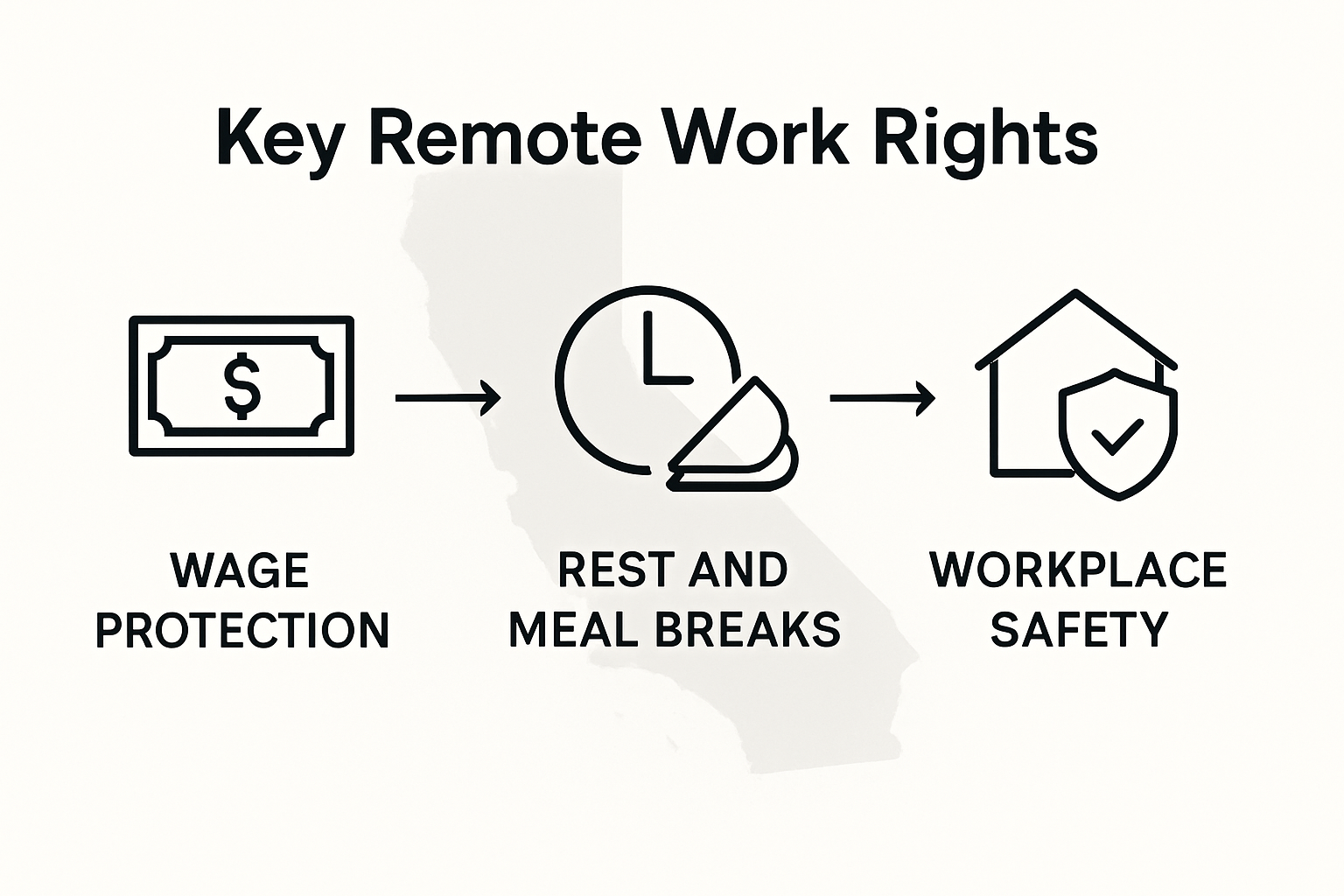
    The legal framework for work from home rights encompasses several critical areas, including compensation standards, equipment provisions, and workplace safety regulations. Employees working remotely are entitled to the same fundamental protections as in-office workers, which means employers must maintain California overtime pay standards regardless of work location. This includes ensuring accurate time tracking, proper wage calculations, and compliance with state labor regulations that apply to remote work scenarios.

    Key aspects of California work from home rights include:

    • Protection against wage discrimination
    • Right to ergonomic workspace considerations
    • Maintenance of meal and rest break entitlements
    • Equal opportunity for professional development
    • Protection from discriminatory remote work policies

    Understanding these rights requires recognizing that remote work does not diminish an employee’s legal protections. Employers must adapt their policies to accommodate the evolving nature of work environments while maintaining compliance with California’s robust labor laws. Employees should proactively document their work hours, communicate with supervisors about expectations, and be aware of their legal rights in remote work settings.

    Types of Remote Work and Employee Status

    Remote work has evolved into a complex ecosystem of employment arrangements that significantly impact workers’ legal status and professional rights. Various remote work models have emerged, each presenting unique challenges and protections for California employees. These arrangements range from full-time remote positions to more flexible options that blur traditional employment boundaries.

    The primary categories of remote work in California include full-time remote employees, part-time remote workers, freelance professionals, and contract-based digital workers. Each classification carries distinct implications for legal protections, tax obligations, and workplace rights. Fractional work arrangements have become increasingly prominent, where professionals provide specialized services to multiple organizations, challenging conventional employment paradigms and requiring nuanced understanding of worker classifications.

    Key distinctions in remote work status involve:

    • Employee classification (W-2 vs 1099)
    • Benefits eligibility
    • Tax reporting requirements
    • Workers’ compensation coverage
    • Overtime and wage protection standards

    California law provides robust protections across these diverse work arrangements, ensuring that regardless of work location or employment model, workers retain fundamental rights. Employees must carefully understand their specific classification, as this directly impacts their legal protections, compensation structures, and potential recourse in workplace disputes. Employers are required to clearly define employment status, maintain transparent communication, and adhere to state labor regulations that protect remote workers’ interests.

    California Labor Laws for Remote Workers

    California’s labor laws for remote workers represent a comprehensive framework designed to protect employee rights in increasingly flexible work environments. These regulations ensure that workers maintain robust protections regardless of their physical work location, addressing the unique challenges presented by remote and distributed workforce models. Understanding employment contract basics becomes crucial in navigating these complex legal landscapes.

    Man working from home

    The state’s labor laws mandate several critical protections for remote workers, including wage requirements, workplace safety standards, and anti-discrimination provisions. Employers must maintain the same legal obligations for remote employees as they would for in-office workers, which means providing appropriate compensation, maintaining accurate time tracking, and ensuring equal opportunities for professional development. This includes compliance with minimum wage standards, overtime regulations, and providing necessary equipment or compensation for home office expenses.

    Key labor law protections for remote workers include:

    • Right to accurate wage documentation
    • Protection against workplace discrimination
    • Maintenance of meal and rest break entitlements
    • Compensation for work-related expenses
    • Equal access to professional growth opportunities
    • Workers’ compensation coverage

    Remote workers in California are entitled to the same comprehensive legal protections as traditional employees. This means employers cannot circumvent labor laws by simply changing work location, and workers retain their fundamental rights regardless of whether they work from home, a coffee shop, or a remote office. Understanding these protections empowers employees to advocate for fair treatment and ensure their rights are consistently respected in evolving work environments.

    Infographic outlining key remote worker rights

    Employer Duties and Wage Compliance Risks

    Employers in California face significant legal responsibilities when managing remote workers, with complex obligations that extend far beyond traditional workplace boundaries. Understanding wage theft protections becomes critical in navigating the intricate landscape of remote work compensation and compliance. The potential financial and legal risks of mismanaging remote worker wages can be substantial, creating a challenging environment for businesses.

    The primary employer duties in remote work settings include accurate time tracking, proper wage documentation, and consistent compensation standards. Employers must implement robust systems that precisely record work hours, ensure appropriate overtime calculations, and maintain transparent payment practices. This includes providing clear compensation guidelines for remote employees, covering expenses related to home office setups, and maintaining equitable treatment across different work arrangements.

    Key compliance risks for employers include:

    • Potential penalties for wage misclassification
    • Legal consequences of improper overtime calculations
    • Risks associated with inconsistent wage reporting
    • Potential litigation from wage and hour disputes
    • Financial penalties for non-compliance with labor regulations
    • Reputational damage from systematic wage violations

    California’s stringent labor laws create a high-stakes environment where employers must be meticulously careful about remote worker compensation. Even unintentional violations can result in significant financial penalties, requiring companies to develop comprehensive compliance strategies that protect both employee rights and organizational interests. Proactive communication, transparent documentation, and consistent application of wage standards are essential in mitigating potential legal and financial risks associated with remote work arrangements.

    Woman Woringk from Home

    Remote workers in California frequently encounter complex workplace violations that can significantly impact their professional and financial well-being. Understanding workplace discrimination types becomes crucial in identifying and addressing potential legal infractions that may occur in remote work environments. These violations range from subtle forms of mistreatment to more overt legal transgressions that directly challenge employee rights.

    The most prevalent workplace violations for remote workers include wage manipulation, discriminatory practices, wrongful termination, and harassment. Employers may attempt to exploit the less visible nature of remote work by implementing unfair policies, failing to compensate for all worked hours, or creating hostile work environments that are more challenging to document. These violations can manifest through unequal treatment, inconsistent performance evaluations, denied promotion opportunities, or systematic exclusion from important professional communications and development programs.

    Key legal options for employees facing workplace violations include:

    • Filing formal complaints with California Labor Commissioner
    • Pursuing civil litigation for damages
    • Submitting discrimination claims to state and federal agencies
    • Requesting mediation or arbitration
    • Documenting all instances of potential workplace misconduct
    • Seeking legal consultation from employment law specialists

    California provides robust legal protections that empower remote workers to challenge workplace violations effectively. Employees have multiple avenues for seeking justice, including administrative complaints, civil lawsuits, and specialized employment tribunals. Successful legal action not only provides potential financial compensation but also helps establish precedents that protect future workers from similar discriminatory or unethical practices. Proactive documentation, understanding of legal rights, and timely intervention are critical strategies for addressing workplace violations in remote work settings.

    Know Your Work From Home Rights and Take Action Today

    Navigating the complex landscape of California work from home rights can be overwhelming especially when facing issues like wage misclassification or unpaid overtime. The challenges detailed in this article highlight how crucial it is to understand your employee classification and wage protections under California labor laws. You deserve accurate wage payments, proper time tracking, and fair treatment even when working remotely.

    Take control of your remote work situation with clear guidance and expert support from California Labor Law. We offer free legal resources, up-to-date information on wage and hour protections, and actionable steps to defend your rights. Whether you are dealing with wage theft, discriminatory practices, or unclear compensation policies we provide the tools to understand and assert your rights now.

    If you are experiencing a California employment law issue please contact us at 1-866-355-9991 for a free employment law consultation with an experienced attorney.

    Frequently Asked Questions

    What are my work from home rights as a California employee?

    As a California employee working from home, you are entitled to protections regarding wage standards, workplace safety, meal and rest breaks, and protections against discrimination and wrongful termination, similar to those of in-office workers.

    How does California labor law protect remote workers regarding compensation?

    California labor law ensures that remote workers receive fair compensation by maintaining wage requirements, overtime pay standards, and requiring employers to cover expenses related to home office setups.

    What should I do if I encounter workplace violations while working remotely?

    If you encounter workplace violations, document all instances of misconduct, and consider filing formal complaints with the California Labor Commissioner, pursuing civil litigation, or reporting discrimination to relevant state and federal agencies.

    Are my meal and rest breaks still protected when working from home?

    Yes, as a remote worker in California, you maintain the right to meal and rest breaks as outlined in state labor laws, just like traditional office workers.

  • Exempt vs Nonexempt Employees – Rights Under California Law

    Exempt vs Nonexempt Employees – Rights Under California Law

    Nearly half of hourly workers in California report confusion about their exempt and nonexempt status, directly affecting their unpaid overtime claims. For those in the service industry, this misunderstanding can mean missing out on thousands in extra pay every year. Clear definitions matter because your classification decides whether you receive essential wage protections and overtime benefits. This guide breaks down the difference so you can confidently assess your rights under California’s labor laws.

    Exempt vs Nonexempt Status Defined Clearly

    In California’s complex labor landscape, understanding the difference between exempt and nonexempt employees is crucial for workers seeking fair compensation. Unlike simple job titles, employee classification hinges on specific legal criteria that go far beyond what most workers realize. Detailed classification standards reveal a nuanced framework determining workers’ rights and wage protections.

    To qualify as an exempt employee in California, workers must meet three critical requirements: earning a minimum salary, performing specific job duties, and demonstrating independent decision-making capacity. Specifically, exempt employees must earn at least twice the state’s minimum wage and spend more than 50% of their time performing executive, administrative, or professional tasks that involve significant independent judgment. This means a manager’s job title alone does not automatically make them exempt – their actual daily responsibilities determine their status.

    HR manager highlighting exempt employee checklist

    Nonexempt employees, by contrast, receive critical wage protections including overtime pay, mandatory meal and rest breaks, and minimum wage guarantees. These workers are entitled to compensation for hours worked beyond 8 per day or 40 per week, with overtime calculated at 1.5 times their regular hourly rate. Worker classification guidelines emphasize that job duties, not titles, ultimately define an employee’s legal status and accompanying rights.

    Here’s a side-by-side look at major differences between exempt and nonexempt employees in California:

    Category Exempt Employees Nonexempt Employees
    Pay Structure Fixed salary Hourly wages
    Overtime Eligibility Not eligible for overtime Receive overtime after 8 hrs/day
    Meal & Rest Breaks Not entitled to protected breaks Guaranteed meal and rest breaks
    Job Duties Advanced, independent tasks Routine or supervised tasks

    Pro tip: If you suspect your employer might be misclassifying your employment status, document your actual job duties meticulously and consult with a California labor law specialist to understand your rights.

    Key Differences in Wages and Overtime Rights

    Understanding the wage and overtime rights for exempt and nonexempt employees is critical for California workers seeking fair compensation. Employee classification standards create stark differences in how workers are compensated, with significant implications for monthly and annual earnings. The core distinction lies in the legal protections and financial entitlements afforded to each worker classification.

    Nonexempt employees enjoy robust wage protections that guarantee overtime compensation at 1.5 times their regular hourly rate. These workers receive payment for all hours worked, with mandatory overtime for any time exceeding 8 hours per day or 40 hours per week. Additionally, nonexempt workers are entitled to mandatory meal and rest breaks, ensuring basic workplace protections. California overtime regulations specifically mandate these financial safeguards, creating a safety net for hourly and part-time workers.

    Infographic comparing exempt and nonexempt employee rights

    Exempt employees, typically in professional, executive, or administrative roles, trade these hourly protections for a fixed salary. While they receive consistent pay regardless of hours worked, they lose critical overtime and break-time rights. This classification means exempt workers might work extended hours without additional compensation, making their effective hourly rate potentially lower than nonexempt employees. The trade-off involves presumed higher-level responsibilities and more autonomy in job performance.

    Pro tip: Carefully review your job description and actual daily responsibilities to determine whether your current classification accurately reflects your work, as misclassification can result in significant lost wages.

    California’s legal framework for employee classification is remarkably complex, designed to protect workers while providing clarity for employers. Independent contractor rights underscore the state’s commitment to precise worker categorization. The state employs a multi-factor test that goes far beyond simple job titles, examining the actual nature of work performed, level of control, and economic realities of the employment relationship.

    The primary legal criteria for classification involve three critical components: salary level, job duties, and degree of independent decision-making. Exempt employees must consistently earn a minimum salary at least twice the state’s minimum wage, spend over 50% of their time performing specialized tasks, and demonstrate substantial independent judgment in their role. This means a manager’s title alone does not automatically confer exempt status – the actual responsibilities and decision-making authority are paramount in determining classification.

    The California Labor Commissioner’s office uses a comprehensive set of guidelines that consider multiple factors beyond traditional job descriptions. These include the worker’s skill level, the permanence of the working relationship, the extent of investment in equipment or materials, and the degree of control exercised by the employer. The goal is to prevent misclassification that could deprive workers of essential protections like overtime pay, meal breaks, and minimum wage guarantees. By implementing such rigorous standards, California aims to ensure fair treatment across diverse industries and job roles.

    Pro tip: Maintain detailed documentation of your actual job duties, hours worked, and decision-making responsibilities to protect yourself against potential misclassification.

    Common Misclassifications and Employer Duties

    Employee misclassification remains a persistent challenge in California, with significant legal and financial consequences for employers who fail to comply with state labor regulations. Employer classification risks expose businesses to potential lawsuits, substantial wage penalties, and regulatory scrutiny. The most common mistakes occur when employers incorrectly assume that job titles or salary alone determine an employee’s exempt status.

    The California Industrial Welfare Commission Wage Orders outline specific criteria that must be met for legitimate exempt classification. Employers must demonstrate that workers consistently perform executive, administrative, or professional duties that involve independent decision-making. Simply paying a worker a salary does not automatically make them exempt. Critical factors include the percentage of time spent on specialized tasks, the level of independent judgment exercised, and the complexity of the work performed. Misclassification can result in retroactive payment of overtime, meal and rest break penalties, and potential legal damages.

    Employers bear the entire burden of proving an employee’s exempt status, which requires comprehensive documentation and a thorough understanding of California’s nuanced labor laws. Common red flags include classifying workers as exempt while requiring them to perform predominantly non-exempt tasks, making improper salary deductions, or failing to meet the precise salary threshold. The financial risks are substantial – employers can face penalties including unpaid wages, interest, legal fees, and potential civil penalties for willful misclassification.

    This summary outlines common employer pitfalls and their financial risks:

    Misclassification Error Potential Employer Consequence Example Scenario
    Relying on job titles alone Retroactive overtime owed “Manager” doing hourly tasks
    Not meeting salary threshold Penalties plus back pay Salary below twice minimum wage
    Inadequate job duty documentation Legal disputes, increased fines Vague worker responsibilities

    Pro tip: Conduct a comprehensive internal audit of employee classifications annually, consulting with a California labor law specialist to ensure full compliance and minimize potential legal risks.

    How to Verify and Address Classification Errors

    Navigating employee classification requires a systematic approach to identifying and correcting potential legal vulnerabilities. Wage theft prevention begins with a comprehensive review of job descriptions, actual work performed, and compensation structures. Employers must conduct a meticulous audit that goes beyond surface-level job titles to examine the true nature of each worker’s responsibilities and decision-making authority.

    The verification process involves a detailed multi-step analysis of each employee’s role. Critical evaluation points include the percentage of time spent on exempt-level tasks, the degree of independent judgment exercised, and the complexity of work performed. Employers should create a detailed job duty worksheet that breaks down daily responsibilities, comparing them against California’s strict exempt classification criteria. This documentation must demonstrate that workers consistently perform high-level duties that justify exempt status, with concrete evidence of strategic decision-making, independent analysis, and specialized knowledge.

    Addressing classification errors requires a proactive and transparent approach. When misclassification is discovered, employers must immediately reclassify the worker, adjust compensation, and potentially provide back pay for overtime and missed breaks. The process involves calculating retroactive wages, documenting the correction, and implementing safeguards to prevent future misclassification. Legal consultation is crucial during this process, as errors can lead to significant financial penalties and potential civil litigation.

    Pro tip: Create a detailed job classification matrix that tracks each employee’s actual duties, decision-making authority, and compensation, updating it quarterly to ensure ongoing compliance with California labor regulations.

    Understand Your Employee Classification and Protect Your Rights Today

    If you are unsure whether your job duties truly match your exempt or nonexempt classification, you are not alone. Many California workers face challenges like misclassification that can lead to unpaid overtime, missed meal and rest breaks, and lost wages. This article explained critical concepts such as salary thresholds and employer duties that affect your legal protections. Knowing your exact employment status is essential to claim the rights you deserve.

    Visit California Labor Law to explore comprehensive guides and use free legal tools designed to help you verify your classification and calculate owed wages. Our expert resources cover everything from wage theft prevention to understanding overtime rules. Don’t wait for employer audits or penalties find you first. Take control of your situation now by reviewing your job duties and salary details with trusted advice at California Labor Law. Protect your hard-earned money and workplace rights today by calling 1-866-355-9991 for a free California employment law consultation.

    Frequently Asked Questions

    What is the main difference between exempt and nonexempt employees?

    Exempt employees are not entitled to overtime pay and typically earn a fixed salary, while nonexempt employees are paid hourly and are eligible for overtime compensation after 8 hours of work in a day or 40 hours in a week.

    How can I determine if I am classified as an exempt or nonexempt employee?

    To determine your classification, examine your job duties, salary level, and the degree of independent decision-making in your role. If you perform executive, administrative, or professional tasks and earn at least twice the minimum wage, you may be classified as exempt.

    What are my rights as a nonexempt employee in California?

    Nonexempt employees in California are entitled to minimum wage, mandatory overtime pay at 1.5 times the regular hourly rate for overtime hours, and guaranteed meal and rest breaks.

    What should I do if I believe I am misclassified as an exempt employee?

    If you suspect misclassification, document your actual job duties and responsibilities. Consult with a labor law specialist to understand your rights and discuss potential next steps for addressing the issue.

  • Termination While on Medical Leave – Your California Rights

    Termination While on Medical Leave – Your California Rights

    Losing your job while on medical leave can feel like a violation of basic workplace values. California law provides some of the strongest employment protections in the United States. More than 60 percent of wrongful termination claims involve medical issues or protected leave. This article uncovers the rights you have as a California employee, explains what counts as illegal termination, and outlines steps to safeguard your career after health-related setbacks.

    Defining Termination While on Medical Leave

    Termination while on medical leave represents a serious legal situation where an employer ends an employee’s job during a period of legally protected medical absence. This complex issue involves understanding specific protections under California and federal law. Medical leave protections ensure employees cannot be fired simply for taking necessary time off to address serious health conditions.

    Under the Family and Medical Leave Act (FMLA) and California Family Rights Act (CFRA), eligible employees are granted up to 12 workweeks of unpaid, job-protected leave per calendar year. Termination during this protected period is generally prohibited unless the employer can demonstrate the dismissal is entirely unrelated to the medical leave. This means an employer cannot use medical leave as a pretext for firing an employee who is otherwise performing their job satisfactorily.

    Key elements that define termination while on medical leave include the following scenarios:

    • Dismissal occurring during an approved medical leave period
    • Termination that appears to be connected to the employee’s medical condition
    • Failure to reinstate an employee to their original or equivalent position after leave
    • Discriminatory actions related to an employee’s medical status or need for leave

    Pro tip: Document every interaction with your employer during medical leave and maintain detailed records of your medical documentation to protect your employment rights.

    California Laws Governing Medical Leave Terminations

    California provides robust legal protections for employees taking medical leave, with multiple statutes safeguarding workers from wrongful termination. California employment laws establish comprehensive frameworks that shield employees from discriminatory practices during medical absences, including protections under the Family and Medical Leave Act (FMLA), California Family Rights Act (CFRA), and Pregnancy Disability Leave (PDL).

    Infographic of medical leave protections California

    The state’s legal landscape offers multifaceted protections that prevent employers from arbitrarily terminating employees during medical leave. Specifically, these laws require that employers maintain an employee’s position or provide an equivalent role upon return, ensuring job security during challenging health periods. Employers can only terminate an employee on medical leave if they can definitively demonstrate legitimate, non-discriminatory reasons completely unrelated to the medical absence.

    Key legal protections for employees on medical leave include:

    • Job restoration to the same or equivalent position
    • Continued healthcare coverage during leave
    • Protection from discriminatory actions
    • Preservation of seniority and benefits status
    • Prohibition of retaliation for taking medical leave

    Pro tip: Maintain comprehensive documentation of your medical condition, leave requests, and all communications with your employer to strengthen your legal position if disputes arise.

    Here is a summary of how major California and federal laws address termination during medical leave:

    Law/Act Main Protections Coverage Limitations
    FMLA (Federal) Grants job-protected leave; prohibits firing for leave use Applies to employers with 50+ employees, employee must meet eligibility
    CFRA (California) Extends job protection; covers medical and family leaves Expands qualifying conditions beyond FMLA
    PDL (California) Protects job during pregnancy-related disability Only applies to pregnancy-related conditions

    Employer Obligations and Protected Rights

    Employers in California have substantial legal obligations when managing employees on medical leave, with specific responsibilities designed to protect worker rights. Employer medical leave requirements mandate comprehensive protections that go beyond simple job preservation, encompassing healthcare benefits maintenance, potential reasonable accommodations, and strict guidelines against discriminatory practices.

    Manager handing paperwork to employee

    Under California law, employers must navigate a complex landscape of legal requirements when an employee takes medical leave. This includes maintaining the employee’s health insurance coverage, holding their original position or providing an equivalent role, and ensuring no retaliatory actions are taken against the employee. Critically, employers cannot terminate an employee solely because they are on medical leave, and they must demonstrate legitimate, non-discriminatory reasons if considering job separation.

    Key employer obligations during medical leave include:

    • Continuing health insurance coverage
    • Preserving job status or providing equivalent position
    • Avoiding discriminatory actions
    • Considering reasonable workplace accommodations
    • Protecting employee’s seniority and benefit accrual
    • Maintaining communication about return-to-work expectations

    Pro tip: Carefully document all interactions and communications related to medical leave to create a clear record of compliance and protect both employee and employer rights.

    Prohibited Reasons for Firing on Leave

    California employment law establishes clear boundaries for employer actions during an employee’s medical leave, explicitly prohibiting terminations based on discriminatory or retaliatory motivations. Termination restrictions during medical leave are comprehensive, protecting employees from wrongful discharge that stems from their use of legally protected medical leave or their underlying health conditions.

    Employers are strictly forbidden from firing employees for reasons directly connected to their medical leave status. This includes terminations based on pregnancy, disability, serious health conditions, or as a punitive response to an employee exercising their legal right to take medical leave. The law requires that any potential termination must be demonstrably unrelated to the medical leave, with clear documentation of legitimate business reasons such as documented performance issues, company restructuring, or economic necessities that would apply regardless of the employee’s leave status.

    Specifically prohibited reasons for termination include:

    • Retaliation for taking medical leave
    • Discrimination based on medical condition
    • Targeting employees who request reasonable accommodations
    • Penalizing employees for using FMLA or CFRA protections
    • Terminating based on perceived future productivity concerns
    • Making employment decisions influenced by medical leave history

    Pro tip: Collect and preserve all documentation related to your medical leave, performance reviews, and workplace communications to build a strong defense against potential wrongful termination.

    The following table highlights practical differences between lawful and unlawful terminations during medical leave:

    Scenario Lawful Termination Unlawful Termination
    Reason for Dismissal Documented performance or business need unrelated to leave Related to employee’s medical condition or leave usage
    Documentation Required Clear, objective records of performance or business justification Employer lacks non-discriminatory evidence
    Return-to-Work Handling Employee informed properly, position offered if available Denied reinstatement without legitimate reason

    Next Steps if Your Rights Are Violated

    When an employer violates your medical leave rights, taking swift and strategic action becomes crucial to protecting your legal interests. Wrongful termination protections provide employees multiple avenues for addressing workplace violations, including administrative complaints, legal action, and potential monetary compensation.

    The initial steps in challenging a potential violation involve carefully documenting everything related to your medical leave and termination. This includes collecting all communication records, performance evaluations, medical documentation, and any evidence demonstrating the potential discriminatory or retaliatory nature of your employer’s actions. Gathering comprehensive documentation will strengthen your potential legal claim and provide critical evidence if you need to pursue administrative complaints or litigation.

    Key actions to take when your rights are violated include:

    • Requesting a written explanation for your termination
    • Preserving all employment and medical records
    • Filing a complaint with the California Labor Commissioner
    • Contacting the Equal Employment Opportunity Commission (EEOC)
    • Consulting with an employment law attorney specializing in medical leave violations
    • Preparing a detailed timeline of events surrounding your leave and termination

    Pro tip: Create a dedicated file folder with copies of all relevant documents and maintain a chronological journal detailing every interaction related to your medical leave and potential rights violation.

    Protect Your Rights When Facing Termination While on Medical Leave

    If you are worried about losing your job during medical leave or suspect an employer has violated your protected rights under the Family and Medical Leave Act or California laws like CFRA and PDL you are not alone. Being terminated while on medical leave can feel overwhelming and unfair especially when your health or family needs are involved. Your key challenges might include understanding your legal protections resisting wrongful termination based on discriminatory or retaliatory reasons and knowing how to take action effectively.

    At California Labor Law we empower you with clear legal guides and resources tailored specifically to employment law issues in California. You can learn what steps to take if your employer fails to reinstate you or discriminates against you due to your medical leave. Our site offers practical advice on documenting your case and directs you to trusted advocates who can help fight wrongful termination. Don’t wait until it is too late take control of your situation and explore wrongful termination protections and employer medical leave requirements now to safeguard your employment future.

    Call California Labor Law today at 1-866-355-9991 for immediate support and know your rights so you can confidently stand up against unfair termination during medical leave.

    Frequently Asked Questions

    What protections do I have if I am terminated while on medical leave?

    Employees on medical leave are protected by laws like FMLA and CFRA, which prohibit termination during the leave period unless the employer can prove the termination is unrelated to the leave.

    Can my employer fire me for taking a medical leave?

    No, employers cannot fire you for taking a legally protected medical leave. Termination during this time is generally prohibited unless there are valid, documented reasons unrelated to your leave.

    What actions can I take if I believe I was wrongfully terminated while on medical leave?

    If you suspect wrongful termination, gather documentation related to your medical leave and termination, and consider filing a complaint with the California Labor Commissioner or contacting an employment law attorney.

    What should I do if I am not reinstated to my job after medical leave?

    If you are not reinstated to your original or an equivalent position after your medical leave, document the situation and consult with a legal expert to explore your options for potential legal action.

  • Minimum Shift Length: Why It Matters for California Workers

    Minimum Shift Length: Why It Matters for California Workers

    Understanding California’s 4-Hour Minimum Pay Rule: Protection for Employees

    Most service workers in California experience unpredictable shift schedules that can make planning and budgeting stressful. When your hours are cut short or you are sent home early, you might wonder if your employer is following state labor laws.

    California mandates minimum protections for shift lengths and split shift pay, offering vital support if you deal with last-minute changes or unpaid gaps in your workday.

    Understanding your rights can help you identify potential wage violations and secure the compensation you deserve.

    Defining Minimum Shift Length Laws

    Minimum shift length laws in California represent critical workplace protections designed to ensure fair compensation and predictable work schedules for employees.

    These regulations establish clear guidelines about how employers must structure and compensate workers during their scheduled shifts.

    Workday definitions from California’s Department of Industrial Relations provide the foundational framework for understanding these complex labor standards.

    California law recognizes that a workday is any consecutive 24-hour period beginning at the same time each calendar day. Within this definition, employers have some flexibility in scheduling, including options for alternative work schedules like 10-hour or 12-hour shifts.

    However, these schedules must adhere to specific legal requirements that protect worker rights and ensure appropriate compensation. The primary goal is maintaining a balance between employer operational needs and employee wage protections.

    Defining Minimum Shift Length Laws in California

    Special considerations exist for unique work arrangements, particularly split shifts. Split shift regulations provide additional protections for workers whose workday is interrupted by non-paid, non-working time.

    In such scenarios, employees are entitled to a premium payment equal to one hour at minimum wage, ensuring they are compensated for the inconvenience of fragmented work schedules.

    These nuanced regulations demonstrate California’s commitment to comprehensive labor protections that go beyond basic hourly wage requirements.

    Pro tip: Always request a detailed written explanation of your work schedule and potential shift premiums to understand your exact compensation structure and legal protections.

    How Reporting Time Pay Works

    Reporting time pay represents a critical worker protection mechanism designed to compensate employees for unexpected scheduling disruptions.

    California’s Department of Industrial Relations defines this compensation as a safeguard ensuring workers receive payment even when employers fail to provide sufficient work hours.

    Essentially, this regulation protects employees from financial uncertainty caused by last-minute scheduling changes or unexpected shift cancellations.

    Under California law, employees are entitled to receive compensation ranging from two to four hours of pay when called to work but not provided with substantial work time.

    The specific payment structure depends on the length of the scheduled shift and the actual hours worked. If an employee is scheduled for a shift but sent home early or not utilized for the full time, they are still guaranteed a minimum payment.

    This legal provision ensures workers are not financially penalized for an employer’s scheduling inconsistencies.

    Interestingly, federal guidelines clarify that these reporting time pay provisions are considered compensation for lost wages rather than standard work hours.

    This distinction is important because it means these payments are typically not included in overtime calculations. The primary purpose remains protecting workers from unpredictable scheduling practices that could otherwise result in significant income loss.

    Exceptions exist for circumstances beyond an employer’s control, such as natural disasters, utility failures, or actions by civil authorities.

    Pro tip: Always document and retain proof of your scheduled shift and any unexpected changes to support potential reporting time pay claims.

    Here’s a summary of how California’s reporting time pay and split shift pay differ:

    Compensation Type When It Applies Minimum Payment Amount
    Reporting Time Pay Sent home early after reporting to work 2-4 hours of regular pay
    Split Shift Premium Scheduled split with unpaid time gaps 1 hour at minimum wage per split shift

    Variations and Exceptions by Industry

    California’s labor regulations recognize that different industries have unique operational requirements, leading to specialized shift length and compensation rules.

    Split shift regulations demonstrate this nuanced approach, where workplace accommodations vary based on specific industry standards and employee living arrangements.

    These targeted provisions ensure that labor laws remain flexible while maintaining essential worker protections across diverse employment sectors.

    Industry-specific exceptions are particularly pronounced in sectors with complex scheduling demands. The Industrial Welfare Commission’s Wage Orders outline detailed variations for different professional environments.

    Healthcare workers, for instance, can work 12-hour shifts without traditional overtime calculations, while construction, logging, and mining industries have unique rules tailored to their operational challenges.

    These specialized regulations acknowledge that standard eight-hour shift models do not universally apply across all professional contexts.

    The complexity of these industry variations means that workers must understand the specific rules governing their particular sector. Some industries provide additional compensation mechanisms, while others might have alternative scheduling arrangements that differ from standard employment practices.

    Factors like minimum wage levels, workplace residency, and specific job functions can significantly influence how shift length and compensation are calculated.

    This intricate framework ensures that labor laws remain responsive to the diverse needs of California’s dynamic workforce.

    Pro tip: Always consult your industry-specific wage order and review your employment contract to understand the unique shift length and compensation rules that apply to your specific profession.

    Employee Rights and Employer Obligations

    California labor laws establish a comprehensive framework of protections designed to safeguard workers across all industries.

    California’s worker protection statutes mandate that employers must provide safe working environments, ensure fair compensation, and respect fundamental employee rights regardless of immigration status.

    These regulations create a balanced system that holds employers accountable while empowering workers to understand and defend their legal entitlements.

    The state’s labor regulations outline specific obligations for employers, including requirements for minimum wage, overtime compensation, mandatory rest and meal breaks, and protection from workplace retaliation.

    Detailed labor enforcement guidelines specify that employers must provide rest breaks every four hours and meal breaks after five consecutive hours of work.

    Workers have the explicit right to inquire about their pay and working conditions without fear of punishment, with legal mechanisms in place to protect them from potential employer misconduct.

    Key worker rights extend beyond basic wage protections and include fundamental workplace safeguards. Employees are entitled to safe working conditions, fair treatment, and the ability to report violations without risking their employment.

    The legal framework ensures that workers can challenge unfair practices, seek compensation for unpaid wages, and hold employers accountable for labor law violations.

    This system of protections applies universally, creating a standardized approach to worker rights that transcends individual industry variations and provides a consistent standard of treatment.

    Pro tip: Document all work-related interactions, schedules, and communications to protect yourself in case you need to file a labor rights complaint.

    Common Violations and Steps for Recovery

    Workplace labor violations represent serious challenges for California employees, with multiple types of misconduct threatening worker rights and fair compensation.

    Comprehensive documentation from the Labor Commissioner’s Office identifies common violations including unpaid minimum wage, overtime compensation disputes, missed meal and rest breaks, and systematic wage theft. These infractions can significantly impact workers’ financial stability and legal protections.

    The recovery process for workplace violations involves strategic documentation and formal reporting mechanisms. Workers must collect and preserve critical evidence such as paystubs, timesheets, work schedules, and communication records documenting the specific labor law violations.

    State labor enforcement guidelines provide clear pathways for filing complaints, emphasizing that workers can seek remedies regardless of immigration status.

    The Labor Commissioner’s Office investigates claims and can help workers recover unpaid wages, enforce compliance, and protect against potential employer retaliation.

    Important recovery steps include understanding statutory filing deadlines, gathering comprehensive documentation, and being prepared to articulate specific workplace violations. Workers should document dates, times, specific monetary amounts owed, and any patterns of systematic misconduct.

    The legal system provides multiple avenues for addressing labor violations, including filing wage claims, pursuing administrative hearings, and potentially seeking additional legal remedies through civil litigation if administrative processes prove insufficient.

    Pro tip: Maintain a contemporaneous, detailed log of work hours, communications, and potential violations to strengthen your potential wage recovery claim.

    This table highlights common workplace violations and best evidence to collect when filing a claim:

    Violation Type Key Evidence to Collect
    Missed meal/rest breaks Timesheets or punch records
    Unpaid wages Paystubs and scheduled hours
    Unreported schedule changes Written communication, work logs
    Retaliation for complaints Emails, written warnings or notices

    Stand Up for Your Rights on Minimum Shift Lengths in California

    Understanding minimum shift length laws and reporting time pay is crucial for California workers who face unpredictable schedules and unfair pay.

    If you have experienced shifts being cut short or unpaid waiting periods during your workday you deserve to know your legal protections and how to claim what is owed. These laws protect you from missing wages due to last-minute changes or split shifts that disrupt your work-life balance.

    Do not wait to act on your rights. Visit California Labor Law to access clear legal guides, practical tools, and helpful calculators designed specifically to help you identify if your employer is violating minimum shift length requirements.

    Take control of your work schedule’s fairness and ensure you receive every dollar you have earned by calling 1-866-355-9991 now for a free California employee shift length evaluation.

    Frequently Asked Questions

    What are minimum shift length laws in California?

    Minimum shift length laws in California are regulations that establish requirements for the duration and compensation of scheduled work shifts, ensuring fair pay and predictable schedules for employees.

    How does reporting time pay work under California law?

    Reporting time pay guarantees that employees receive compensation ranging from two to four hours of pay if they report to work but are not given sufficient hours due to last-minute scheduling changes or cancellations.

    What is a split shift, and how is it compensated in California?

    A split shift occurs when an employee’s work schedule is interrupted by a non-paid break. Employees working split shifts are entitled to a premium payment equal to one hour at minimum wage for the inconvenience of the disrupted schedule.

    What rights do California workers have regarding overtime and meal breaks?

    California workers have the right to receive overtime pay, adhere to mandatory rest and meal breaks, and be protected from retaliation for exercising their rights concerning pay and working conditions.

  • California Employee Misclassification: Hidden Risks and How It Affects Workers

    California Employee Misclassification: Hidden Risks and How It Affects Workers

    The Risks of Employee Misclassification in California: Protecting Your Rights

    Most workers in California do not realize that a single error in how they are classified can cost them the right to minimum wage, overtime pay, and vital safety nets.

    Misclassification is not just a paperwork issue, it means losing protections many workers depend on every day.

    If you are unsure about your employee status, uncovering the truth could mean gaining access to rights and benefits that can directly impact your financial stability and workplace security.

    Misclassification of Employees in California Law

    Employee misclassification represents a serious legal issue where workers are improperly labeled as independent contractors instead of employees.

    In California, this practice is considered a form of wage fraud that systematically strips workers of critical legal protections and benefits.

    California law focuses intensely on the actual work performed, not just the contractual language used to define a worker’s status.

    Under California statutes, employers cannot simply declare a worker an independent contractor through paperwork. The state applies specific legal tests to determine a worker’s true employment classification, examining factors like control over work performance, integration into business operations, and economic dependency.

    Workers misclassified as independent contractors lose essential rights including minimum wage guarantees, overtime compensation, unemployment insurance, workers’ compensation coverage, and collective bargaining protections.

    Legal Consequences for misclassification can be severe. Businesses found deliberately misclassifying workers may face significant financial penalties, back wage requirements, and potential civil litigation.

    State enforcement agencies like the Bureau of Field Enforcement actively investigate and prosecute such violations, ensuring workers receive appropriate legal protections and compensation.

    Pro tip: If you suspect misclassification, document all work details, hours worked, and communication with your employer to build a strong potential legal case.

    Employee vs. Independent Contractor: Key Distinctions

    In California, the legal classification of workers is far more complex than a simple contract designation. California law applies rigorous criteria to determine worker status, focusing on the actual nature of the working relationship rather than just paperwork labels.

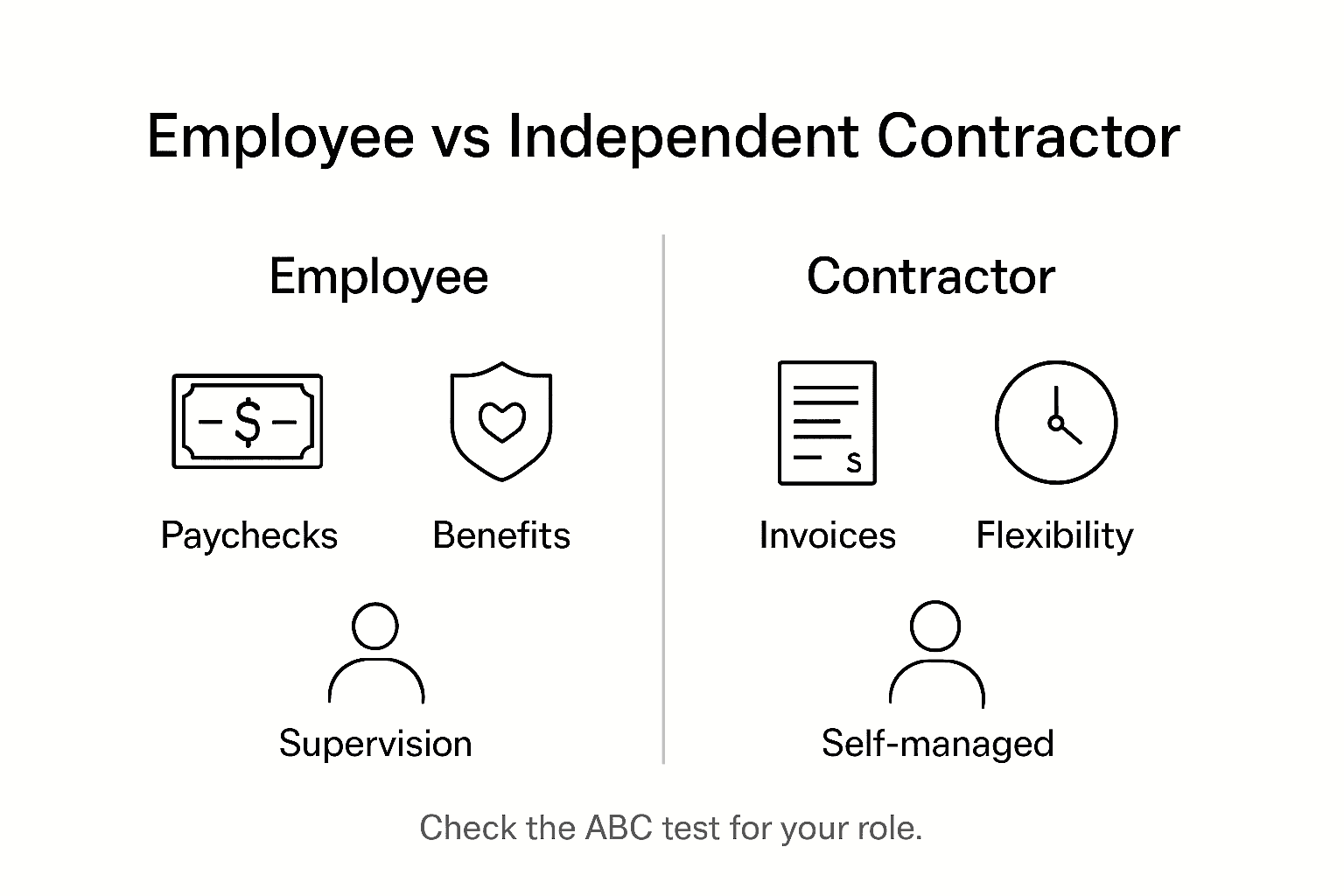
    The ABC test provides the primary framework for distinguishing between employees and independent contractors, placing a significant burden of proof on employers to demonstrate that a worker is truly an independent contractor.

    Under the ABC test, three critical conditions must be met for a worker to be classified as an independent contractor.

    First, the worker must be free from the company’s control and direction in performing work.

    Second, the work performed must be outside the usual course of the company’s business.

    Third, the worker must be independently established in the same type of work they are performing.

    Employees, in contrast, are typically integrated into the company’s core operations, receive regular wages, have taxes withheld, and are subject to direct supervision.

    Here’s a side-by-side summary of employee versus independent contractor status in California law:

    Aspect Employee Status Independent Contractor Status
    Tax Withholding Handled by employer Managed by worker
    Legal Protections Extensive; labor laws Limited; few safeguards
    Control Over Work Direct employer control Worker sets own methods
    Eligibility for Benefits Health, unemployment, workers’ comp Typically not eligible

    The consequences of misclassification can be substantial. Employers face significant legal and financial risks when incorrectly categorizing workers, including potential back wage payments, tax penalties, and civil litigation.

    Workers misclassified as independent contractors lose critical protections such as minimum wage guarantees, overtime compensation, unemployment insurance, workers’ compensation, and the right to join unions.

    This makes understanding the nuanced distinctions between employee and contractor status crucial for both workers and businesses operating in California.

    Infographic comparing employee and independent contractor roles

    Pro tip: Request a detailed written description of your work arrangement and compare it against the ABC test criteria to determine your potential employment classification.

    California Assembly Bill 5 (AB 5) transformed worker classification standards by establishing the ABC test as the primary legal mechanism for determining employee status.

    This landmark legislation shifted the burden of proof squarely onto employers, creating a presumption that workers are employees unless specific conditions are definitively met.

    The test requires employers to demonstrate three critical elements: the worker’s freedom from company control, performance of work outside the company’s core business operations, and active engagement in an independently established professional trade.

    The ABC test represents a fundamental shift in how California evaluates employment relationships. Under this framework, employers must satisfy all three prongs of the test to classify a worker as an independent contractor.

    The first prong examines the employer’s direct control over work performance, the second evaluates whether the work falls outside the company’s typical business model, and the third requires evidence that the worker operates an independently established business in the same domain.

    State labor authorities provide extensive guidance on interpreting and applying these complex legal standards, recognizing the nuanced nature of modern workplace relationships.

    While the ABC test provides a comprehensive framework, California law acknowledges that certain professional categories may require alternative classification approaches.

    Specific industries and professions can qualify for exemptions, potentially reverting to older multi-factor tests like the Borello test.

    These exceptions underscore the complexity of worker classification and highlight the importance of understanding industry-specific legal nuances.

    Employers who misclassify workers face significant financial penalties, including potential back wage payments, tax liabilities, and legal sanctions.

    Pro tip: Consult with an employment law specialist to thoroughly review your specific work arrangement and verify proper classification under California’s intricate legal standards.

    Rights and Protections Lost Through Misclassification

    Workers misclassified as independent contractors forfeit numerous critical legal protections that employees automatically receive under California labor laws.

    Workplace rights can be dramatically compromised by improper classification, creating substantial financial and professional vulnerabilities for workers who lack fundamental employment safeguards. These lost protections extend across multiple dimensions of workplace safety, compensation, and legal recourse.

    The most significant rights eliminated through misclassification include essential wage and hour protections. Independent contractors lose guaranteed minimum wage standards, overtime compensation, meal and rest break requirements, and protection against wage theft.

    They become ineligible for critical benefits such as health insurance, workers’ compensation, unemployment insurance, and disability coverage.

    Additionally, misclassified workers surrender important legal protections like protection from workplace discrimination, sexual harassment safeguards, and the right to collectively bargain or join unions.

    Beyond immediate financial implications, misclassification creates long-term professional risks. Workers classified as independent contractors bear full responsibility for tax withholdings, lack structured career advancement opportunities, and have minimal legal recourse in disputes with hiring entities.

    The financial burden of self-employment taxes, absence of employer-sponsored retirement plans, and increased personal liability can create significant economic instability.

    These systemic disadvantages disproportionately impact workers in vulnerable industries, transforming what appears to be flexible work into a precarious employment arrangement.

    The table below highlights which workplace rights are lost when a worker is misclassified in California:

    Lost Protection Impact on Worker Long-term Consequence
    Overtime Pay No extra compensation Lower annual income
    Unemployment Insurance Ineligible for support Financial instability after job loss
    Collective Bargaining Cannot join a union Weakened negotiating power
    Employer-sponsored Retirement No retirement plan access Higher retirement planning burden

    Pro tip: Document all work-related communications, hours worked, and job responsibilities to build evidence supporting your potential employee classification.

    Employer Liability and How Workers Can Take Action

    California’s labor regulations establish comprehensive employer liability for worker misclassification, creating multiple avenues for workers to seek justice and compensation. The state’s legal framework provides robust protections that enable employees to challenge improper classification without fear of retaliation.

    Workers retain critical rights to pursue claims regardless of their immigration status, ensuring a level playing field for all workers subjected to potential workplace violations.

    Employers face significant legal and financial consequences for misclassification. Potential penalties include substantial fines, mandatory back wage payments, and potential civil litigation.

    Workers can initiate action through several official channels, including filing complaints with the California Bureau of Field Enforcement, the Labor Commissioner’s Office, or through direct legal action.

    The state offers multilingual support and explicit protections against employer retaliation, empowering workers to assert their rights without risking their professional standing or future employment opportunities.

    The process of challenging misclassification involves gathering comprehensive documentation of work performance, hours, responsibilities, and communication with the employer.

    Workers should collect critical evidence such as:

    • work contracts,
    • communication records,
    • payment documentation,
    • and detailed accounts of job duties.

    An employment attorney can provide strategic guidance in navigating the complex legal landscape, helping workers understand their specific rights and the most effective approach to addressing potential misclassification.

    Collective actions may also be available for groups of workers experiencing systematic misclassification, multiplying the potential impact of legal challenges.

    Pro tip: Maintain a detailed, contemporaneous record of all work-related activities and communications to strengthen your potential legal claim.

    Protect Your Rights Against Employee Misclassification in California

    If you feel your work arrangement might not meet the strict legal standards under the ABC test or if you suspect wage theft due to improper classification, it is critical to understand your rights and act quickly.

    At California Labor Law, we provide trusted resources and clear guidance to help you identify if you have been misclassified. Our site offers detailed legal information, wage calculators, and direct access to advocates ready to assist you.

    Don’t let misclassification cost you what you deserve. Take the first step toward recovering unpaid wages and protecting your future by calling 1-866-355-9991 for a free California employee misclassification consultation.

    Frequently Asked Questions

    What is employee misclassification?

    Employee misclassification occurs when a worker is incorrectly labeled as an independent contractor rather than as an employee, stripping them of essential legal protections and benefits.

    What are the risks of being misclassified as an independent contractor?

    Workers misclassified as independent contractors lose key rights, such as minimum wage guarantees, overtime pay, unemployment insurance, workers’ compensation, and the ability to collectively bargain.

    How can I determine if I am misclassified as an independent contractor?

    To determine if you are misclassified, compare your work arrangement against the ABC test criteria, which assess your control over work, the nature of the work in relation to the business, and whether you operate an independently established trade.

    What should I do if I suspect I am misclassified?

    If you suspect misclassification, document your work details, hours, and communications with your employer. Consult with an employment law specialist for guidance on addressing your classification status.

  • California Paid Sick Leave: Worker Entitlements, Accrual, and 2026 Updates

    California Paid Sick Leave: Worker Entitlements, Accrual, and 2026 Updates

    What California Employees Get for Paid Sick Leave in 2026: Full Guide

    Missing just one day of work can leave a typical retail or service employee wondering how they will cover the bills.

    California protects its workforce with some of the strongest sick pay laws in the United States, giving even part-time employees the right to paid days off for illness or family care.

    Understanding these rights is a must for any worker who wants to avoid wage loss or unfair treatment.

    Defining California Sick Pay Laws

    California’s Paid Sick Leave (PSL) law represents a comprehensive worker protection framework that guarantees critical health and wellness rights for employees across the state.

    Established in 2015 and significantly expanded in 2024, these regulations ensure workers can prioritize their health and family care without financial penalty.

    Under current California law, most workers who have completed 30 days of employment within a year are eligible for paid sick leave. The law covers a broad range of health-related scenarios, including personal medical treatment, diagnosis, preventative care, and caring for ill family members.

    Employers have two primary approaches to implementing sick leave: they can either allow employees to accrue sick time progressively or provide a set number of days upfront at the beginning of each work year.

    The most recent legislative updates, effective January 1, 2024, now guarantee workers five paid sick days annually, significantly expanding previous protections.

    These changes reflect California’s commitment to worker well-being, ensuring employees do not face impossible choices between earning income and maintaining personal or family health.

    Full-time, part-time, and temporary workers are all potentially covered, depending on specific eligibility criteria.

    Pro tip: Always review your specific employment contract and keep detailed records of your worked hours to ensure you understand and can fully utilize your sick leave benefits.

    Minimum Sick Leave and Accrual Methods

    California’s recent legislative updates have significantly transformed paid sick leave regulations, introducing more robust protections for workers across the state.

    The Healthy Workplaces, Healthy Families Act now mandates a substantial increase in minimum paid sick leave, expanding from 24 hours/3 days to 40 hours/5 days annually for most employees.

    Employers in California have multiple options for implementing sick leave accrual. The primary methods include progressive accrual and upfront allocation.

    Under the progressive accrual method, employees earn one hour of sick leave for every 30 hours worked, allowing gradual accumulation of time.

    Alternatively, employers can choose to front-load the entire 40 hours at the start of the employment year, providing immediate access to paid time off.

    Importantly, the law allows employers flexibility in choosing an accrual method, provided it meets or exceeds the minimum state requirements.

    The new regulations also establish clear guidelines for sick leave usage and carryover. Employers can limit annual sick leave usage to 40 hours, but must permit total accrual up to 80 hours. This means workers can accumulate sick time across multiple years, creating a safety net for extended health challenges.

    The law applies broadly, covering full-time, part-time, and temporary workers who meet specific eligibility criteria, demonstrating California’s comprehensive approach to worker protections.

    Pro tip: Carefully document your worked hours and review your employer’s specific sick leave policy to maximize your entitlements and understand exactly how your sick time accrues.

    Infographic with sick leave eligibility and rules

    Here’s a summary of how California’s paid sick leave accrual methods compare:

    Accrual Method How Time Accrues Employee Access Maximum Annual Usage
    Progressive Accrual 1 hour per 30 hours worked Earned gradually Up to 40 hours
    Upfront Allocation Full 40 hours provided at year start Available immediately Up to 40 hours

    Who Qualifies for Paid Sick Leave

    California’s paid sick leave law provides expansive coverage, ensuring that a wide range of workers can access critical health protections. Most employees who work 30 days or more within a year for the same employer qualify for paid sick leave, creating a comprehensive safety net that spans multiple employment categories.

    The law’s eligibility criteria are designed to be inclusive, covering full-time, part-time, temporary, and seasonal workers. Employees must complete a 90-day employment period before becoming eligible to use their accrued sick leave.

    This approach ensures that workers across diverse industries and employment arrangements can benefit from paid time off for personal or family health needs.

    Notably, the legislation extends protections to workers covered by collective bargaining agreements, further broadening its scope.

    While the law provides broad coverage, some specific employment situations may have unique considerations. Government employees, certain construction workers, and airline crew members might have different sick leave provisions. Independent contractors and some temporary staffing agency workers may also face different rules.

    Employers are required to provide clear information about sick leave eligibility during the hiring process and maintain transparent policies that outline exactly how and when employees can access their paid sick time.

    Pro tip: Carefully review your employment contract and ask your human resources department about your specific sick leave eligibility to understand your exact entitlements.

    Permitted Uses and Expanded Protections

    California’s paid sick leave law provides comprehensive protection for workers, extending far beyond traditional medical scenarios.

    The legislation covers a broad range of health-related and personal safety needs, ensuring employees can take time off for various critical situations without fear of workplace retaliation.

    The law defines permitted uses expansively, allowing employees to use sick leave for multiple purposes. Workers can take time off for personal medical treatment, diagnosis, or preventive care, as well as caring for family members with health conditions.

    The definition of family is notably inclusive, covering children, parents, spouses, grandparents, siblings, and even designated persons chosen by the employee.

    Additionally, the law provides critical protections for victims of domestic violence, sexual assault, and stalking, recognizing that personal safety often requires time away from work.

    Expanded protections mean employees have significant flexibility in using their sick leave. The law explicitly safeguards workers from retaliation when utilizing their paid time off, preventing employers from penalizing staff for exercising their legal rights.

    This includes protection for union members and workers covered by collective bargaining agreements, further strengthening the safety net for California employees.

    The 2024 amendments have particularly emphasized these protections, ensuring that workers can prioritize their health and personal safety without professional consequences.

    Pro tip: Document every instance when you use sick leave and keep detailed records of your conversations with employers to protect yourself against potential workplace retaliation.

    Employer Responsibilities and Anti-Retaliation

    California’s paid sick leave laws impose significant legal obligations on employers, requiring them to carefully manage employee leave rights and prevent workplace discrimination.

    Employers must proactively update their policies to comply with the 2024 paid sick leave expansions, implementing comprehensive tracking and reporting mechanisms that protect worker entitlements.

    The law mandates strict anti-retaliation provisions, prohibiting employers from taking adverse actions against employees who exercise their sick leave rights. This includes preventing any form of discrimination, disciplinary action, or workplace punishment related to legitimate sick leave usage.

    Employers must accurately track and report paid sick leave hours on wage statements, maintain transparent policies about leave accrual and usage, and ensure that employees understand their rights under the new regulations.

    These requirements apply across all employment categories, including workers covered by collective bargaining agreements.

    Specific employer responsibilities include updating attendance and disciplinary policies, establishing clear communication channels about sick leave entitlements, and training management personnel on the nuanced requirements of the new legislation.

    Violations can result in significant legal penalties, including potential lawsuits and financial sanctions.

    Employers must also recognize the expanded definition of family members and personal safety scenarios that qualify for protected leave, ensuring their policies reflect the law’s comprehensive approach to worker protection.

    Pro tip: Maintain meticulous documentation of all sick leave requests, approvals, and communications to protect both employee rights and employer compliance.

    Common Pitfalls and Local Differences

    Navigating California’s paid sick leave landscape requires careful attention to the complex interplay between state and local regulations. Local ordinances can create significant variations in sick leave requirements, making it crucial for both employers and employees to understand the nuanced legal environment.

    The state’s SB 616 legislation partially preempts local paid sick leave laws, but some municipal regulations remain more generous and continue to apply.

    Cities like San Francisco, Los Angeles, and San Diego have historically maintained their own sick leave ordinances that may provide additional protections beyond state minimums.

    These local variations can impact accrual rates, usage limits, and documentation requirements, creating potential compliance challenges for multi-location businesses and workers who move between jurisdictions.

    Employers face several common pitfalls when implementing paid sick leave policies.

    These include:

    • misunderstanding accrual caps,
    • failing to properly track and document leave usage,
    • and overlooking differences between state and local requirements.

    Incorrect implementation can result in significant legal and financial penalties.

    Workers, meanwhile, must be proactive in understanding their specific rights, which can vary based on their employment type, location, and the specific terms of their employment contract. The complexity of these regulations underscores the importance of careful review and ongoing education about sick leave rights.

    Pro tip: Always verify the most current local sick leave regulations for your specific city and maintain open communication with your human resources department about your precise entitlements.

    This table summarizes key local sick leave differences in major California cities:

    City Accrual Rate Annual Max Hours Unique Requirements
    San Francisco 1 hour per 30 hours Up to 72 hours Applies to all employers
    Los Angeles 1 hour per 30 hours Up to 48 hours Special small employer rules
    San Diego 1 hour per 30 hours Up to 40 hours Carryover allowed

    Understand Your California Paid Sick Leave Rights and Get the Help You Deserve

    California’s sick pay laws provide crucial protections ensuring workers have access to paid time off for their health and family needs.

    However navigating the detailed accrual rules, eligibility requirements, and expanding legal protections can be overwhelming. Many employees worry about whether they are receiving their full sick leave benefits or fear retaliation when using their earned time off.

    Don’t let confusion about sick leave usage or employer compliance hold you back. At California Labor Law, we specialize in empowering California employees with clear, accessible information on paid sick leave, wage rights, and workplace protections.

    Our legal guides and resources help you confidently determine if your sick leave implementation meets state requirements while protecting you from unfair treatment.

    Learn more about your rights by calling 1-866-355-9991 for a free California paid sick leave rights consultation. If you have questions about sick leave accruals or employer violations, connect with legal advocates ready to support you today.

    Frequently Asked Questions

    What are the key requirements for paid sick leave in California?

    Most employees who work 30 days or more within a year for the same employer qualify for paid sick leave, which guarantees a minimum of five paid sick days annually.

    How do California sick pay accrual methods differ?

    California employers can choose between two main methods for implementing sick leave: progressive accrual (1 hour for every 30 hours worked) or upfront allocation (providing 40 hours at the beginning of the year).

    Can I use my sick leave for family care?

    Yes, California’s paid sick leave law allows employees to use their paid sick leave for personal medical treatment as well as for caring for ill family members, including children, parents, and spouses.

    What protections are in place for workers using sick leave?

    Workers are protected from retaliation when using their paid sick leave, meaning employers cannot penalize employees for taking the sick time they are entitled to under the law.

  • Can California Employers Reduce Your Pay?

    Can California Employers Reduce Your Pay?

    Can Employers in California Legally Reduce Your Pay?

    In a recent study, nearly 60% of workers that experienced a pay cut stated it was involuntary. Understanding what qualifies as a lawful wage reduction under California law is critical when job security and income are on the line.

    This guide clarifies the difference between legal and illegal pay cuts, helping American employees recognize their rights and the steps they can take if they face unfair changes to their compensation.

    Defining Pay Reduction Under California Law

    Pay reduction in California involves complex legal considerations that protect workers from arbitrary or discriminatory wage changes. Under California law, employers are not granted unlimited discretion to reduce an employee’s compensation. Wage reduction specifically refers to any decrease in an employee’s regular pay rate, which can occur through various mechanisms but must comply with strict legal standards.

    California law recognizes two primary types of pay reductions: prospective and retroactive. Prospective wage changes must be communicated in advance and cannot drop an employee’s earnings below minimum wage standards.

    Employers must provide clear, written notification before implementing any reduction, ensuring transparency and allowing employees to understand potential changes to their compensation structure.

    Retroactive pay reductions, which attempt to reduce wages for work already performed, are generally prohibited and can constitute wage theft.

    Here’s a summary of legal distinctions between prospective and retroactive pay reductions in California:

    Reduction Type Legal Status Notification Required Effect on Past Earnings
    Prospective Generally allowed with conditions Written advance notice is mandatory Does not affect past earnings
    Retroactive Generally prohibited by law Not permitted Attempts to reduce past earnings are illegal

    The legal framework surrounding pay reduction includes several critical protections for employees. Key restrictions mandate that wage reductions cannot be discriminatory, retaliatory, or implemented in bad faith. This means an employer cannot reduce pay based on protected characteristics like race, gender, age, or as punishment for reporting workplace violations.

    California’s equal pay protections further reinforce these standards, ensuring that pay changes cannot be used as a mechanism for workplace discrimination.

    Pro Tip: Wage Protection Strategy: Always request written documentation detailing any proposed pay reduction, including the specific reasons, effective date, and precise percentage or dollar amount of the change, which can serve as critical evidence if you need to challenge the reduction legally.

    When and Why Employers May Lower Wages

    Employers in California may legally reduce wages under specific circumstances, but these actions are strictly regulated to prevent worker exploitation. Wage reduction can occur due to various legitimate business reasons, including economic challenges, organizational restructuring, or performance-related adjustments.

    Final paycheck laws provide important context for understanding the legal boundaries of such changes.

    Several valid scenarios justify potential wage reductions. These include:

    • economic downturns affecting business performance,
    • company restructuring,
    • changes in job responsibilities,
    • market rate adjustments,
    • and performance-related modifications.

    Employers must provide advance written notice before implementing any wage reduction, ensuring transparency and giving employees an opportunity to understand the rationale behind the change. Critical conditions for legal wage reduction include maintaining minimum wage standards, avoiding discriminatory practices, and ensuring the reduction applies consistently across similar job roles.

    Infographic: reasons for legal wage reductions

    Business circumstances that may trigger wage reductions include budget constraints, shifts in organizational strategy, technological changes affecting job functions, and competitive market pressures. Employers cannot reduce wages as a form of retaliation or discrimination.

    California’s minimum wage protections mandate that any reduction must still keep employee compensation at or above the state-mandated minimum wage rate.

    Additionally, significant wage reductions might be considered constructive termination if they substantially alter the original employment agreement.

    Pro Tip: Wage Reduction Defense: Document every communication regarding proposed wage changes, request detailed written explanations from your employer, and consult with an employment attorney if the reduction seems inappropriate or potentially illegal.

    California law establishes strict legal requirements governing wage reductions to protect employees from arbitrary or unfair compensation changes. Wage reduction regulations mandate specific procedural and substantive guidelines that employers must follow when considering modifying an employee’s compensation.

    Workplace microaggressions can sometimes manifest through inappropriate wage reduction practices, highlighting the importance of understanding these legal protections.

    Under California Labor Code, employers face significant restrictions when attempting to reduce employee wages. Key legal requirements include: providing advance written notice of any wage reduction, ensuring the new wage rate does not fall below minimum wage standards, and maintaining consistent application across similar job classifications.

    Understanding layoff versus termination becomes crucial when wage reductions might effectively constitute a constructive discharge, which could trigger additional legal protections for employees.

    Legal Requirements for Reducing Pay

    The legal framework prohibits specific wage reduction practices that could be considered discriminatory or retaliatory. California Labor Code § 221 explicitly prevents employers from collecting or recovering previously paid wages, which means any wage reduction must be prospective and cannot retroactively diminish compensation already earned.

    Employers must also ensure that wage reductions are not implemented as a form of punishment, discrimination, or retaliation against employees who have exercised their legal workplace rights.

    Pro Tip: Wage Reduction Verification: Always request a detailed, written explanation of any proposed wage reduction, documenting the specific reasons, effective date, and precise calculation to protect yourself from potential legal violations.

    Employee Rights and Retaliation Protections

    California provides robust legal protections for employees against retaliatory actions, including wage reductions designed to punish or intimidate workers.

    Retaliation protections are fundamental to ensuring workplace fairness and preventing employers from undermining employee rights through economic manipulation. Wrongful termination laws reinforce these protections by establishing clear boundaries for employer conduct.

    Employees have specific legal safeguards that shield them from retaliatory wage reductions. These protections cover a wide range of scenarios, including situations where workers report workplace violations, participate in investigations, or exercise their legal rights.

    Understanding workplace discrimination becomes crucial in recognizing subtle forms of retaliation that might manifest through seemingly legitimate wage adjustments.

    California law explicitly prohibits employers from reducing pay as a punishment for employees who:

    • File complaints about workplace safety
    • Report harassment or discrimination
    • Participate in workplace investigations
    • Assert their legal employment rights

    The legal framework provides multiple avenues for employees to challenge retaliatory wage reductions. Workers can file complaints with the California Labor Commissioner’s Office, pursue civil litigation, or seek intervention from state employment protection agencies.

    Employers who engage in retaliatory practices face significant penalties, including potential monetary damages, reinstatement of wages, and additional punitive sanctions.

    Critically, the burden of proof in retaliation cases often falls on the employer to demonstrate that any wage reduction was based on legitimate business reasons rather than punitive motivations.

    Pro Tip: Retaliation Documentation: Maintain a detailed, contemporaneous record of all communications, performance evaluations, and incidents related to potential wage reduction retaliation, as this documentation can be crucial in substantiating your legal claims.

    Responding to Illegal or Unfair Wage Cuts

    Employees confronting illegal or unfair wage reductions have several strategic options to protect their rights and financial interests. Wage dispute resolution requires a systematic approach that combines documentation, communication, and potential legal intervention.

    Wage theft protections provide critical frameworks for workers challenging inappropriate compensation modifications.

    The first step in responding to illegal wage cuts involves gathering comprehensive documentation. Employees should compile evidence including original employment contracts, previous pay stubs, communication records about the wage reduction, and any written notifications from the employer.

    Workers can file formal complaints through multiple channels, including:

    • Submitting a wage claim with the California Labor Commissioner’s Office
    • Consulting with an employment law attorney
    • Reporting potential labor law violations to state employment agencies
    • Requesting an internal review with human resources

    California law provides robust mechanisms for challenging unlawful wage reductions. Employees have the right to file a retaliation complaint if the wage cut appears discriminatory or punitive.

    Overtime pay rules can also factor into wage reduction disputes, potentially revealing additional compensation violations. The legal process typically involves an investigation that examines the employer’s rationale, ensuring that any wage reduction meets legal standards of fairness and non-discrimination.

    Below is a quick reference for employee actions in response to unlawful wage reductions:

    Step Action Purpose
    1 Gather pay and communication records Build evidence of the reduction
    2 Request a written explanation from employer Clarify reasons and timing
    3 File a formal complaint or consult attorney Initiate legal or official challenge

    Protect Your Rights Against Unlawful Pay Reductions in California

    Worried your employer may have illegally reduced your pay in violation of California law? This article clearly outlines your rights against retroactive wage cuts, retaliatory pay reductions, and discriminatory compensation changes. If you are facing confusion or frustration regarding sudden wage changes, you are not alone.

    Understanding terms like prospective wage changes and your protections under California Labor Code is crucial for securing fair treatment and preventing wage theft.

    Take control today by exploring detailed legal guides and tools available at California Labor Law. Get empowered with step-by-step instructions on how to document wage disputes and challenge unlawful reductions effectively.

    Don’t let illegal pay cuts go unanswered. Call California Labor Law now at 1-866-355-9991 for a free reduced wage consultation and discover how to protect your earnings starting today.

    Frequently Asked Questions

    Can an employer reduce an employee’s pay in California?

    Yes, an employer can reduce an employee’s pay in California, but they must follow strict legal requirements, including providing advance written notice and ensuring that the new pay rate does not fall below minimum wage.

    What types of pay reductions are allowed under California law?

    California law recognizes two types of pay reductions: prospective, which must be communicated in advance, and retroactive, which is generally prohibited. Prospective reductions must adhere to minimum wage laws and cannot discriminate against employees.

    What should I do if my pay has been unfairly reduced?

    If your pay has been unfairly reduced, gather documentation of your employment contract and communications regarding the reduction. You can file a complaint with the California Labor Commissioner’s Office or consult with an employment attorney for guidance.

    Are there protections against retaliatory pay reductions?

    Yes, California law provides protections against retaliatory pay reductions. Employers cannot lower wages as a punishment for reporting workplace violations or exercising legal rights. Employees can take legal action if they believe a pay reduction was retaliatory.

  • Independent Contractor Rights in California

    Independent Contractor Rights in California

    California Independent Contractor Laws: Rights and Protections

    Up to 2.1 million workers in the United States face misclassification issues each year, making California’s strict laws around independent contractor status especially relevant.

    For both workers and employers, understanding these rules is vital because the difference impacts not only wages and job security but also access to legal protections.

    This article brings clarity to the confusing standards, offering guidance that helps every American navigate California’s tough approach to worker classification.

    Defining Independent Contractor Status in California

    Understanding independent contractor status in California requires navigating complex legal criteria that determine whether a worker is classified as an employee or an independent contractor.

    The state uses a stringent three-part test known as the ABC test to make this critical determination, which shifts the burden of proof to the hiring entity to demonstrate that a worker is truly an independent contractor.

    California’s approach to independent contractor classification is notably strict, prioritizing worker protections. The California Department of Industrial Relations emphasizes that workers are presumed to be employees unless the hiring entity can definitively prove all three conditions of the ABC test are met.

    These conditions require demonstrating that the worker:

    • Is free from the control and direction of the hiring entity
    • Performs work outside the usual course of the hiring entity’s business
    • Is customarily engaged in an independently established trade, occupation, or business

    The implications of this test are significant. Workers misclassified as independent contractors can lose critical protections like minimum wage guarantees, overtime pay, meal and rest breaks, and workers’ compensation coverage.

    California Labor and Workforce Development Agency provides comprehensive guidance on navigating these complex employment status regulations.

    Pro tip: Always request a written contract that explicitly outlines your work arrangement, specifying your independence, control over your work process, and the specific services you’ll provide to help establish your independent contractor status.

    Defining Independent Contractor Status in California

    California’s worker classification system represents a complex legal framework designed to protect workers and ensure fair employment practices. The state relies primarily on the ABC test, a rigorous method of determining whether a worker qualifies as an independent contractor or an employee.

    The California Department of Industrial Relations provides comprehensive guidelines that make worker misclassification challenging and legally consequential.

    The ABC test establishes three critical criteria that must be simultaneously satisfied for a worker to be considered an independent contractor:

    • Autonomy Test: The worker must be free from the hiring entity’s control and direction in performing work
    • Business Scope Test: The worker’s tasks must fall outside the usual course of the hiring entity’s business operations
    • Independent Business Test: The worker must be customarily engaged in an independently established trade or business similar to the work being performed

    The California Franchise Tax Board further emphasizes that these standards extend beyond simple contractual agreements, focusing on the actual working relationship’s substantive characteristics. Companies cannot circumvent these requirements through contractual language alone, as the practical implementation of the working relationship takes precedence.

    The legal implications of misclassification are substantial. Businesses found incorrectly categorizing workers can face significant financial penalties, including back taxes, retroactive benefits, and potential legal damages.

    Workers improperly classified as independent contractors may lose critical protections like minimum wage guarantees, overtime compensation, workers’ compensation, and unemployment insurance.

    Pro tip: Maintain comprehensive documentation of your working relationship, including contracts, scope of work, payment terms, and evidence of your independent business status to strengthen your classification argument.

    Distinct Rights Versus Employee Protections

    The landscape of worker rights in California presents a stark contrast between independent contractors and traditional employees, with significant legal and financial implications for both parties. The California Department of Industrial Relations emphasizes the critical differences in legal protections and benefits that separate these two worker classifications.

    Independent contractors fundamentally lack many standard workplace protections afforded to employees, including:

    • No guaranteed minimum wage requirements
    • No overtime compensation
    • No workers’ compensation coverage
    • No unemployment insurance benefits
    • No protection against workplace discrimination
    • No mandatory meal or rest breaks
    • No employer-sponsored health insurance
    • No paid sick leave or vacation time

    The California Labor and Workforce Development Agency highlights that these differences extend beyond immediate financial considerations.

    Independent contractors essentially operate as small business owners, assuming significantly more personal and financial risk compared to traditional employees. This means they are responsible for their own tax withholdings, business expenses, professional insurance, and retirement planning.

    The trade-off for these reduced protections includes greater flexibility and potential tax advantages. Independent contractors can often deduct business-related expenses, set their own schedules, work for multiple clients, and negotiate their compensation rates. However, these benefits come with increased personal responsibility and less job security.

    Pro tip: Carefully document all work agreements, negotiate clear contract terms, and consider consulting a tax professional to understand the full financial implications of independent contractor status.

    Understanding these distinctions is crucial for making informed career decisions. Workers must carefully evaluate their specific working conditions, potential risks, and long-term financial strategies when determining whether independent contractor status aligns with their professional goals and personal financial needs.

    Here’s a summary comparing independent contractors and employees in California:

    Aspect Independent Contractor Employee
    Work Schedule Control Sets own hours and project timeline Follows employer’s set schedule
    Tax Responsibilities Pays self-employment taxes and handles deductions Employer withholds and pays payroll taxes
    Access to Benefits No employer-provided benefits Eligible for employer-sponsored benefits
    Job Security Project-based or freelance work only Ongoing employment relationship
    Legal Protections Not covered by most labor laws Covered by wage, hour, and safety laws
    Business Expense Deductions May deduct qualifying business expenses Limited to unreimbursed employee expenses

    Wage Rights, Contract Terms, and Benefits

    Independent contractors in California face a unique set of challenges when it comes to wage rights and contractual protections.

    The California Department of Industrial Relations clearly outlines that these workers operate outside traditional employment frameworks, fundamentally altering their financial and legal landscape.

    The critical differences in wage rights for independent contractors include:

    • Complete responsibility for personal tax calculations and payments
    • No guaranteed hourly minimum wage
    • No mandatory overtime compensation
    • No automatic access to standard employment benefits
    • Personal liability for business expenses and equipment
    • Self-funded healthcare and retirement planning
    • No unemployment insurance eligibility
    • No workers’ compensation protection

    California Labor and Workforce Development Agency emphasizes that independent contractors must negotiate every aspect of their compensation and working conditions. This means crafting detailed contracts that explicitly outline payment terms, project scope, deliverables, and compensation structures becomes critically important.

    Successful independent contractors treat these agreements as comprehensive business contracts rather than traditional employment documents.

    The financial landscape for independent contractors demands sophisticated financial management. While they sacrifice standard employee protections, they gain significant tax advantages through business expense deductions, the ability to set competitive rates, and flexibility in choosing projects. However, these benefits come with increased personal risk and the requirement for meticulous financial planning.

    Pro tip: Always draft comprehensive written contracts that clearly define payment schedules, scope of work, termination conditions, and dispute resolution mechanisms to protect your professional interests.

    Independent Contractor Wage Rights, Contract Terms, and Benefits

    Worker misclassification represents a serious legal and financial risk for businesses operating in California. The California Department of Industrial Relations highlights the substantial consequences that can arise from incorrectly categorizing workers as independent contractors instead of employees.

    The potential risks and penalties for misclassification are extensive and can include:

    • Significant financial penalties and fines
    • Retroactive payment of unpaid wages and benefits
    • Mandatory payment of back taxes and social security contributions
    • Potential criminal charges for intentional misclassification
    • Mandatory compensation for denied employee benefits
    • Legal costs associated with defending against misclassification claims
    • Potential loss of business licenses
    • Substantial state and federal tax penalties

    California Labor and Workforce Development Agency emphasizes that workers have multiple legal avenues to challenge misclassification. Employees can file claims with state labor boards, pursue civil lawsuits, and seek retroactive compensation for denied benefits. The burden of proof typically falls on the employer to demonstrate that the worker truly meets the independent contractor criteria.

    The financial implications of misclassification can be devastating for businesses. Penalties can accumulate quickly, potentially resulting in hundreds of thousands of dollars in fines, back wages, and legal expenses. Small businesses are particularly vulnerable, as a single misclassification case can potentially bankrupt the entire organization.

    Pro tip: Maintain meticulous documentation of worker classifications, work agreements, and job descriptions to create a robust defense against potential misclassification claims.

    Understanding the legal landscape of worker classification is crucial for protecting both businesses and workers. Proactive compliance and careful evaluation of worker status can help prevent costly legal challenges and ensure fair treatment for all parties involved.

    To better understand the impact of misclassification, see this comparison of consequences for both workers and businesses:

    Consequence Impact on Worker Impact on Business
    Loss of Benefits No health insurance or paid leave Must pay retroactive benefits if found liable
    Wage Protections Cannot claim minimum wage or overtime Subject to wage and hour claims and penalties
    Tax Implications Responsible for full self-employment tax May owe back payroll taxes and penalties
    Legal Remedies Can file claims or lawsuits for misclassification Exposed to lawsuits, fines, and government investigations
    Business Viability Less financial predictability Fines may threaten continued operation

    Protect Your Independent Contractor Rights with Expert Guidance

    Navigating California’s stringent ABC test and understanding your worker classification can be overwhelming. If you suspect you are misclassified or want to ensure your status reflects your true work relationship, it is critical to know your rights and legal protections. Misclassification can lead to loss of essential benefits and leave you vulnerable to financial and legal risks.

    At California Labor Law, we provide clear legal guides, up-to-date resources, and tools designed to empower you to assert your independent contractor rights effectively.

    Protect Your Independent Contractor Rights with Expert Guidance

    Take control of your work status today. Call 1-866-355-9991 for a free California employment law consultation and explore how California laws apply to your situation by speaking with advocates ready to help you secure your rightful compensation and protections now.

    Frequently Asked Questions

    What is the ABC test for independent contractors in California?

    The ABC test is a three-part legal standard used in California to determine whether a worker is classified as an independent contractor or an employee. The test requires demonstrating that the worker is free from control by the hiring entity, performs work outside the usual course of the hiring entity’s business, and is engaged in an independently established trade or business.

    What rights do independent contractors have in California?

    Independent contractors in California do not have the same rights as employees, such as minimum wage guarantees, overtime pay, or workers’ compensation. However, they have the freedom to negotiate their terms of work, set their own hours, and are able to deduct business expenses from their taxes.

    What are the consequences of misclassification for workers?

    Workers misclassified as independent contractors may lose essential benefits such as minimum wage, overtime compensation, workers’ compensation, and unemployment insurance. They also may face difficulties in asserting their rights and receiving fair treatment under labor laws.

    How can independent contractors protect their rights in California?

    Independent contractors can protect their rights by maintaining comprehensive documentation of their work arrangements, negotiating clear and detailed contracts, and consulting with legal or tax professionals to understand the implications of their classification.

  • Discrimination Based on Age: Impact on California Workers

    Discrimination Based on Age: Impact on California Workers

    Most workers over 40 are surprised to learn that nearly one in five discrimination complaints involves age bias. This issue threatens the financial security and dignity of experienced professionals across the United States every year. Understanding age discrimination at work means uncovering how unfair treatment, subtle or overt, can limit job opportunities and erode rights protected by both state and federal law.

    What Is Age Discrimination at Work?

    Age discrimination represents a serious workplace violation targeting workers aged 40 and older, involving unfair treatment based exclusively on an employee’s age. Understanding workplace discrimination types and impacts reveals how these practices systematically disadvantage experienced professionals.

    Under California law, age discrimination occurs when employers make employment decisions that negatively impact workers over 40 simply because of their age. This can manifest through various harmful practices such as:

    • Refusing to hire qualified older candidates
    • Passing over experienced workers for promotions
    • Creating hostile work environments that marginalize older employees
    • Implementing policies that disproportionately affect workers based on age

    The legal framework protecting workers is clear. The Age Discrimination in Employment Act (ADEA) explicitly prohibits employment discrimination against individuals 40 years and older, covering critical aspects like hiring, compensation, job assignments, training, and termination. Employers cannot use age as a determining factor in making workforce decisions that impact an employee’s professional opportunities and advancement.

    Recognizing age discrimination requires understanding its subtle and sometimes invisible manifestations. While some instances are overt, many discriminatory practices are more nuanced – involving implicit biases, stereotypes about older workers’ capabilities, or indirect policies that systematically disadvantage experienced professionals. Workers experiencing such treatment have legal protections and potential recourse through state and federal employment discrimination laws.

    Types of Age Discrimination in Employment

    Age discrimination in the workplace manifests through multiple complex and often subtle mechanisms that systematically disadvantage workers over 40. Understanding workplace discrimination types and impacts helps illuminate these nuanced yet harmful practices.

    Hiring Discrimination represents one of the most pervasive forms of age-based workplace bias. This occurs when employers create recruitment processes that implicitly or explicitly filter out older candidates, such as:

    • Using coded language in job descriptions targeting younger applicants
    • Requiring unnecessary technological skills as barriers
    • Conducting interview processes that subtly discourage older workers
    • Implementing digital application systems difficult for experienced professionals to navigate

    Another critical category involves Compensation and Advancement Discrimination, where older employees experience systematic professional marginalization. California civil rights documentation highlights specific discriminatory practices including unequal pay scales, reduced training opportunities, and strategic exclusion from promotions.

    Older employees discuss salary review with manager

    Workplace harassment and hostile environment creation constitute additional devastating forms of age discrimination. These include persistent negative comments about an employee’s age, intentional social isolation, assignment of less prestigious projects, or creating work conditions that pressure older workers into early retirement. Such practices not only violate legal standards but also represent profound breaches of professional respect and human dignity.

    Types of age discrimination infographic

    California Laws Governing Age Discrimination

    Age discrimination laws in California provide comprehensive protections for workers over 40, establishing robust legal frameworks to prevent workplace bias. Understanding workplace harassment laws helps employees recognize their rights under these critical statutes.

    The California Fair Employment and Housing Act represents the primary legal mechanism safeguarding workers from age-based discrimination. This landmark legislation applies to employers with five or more employees and explicitly prohibits discriminatory practices, including:

    • Refusing to hire qualified candidates based on age
    • Implementing policies that disproportionately impact older workers
    • Denying promotions or professional development opportunities
    • Creating hostile work environments targeting older employees

    Under California’s comprehensive legal protections, age discrimination is prohibited across multiple employment domains. Employers cannot make workforce decisions based on an individual’s age, including:

    1. Recruitment and hiring processes
    2. Compensation and benefits
    3. Performance evaluations
    4. Training and professional development
    5. Termination or layoff procedures

    Workers experiencing age discrimination have multiple legal avenues for recourse. The state’s robust legislative framework empowers employees to file complaints with the California Civil Rights Department, seek legal remedies, and challenge discriminatory workplace practices that compromise their professional opportunities and economic security.

    Employee Rights and Employer Responsibilities

    Employee rights in age discrimination cases represent a critical protection for workers over 40, ensuring fair treatment and professional opportunities. Wrongful termination resources can help workers understand their legal protections against discriminatory practices.

    California law mandates clear responsibilities for employers regarding age-based workplace treatment. Labor regulations explicitly prohibit employers from making employment decisions based on age, which includes several key restrictions:

    • Avoiding age preferences in job advertisements
    • Eliminating biased recruitment practices
    • Preventing discriminatory performance evaluations
    • Ensuring equal training and promotion opportunities
    • Maintaining age-neutral workplace policies

    Employees aged 40 and over possess specific legal protections that guarantee their right to fair employment treatment. These rights encompass multiple aspects of professional engagement, including:

    1. Protection from discriminatory hiring practices
    2. Equal compensation opportunities3. Fair performance assessment
    3. Access to professional development
    4. Legal recourse for discriminatory actions

    Should employers violate these standards, workers can pursue legal remedies through state and federal agencies. The California Civil Rights Department provides robust mechanisms for investigating and addressing age discrimination, potentially resulting in remedies such as back pay, policy modifications, and workplace interventions that restore professional dignity and opportunity.

    Workers experiencing age discrimination have multiple legal pathways to seek justice and compensation. Wrongful termination settlement amounts offer insight into potential financial remedies available for victims of workplace discrimination.

    Legal claims for age discrimination must be filed strategically and within specific timeframes. California civil rights regulations establish critical guidelines for addressing workplace discrimination, including:

    • Filing complaints within three years of the discriminatory act
    • Documenting specific instances of age-based mistreatment
    • Gathering evidence of discriminatory practices
    • Maintaining detailed employment records
    • Consulting with employment law specialists

    Potential remedies for age discrimination victims can be comprehensive and may include:

    1. Back pay and lost wage compensation
    2. Reinstatement to previous position
    3. Damages for emotional distress
    4. Punitive damages in severe cases
    5. Mandatory workplace policy changes

    Recent legal developments have introduced additional protections for workers. Employers now face increased accountability, with new regulations encouraging prompt correction of discriminatory practices. Workers can pursue claims through multiple channels, including the California Civil Rights Department, federal Equal Employment Opportunity Commission, and civil litigation, ensuring multiple avenues for addressing workplace age discrimination and seeking meaningful workplace justice.

    Protect Your Rights Against Age Discrimination Today

    Age discrimination at work can severely impact your career and well-being if you are 40 or older. The challenges discussed in this article reveal how unfair hiring practices, biased promotions, and hostile workplaces undermine your professional opportunities. These experiences may leave you feeling powerless and uncertain about how to fight back. You deserve fair treatment and a respectful workplace no matter your age.

    If age discrimination affects you, do not wait to assert your legal rights. Call California Labor Law at 1-866-355-9991 for a free California age discrimination consultation.

    Frequently Asked Questions

    What is age discrimination in the workplace?

    Age discrimination in the workplace refers to unfair treatment of employees aged 40 and older based solely on their age. This can include practices such as refusing to hire or promote older workers, creating hostile work environments, or implementing policies that disproportionately affect them.

    What laws protect workers from age discrimination?

    Workers are protected from age discrimination by several laws, including the Age Discrimination in Employment Act (ADEA) and the California Fair Employment and Housing Act. These laws prohibit employers from making employment decisions based on age, including hiring, compensation, and promotions.

    How can employees address age discrimination claims?

    Employees can address age discrimination claims by filing complaints with relevant state and federal agencies, such as the California Civil Rights Department. They should document instances of discrimination, gather evidence, and consult with employment law specialists for guidance on their legal rights.

    What types of practices constitute age discrimination?

    Types of practices that constitute age discrimination include discriminatory hiring processes, unequal pay and training opportunities, hostile work environments, and policies that specifically disadvantage older workers. Employers must avoid biased recruitment and performance evaluations to ensure fair treatment for all employees.