Category: California Labor Law

  • Reasonable Accommodation Laws in California Workplaces

    Reasonable Accommodation Laws in California Workplaces

    Understanding Reasonable Accommodation Laws Under California FEHA and ADA

    Over 70 million adults live with some form of disability in the United States, yet many still struggle to access fair opportunities on the job.

    Finding the right balance between employee needs and business requirements can be confusing for both workers and managers.

    Understanding how reasonable accommodation laws actually work helps every American create a more inclusive and supportive work environment.

    What Are Reasonable Accommodation Laws?

    Reasonable accommodation laws are critical legal protections designed to ensure workers with disabilities have equal opportunities in the workplace.

    Under the California Fair Employment and Housing Act, employers with five or more employees must provide necessary modifications that enable qualified individuals with physical or mental disabilities to perform essential job functions.

    These accommodations can take many forms, ranging from physical workspace adjustments to scheduling flexibility.

    An employer might install a wheelchair ramp, provide specialized computer equipment, adjust work hours, modify job duties, or offer assistive technologies that help an employee with a disability perform their core job responsibilities.

    What Are Reasonable Accommodation Laws?

    The fundamental goal is creating an inclusive environment where talented workers are not prevented from contributing due to disability-related challenges.

    The legal standard requires that accommodations be “reasonable” – meaning they do not create an undue hardship for the employer. This nuanced approach balances employee rights with business operational considerations.

    Workplace accommodation modifications must be practical, effective, and implemented without causing significant difficulty or expense to the organization. Workers requesting accommodations typically need to provide documentation demonstrating their disability and proposed modifications, working collaboratively with their employer to find mutually acceptable solutions.

    Key aspects of reasonable accommodation laws include protecting employees from discrimination, ensuring equal employment opportunities, and promoting workplace diversity.

    These laws recognize that disabilities should not be barriers to professional success, and they empower workers to seek the support needed to fully utilize their skills and talents in their chosen careers.

    Major Types of Reasonable Workplace Accommodations

    Reasonable workplace accommodations encompass a wide range of modifications designed to support employees with disabilities. Workplace modifications can be categorized into several key types, each addressing different aspects of job performance and workplace accessibility.

    Physical environment adjustments represent one crucial category, which might include installing wheelchair ramps, modifying workstations, providing ergonomic furniture, or redesigning workspace layouts to enhance mobility and comfort.

    Technology and communication accommodations form another critical category. Employers might provide specialized equipment like assistive listening devices, voice amplification systems, screen reading software, document enlargement tools, or sign-language interpreters.

    These technological adaptations enable employees with sensory or communication disabilities to perform job functions effectively.

    For instance, a visually impaired employee might receive screen magnification software, while a hearing-impaired worker could be provided with real-time captioning technology during meetings.

    Scheduling and job duty accommodations represent a third important type of reasonable workplace modification. Adaptive workplace solutions in this category might include flexible work hours, part-time scheduling, periodic rest breaks, work-from-home options, or modified job responsibilities that align with an employee’s capabilities.

    These adjustments recognize that disability management sometimes requires reimagining traditional work structures to support individual employee needs.

    Ultimately, reasonable accommodations are about creating an inclusive workplace where talented individuals can contribute their skills regardless of physical or mental challenges.

    By offering flexible, personalized support, employers not only comply with legal requirements but also cultivate a diverse, innovative work environment that values individual differences and potential.
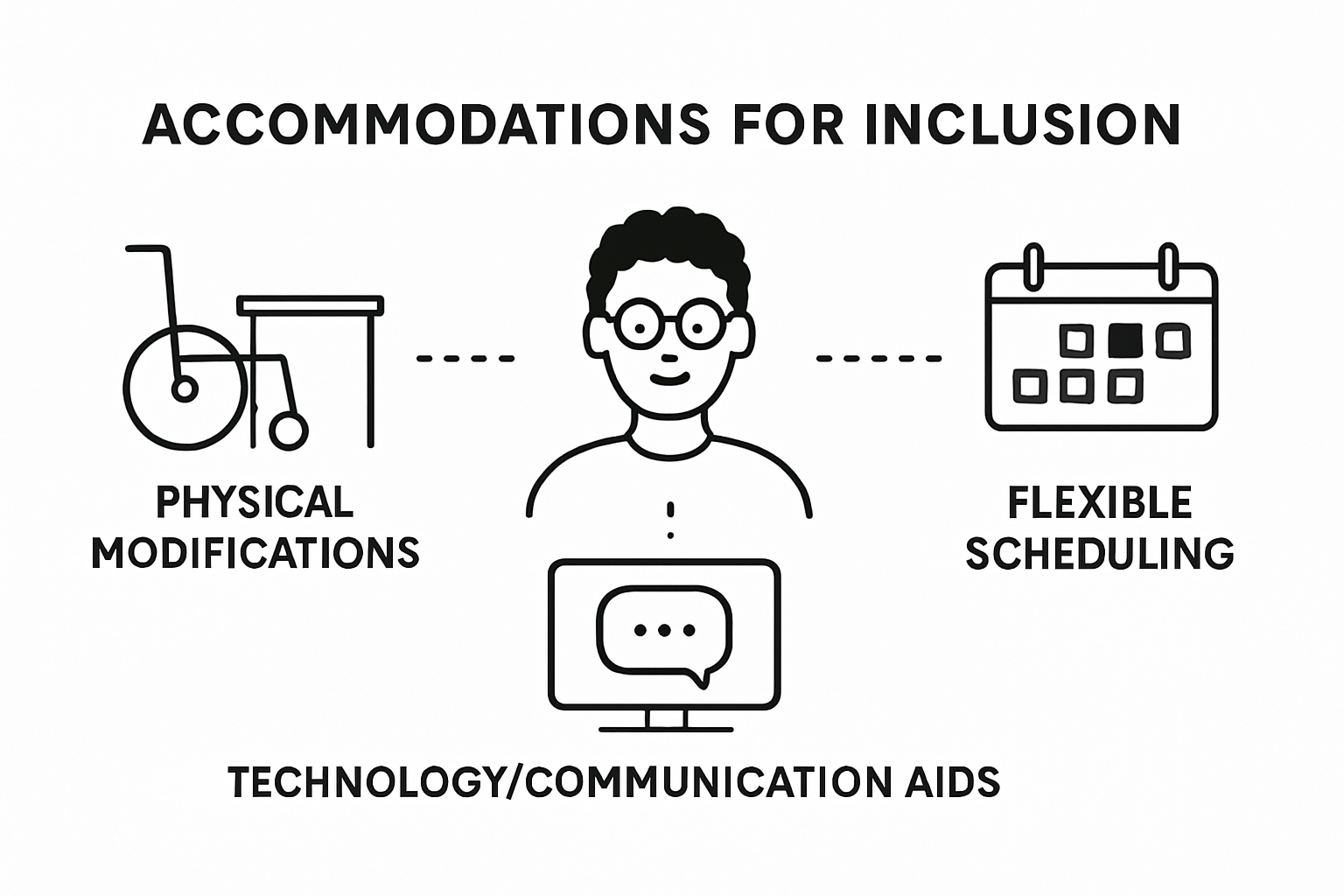
    Infographic: types of workplace accommodations

    California law establishes robust legal protections for employees with disabilities, placing significant responsibilities on employers to ensure fair and inclusive workplace practices.

    Legal requirements for workplace accommodations mandate that employers engage in a timely, good-faith interactive process when an employee requests reasonable modifications or when the employer recognizes a potential accommodation need.

    This interactive process is not a passive obligation but an active responsibility to collaborate with employees to find suitable workplace adjustments.

    The legal framework explicitly prohibits employer retaliation against workers seeking reasonable accommodations. Under California Government Code provisions, employers cannot penalize, demote, terminate, or discriminate against employees who request disability-related workplace modifications.

    Confidentiality is another critical legal requirement, with employers obligated to maintain strict privacy regarding any medical documentation or disability-related information shared during the accommodation request process.

    Employers must demonstrate a proactive approach to understanding and implementing reasonable accommodations. This involves training management and human resources personnel about legal obligations, developing clear accommodation request protocols, and maintaining documentation of the interactive process.

    Workplace disability rights extend beyond mere compliance; they represent a commitment to creating an equitable work environment that respects individual differences and supports employees’ professional success.

    Ultimately, California’s legal framework surrounding reasonable accommodations is designed to balance employee rights with business operational needs.

    By establishing clear guidelines and expectations, the law ensures that workers with disabilities have meaningful opportunities to contribute their skills and talents, while providing employers with a structured approach to implementing workplace adaptations.

    Requesting Accommodations: Processes and Documentation

    Employees seeking reasonable accommodations must navigate a structured process that begins with open communication and careful documentation.

    Workplace accommodation request procedures typically start with a direct conversation with the employer, where the employee clearly articulates their specific disability-related needs and how these modifications will enable them to perform essential job functions effectively.

    Documentation plays a critical role in the accommodation request process. Employees should be prepared to provide relevant medical documentation that substantiates their disability and explains the specific accommodations required.

    Reasonable accommodation documentation packages are available through the California Civil Rights Department, offering guidance on the type and scope of medical information employers can legally request.

    These documents should focus on functional limitations and recommended workplace modifications, protecting the employee’s medical privacy while providing sufficient information to support the accommodation request.

    The interactive process is a collaborative effort requiring good faith participation from both the employer and employee. This means engaging in meaningful dialogue, exploring multiple potential accommodations, and finding solutions that meet the employee’s needs without causing undue hardship to the employer.

    Employees should be prepared to discuss alternative modifications if their initial request cannot be implemented exactly as proposed.

    Maintaining detailed records of all communications, requests, and proposed accommodations is crucial for protecting the employee’s rights and documenting the interactive process.

    Understanding the nuanced steps of accommodation requests can empower employees to effectively advocate for their workplace needs.

    The process is designed to be flexible and individualized, recognizing that each disability and workplace environment presents unique challenges and opportunities for meaningful workplace adaptation.

    California employers face significant legal risks when they fail to properly handle reasonable accommodation requests. Disability accommodation legal violations can result in substantial financial penalties, potential discrimination lawsuits, and regulatory sanctions.

    These violations occur when employers refuse to engage in the interactive process, deny reasonable accommodations without demonstrating undue hardship, retaliate against employees requesting modifications, or discriminate based on disability status.

    Employees encountering workplace accommodation challenges have multiple legal pathways to address potential violations. They can file complaints with the California Civil Rights Department, submit claims through the Equal Employment Opportunity Commission, or pursue civil litigation against their employer.

    Documentation becomes crucial in these scenarios, with employees needing to maintain detailed records of accommodation requests, employer communications, medical documentation, and any instances of discriminatory treatment or failure to accommodate.

    Employment attorney support can be instrumental in navigating complex reasonable accommodation disputes. Legal professionals specializing in employment law can evaluate the strength of a potential claim, help gather necessary evidence, negotiate with employers, and represent employees in administrative hearings or court proceedings.

    They understand the nuanced legal standards that define reasonable accommodations and can effectively challenge employers who fail to meet their legal obligations.

    Ultimately, the legal framework surrounding reasonable accommodations is designed to protect employees’ rights while providing employers with clear guidelines for creating inclusive workplaces.

    By understanding potential risks, documentation requirements, and available legal remedies, workers can effectively advocate for their rights and ensure they receive the workplace modifications necessary to perform their job functions successfully.

    Understanding Your Rights and Taking Action on Reasonable Accommodation Laws in California Workplaces

    Navigating reasonable accommodation laws can be overwhelming, especially when you face challenges like employer denial, retaliation, or unclear documentation requirements.

    This article highlights crucial concepts such as the interactive process, undue hardship, and workers’ protections under the California Fair Employment and Housing Act. You deserve a workplace that respects your rights and supports your unique needs without fear of discrimination or penalty.

    Understanding Your Rights and Taking Action on Reasonable Accommodation Laws in California Workplaces

    If you are struggling to secure the accommodations you need or believe your rights have been violated, it is vital to act now. Visit California Labor Law to access clear legal guides that simplify your path forward. Don’t wait until your situation worsens. Empower yourself today and call 1-866-355-9991 to get a free California work accommodations violation consultation.

    Frequently Asked Questions

    What are reasonable accommodation laws?

    Reasonable accommodation laws require employers to make necessary modifications for workers with disabilities, ensuring they can perform essential job functions. This includes adjustments like physical changes to the workspace or flexible scheduling.

    What types of accommodations can I request at work?

    You can request various accommodations, including physical modifications (like ramps), technology aids (like screen readers), flexible work schedules, or job duty adjustments that align with your abilities.

    How do I request a reasonable accommodation from my employer?

    To request a reasonable accommodation, start by discussing your needs directly with your employer. Be prepared to provide documentation that outlines your disability and the specific accommodations needed to perform your job effectively.

    What should I do if my employer denies my accommodation request?

    If your employer denies your accommodation request, document the communications and your employer’s reasoning. You can file a complaint with the appropriate authorities, such as the California Civil Rights Department, or consult an employment attorney for legal guidance.

  • Understanding Wrongful Termination Statute of Limitations

    Understanding Wrongful Termination Statute of Limitations

    What are the Statute of Limitations for California Wrongful Termination?

    Getting fired unfairly is tough, and knowing your rights matters even more when time is ticking. There is something most people miss: the window to take legal action can disappear fast. In some states you might have only 180 days to file a claim or you could have up to 3 years, depending on a few key details. That countdown can run out before you even know it began, and waiting too long means you could lose your shot at justice for good.

    What is the Wrongful Termination Statute of Limitations?

    A wrongful termination statute of limitations represents the legal time frame within which an employee can file a lawsuit against their employer for unlawful job dismissal. This critical legal concept determines how long workers have to take legal action after experiencing potentially illegal termination.

    The statute of limitations varies depending on the specific type of wrongful termination claim and applicable state or federal laws. According to Cornell Law School, these time limits are designed to ensure fair legal proceedings and prevent stale claims from surfacing years after an incident.

    Typical time frames for wrongful termination claims can range from 180 days to 3 years, depending on several factors:

    • Federal discrimination claims through the Equal Employment Opportunity Commission (EEOC)
    • State level employment law violations
    • Specific types of workplace misconduct

    Factors Influencing Statute of Limitations

    Multiple elements impact the precise duration for filing a wrongful termination lawsuit. Key considerations include:

    • The nature of the termination (discriminatory, retaliatory, contractual breach)
    • Whether the claim involves state or federal law
    • The specific employment sector and type of violation

    Employees should understand their complete rights in wrongful termination cases to ensure they do not miss critical filing deadlines. Waiting too long can permanently forfeit your ability to seek legal remedy for an unjust job loss.

    To help you understand the factors that impact the wrongful termination statute of limitations, the following table summarizes key variables and their effects on filing deadlines.

    Factor Impact on Statute of Limitations Example
    Type of Claim Different claims have unique time frames Discrimination vs. Retaliation
    Applicable Law (State vs. Federal) State and federal laws set varying limitations EEOC (federal) vs. state law claims
    Nature of Termination The reason behind the firing can affect deadlines Contract breach vs. discrimination
    Discovery of Wrongful Action Time may start when employee learns of the action Hidden vs. obvious violations
    Employment Sector Special rules may apply in some industries Private vs. public sector

    Comprehending these time limitations is crucial because once the statute of limitations expires, courts will typically dismiss the case without considering its merits. This underscores the importance of prompt legal action and consultation with employment law professionals who can guide you through the complex process of challenging an unlawful termination.

    Why Does the Statute of Limitations Matter in Employment Disputes?

    Statutes of limitations serve as critical legal safeguards that protect both employees and employers by establishing clear boundaries and time frames for resolving workplace disputes. These legal time constraints are not merely procedural technicalities but fundamental mechanisms ensuring fairness and preventing potential long-term legal uncertainties.

    Preserving Evidence and Ensuring Timely Resolution

    The statute of limitations plays a crucial role in maintaining the integrity of legal proceedings. As the Fair Labor Standards Act indicates, time-bound legal claims help preserve critical evidence and witness testimonies that might otherwise become unreliable or disappear over extended periods.

    Key reasons why statutes of limitations are essential include:

    • Protecting employers from indefinite legal vulnerability
    • Ensuring evidence remains fresh and credible
    • Encouraging prompt resolution of workplace conflicts

    Beyond procedural requirements, statutes of limitations have significant practical implications for employment disputes. When employees delay filing claims, they risk permanently losing their legal recourse. This potential forfeiture underscores the importance of understanding and respecting these time limitations.

    Moreover, these legal time frames serve multiple purposes:

    • Preventing stale claims with potentially degraded evidence
    • Promoting workplace stability and legal predictability
    • Balancing the interests of both employees and employers

    Employees seeking legal representation in California wrongful termination cases must recognize that timing is everything. Missing a critical deadline can mean the difference between obtaining justice and having a valid claim completely dismissed.

    Ultimately, statutes of limitations are not obstacles but essential mechanisms that ensure fair, timely, and effective resolution of workplace disputes. They compel both parties to address potential legal issues promptly and systematically, thereby maintaining a balanced and responsive employment legal framework.

    How the Wrongful Termination Statute of Limitations Works

    The wrongful termination statute of limitations operates as a complex legal mechanism that defines the precise window during which an employee can pursue legal action against an employer for unlawful job dismissal. Understanding its operational framework requires examining the intricate details of claim initiation, calculation, and potential exceptions.

    Calculating the Time Frame

    Statute of limitations calculation begins from a specific triggering event, typically the date of termination or the moment the employee becomes aware of the wrongful action. According to 29 U.S. Code 255, these time limits are not arbitrary but strategically designed to balance fairness between employees and employers.

    Key elements in calculating the time frame include:

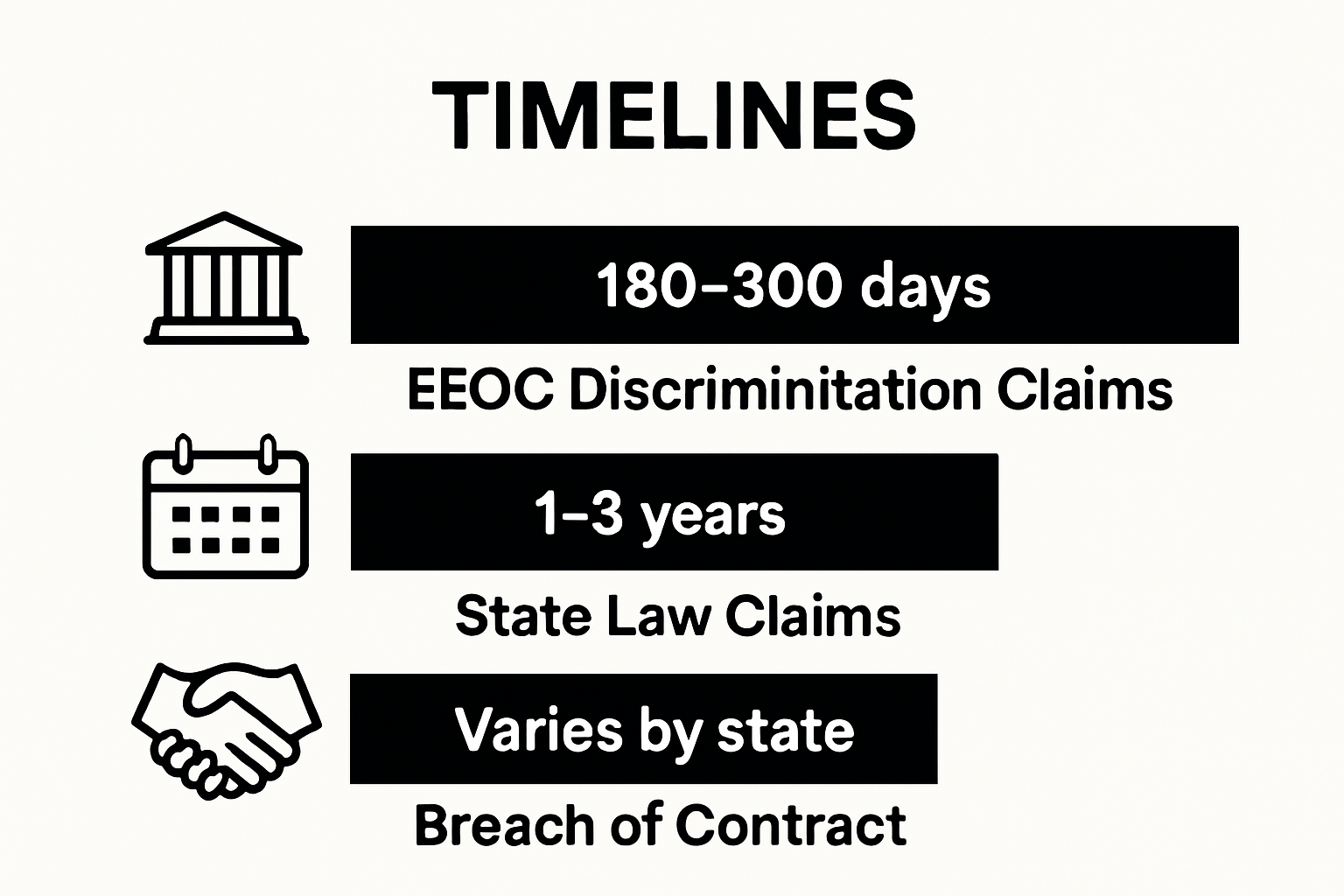
    Simple bar chart compares common wrongful termination claim deadlines

    • The specific type of employment violation
    • Whether the claim involves state or federal law
    • The intentionality of the employer’s actions

    Variations in Limitation Periods

    Different types of wrongful termination claims have distinct limitation periods. Some claims might have shorter windows, while others provide more extended periods for legal action. Critical variations exist based on:

    • Discrimination claims (typically 180 to 300 days)
    • Retaliation claims
    • Breach of employment contract disputes

    Employees should check their wait time penalty options to understand how timing impacts their potential legal remedies. The complexity of these time frames underscores the importance of prompt and strategic legal consultation.

    Below is a comparison table outlining common types of wrongful termination claims and their typical statute of limitations, helping you quickly see how your situation might be categorized.

    Type of Claim Typical Statute of Limitations Triggering Event
    Discrimination (Federal) 180-300 days Date of termination or discovery
    Retaliation 180 days to 3 years Date of adverse action
    Breach of Contract 2-3 years (varies by state) Date of contract breach/termination
    State Law Violations 1-3 years Date of incident/termination/discovery
    Wage/Hour (FLSA) 2-3 years Date of wage violation or termination

    The statute of limitations is not just a procedural hurdle but a critical legal safeguard. It ensures that evidence remains fresh, witnesses are available, and both parties can effectively address workplace disputes within a reasonable timeframe. Employees must act swiftly and precisely, recognizing that delays can permanently extinguish their right to seek justice for wrongful termination.

    Key Concepts in Wrongful Termination and Statute of Limitations

    Wrongful termination and its associated legal time constraints represent a complex intersection of employment law that requires nuanced understanding. These legal principles protect employee rights while establishing clear boundaries for potential legal recourse against employers who violate workplace regulations.

    Defining Wrongful Termination

    Wrongful termination occurs when an employee is fired for illegal reasons that violate established employment laws or public policy. According to 29 U.S. Code 255, legal frameworks recognize several critical scenarios constituting wrongful termination:

    • Discrimination based on protected characteristics
    • Retaliation for reporting workplace violations
    • Termination that breaches explicit employment contracts
    • Firing an employee for exercising legal rights

    Statute of limitations fundamentally serves as a legal time barrier that defines the window during which an employee can pursue legal action. The critical aspects include:

    • Precise calculation of the legal time frame
    • Recognition of different limitation periods for various claim types
    • Understanding triggering events that initiate the limitation period

    Employees seeking comprehensive insights can explore our California employment law blog for deeper understanding of these complex legal nuances. The interplay between wrongful termination claims and their associated time limitations requires careful navigation and strategic legal planning.

    employment law office

    Ultimately, understanding these key concepts empowers employees to recognize potential workplace violations and take timely, informed action. The statute of limitations is not merely a procedural technicality but a crucial mechanism ensuring fair resolution of employment disputes while protecting both employee rights and employer interests.

    Do Not Lose Your Chance to Act on Wrongful Termination

    Are you worried about missing the tight deadlines explained in this article? The statute of limitations can rob you of your chance for justice if you wait too long. Many California workers struggle with the fear and confusion of when and how to file a claim for wrongful termination. Missing the filing window can mean permanent loss of your rights, as this article highlights.

    Do not let uncertainty hold you back. Find real answers and tools that put you in control. Our website, California Labor Law, offers quick guides, legal calculators, and current law updates to help you understand your options right now. If you think you are owed lost wages or wait time penalties after being let go, start with our California wait time penalty resource for potential claims. Confused about your broader legal protections? Call us at 1-866-355-9991 to discuss your options today with a free wrongful termination consultation.

    Frequently Asked Questions

    What is the statute of limitations for wrongful termination claims?

    The statute of limitations for wrongful termination claims can range from 180 days to 3 years, depending on the nature of the claim and applicable state or federal laws.

    Why is the statute of limitations important in wrongful termination cases?

    The statute of limitations is essential because it sets a deadline for filing claims, ensuring timely legal action and preserving evidence, which helps maintain the fairness of the legal process.

    How do I calculate the time frame for filing a wrongful termination lawsuit?

    The time frame typically begins from the date of termination or the moment the employee becomes aware of the wrongful action, influenced by the specific type of violation and applicable laws.

    What happens if I miss the statute of limitations deadline?

    If you miss the statute of limitations deadline, you may permanently lose your right to pursue legal action for wrongful termination, and the court will likely dismiss your case without considering its merits.

  • How to File Wage Claim: Your Step-by-Step Process

    How to File Wage Claim: Your Step-by-Step Process

    How to File a California Wage Claim

    Filing a wage claim sounds daunting and complex for most workers, but the payoff can be huge. Workers who file wage claims recover millions in unpaid wages each year, sometimes from employers who never expected to get caught. Many assume gathering paperwork and jumping through agency hoops is impossible without a law degree. But the real secret is that most successful wage claims come down to getting organized and being persistent—even if you have never done anything like this before.

    Step 1: Gather Necessary Documentation and Evidence

    Filing a wage claim requires careful preparation and strategic documentation collection. This initial step is crucial in building a compelling case that demonstrates the precise details of your wage dispute. Comprehensive evidence will significantly strengthen your claim and provide clear documentation of potential labor law violations.

    Begin by systematically collecting all financial records related to your employment. Paychecks, pay stubs, time records, employment contracts, and any written communication with your employer become critical pieces of evidence. Focus on gathering documents that show your work hours, agreed compensation rates, actual payments received, and any discrepancies between promised and actual wages.

    Track down every relevant document, even if it seems minor. Bank statements showing deposit amounts, work schedules, text messages discussing compensation, and email exchanges can provide essential context. Electronic records are particularly valuable, as they create a verifiable trail of communication and financial transactions. If you have kept a personal log of hours worked or overtime, include these detailed records as supplementary evidence.

    Be meticulous in your documentation process. Organize your materials chronologically and create digital and physical copies. Scan paper documents and store them securely in multiple locations. Highlight or annotate sections that specifically demonstrate wage discrepancies or potential violations. This approach not only preserves your evidence but also makes it easier to reference during the wage claim process.

    Key documents to collect include:

    • Original job offer or employment contract
    • Complete set of pay stubs from the period of dispute
    • Bank statements showing wage deposits
    • Written communication about wages or work hours
    • Time sheets or work schedules
    • Performance reviews or salary negotiation documents

    By thoroughly gathering and organizing your documentation, you create a solid foundation for your wage claim. Each piece of evidence serves as a puzzle piece that helps reconstruct the full picture of your wage dispute. Taking time to be thorough and systematic in this initial step can significantly improve your chances of a successful resolution.

    Here is a checklist table you can use to organize and verify key documents before filing your wage claim.

    Document Type Purpose Verified (Yes/No)
    Employment contract/job offer Confirms terms of employment and pay rate
    Complete set of pay stubs Documents payments made and any discrepancies
    Bank statements (wage deposits) Verifies actual receipt or non-receipt of wages
    Written communications (emails/texts) Supports claims about wage agreements/disputes
    Time sheets/work schedules Demonstrates hours worked and overtime
    Performance reviews/salary records May show negotiated pay or job responsibilities
    Personal log of hours worked Supplements other time records

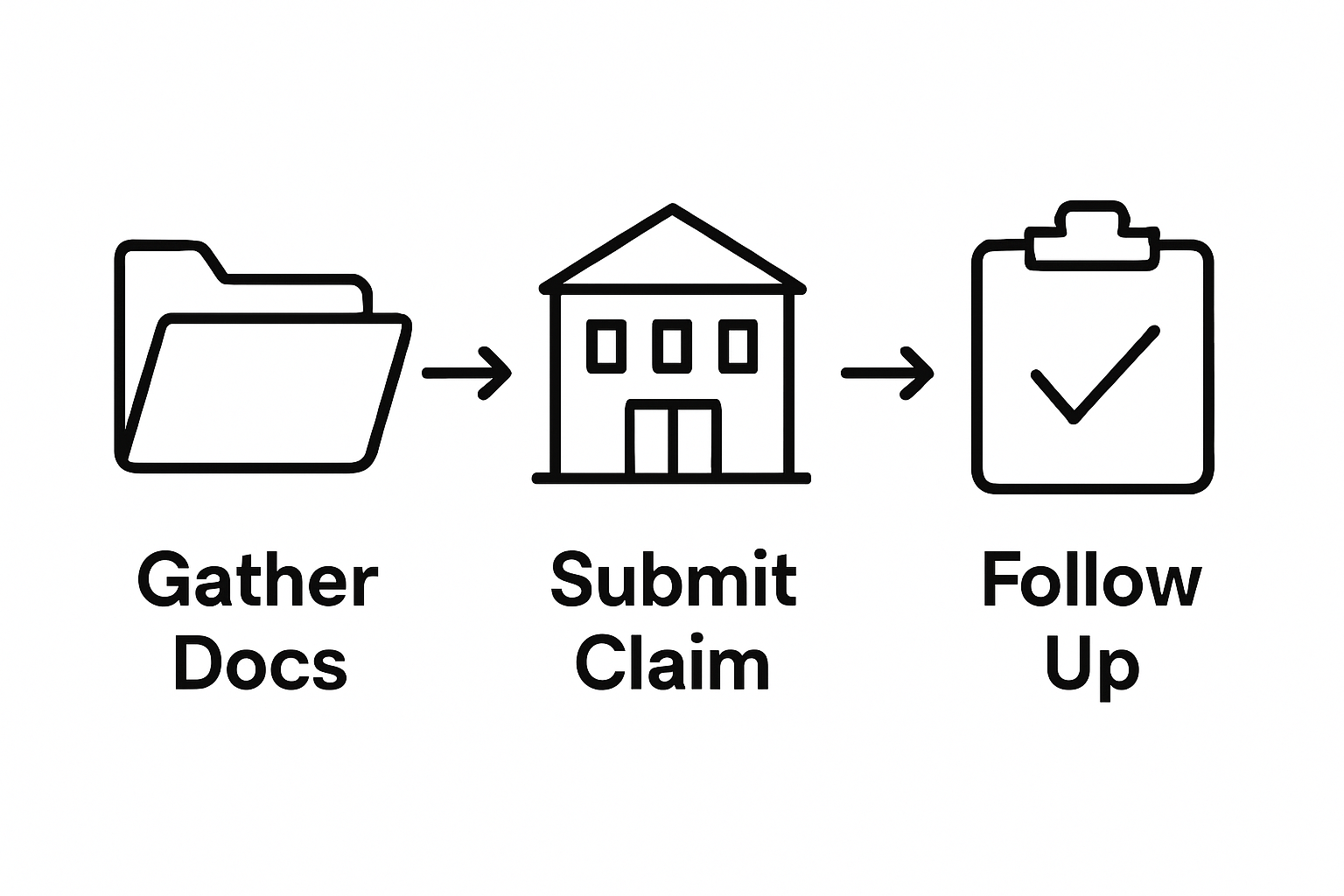
    Infographic summarizing steps to file a wage claim

    California Department of Industrial Relations recommends maintaining comprehensive records as the first critical step in pursuing a wage claim.

    Step 2: Determine the Appropriate Filing Agency

    Navigating the complex landscape of wage claim filing requires understanding which agency has jurisdiction over your specific employment situation. The right filing agency can make the difference between a successful resolution and a dismissed claim. Each type of wage dispute falls under different regulatory frameworks, making careful agency selection critical to your legal strategy.

    In California, workers have multiple options for filing wage claims depending on the nature of their specific wage violation. The primary agencies handling wage disputes include the California Labor Commissioner’s Office (Division of Labor Standards Enforcement), federal Wage and Hour Division, and potentially local county labor enforcement offices. Your choice depends on several key factors: the type of wage violation, total amount of unpaid wages, and whether the issue involves state or federal labor regulations.

    For most California workers experiencing state labor law violations, the California Labor Commissioner’s Office represents the primary avenue for wage claims. This agency handles disputes involving minimum wage violations, unpaid overtime, meal and rest break penalties, and other state-specific employment regulations. They provide a straightforward process for workers seeking to recover unpaid wages through administrative hearings.

    Federal wage claims through the U.S. Department of Labor become more appropriate when your situation involves violations of national labor standards like the Fair Labor Standards Act. These claims typically address issues such as minimum wage violations across state lines, specific overtime calculations, or employment practices affecting interstate commerce.

    Key considerations for selecting your filing agency include:

    • Total amount of unpaid wages
    • Type of wage violation (state vs. federal)
    • Whether your employer operates across multiple states
    • Specific labor law potentially violated
    • Statute of limitations for your claim

    Take time to research and understand the specific jurisdiction of each agency. Consulting with a local employment law attorney can provide personalized guidance on selecting the most appropriate filing mechanism for your unique situation. Some workers might even find they can file simultaneously with multiple agencies, maximizing their chances of wage recovery.

    Below is a summary table comparing agencies you might file your wage claim with, highlighting jurisdiction, applicable violations, and special considerations.

    Agency Jurisdiction Scope Types of Violations Addressed Special Considerations
    California Labor Commissioner State (California employees) Minimum wage, unpaid overtime, state labor Handles state-specific law violations
    U.S. Department of Labor (WHD) Federal (nationwide) FLSA violations, minimum wage, overtime Use for federal law or interstate issues
    Local County Labor Office County/local May address local wage and hour rules Only in certain regions or cities

    U.S. Department of Labor recommends carefully evaluating your specific wage dispute to determine the most effective filing route for your circumstances.

    Step 3: Complete the Wage Claim Form Accurately

    Filling out a wage claim form represents a critical moment in your pursuit of unpaid wages. Precision and thoroughness can make the difference between a successful claim and an immediate dismissal. This step demands careful attention to detail and a methodical approach to documenting your wage dispute.

    Begin by obtaining the official wage claim form from the appropriate agency you identified in the previous step. Most state labor departments provide these forms online, allowing you to download and complete them electronically or print for manual completion. Carefully read every section of the form before you start filling it out, ensuring you understand exactly what information is required.

    The wage claim form will typically request comprehensive details about your employment and wage dispute. You will need to provide personal information, employer details, specific wage violation information, and supporting documentation. Be prepared to outline the exact nature of your wage claim, including precise dates, amounts of unpaid wages, and a clear explanation of how your employer violated wage regulations. Learn more about identifying wage theft in your workplace.

    Documentation is key in this process. Attach copies of all supporting evidence you collected in the first step. This includes pay stubs, time records, communication with your employer, and any other relevant financial documents. Ensure that every document is clear, legible, and directly supports the claims you are making. Avoid sending original documents unless specifically requested, as these may not be returned.

    Important information to include on your wage claim form:

    • Complete personal contact information
    • Employer’s full legal business name and contact details
    • Exact dates of employment
    • Specific wage violations with precise monetary amounts
    • Dates and amounts of unpaid wages
    • Supporting documentation references

    Double-check every section of the form before submission.

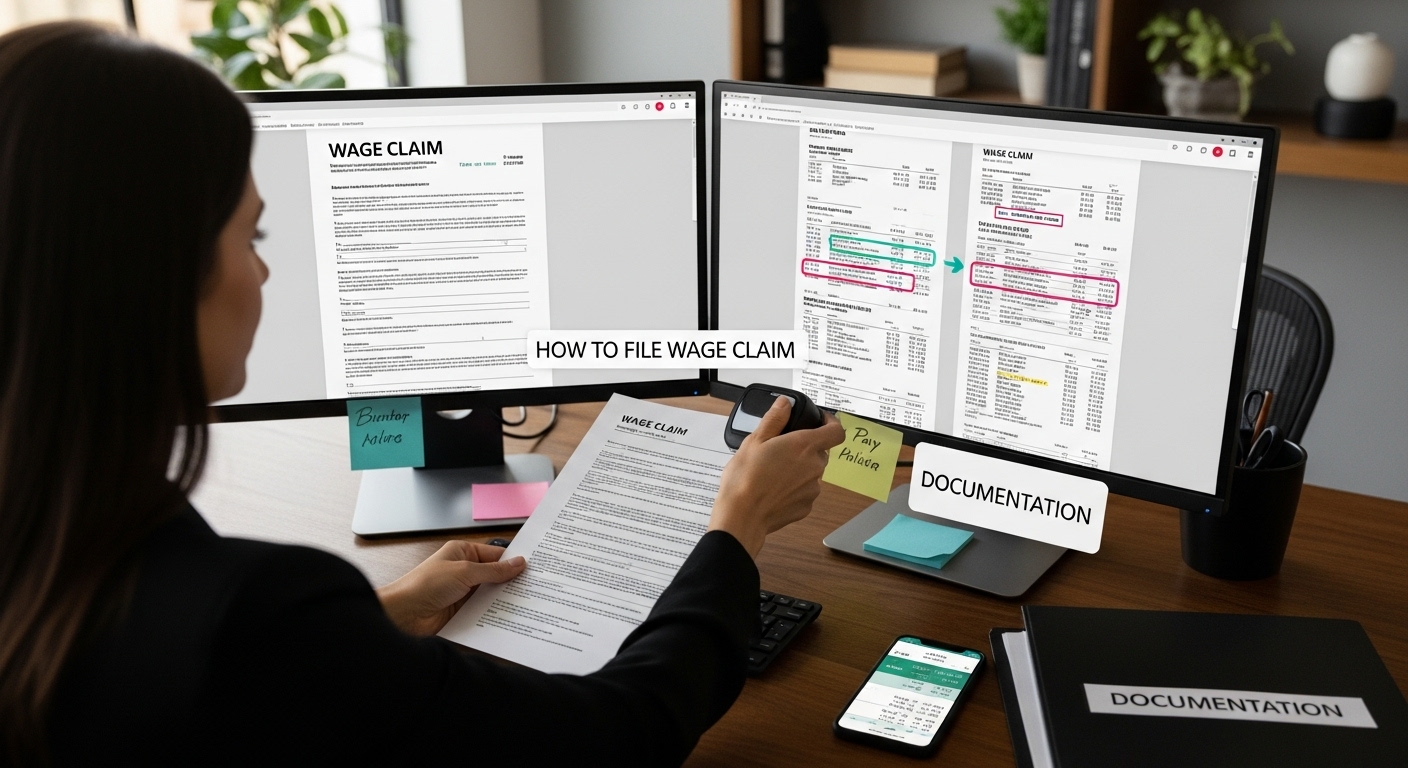
    wage claim documents Errors or incomplete information can significantly delay or potentially invalidate your claim. If you are uncertain about any part of the form, consider consulting with an employment law attorney who can provide guidance on completing the document accurately.

    North Dakota Department of Labor and Human Rights emphasizes that thoroughly and accurately completed wage claim forms are essential for successful resolution of wage disputes.

    Step 4: Submit Your Wage Claim and Keep Proof of Submission

    Submitting your wage claim represents a pivotal moment in your pursuit of justice. This step transforms your carefully gathered documentation into an official legal process. The manner in which you submit your claim can significantly impact its processing and potential success.

    Choose your submission method strategically. Most agencies offer multiple options including online submission, email, postal mail, or in-person filing. Certified mail with return receipt provides the most robust documentation of your claim submission. This method creates an official record that proves exactly when and how you submitted your wage claim, which can be crucial if disputes arise about the timeliness or receipt of your documentation.

    Prepare a comprehensive submission package that includes your completed wage claim form, all supporting documentation, and any additional required materials. Understand more about protecting yourself from wage theft during this critical process. Make multiple copies of everything you submit. One copy should remain in your personal files, another should be sent to the agency, and a third can serve as a backup.

    When submitting electronically, use a reliable email account and request a read receipt or confirmation of submission. If filing in person, request a time-stamped receipt that demonstrates the exact moment of submission. Digital submissions should be made in universally accepted formats like PDF to ensure readability and prevent potential technical issues.

    Critical submission documentation to retain:

    • Original completed wage claim form
    • Copies of all supporting financial documents
    • Submission confirmation or receipt
    • Tracking information for mailed documents
    • Agency contact information and reference numbers

    Verify your submission thoroughly before sending. Check that all required fields are completed, documents are legible, and you have included every necessary piece of evidence. Follow up within a week of submission to confirm the agency has received your claim and initiated processing.

    North Dakota Department of Labor and Human Rights recommends maintaining meticulous records throughout the wage claim submission process to protect your legal interests.

    Step 5: Prepare for the Investigation Process

    The investigation process transforms your wage claim from a personal complaint into an official legal proceeding. This critical stage determines whether your wage claim will result in financial recovery or potential resolution with your employer. Understanding and preparing for this process can significantly impact your claim’s success.

    Expect the investigating agency to conduct a comprehensive review of your submitted documentation and potentially reach out for additional information. They will likely contact your employer to request their perspective and financial records related to your wage claim. This means you must remain accessible and responsive throughout the investigation. Provide prompt and clear responses to any communication from the investigating agency, and be prepared to offer additional context or documentation if requested.

    Documenting every interaction becomes crucial during this phase. Keep detailed records of all communications, including dates, times, names of officials you speak with, and summaries of conversations. Learn more about protecting your rights during wage disputes to ensure you’re fully prepared. Create a dedicated file or digital folder where you can organize all correspondence and additional materials that might be requested during the investigation.

    Prepare yourself mentally for potential negotiations or mediation. The investigation process might involve direct communication between the agency, you, and your employer to resolve the wage dispute. This could mean potential settlement discussions or opportunities to clarify misunderstandings about your wage claim. Maintain a professional and factual approach, focusing on the documented evidence rather than emotional arguments.

    Key preparation steps for the investigation process:

    • Remain readily available for agency communications
    • Organize all supporting documentation
    • Create a detailed timeline of wage violations
    • Prepare concise, factual statements about your claim
    • Understand your rights under labor laws
    • Consider potential legal consultation

    Maintain realistic expectations about the investigation timeline. These processes can take weeks or even months depending on the complexity of your claim and the agency’s current workload. Stay patient, continue to document everything, and be prepared to provide additional information if requested.

    U.S. Department of Labor recommends maintaining clear, professional communication and being prepared to substantiate your wage claim throughout the investigation process.

    Step 6: Follow Up and Verify the Status of Your Claim

    Following up on your wage claim is not just a recommended step it is a critical component of ensuring your claim receives proper attention and resolution. Proactive communication can significantly impact the speed and outcome of your wage dispute. The investigation process can be complex and time-consuming, making your active involvement essential.

    Establish a systematic approach to tracking your claim’s progress. Create a dedicated communication log where you record every interaction, including dates, names of officials contacted, and summaries of conversations. Most agencies provide multiple channels for status updates, including phone numbers, email addresses, and sometimes online tracking systems. Learn more about protecting your wage claim rights to understand the nuances of follow-up procedures.

    Develop a strategic follow-up schedule that balances persistence with professionalism. Contact the assigned investigator or agency every two to three weeks to request a status update. When you reach out, be courteous, concise, and prepared with your claim reference number and specific questions. Email communications provide a written record, but phone calls can sometimes yield more immediate insights.

    Be prepared for potential challenges during the follow-up process. Investigations can be delayed by various factors, including workload, complexity of the claim, or the need for additional documentation. Maintain patience while remaining vigilant. If you encounter significant delays or feel your claim is not progressing, consider seeking legal consultation to understand your options.

    Key follow-up strategies to implement:

    • Maintain a detailed communication log
    • Set regular reminder dates for status inquiries
    • Keep all original and copied documentation accessible
    • Prepare a concise summary of your claim for quick reference
    • Stay professional and persistent in your communications
    • Be ready to provide additional information promptly

    Document every interaction and communication attempt. Save email confirmations, note down phone call details, and keep copies of all correspondence. These records can be crucial if you need to escalate your claim or demonstrate your diligence in pursuing resolution.

    U.S. Department of Labor recommends maintaining consistent and professional communication throughout the wage claim investigation process.

    Struggling With a Wage Claim? Let Us Guide You

    Facing unpaid wages, confusing paperwork, or employer retaliation can be overwhelming when all you want is a fair outcome. This article has walked you through each step of the claim process, but real-world wage disputes often create anxiety and leave you questioning if you have enough evidence or if your rights will actually be protected. That is where you can rely on us.

    Do not let uncertainty, missed deadlines, or mistakes threaten your claim. Get accurate answers, wage calculators, and direct access to legal advocates by visiting our platform at California Labor Law. Take back control by exploring our free legal resources and know your rights about wage theft now. If you need help today, our team is ready to listen and offer immediate support. Call California Labor Law at 1-866-355-9991 for a free wage claim consultation.

    Frequently Asked Questions

    What documents do I need to gather for filing a wage claim?

    To file a wage claim, you should collect all financial records related to your employment, including paychecks, pay stubs, time records, employment contracts, and written communication with your employer. Other evidence such as bank statements, work schedules, and any personal logs detailing hours worked are also helpful.

    How do I determine which agency to file my wage claim with?

    The agency to file your wage claim with depends on the type of wage violation and whether it falls under state or federal law. In California, the California Labor Commissioner’s Office generally handles state wage claims, while the federal Wage and Hour Division is appropriate for claims involving national labor standards like the Fair Labor Standards Act.

    How do I fill out the wage claim form correctly?

    When filling out the wage claim form, ensure that you provide all required information accurately, including detailed employment information, specific wage violation data, and supporting documentation. It is crucial to review the form thoroughly before submission to avoid errors that could lead to dismissal of your claim.

    What should I do after submitting my wage claim?

    After submitting your wage claim, keep a record of your submission, including any receipts or confirmations. Establish a follow-up schedule to check on the status of your claim, contacting the assigned investigator every few weeks to ensure timely progress and addressing any additional information requests promptly.

  • Understanding Final Paycheck California Regulations and Rights

    Understanding Final Paycheck California Regulations and Rights

    Regulations and Rights in California for Final Paychecks

    Final paychecks in California might sound simple at first. Many people just expect to collect their last wages and move on. But state law does not leave any room for guesswork. California requires employers to pay all final wages immediately if someone is fired and can penalize them every single day they delay. That flips the usual power dynamic and gives employees powerful leverage during those final moments on the job.

    What is a Final Paycheck in California?

    A final paycheck in California represents the last monetary compensation an employee receives when their employment relationship ends, whether through termination, resignation, or mutual separation. This critical payment encompasses all wages earned up to the employee’s last working day, including regular wages, overtime, accrued vacation time, and any other outstanding compensation.

    Under California labor law, a final paycheck is not just a routine transaction but a legally mandated process with specific requirements. According to the California Department of Industrial Relations, employers must follow strict guidelines regarding the timing and complete payment of final wages. These regulations protect workers by ensuring they receive all compensation owed to them promptly and comprehensively.

    Key Components of a Final Paycheck

    A comprehensive final paycheck in California typically includes multiple elements:

    • Regular Wages: All hours worked up to the final day of employment
    • Overtime Compensation: Any additional hours worked beyond standard work hours
    • Unused Vacation Time: Accrued and unused paid time off
    • Prorated Wages: Earnings for partial pay periods

    The timing of final paycheck delivery varies depending on the circumstances of employment termination. For involuntary terminations, employers must provide immediate payment. In cases of voluntary resignation with 72 hours’ notice, payment is due on the last working day. Without sufficient notice, employers have 72 hours to issue the final paycheck.

    If you want to learn more about waiting time penalties related to delayed final paychecks, our comprehensive guide can help you understand your rights and potential recourse.

    Understanding these regulations is crucial for employees to ensure they receive fair compensation and for employers to maintain legal compliance in their payroll practices.

    This table outlines the primary components of a California final paycheck, distinguishing each element to clarify what employees can expect as part of their final compensation.

    Component Description
    Regular Wages Pay for all regular hours worked through the final day
    Overtime Compensation Additional pay for hours worked beyond standard weekly limits
    Unused Vacation Time Payment for accrued, unused paid time off (as required by law)
    Prorated Wages Earnings for partial pay periods if employment ends mid-cycle

    Why Final Paycheck Matters for Employees and Workers

    Final paychecks are far more than routine financial transactions; they represent critical legal protections and financial safeguards for California workers. These payments ensure that employees receive complete compensation for their labor, protecting them from potential wage theft and financial uncertainty during job transitions.

    A final paycheck serves as a crucial mechanism for workers to secure their rightful earnings. By mandating immediate or timely payment upon employment termination, California labor laws prevent employers from withholding wages arbitrarily. Workers facing potential wage disputes can use these regulations as a powerful tool to defend their economic interests and ensure fair treatment.

    Comprehensive Compensation Breakdown

    The significance of a final paycheck extends beyond basic wages. It encompasses multiple critical financial components that protect workers during employment transitions:

    • Full Wage Recovery: Ensuring every hour worked is compensated
    • Unused Benefit Redemption: Converting accrued vacation or paid time off into monetary value
    • Immediate Financial Stability: Providing immediate access to earned income

    According to the National Conference of State Legislatures, these regulations are designed to prevent financial hardship and protect workers from potential economic exploitation. By requiring prompt and complete payment, California labor laws create a robust framework that prioritizes employee financial security.

    Understanding the importance of final paychecks empowers workers to recognize their rights, demand fair treatment, and navigate employment transitions with confidence and financial protection.

    Understanding California Labor Laws on Final Paychecks

    California labor laws surrounding final paychecks represent a robust legal framework designed to protect workers and ensure fair compensation during employment transitions. These regulations establish clear guidelines for employers regarding the timing, completeness, and delivery of final wages, creating a structured approach to protecting employee earnings.

    The California Department of Industrial Relations mandates specific timeframes for final paycheck delivery based on the circumstances of employment termination. Immediate payment is required for involuntary terminations, while voluntary resignations follow different protocols. For employees who provide at least 72 hours’ notice before leaving, the final paycheck is due on their last working day.

    The following table summarizes the required timelines for final paycheck delivery in California, helping you easily compare employer obligations based on how employment ends.

    Termination Type Notice Requirement Final Paycheck Due Date
    Involuntary (Fired/Laid Off) Not applicable Immediately at termination
    Voluntary (Resignation with 72+ Hours Notice) At least 72 hours before last day On the employee’s last working day
    Voluntary (Resignation with Less Than 72 Hours Notice) Less than 72 hours notice Within 72 hours of notice
    Without sufficient notice, employers have 72 hours to issue the complete payment.

    Infographic showing California final paycheck timelines for fired vs. resigned workers.

    Comprehensive Wage Protection Mechanisms

    California’s labor laws include multiple protective provisions to safeguard employee earnings:

    • Waiting Time Penalties: Employers who fail to provide timely final paychecks may incur daily penalties
    • Full Wage Calculation: Includes regular wages, overtime, unused vacation time, and prorated earnings
    • Legal Recourse: Employees have multiple avenues to challenge incomplete or delayed payments

    If you want to calculate potential waiting time penalties, our specialized tool can help you understand your potential compensation.

    According to the California Department of Industrial Relations, these regulations are designed to prevent wage theft and ensure workers receive their complete compensation promptly. By establishing clear legal standards, California creates a protective environment that prioritizes employee financial rights and holds employers accountable for fair payment practices.

    Wage theft represents a significant legal and financial challenge for California workers, with final paychecks serving as a critical focal point for understanding and preventing unlawful employment practices. These complex interactions between employer obligations and employee rights demand careful navigation and comprehensive understanding.

    Defining Wage Theft in Context of Final Paychecks

    Wage theft occurs when employers intentionally or negligently withhold earned compensation, including wages, overtime, or final paycheck amounts. Specific forms of wage theft related to final paychecks include deliberately delaying payment, underpaying total wages owed, or refusing to include all compensable earnings such as unused vacation time or prorated wages.

    Protective Mechanisms and Employee Rights

    California labor laws provide robust protections against wage theft, establishing clear mechanisms for workers to defend their financial interests:

    • Waiting Time Penalties: Financial penalties assessed against employers who fail to provide timely final payments
    • Wage Claim Procedures: Official channels for employees to challenge incomplete or missing compensation
    • Legal Recourse: Multiple avenues for recovering unpaid wages, including administrative complaints and civil litigation

    Victims of wage theft can explore comprehensive resources to understand their options and potential recovery strategies.

    According to the California Department of Industrial Relations, these legal frameworks are designed to create accountability, ensuring that workers receive complete and timely compensation. By establishing clear standards and meaningful consequences, California’s labor laws serve as a powerful deterrent against unethical employment practices and protect workers’ fundamental right to fair payment.

    How Final Paycheck Issues Affect Employment Disputes

    Final paycheck disputes represent a critical intersection of legal and financial tensions between employees and employers in California. These conflicts can escalate quickly, transforming routine employment separations into complex legal challenges that impact both parties’ professional and financial futures.

    Escalation of Workplace Conflicts

    Final paycheck issues frequently serve as catalysts for broader employment disputes, triggering potential legal actions that extend far beyond the immediate compensation concern. When employers fail to comply with California’s strict final paycheck regulations, employees gain substantial leverage in challenging not just the specific wage discrepancy, but potentially other workplace misconduct or labor law violations.

    Employment disputes stemming from final paycheck problems can manifest through multiple legal mechanisms:

    • Administrative Complaints: Formal wage claims filed with state labor authorities
    • Civil Litigation: Lawsuits seeking comprehensive financial recovery
    • Potential Punitive Damages: Additional financial penalties against employers who demonstrate willful wage violations

    Explore comprehensive guidance on understanding wait time penalties to grasp the full potential financial implications of these disputes.

    According to the California Division of Labor Standards Enforcement, these disputes are not merely financial transactions but critical opportunities to enforce worker protections. The potential for significant financial penalties against employers creates a powerful deterrent against systemic wage theft and encourages comprehensive compliance with labor regulations.

    california paycheck dispute

    Secure Your Final Paycheck Rights Today

    Are you worried about missing wages or delayed payment after leaving your job? Many workers in California face the uncertainty and stress of final paycheck problems, not knowing if their employer is truly following the law. Understanding concepts like waiting time penalties and wage theft can make all the difference when your financial stability is on the line.

    Take control and discover the exact steps to protect your pay. Access free tools that show if you are owed additional money by visiting California Labor Law. Our site offers clear guides about waiting time penalties and shows you how to calculate potential penalties when your paycheck is late. If you want real answers right now, connect with an advocate by calling us at 1-866-355-9991 to schedule a free final paycheck rights consultation and make sure you receive every dollar you have earned.

    Frequently Asked Questions

    What is a final paycheck in California?

    A final paycheck in California is the last payment an employee receives upon termination, resignation, or mutual separation, including all wages earned, overtime, unused vacation time, and any outstanding compensation.

    What are the requirements for delivering a final paycheck in California?

    Employers must provide an immediate final paycheck for involuntary terminations. For voluntary resignations, if an employee gives 72 hours’ notice, payment is due on the last working day; otherwise, the employer has 72 hours to issue the final paycheck.

    What components should be included in a final paycheck?

    A final paycheck in California should include regular wages, overtime compensation, unused vacation time, and any prorated wages for partial pay periods.

    What can employees do if they don’t receive their final paycheck on time?

    If an employer fails to deliver a final paycheck on time, employees may be entitled to waiting time penalties, can file claims with state labor authorities, or pursue civil litigation for financial recovery.

  • Understanding Overtime for Salaried Employees: Key Insights

    Understanding Overtime for Salaried Employees: Key Insights

    Can Salaried Employees Get Overtime?

    Overtime pay is usually seen as a perk only for hourly workers, but salaried employees in the US still rack up thousands of extra work hours every year. Turns out, the lines are much blurrier than people think. Federal law says millions of salaried workers are actually eligible for overtime, depending on their job duties and salary level. Most people miss out simply because they do not know the rules.

    What Is Overtime for Salaried Employees?

    Overtime for salaried employees represents additional compensation paid for work performed beyond standard working hours. Unlike hourly workers who automatically receive overtime, salaried employees navigate a more complex compensation landscape governed by specific legal regulations. Understanding overtime rules requires examining multiple factors that determine whether an employee qualifies for extra wages.

    Defining Overtime for Salary Workers

    At its core, overtime refers to compensation for hours worked beyond a standard 40-hour workweek. For salaried employees, this definition becomes nuanced based on their job classification and exemption status. The Fair Labor Standards Act (FLSA) establishes critical guidelines determining which salaried workers receive overtime pay.

    According to the U.S. Department of Labor, overtime eligibility depends on several key factors:

    • Employee’s salary level
    • Job responsibilities and duties
    • Specific industry regulations
    • Exemption status under federal labor laws

    Exemption and Compensation Rules

    Not all salaried employees qualify for overtime compensation. The Department of Labor classifies certain employees as “exempt” based on their job duties, salary level, and professional responsibilities. Exempt employees typically include:

    • Executive managers with significant supervisory responsibilities
    • Professional workers requiring advanced degrees
    • Administrative personnel performing specialized, non-manual work
    • Outside sales representatives
    • Certain computer and technology professionals

    These exempt employees do not receive additional compensation for hours worked beyond 40 per week.

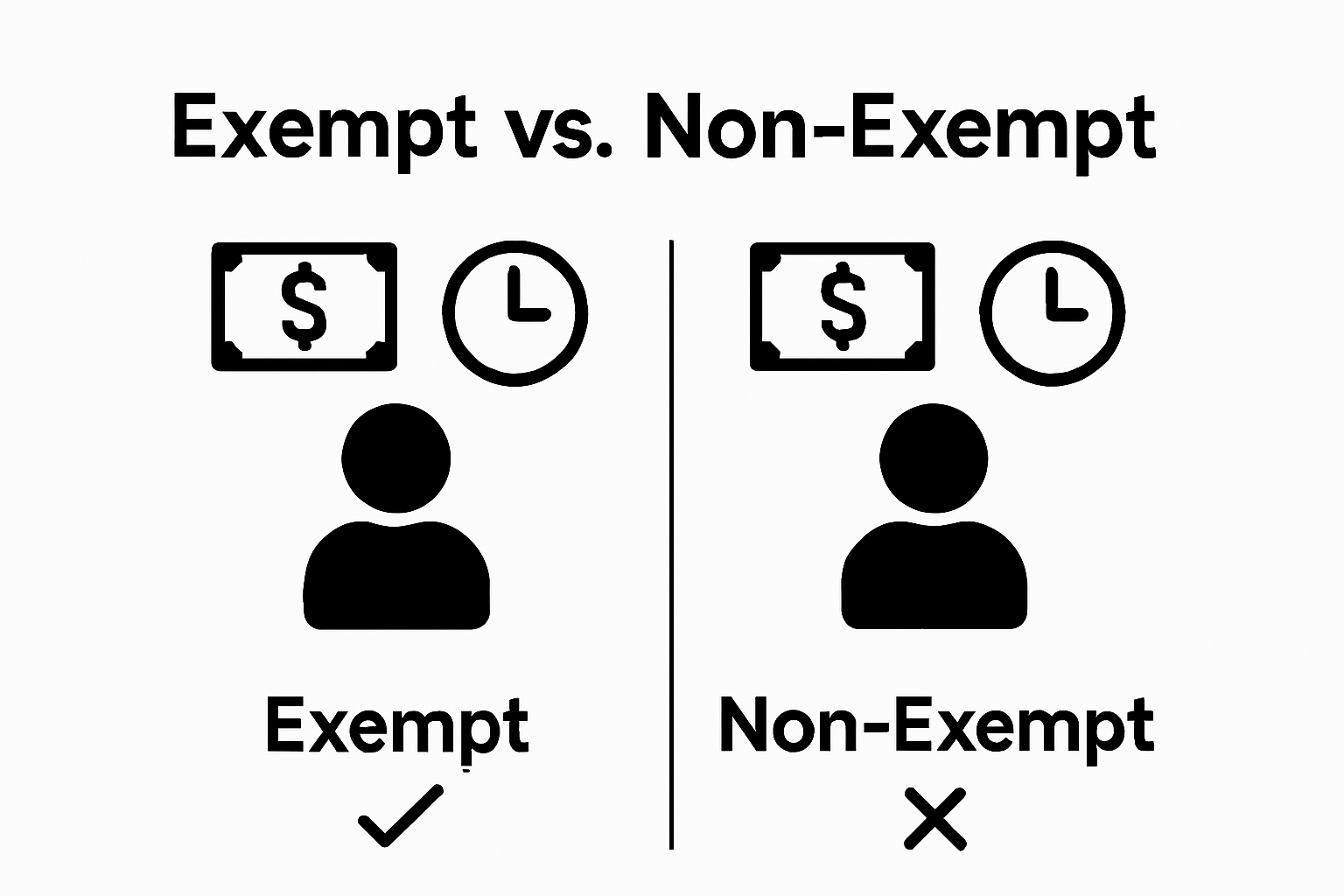
    The following table summarizes the key differences between exempt and non-exempt salaried employees as discussed in the article.

    Employee Type Overtime Eligibility Typical Roles/Examples Basis for Classification
    Exempt Not entitled to overtime pay Executive managers, professionals, Salary level, job duties, exemption status
    administrative staff, outside sales, under federal and state labor laws
    certain computer professionals
    Non-Exempt Entitled to overtime pay Salaried workers not meeting exemption Do not meet exemption criteria
    (1.5x or 2x regular rate for hours threshold, general salaried employees
    over set limits)

    Infographic comparing exempt vs. non-exempt salaried employees and overtime eligibility For non-exempt salaried workers, employers must calculate overtime pay at one and a half times their regular hourly rate for extra hours worked.


    Why Overtime Matters for Salaried Workers

    Overtime compensation represents more than just additional financial recognition for salaried workers. It serves as a critical mechanism protecting employee rights, ensuring fair labor practices, and maintaining healthy workplace boundaries. Exploring wage protection strategies reveals the complex dynamics between employee contributions and appropriate compensation.

    Financial and Professional Implications

    For salaried employees, overtime matters significantly because it directly impacts their economic well-being and professional respect. When workers consistently perform beyond standard work hours without proper compensation, they effectively subsidize their employer’s operational costs. According to research from the National Institutes of Health, excessive work hours correlate with several critical workplace challenges:

    • Increased employee stress levels
    • Higher risk of burnout
    • Reduced overall job satisfaction
    • Potential negative health outcomes
    • Decreased long-term productivity

    Protecting Worker Rights and Workplace Equity

    Overtime regulations function as a fundamental safeguard against labor exploitation. By establishing clear guidelines for compensation beyond standard work hours, these rules prevent employers from demanding unreasonable work commitments without appropriate financial recognition. Key protections include preventing unpaid extended work hours, ensuring fair compensation for additional labor, and maintaining transparent employment standards.

    For salaried workers, understanding and advocating for proper overtime compensation represents an essential aspect of professional self-advocacy. While not all salaried positions qualify for overtime, those that do provide critical financial protections that acknowledge the true value of an employee’s time and contributions.

    How Overtime Regulations Work in California

    California overtime regulations represent some of the most comprehensive worker protection laws in the United States, offering robust safeguards beyond federal standards. Learn precise overtime calculation methods to understand how these critical protections function for employees across various industries.

    California Overtime Calculation Rules

    Under California law, overtime compensation is calculated differently compared to federal guidelines. The state mandates overtime pay not just for hours worked beyond 40 per week, but also for daily work exceeding specific thresholds. According to the California Department of Industrial Relations, employees are entitled to overtime compensation under two primary scenarios:

    • One and a half times the regular rate for hours worked beyond 8 in a single workday
    • One and a half times the regular rate for the first 8 hours worked on the seventh consecutive day of work in a workweek
    • Double the regular rate for hours worked beyond 12 in a single workday
    • Double the regular rate for hours worked beyond 8 on the seventh consecutive day of work

    Exemptions and Special Considerations

    While California provides extensive overtime protections, certain employee classifications remain exempt from these regulations. Exempt employees typically include executive, administrative, and professional workers who meet specific salary and job duty requirements. These exemptions depend on multiple factors:

    • Employee’s monthly salary
    • Primary job responsibilities
    • Level of independent decision making
    • Professional skill requirements

    Employers must carefully evaluate each position to determine overtime eligibility, ensuring compliance with both state and federal labor regulations. Workers who believe their overtime rights have been violated can seek legal recourse through state labor board complaints or civil litigation.

    This table outlines the major differences between federal and California overtime regulations as they apply to salaried employees.

    Regulation Area Federal Law (FLSA) California Law
    Standard Workweek 40 hours per week 8 hours per day / 40 hours per week
    Overtime Rate 1.5x regular hourly rate for hours > 40/week 1.5x for >8/day or >40/week; 2x for >12/day
    Seventh Workday Not specifically addressed 1.5x for first 8 hours, 2x after 8 hours
    Exemptions Based on FLSA salary and duty tests Based on state salary/duties, sometimes stricter
    Worker Protection Meets federal minimum standards Offers broader coverage and greater employee rights

    California overtime discussion office

    Key Concepts Surrounding Overtime for Salaried Employees

    Understanding overtime for salaried employees requires navigating complex legal and professional frameworks that define compensation beyond standard working hours. Explore comprehensive overtime compensation strategies to gain deeper insight into these nuanced workplace regulations.

    Fundamental Overtime Definitions

    Overtime compensation represents more than simple monetary calculation. According to the U.S. Department of Labor, key concepts include differentiating between exempt and non-exempt employee classifications, which fundamentally determine overtime eligibility. Critical distinctions emerge through several core principles:

    • Salary threshold determining overtime qualification
    • Job responsibility classifications
    • Professional role complexity
    • Level of independent decision making authority
    • Specific industry regulatory requirements

    Compensation Calculation Frameworks

    Salaried employee overtime calculations involve multiple considerations beyond straightforward hourly rate multiplications. Employers must evaluate several intricate factors when determining appropriate compensation:

    • Base salary amount
    • Regular hourly equivalent rate
    • Total hours worked beyond standard workweek
    • Specific state and federal regulatory guidelines
    • Potential additional compensation structures

    The complexity of overtime regulations underscores the importance of understanding individual employment contracts, workplace policies, and legal protections. Employees should carefully review their specific job classifications and compensation structures to fully comprehend their potential overtime entitlements and rights.

    Uncover Your True Overtime Rights Today

    Many salaried employees wonder if they are truly receiving the overtime pay they deserve. This article highlights how confusing exemption status, complex overtime calculation methods, and unclear job classifications can leave you unpaid for extra hours worked. If you have ever questioned your eligibility or felt uncertain about California’s overtime rules, you are not alone. Your financial well-being and workplace fairness depend on understanding these regulations and ensuring your rights are enforced.

    Now is the time to take control, avoid wage theft, and secure the compensation the law guarantees you. Visit California Labor Law for easy-to-read guides, legal tools, and free resources. Use our overtime pay calculators or contact a real advocate for immediate answers. Protect your rights, get the payment you earned, and feel confident at work. Take the first step and connect with our experts now by calling us anywhere in California at 1-866-355-9991 for a free overtime rights consultation.

    Frequently Asked Questions

    What is overtime for salaried employees?

    Overtime for salaried employees refers to additional compensation paid for hours worked beyond the standard 40-hour workweek. It varies based on job classification and exemption status under the Fair Labor Standards Act (FLSA).

    How is overtime calculated for salaried employees?

    For non-exempt salaried employees, overtime is typically calculated at one and a half times their regular hourly rate for hours worked over 40 in a workweek. Employers need to evaluate base salary and total hours worked to determine the correct compensation.

    Who qualifies for overtime pay under federal law?

    Under federal law, non-exempt salaried workers qualify for overtime pay, while exempt employees—such as executive managers or certain professionals—do not receive additional compensation for hours worked beyond 40 per week.

    How do California overtime regulations differ from federal standards?

    California overtime laws are more comprehensive, mandating overtime pay for work beyond 8 hours in a single day and additional rules for the seventh consecutive workday, while federal law only requires overtime pay for work exceeding 40 hours in a week.

  • Understanding Employment Reference Laws: Key Insights

    Understanding Employment Reference Laws: Key Insights

    Most people think a work reference is just a quick phone call or a basic email about your job history. But that simple message can trigger big legal consequences if not handled correctly. In fact, false or misleading statements in a reference can seriously damage a career and open the door to lawsuits, which means reference checks are much more than routine paperwork.

    What Are Employment Reference Laws?

    Employment reference laws are complex legal frameworks that govern how employers can provide information about current or former employees to potential new employers. These regulations protect both employees and employers by establishing guidelines for sharing professional background details while preventing unfair or discriminatory practices.

    Employment reference laws create a delicate balance between an employer’s right to share truthful information and an employee’s right to be evaluated fairly. Generally, these laws permit employers to disclose factual, job-related information about an employee’s work history, performance, and professional conduct. However, employers must ensure that the information shared is accurate, verifiable, and not maliciously intended.

    Key protections under employment reference laws typically include:

    • Prohibiting false or misleading statements about an employee’s work performance
    • Preventing discriminatory references based on protected characteristics
    • Shielding employers from potential legal liability when providing good faith references
    • Establishing guidelines for what information can be legally disclosed

    Infographic comparing legal and illegal types of employment references

    Most jurisdictions recognize that employers have a qualified privilege to share work-related information. According to Nolo Legal Research, this means employers can provide truthful, job-related information about former employees without fear of legal repercussions. However, references that are demonstrably false, malicious, or discriminatory can expose employers to potential lawsuits.

    Employees interested in understanding their rights can learn more about workplace protections to ensure they are treated fairly during professional transitions. Understanding these legal nuances helps both employers and employees maintain professional integrity and respect throughout the reference process.

    To help clarify the foundational legal protections offered by employment reference laws, the following table organizes the main types of protections and how they serve both employees and employers.

    Legal Protection Description
    Prohibition of false or misleading statements Employers cannot provide untrue or deceptive information about an employee
    Protection from discrimination References cannot be based on protected personal characteristics (age, race, gender, etc.)
    Qualified privilege for employers Employers are shielded from liability for truthful, job-related references given in good faith
    Legal recourse for employees Employees can seek remedies for inaccurate or malicious references
    Record retention requirements Employers must keep employment records to support reference accuracy and legal compliance

    Why Employment Reference Laws Matter for Employees

    Employment reference laws play a critical role in protecting employees from potential professional harm and ensuring fair treatment during career transitions. These legal frameworks are not just bureaucratic guidelines but powerful mechanisms that safeguard workers’ professional reputations and future opportunities.

    Professional Reputation Protection

    Employment reference laws serve as a crucial shield against unfair or malicious characterizations of an employee’s work performance. False or misleading statements about an employee’s professional capabilities can significantly damage their career prospects. These laws create legal accountability, ensuring that employers cannot arbitrarily harm an individual’s professional standing through inaccurate or discriminatory references.

    Key protections for employees include:

    • Prevention of retaliatory or vindictive references
    • Legal recourse against employers who provide false information
    • Protection from discrimination based on personal characteristics
    • Ensuring references remain factual and job-performance related

    Preventing Discriminatory Practices

    Employment reference laws are fundamental in combating workplace discrimination. By establishing clear legal boundaries, these regulations prevent employers from using references as a mechanism for unfair treatment. According to Washington State Law, employers are expected to provide references that focus exclusively on job performance and professional conduct.

    Employees facing potential reference challenges can explore legal support options to understand their rights and protect their professional interests. Understanding these laws empowers workers to challenge inappropriate or discriminatory reference practices and maintain their professional dignity throughout their career journey.

    How Employment Reference Laws Operate in California

    California employment reference laws represent a comprehensive legal framework designed to protect workers while providing employers reasonable latitude in sharing professional information. These state-specific regulations go beyond federal guidelines, offering robust protections for employees during professional transitions.

    Under California law, employers have specific obligations when providing references about current or former employees. The state mandates that references must be factual, job-performance related, and free from discriminatory content. This means employers cannot include personal opinions or information unrelated to an employee’s professional capabilities.

    Key operational principles of California employment reference laws include:

    • Strict prohibition of references based on protected characteristics
    • Requirements for maintaining accurate employment records
    • Legal mechanisms to challenge inaccurate or malicious references
    • Protections against retaliatory reference practices

    According to California Government Code Section 12946, employers must preserve employment records for a minimum of four years. This requirement ensures transparency and provides a mechanism for employees to challenge potentially unfair or discriminatory references.

    Employees seeking to understand their rights in complex reference situations can consult professional legal guidance to navigate potential challenges. The intricate nature of employment reference laws in California underscores the importance of being informed and proactive about one’s professional documentation and potential legal recourse.

    This table presents a comparison of California state-specific employment reference law requirements versus general federal law, highlighting unique protections and obligations for employers and employees in California.

    Feature/Requirement California Law Federal Law
    Scope of Permitted Reference Must be factual and job-performance related; excludes personal opinions Focus on job-related, factual data
    Prohibition of Discriminatory References Strictly enforced, including additional protected categories Required under anti-discrimination laws
    Record Keeping Requirement Minimum 4-year employment record retention mandated Varies, not always required
    Challenging Malicious References Legal mechanisms specifically outlined General legal recourse
    Anti-Retaliation Protections Protections against retaliatory references Less explicit

    Employment references represent a critical intersection between professional communication and legal accountability. These communications are not mere routine exchanges but complex interactions governed by nuanced legal standards designed to protect both employers and employees from potential misconduct.

    Employment reference laws establish clear boundaries for professional information sharing, ensuring that references remain objective, factual, and focused on job-related performance. These legal frameworks prevent arbitrary or discriminatory practices that could unfairly impact an individual’s career trajectory.

    Critical legal protections in employment references include:

    • Prohibition of references based on protected personal characteristics
    • Requirements for accuracy and good faith reporting
    • Limitations on sharing confidential or irrelevant personal information
    • Legal mechanisms for challenging inaccurate references

    Understanding Reference Scope and Limitations

    According to U.S. Department of Labor guidelines, employment references must comply with federal anti-discrimination laws. This means references cannot reveal information related to an employee’s age, race, gender, disability status, or other protected characteristics. Employers who violate these standards may face significant legal consequences.

    Workers seeking comprehensive insights into their workplace rights can explore detailed legal guidance to understand the intricate protections surrounding professional references. By understanding these legal concepts, employees can better safeguard their professional reputation and challenge potential misconduct during career transitions.

    employee reference legal guidance

    Protect Your Professional Future with Trusted California Employment Law Resources

    Worried that a past employer might unfairly harm your reputation or job search by providing a misleading or discriminatory reference? Many California employees share this concern. The protections described in our article highlight how important it is to understand employment reference laws and your rights to accurate, good faith information. If you are facing negative references or feel your background is being misrepresented, you are not alone and you do not have to face this confusing process without guidance.

    Now is the time to take control of your professional narrative. Call us at 1-866-355-9991 or fill out the form for your free California employment law consultation.

    Frequently Asked Questions

    What are employment reference laws?

    Employment reference laws are legal frameworks that dictate how employers can provide information about current or former employees to potential new employers, protecting both parties by ensuring truthful and fair reference sharing.

    What information can employers legally share about a former employee?

    Employers can legally share factual, job-related information about an employee’s work history, performance, and conduct, as long as it is accurate and not malicious.

    How do employment reference laws protect employees?

    These laws prevent unfair or malicious references, protect against discriminatory practices, and provide employees with legal recourse if false information is shared about them.

    What specific protections do California employment reference laws provide?

    California employment reference laws require that references be factual and job-performance related, prohibiting any references based on protected characteristics, and mandate employers to keep accurate employment records.

  • Understanding Employee Privacy Rights: Key Concepts Explained

    Understanding Employee Privacy Rights: Key Concepts Explained

    Employee privacy rights might sound like technical legal stuff. Yet over 80 percent of companies now monitor workers in some digital form, and most employees have no idea just how far this goes. The real shock is that your breakroom chat or even what you post after hours could end up under your boss’s microscope, and that is just scratching the surface.

    What Are Employee Privacy Rights and Why Do They Matter?

    Employee privacy rights represent a critical legal framework protecting workers from unwarranted intrusions into their personal and professional lives. These rights define the boundaries between an employer’s legitimate business interests and an individual’s fundamental right to personal autonomy and dignity.

    The Core Principles of Employee Privacy

    Employee privacy rights fundamentally protect workers from excessive monitoring, unwarranted data collection, and inappropriate use of personal information. The legal landscape surrounding these rights is complex, balancing employer needs with individual protections. Understanding workplace privacy protections reveals several key principles:

    • Personal Information Control: Employees have the right to know what data employers collect and how it will be used
    • Consent Requirements: Employers must typically obtain explicit consent before collecting sensitive personal information
    • Data Security: Companies are obligated to protect employee data from unauthorized access or breaches

    Why Privacy Matters in the Workplace

    Privacy rights are not just legal technicalities but fundamental protections that maintain worker dignity and prevent potential exploitation. According to research from the Government Accountability Office, workplace monitoring can significantly impact employee psychological well-being and professional performance.

    Employers have legitimate interests in protecting company resources and ensuring productivity. However, unchecked surveillance can create hostile work environments, erode trust, and potentially violate constitutional protections against unreasonable searches.

    Modern workplace privacy extends beyond traditional concepts. It now encompasses digital communications, email monitoring, social media scrutiny, and biometric data collection. Workers must understand their rights to recognize when employers potentially overstep legal boundaries.

    Navigating these complex privacy considerations requires awareness, understanding, and sometimes legal intervention. Our comprehensive guide on workplace rights can help employees better understand their protections and potential recourse if their privacy is compromised.

    The legal framework governing employee privacy rights is a complex network of federal and state regulations designed to protect workers from unwarranted intrusions while balancing legitimate business interests. Understanding these legal protections requires examining multiple layers of statutory and constitutional safeguards.

    Constitutional and Statutory Foundations

    Employee privacy rights stem from a combination of constitutional amendments and specific federal and state laws. The Fourth Amendment provides fundamental protection against unreasonable searches, which extends into workplace contexts. Research from the National Archives highlights the Privacy Act of 1974 as a critical milestone, establishing key principles for information handling and individual privacy protections.

    Key legal protections include:

    • Constitutional Protections: Fourth Amendment safeguards against unreasonable searches
    • Federal Regulations: Privacy Act of 1974 and related workplace privacy statutes
    • State-Level Protections: Varying laws providing additional employee privacy safeguards

    Legal frameworks protect employees across multiple domains of workplace interaction. These protections cover personal information, electronic communications, physical searches, and surveillance technologies. Employers must navigate strict guidelines when collecting, storing, and using employee data.

    Critical areas of legal protection include:

    • Personal information collection and consent
    • Electronic communication monitoring
    • Background check limitations
    • Biometric data protection
    • Social media privacy boundaries

    Enforcement and Employee Rights

    Employees have multiple mechanisms for addressing privacy violations. Administrative complaints, civil lawsuits, and regulatory interventions provide recourse when employers overstep legal boundaries. Learn more about protecting your workplace rights to understand the full range of available legal protections.

    The evolving legal landscape continues to adapt to technological changes, requiring ongoing vigilance from both employers and employees to maintain appropriate privacy standards in the workplace.

    How Employee Privacy Rights Apply in the Workplace

    Employee privacy rights manifest in complex, nuanced ways across various workplace interactions, establishing critical boundaries between employer oversight and individual personal autonomy. Understanding these applications requires examining multiple dimensions of workplace privacy protections.

    Electronic Communication and Digital Monitoring

    Modern workplace privacy predominantly centers on digital communication channels. Research from the California Department of Justice reveals that employers possess significant latitude in monitoring workplace electronic communications, but must adhere to specific legal constraints.

    Key digital monitoring considerations include:

    • Email Surveillance: Employers can monitor work email accounts with appropriate disclosures
    • Internet Usage Tracking: Company networks and devices are subject to employer monitoring
    • Social Media Investigations: Limited legal restrictions on reviewing publicly accessible online content

    Physical Space and Personal Information Protection

    Privacy rights extend beyond digital realms into physical workplace environments. Employers cannot conduct arbitrary searches or collect personal information without legitimate business justification. Critical protections safeguard employees against unwarranted intrusions:

    • Restrictions on personal belongings searches
    • Prohibitions against invasive medical inquiries
    • Protection of personal identification information
    • Limitations on biometric data collection

    This table compares key areas of workplace monitoring, outlining what is allowed and what employee rights exist in those contexts.

    Monitoring Area Employer Rights Employee Rights
    Email Surveillance Monitor work emails with disclosures Right to notification and, in some cases, consent
    Internet Usage Tracking Track usage on company networks and devices Protection of personal information if using work resources
    Social Media Investigations Review public posts; limited restrictions Expectation of privacy for non-public information
    Physical Searches Conduct searches for legitimate business reasons Protection from arbitrary or invasive searches
    Biometric Data Collection Collect if necessary and with consent Right to be informed; must provide consent

    Legal frameworks mandate transparent communication regarding privacy practices. Employers must provide clear notifications about monitoring practices and obtain explicit consent for certain data collection activities. Our comprehensive guide on workplace rights can help workers understand these critical protections.

    Employees retain fundamental rights to challenge inappropriate privacy invasions through administrative complaints, internal grievance procedures, and legal mechanisms. The dynamic interplay between employer interests and individual privacy necessitates ongoing vigilance and understanding of evolving workplace privacy standards.

    Key Concepts: Data Protection, Surveillance, and Confidentiality

    Employee privacy represents a sophisticated intersection of legal, technological, and ethical considerations. Understanding the fundamental concepts of data protection, workplace surveillance, and confidentiality is crucial for workers seeking to safeguard their personal information and professional dignity.

    Principles of Data Protection

    Data protection encompasses systematic approaches to managing, securing, and controlling employee personal information. Research from the Electronic Frontier Foundation demonstrates that comprehensive data protection strategies must address multiple dimensions of information management.

    Critical data protection principles include:

    Three icons representing employee data protection principles

    • Minimization: Collecting only necessary personal information
    • Purpose Limitation: Using data exclusively for specified, legitimate purposes
    • Storage Restrictions: Maintaining data only for required durations
    • Security Safeguards: Implementing robust technological and organizational protections

    Workplace Surveillance and Monitoring Boundaries

    Workplace surveillance represents a complex legal terrain where employer interests intersect with employee privacy rights. Monitoring technologies continue to evolve, challenging traditional understanding of workplace privacy. Employers must balance legitimate business needs with respect for individual privacy boundaries.

    Key surveillance considerations involve:

    • Electronic communication monitoring
    • Video surveillance limitations
    • GPS tracking of company vehicles
    • Performance tracking technologies
    • Social media investigation protocols

    Confidentiality and Information Handling

    Confidentiality extends beyond mere data protection, representing a fundamental ethical and legal obligation to preserve sensitive information. Employers bear significant responsibilities in maintaining the integrity of employee personal data. Learn more about protecting your workplace rights to understand comprehensive confidentiality standards.

    The intricate landscape of workplace privacy demands continuous adaptation, requiring both employers and employees to remain informed about emerging technological and legal developments that shape information protection standards.

    Real-World Implications of Employee Privacy Rights

    Employee privacy rights transcend theoretical legal concepts, directly impacting workplace dynamics, professional relationships, and individual psychological well-being. Understanding these real-world implications reveals the profound significance of privacy protections in modern employment environments.

    Psychological and Professional Consequences

    Research from the World Economic Forum demonstrates that invasive workplace monitoring can fundamentally alter employee perceptions of trust, autonomy, and professional dignity. Excessive surveillance creates psychological strain, potentially undermining workplace morale and productivity.

    Key psychological impacts include:

    • Reduced Job Satisfaction: Constant monitoring erodes sense of professional trust
    • Increased Stress Levels: Persistent surveillance creates anxiety and performance pressure
    • Diminished Workplace Engagement: Employees feel dehumanized and controlled
    • Potential Mental Health Challenges: Persistent monitoring can trigger workplace-related psychological distress

    Economic and Career Development Implications

    Privacy rights directly influence career trajectories and economic opportunities. Unauthorized data collection or inappropriate use of personal information can create systemic barriers to professional advancement. Employees face potential discrimination, limited mobility, and compromised professional reputations when privacy boundaries are violated.

    Critical career development considerations involve:

    • Potential employment discrimination based on collected personal data
    • Limitations on career progression due to invasive monitoring
    • Risk of personal information misuse in professional contexts
    • Potential retaliation for asserting privacy rights

    Organizational Culture and Ethical Considerations

    Privacy rights fundamentally shape organizational culture, reflecting an employer’s commitment to ethical treatment and respect for individual dignity. Our comprehensive guide on workplace rights provides deeper insights into navigating these complex interpersonal dynamics.

    workplace privacy employee discussion

    Employers who prioritize robust privacy protections cultivate environments of mutual respect, transparency, and trust. Conversely, organizations that disregard employee privacy risk significant reputational damage, decreased productivity, and potential legal challenges.

    Worried About Your Privacy Rights at Work? Get Trusted Help Today

    If learning about employee privacy rights in the workplace makes you uneasy, you are not alone. Many California workers feel the stress of constant monitoring, unclear data policies, or fear their sensitive information could be mishandled. The risks to your dignity, trust, and mental well-being are real. Understanding principles like data protection, consent requirements, and your right to challenge unlawful practices is essential. But knowing your legal rights does not always make it easy to stand up for them when you need support.

    Your privacy and peace of mind are too important to ignore. Visit California Labor Law for simple guides that cut through legal jargon. If you recognize any signs of improper surveillance or misuse of personal information in your workplace, use our comprehensive workplace rights guide to get clarity on your options. Do not wait until your privacy is compromised. Reach out directly for immediate help and let our experienced legal team empower you to protect your rights right here by calling 1-866-355-9991 for a free privacy rights consultation.

    Frequently Asked Questions

    What are employee privacy rights?

    Employee privacy rights are legal protections that safeguard workers from unwarranted intrusions into their personal and professional lives, ensuring their autonomy and dignity in the workplace.

    Why is employee privacy important in the workplace?

    Employee privacy is crucial because it maintains worker dignity, prevents exploitation, and fosters trust within the organization. Excessive surveillance may lead to a hostile work environment and affect employee morale.

    What types of personal information are protected under employee privacy rights?

    Employee privacy rights protect various types of personal information, including electronic communications, biometric data, and personal identification information from unauthorized access and misuse.

    How can employees address violations of their privacy rights?

    Employees can address privacy violations through various mechanisms such as filing administrative complaints, pursuing civil lawsuits, or utilizing regulatory interventions to seek recourse against employers who overstep legal boundaries.

  • California Harassment Training: Complete Employee Guide

    California Harassment Training: Complete Employee Guide

    Did you know that every California employer with five or more workers must provide harassment prevention training by law? Missing these rules can lead to costly penalties and potential lawsuits. Many businesses struggle to keep up with specific requirements for different employee roles, making compliance a confusing challenge. This guide helps you sort out each step so employers feel confident meeting legal standards while building a respectful workplace for everyone.

    Step 1: Identify Your Training Requirements

    Let’s walk through exactly how you’ll figure out your California harassment training requirements step by step. The goal here is simple: understand precisely what training you need based on your workplace size and employee roles.

    First things first, count your total employees. According to the California Chamber of Commerce, if you have five or more employees, you’re legally required to provide harassment prevention training. This means every single worker counts toward that five person threshold including full time, part time, seasonal, and temporary staff.

    Next, break down your training needs by employee classification. Supervisors and nonsupervisory employees have different training time requirements. Supervisors need two full hours of comprehensive training, while nonsupervisory employees require one hour of targeted instruction. These sessions must occur within six months of hiring or promotion and then repeated every two years.

    Pro Tip: Don’t forget about temporary workers. According to Oakland’s Civil Rights Compliance guidelines, seasonal and temporary employees must receive training within 30 days of hire or within 100 hours worked whichever milestone happens first.

    Specifically, your training must cover practical examples addressing harassment based on gender identity, gender expression, and sexual orientation. Documentation is crucial here. You’ll want to maintain precise training records for each employee for a minimum of two years.

    HR compliance documentation

    One often overlooked group? Unpaid interns, volunteers, and independent contractors also require training under California law. Make sure they’re included in your comprehensive training strategy.

    Here’s a summary of California harassment training requirements by role and employee type:

    Infographic comparing California harassment training requirements by employee type, training duration, and timing.

    Employee Type Minimum Employees Trigger Training Duration Timing Requirement
    Supervisors 5 or more 2 hours Within 6 months, then biannually
    Nonsupervisory Employees 5 or more 1 hour Within 6 months, then biannually
    Temporary/Seasonal Employees 5 or more 1 hour Within 30 days or 100 hours worked
    Unpaid Interns/Volunteers 5 or more 1 hour Within 6 months, then biannually
    Independent Contractors 5 or more 1 hour Within 6 months, then biannually

    What happens next? You’ll need to develop or source a training program that meets these specific California requirements. Get ready to dive into selecting the right training materials that will keep your workplace legally compliant and professionally respectful.

    Step 2: Select an Approved Training Program

    Now that you understand your training requirements, it’s time to choose a training program that meets California’s specific legal standards. Your goal is to find a comprehensive program that not only satisfies legal requirements but also genuinely educates your team about workplace harassment prevention.

    First, understand that California law provides flexibility in training selection. You are not required to use the California Civil Rights Department’s (CRD) specific training program. Instead, you can select from various approved training methods as long as they meet core legal standards.

    Look for programs with qualified trainers who have appropriate credentials. As defined in California Government Code section 12950.1, acceptable trainers include attorneys, experienced HR professionals, or specialized training experts. This means your training can come through online courses, apprenticeship programs, or labor management training trusts provided the instructors meet these professional criteria.

    Pro Tip: Interactive training is key. California requires that your chosen program offers engaging learning experiences that go beyond passive information delivery.

    Your training program must comprehensively address harassment across multiple dimensions including gender identity, gender expression, and sexual orientation. Look for materials that provide practical real world examples and scenarios employees can relate to and learn from.

    Carefully review the program’s format. California allows both in person and online electronic learning platforms. The critical factor is ensuring the training is interactive, educational, and meets all state defined standards.

    What comes next? You’ll want to implement your selected training program and develop a tracking system to document employee completion.

    Get ready to transform your workplace culture through meaningful harassment prevention education.

    Step 3: Register and Access the Course Material

    You’ve selected your training program and now it’s time to get your team registered and ready to learn. Your mission is to smoothly onboard every employee into the harassment prevention training with minimal friction and maximum accessibility.

    The California Civil Rights Department (CRD) offers a fantastic resource for employers free online training modules available in multiple languages including Chinese, Spanish, Tagalog, Vietnamese, and Korean. These modules are an excellent option for employers looking for comprehensive training solutions.

    Start by creating individual access pathways for each employee. Since remote work is increasingly common, you’ll want to ensure every team member can easily access the training materials regardless of their work location. Sharing a direct link to the online training module works best for ensuring everyone can complete their required education.

    Pro Tip: Save all completion certificates immediately after employees finish their training. These documents are crucial for maintaining accurate personnel records and demonstrating legal compliance.

    Remember that California law requires you to compensate employees for the time spent completing mandatory harassment prevention training. This means the training hours count as paid work time and should be scheduled during regular work hours whenever possible.

    Consider your team’s diverse needs when selecting training materials. The multilingual options provided by DFEH can help ensure that language barriers do not prevent any employee from understanding critical workplace harassment prevention concepts.

    What happens next? You’ll track employee completion and prepare for the ongoing documentation required to maintain your organization’s legal compliance. Get ready to transform your workplace culture through meaningful and accessible education.

    Step 4: Complete All Interactive Training Modules

    You’ve registered for the training and now it’s time to dive deep into the content. Your goal is to engage fully with the harassment prevention modules and walk away with a comprehensive understanding of workplace respect and legal requirements.

    According to training guidelines from industry experts, this is not your typical boring compliance course. California mandates truly interactive training that goes far beyond simple text reading. As research from the American Society of Employers indicates, your training must include dynamic formats like classroom sessions, live webinars, or sophisticated e learning platforms with direct trainer access.

    Pay close attention to the key topics you’ll need to master. Your training will cover critical areas including harassment definitions under state and federal law, available legal remedies, bystander intervention strategies, supervisory reporting obligations, and comprehensive anti harassment policy elements.

    Pro Tip: Treat this training as a skill building opportunity. The most effective modules will include real world scenarios that challenge you to think critically about workplace interactions.

    Expect to encounter interactive assessments designed to test your understanding. These are not just checkbox exercises but thoughtful scenarios that require you to demonstrate nuanced comprehension of workplace harassment prevention. You might be asked to analyze complex situations or identify appropriate responses to potential harassment scenarios.

    Remember that supervisors and nonsupervisory employees will have slightly different training requirements. Supervisors typically need more in depth content focused on their specific legal responsibilities for preventing and addressing workplace harassment.

    What comes next? After completing these modules, you’ll be equipped with the knowledge to create a more respectful workplace and understand your legal rights and responsibilities. Get ready to become a proactive champion of workplace dignity.

    Step 5: Verify Compliance and Obtain Certification

    You’ve completed your harassment prevention training and now it’s time to solidify your workplace compliance. Your mission is to carefully document and preserve your training records to meet California’s rigorous legal standards.

    According to guidance from the Oakland Civil Rights Compliance Department, record keeping is not optional. You must retain comprehensive training documentation for at least two years. This means meticulously tracking who was trained, when the training occurred, and the specific content covered during the session.

    Focus on collecting key documentation for each employee. Your verification package should include individual completion certificates, specific training materials used, trainee names, and precise completion dates. Think of this as your compliance insurance policy protecting your organization from potential legal challenges.

    Pro Tip: Create a dedicated digital folder for each employee’s training records. Digital storage makes tracking and retrieving documents significantly easier during potential audits.

    Don’t forget about supplementary materials. California law requires employers to provide additional resources like transgender rights fact sheets and harassment prevention posters. These documents complement your training and demonstrate your commitment to a respectful workplace.

    Pay special attention to the two year recertification cycle. Your documentation should clearly show when employees are due for their next mandatory training session. Proactive tracking prevents accidental compliance gaps that could expose your organization to potential legal risks.

    What happens next? You’ll transition from training completion to ongoing workplace culture management. Your carefully documented training becomes a foundation for creating a more inclusive and respectful professional environment.

    Take Control of Your California Workplace Rights Today

    If you feel overwhelmed by changing regulations, documentation hurdles, or fear of legal pitfalls, you are not alone. Many California workers wonder how to navigate mandatory harassment training, track compliance records, and protect themselves if their rights are ignored. The stakes are high, especially with complex rules around training timing, employee classifications, and ongoing certification.

    Call California Labor Law at 1-866-355-9991 today to schedule a free workplace rights consultation and take control of your employee rights.

    Frequently Asked Questions

    What are the California harassment training requirements for employees?

    Employees in California need harassment prevention training if their employer has five or more employees. This training must include specific topics and be completed within six months of hiring, with recertification occurring every two years.

    How long does California harassment training need to be for supervisors and nonsupervisory employees?

    Supervisors must complete two hours of training, while nonsupervisory employees require one hour. Schedule these sessions within six months of hiring or promotion to remain compliant.

    When must temporary and seasonal employees receive their harassment training?

    Temporary and seasonal employees must complete their training within 30 days of hire or after 100 hours worked, whichever comes first. Ensure you have a plan in place for onboarding their training promptly.

    What types of training formats are acceptable for California harassment training?

    California allows both in-person and online training formats, but the training must be interactive and engaging. Choose programs that include real-world scenarios and interactive assessments to enhance learning.

    How do I document employee completion of harassment training?

    Maintain accurate records by collecting completion certificates, training materials, employee names, and training dates. Create a dedicated digital folder for each employee to easily track compliance over the required minimum of two years.

    What should I include in the training materials for California harassment training?

    Your training materials should cover harassment definitions, legal remedies, bystander intervention strategies, and the organization’s anti-harassment policies. Incorporate multilingual options if needed to ensure all employees understand the content.

  • Understanding Off the Clock Work Laws in California

    Understanding Off the Clock Work Laws in California

    California Off the Clock Work Laws

    Every year, American workers lose billions of dollars to unpaid labor, much of it quietly slipping away during off the clock tasks. Most people assume their salary or hourly wage covers every minute spent working.

    That is not how California sees it. State law treats off the clock work as a serious threat to fair pay and has built some of the toughest worker protections in the country to make sure not a single earned dollar is left on the table.

    What Are Off the Clock Work Laws?

    Off the clock work laws protect employees from working without proper compensation, addressing situations where workers perform job-related tasks outside their officially scheduled hours. These laws are critical in preventing wage theft and ensuring fair treatment in California’s diverse workplace environments.

    Off the clock work represents any labor performed by an employee that occurs outside their standard paid work hours but still benefits the employer. According to the U.S. Department of Labor, this can include various activities such as:

    • Preparing work equipment before scheduled shifts
    • Completing administrative tasks after official work hours
    • Responding to work-related communications during personal time
    • Participating in mandatory training or meetings outside regular work schedules

    Comparison of paid work and off the clock work examples

    Scope and Employee Protections

    California labor laws go beyond federal standards in protecting workers from unpaid labor. Employers are legally required to compensate employees for all work performed, regardless of whether it was explicitly authorized or occurred outside standard work hours.

    Our guide on overtime disputes provides additional insights into workers’ compensation rights.

    The core principle is straightforward: If an employer knows or should have known that work was performed, they must pay for that time. This means even unauthorized overtime or preparatory work must be compensated at appropriate wage rates.

    Why Off the Clock Work Laws Matter for Employees

    Off the clock work laws are fundamental protections that safeguard workers from economic exploitation and ensure fair compensation for their time and effort. These legal provisions are more than just regulatory requirements they represent a critical mechanism for maintaining workplace dignity and preventing systemic wage theft.

    Financial Impact on Workers

    Unpaid work can significantly lower an employee’s total earnings. According to research from the Economic Policy Institute, workers lose billions of dollars annually through uncompensated labor. This financial drain disproportionately affects low wage workers who often lack the resources to challenge unfair employment practices.

    The consequences extend beyond immediate monetary loss:

    • Reduced hourly effective wage rates
    • Potential long term career development impediments
    • Increased financial stress and economic instability

    Workplace Power Dynamics

    Off the clock work laws help rebalance power dynamics between employers and employees. By mandating compensation for all work performed, these regulations prevent employers from extracting free labor through implicit or explicit pressure.

    These laws recognize that work extends beyond traditional clock punching. Modern workplace interactions frequently blur lines between professional and personal time, especially with technologies like smartphones enabling constant communication.

    Legal frameworks ensure employees are not economically penalized for being accessible and responsive to work demands outside standard hours.

    Off the clock work laws represent a fundamental worker protection mechanism that acknowledges human labor as a valuable commodity deserving fair, transparent compensation.

    Why Off the Clock Work Laws Matter for Employees

    Key Concepts Behind Wage Theft and Unpaid Wages

    Wage theft represents a systematic problem where employers deliberately or negligently fail to compensate workers for their complete labor. Understanding the fundamental mechanisms of wage theft is crucial for employees to protect their economic interests and recognize potential workplace violations.

    Defining Wage Theft Mechanisms

    Wage theft encompasses multiple forms of compensation denial. According to the National Employment Law Project, these violations can occur through various subtle and explicit strategies:

    • Refusing to pay minimum wage
    • Neglecting overtime compensation
    • Forcing employees to work off the clock
    • Manipulating timekeeping records
    • Misclassifying workers as independent contractors

    The economic impact of wage theft extends far beyond individual worker experiences. Employers who engage in systematic wage theft create unfair competitive advantages by reducing labor costs at the expense of worker compensation. Our comprehensive guide on wage theft claims provides workers with detailed strategies for addressing these violations.

    Wage theft disproportionately affects vulnerable worker populations, including immigrants, young workers, and individuals in low wage industries.

    Here is a table summarizing key forms of wage theft described in the article and their typical impacts on employees in California.

    Type of Wage Theft Description Example Impact on Employees
    Minimum Wage Violations Paying less than the legal minimum wage Lowered total income, increased hardship
    Overtime Violations Not compensating for hours worked beyond standard limits Lost overtime pay, reduced effective wages
    Off the Clock Work Requiring work outside of paid hours without compensation Unpaid labor, loss of earnings
    Timekeeping Manipulation Falsifying or altering employee time records Unrecorded hours, diminished paychecks
    Worker Misclassification Labeling employees as independent contractors to avoid benefits Loss of legal protections and compensation

    These workers often lack the resources or legal knowledge to challenge improper compensation practices, making systemic protections critically important for maintaining economic fairness and worker dignity.

    How Off the Clock Work Laws Protect Workers

    Off the clock work laws serve as a critical shield protecting employees from economic exploitation, establishing clear legal boundaries that prevent employers from extracting unpaid labor.

    These laws create robust mechanisms to prevent workplace abuse by mandating comprehensive compensation standards. According to the U.S. Department of Labor, workers are entitled to payment for all time spent performing job duties, regardless of whether the work was formally authorized.

    The protection framework includes:

    • Mandatory compensation for preparatory and concluding work activities
    • Compensation for required training and mandatory meetings
    • Protection against informal pressure to work without pay
    • Legal recourse for recovering unpaid wages

    Real-World Implications of These Laws in California

    Off the clock work laws in California represent a powerful legal framework designed to protect workers across diverse industries, addressing nuanced workplace scenarios that extend far beyond traditional compensation models.

    These regulations create meaningful protections that reflect the complex realities of modern employment environments.

    Industry-Specific Challenges

    Different sectors face unique challenges in implementing off the clock work protections. According to research from the California Labor Commissioner’s Office, industries like technology, hospitality, and service sectors frequently encounter complex compensation scenarios. The most prevalent off the clock work challenges include:

    • Technology workers expected to be perpetually available via email
    • Restaurant staff performing side work before and after shifts
    • Retail employees required to conduct inventory or store preparation unpaid
    • Healthcare workers completing patient documentation outside scheduled hours

    The following table compares how off the clock work challenges manifest in different industries:

    Industry Common Off the Clock Work Issues Example Activities
    Technology Expectation to be constantly available Responding to emails after hours
    Hospitality Unpaid pre/post-shift tasks Restaurant staff setting up before/after scheduled time
    Retail Additional work before/after shift hours Inventory checks, store preparation without pay
    Healthcare Documenting work outside scheduled shifts Completing patient files or paperwork after clocking out

    Take Control of Unpaid Work and Protect Your Rights in California

    If you are feeling frustrated by uncompensated off the clock work or worried that your employer may be violating your rights, you are not alone. Many California workers are forced to perform tasks without proper pay, encountering wage theft and unfair workplace demands.

    You have the power to challenge wage theft and claim the compensation you deserve. Use our free legal resources to get clear guidance on unpaid work situations, calculate your owed wages, or learn about wage theft claims.

    Take Control of Unpaid Work and Protect Your Rights in California

    Take the first step. Call California Labor Law at 1-866-355-9991 today for a free off the clock rights consultation. We offer quick, confidential help with your off the clock work questions.

    Frequently Asked Questions

    What constitutes off the clock work?

    Off the clock work includes any job-related tasks performed outside of officially scheduled hours, such as preparing equipment, completing tasks after hours, or attending mandatory training.

    Are employees entitled to payment for off the clock work?

    Yes, employees are legally entitled to compensation for all work performed, including off the clock activities unless they explicitly waived their rights or the work was authorized.

    How do off the clock work laws protect employees from wage theft?

    Off the clock work laws prevent wage theft by mandating that employers compensate employees for all hours worked, ensuring that even unauthorized overtime or preparatory work isn’t taken advantage of.

    What legal recourse do employees have for unpaid off the clock work?

    Employees can file wage claims, participate in class action lawsuits, and seek administrative interventions through state labor boards for unpaid off the clock work in California.

  • How to Prove Retaliation: A Step-by-Step Guide

    How to Prove Retaliation: A Step-by-Step Guide

    Proving Retaliation in the Workplace

    Proving workplace retaliation can sound overwhelming. Most people expect the process to be complicated and risky. The real surprise is how much collecting the right records and mapping a detailed timeline can swing a case in your favor faster than most realize.

    Step 1: Gather Documentation of Your Employment History

    Building a strong retaliation case starts with meticulous documentation of your employment history. This crucial first step involves collecting comprehensive evidence that demonstrates your work performance, interactions with management, and the sequence of events leading to potential retaliatory actions.

    Identifying Critical Employment Records

    Start by assembling a complete set of employment documents that will serve as the foundation of your case. Your collection should include original copies of performance evaluations, employment contracts, emails, text messages, and any written communication with supervisors or human resources.

    According to the California Department of Industrial Relations, workers should specifically focus on documents that show changes in employment conditions after exercising labor rights.

    Pay special attention to chronological details. Create a timeline that maps out key events, including dates of performance reviews, any complaints or grievances filed, and subsequent workplace interactions.

    Your documents should include the following:

    • Original employment contract
    • Performance review documents
    • Email communications
    • Text message records
    • Internal complaint or grievance submissions
    • Workplace policy handbooks
    • Scheduling and assignment records

    Organize these documents systematically, preferably in both digital and physical formats. Make high-quality scans or copies of original documents, ensuring that dates, names, and content are clearly legible.

    Maintaining an organized and comprehensive record will significantly strengthen your ability to demonstrate a pattern of potential retaliation and provide your legal representatives with the necessary evidence to support your case.

    Gather Documentation of Your Employment History

    Step 2: Identify Instances of Protected Activity

    Identifying protected activities is a critical step in proving workplace retaliation. Protected activities are specific actions employees take that are legally safeguarded from employer retaliation, serving as the foundation for building a strong legal case against potential workplace misconduct.

    Understanding Protected Activities

    According to the Centers for Disease Control and Prevention (CDC), key protected activities that could support a retaliation claim include:

    • Filing an official complaint about workplace discrimination
    • Reporting safety violations to regulatory agencies
    • Participating in workplace investigations
    • Refusing to engage in illegal or unethical workplace practices
    • Requesting reasonable accommodations for disabilities
    • Whistleblowing about potential legal or ethical violations

    Preserve all documentation related to these interactions, including dates, names of individuals involved, and specific details of the communication. The strength of a retaliation claim often depends on the clarity and comprehensiveness of these records.

    Step 3: Collect Evidence of Adverse Actions

    Collecting robust evidence of adverse actions is a pivotal moment in proving workplace retaliation. This step transforms your suspicions into a compelling narrative that demonstrates how your employer responded negatively after you engaged in protected activities.

    Adverse actions represent any significant workplace changes that would discourage a reasonable employee from exercising their legal rights. According to the U.S. Department of Labor, these actions can range from subtle workplace manipulations to direct professional consequences.

    Documenting workplace negative actions requires a systematic and comprehensive approach. Begin by creating a detailed chronological record that connects your protected activities with subsequent workplace changes.

    This timeline should capture every professional modification that occurred after you raised concerns or participated in workplace investigations.

    Compile evidence through multiple channels, ensuring you have tangible proof of each adverse action.

    Key adverse actions to document include:

    • Unexpected negative performance evaluations
    • Sudden demotion or reduction in job responsibilities
    • Reduction in work hours or pay
    • Professional isolation or exclusion from team activities
    • Unwarranted disciplinary actions
    • Denial of promotion or professional development opportunities

    Prepare digital and physical copies of all supporting documents. Take careful notes about dates, specific interactions, and the context surrounding each adverse action. The more detailed and objective your documentation, the stronger your potential legal case becomes.

    Collect Evidence of Adverse Actions

    Remember that consistency and comprehensiveness are your greatest allies in proving workplace retaliation.

    Step 4: Establish a Causal Connection

    Establishing a causal connection is the critical bridge that transforms your collection of evidence into a compelling narrative of workplace retaliation. This step involves demonstrating a direct link between your protected activity and the adverse actions taken against you.

    Causal connection means proving that your employer’s negative actions were directly motivated by your previous protected activities.

    According to the U.S. Department of Justice, this requires showing that your protected activity was the likely reason for subsequent workplace consequences.

    Analyze the temporal proximity between your protected activity and the adverse actions. A close timeline can be powerful evidence. For instance, if you filed a workplace harassment complaint and received a negative performance review shortly afterward, this rapid sequence suggests a potential retaliatory motive.

    Look for patterns that demonstrate a clear cause-and-effect relationship, such as sudden changes in workplace treatment immediately following your protected activity.

    Gather comparative evidence that highlights differential treatment. Identify colleagues in similar roles who have not engaged in protected activities and compare their workplace experiences with yours. Document any discrepancies in performance evaluations, promotion opportunities, or professional assignments that suggest targeted retaliation.

    Key strategies for establishing causal connection include:

    • Documenting the exact dates of protected activities and subsequent adverse actions
    • Collecting witness statements about changes in workplace dynamics
    • Preserving communication records that demonstrate shifting workplace attitudes
    • Identifying inconsistencies in employer explanations for negative actions
    • Tracking patterns of behavior that suggest retaliatory intent

    Carefully construct a narrative that connects your protected activity to the adverse actions. Look beyond surface-level explanations and gather evidence that reveals the underlying motivations.

    Remember that a strong causal connection often requires multiple pieces of evidence that collectively paint a clear picture of workplace retaliation.

    Consulting with legal professionals transforms your documented evidence into a strategic legal approach. This critical step involves connecting with attorneys who specialize in employment law and workplace retaliation cases, turning your carefully gathered documentation into a potential legal action.

    According to the U.S. Department of Labor, selecting the right legal representation can significantly impact the trajectory of your retaliation claim. Specialized employment attorneys understand the nuanced legal landscape and can provide expert guidance on the strength of your case, potential strategies, and likely outcomes.

    Prepare comprehensive documentation before your initial consultation. Organize all collected evidence chronologically, including employment records, communication logs, performance evaluations, and detailed timelines of events.

    This preparation demonstrates your seriousness and helps attorneys quickly assess the merits of your case. During the initial meeting, be prepared to discuss every detail meticulously, allowing the attorney to identify potential legal strategies and potential challenges.

    Research potential attorneys through multiple channels. Seek recommendations from professional networks, bar associations, and employment rights organizations.

    Look for lawyers with specific experience in workplace retaliation cases, preferably those familiar with California employment laws. Many attorneys offer free initial consultations, allowing you to evaluate their expertise and approach without immediate financial commitment.

    Key considerations when selecting a legal professional include:

    • Specialized experience in workplace retaliation cases
    • Proven track record of successful employment law outcomes
    • Clear communication and transparency about potential case strategies
    • Understanding of specific California employment regulations
    • Willingness to provide detailed case assessment during initial consultation

    Remember that a strong attorney-client relationship requires mutual trust and open communication. Be honest about all aspects of your case, including potential weaknesses. The right legal professional will provide an objective assessment, helping you understand the realistic potential of your retaliation claim and guiding you through the complex legal process ahead.

    Consult with Legal Professionals

    Step 6: File the Appropriate Claims or Complaints

    Filing the appropriate claims or complaints is the pivotal moment where your documented evidence transforms into official legal action. This step requires precision, careful timing, and a strategic approach to navigating complex administrative processes.

    According to the U.S. Department of Labor, different types of workplace retaliation require filing with specific agencies. Carefully identify the correct agency based on the nature of your retaliation claim.

    For discrimination-related retaliation, you’ll typically file with the Equal Employment Opportunity Commission (EEOC). Wage and hour violations require complaints through the Wage and Hour Division, while workplace safety retaliation demands filing with the Occupational Safety and Health Administration (OSHA).

    Prepare a comprehensive and detailed complaint that clearly outlines the sequence of events. Your documentation from previous steps becomes crucial here. Craft a narrative that demonstrates a clear connection between your protected activity and the subsequent retaliatory actions. Include specific dates, names of individuals involved, and a chronological account of events that support your claim.

    Be mindful of strict filing deadlines, which vary depending on the type of complaint. Most retaliation claims have limited windows for submission, typically ranging from 30 to 180 days from the date of the alleged retaliatory action. Missing these deadlines can permanently eliminate your ability to pursue legal recourse.

    Key considerations when filing a complaint include:

    • Identifying the correct federal or state agency for your specific type of retaliation
    • Gathering all supporting documentation before filing
    • Maintaining copies of all submitted materials
    • Understanding and meeting specific filing deadlines
    • Preparing a clear, concise, and factual narrative of events

    After filing, maintain meticulous records of your submission, including confirmation numbers, dates of filing, and copies of all submitted documents. Follow up regularly with the agency handling your complaint, and be prepared to provide additional information if requested.

    Remember that filing a complaint is a formal process that requires patience, attention to detail, and persistent documentation.

    Ready to Protect Your Workplace Rights? Get Expert Help on Proving Retaliation in California

    If you are worried that your employer retaliated against you after you spoke up, this guide is the first step. You already know how difficult it can feel to gather documentation, prove a causal connection, and face legal deadlines. Your career, reputation, and peace of mind are on the line. But you do not have to fight alone.

    Find out your legal options in minutes. Connect with a legal advocate who understands California retaliation claims and can guide you step-by-step. Visit California Labor Law today, review our expert legal guides, use our wage and penalty calculators, or call us at 1-866-355-9991 for a free workplace rights consultation.

    Frequently Asked Questions

    What documentation do I need to prove retaliation?

    To prove retaliation, you should gather comprehensive documentation of your employment history, including performance evaluations, emails, text messages, complaint submissions, and any changes in workplace interactions or conditions after exercising your labor rights.

    What are considered protected activities in a workplace?

    Protected activities include actions such as filing formal complaints about workplace discrimination, reporting safety violations, participating in investigations, requesting accommodations for disabilities, and whistleblowing on illegal practices.

    How do I establish a causal connection between my protected activity and adverse actions?

    To establish a causal connection, you should document the timeline between your protected activities and any negative workplace actions taken against you. Look for direct links, such as a sudden negative performance review following a complaint, and gather comparative evidence showing differential treatment between you and colleagues who did not engage in protected activities.

    What steps should I take after gathering evidence of retaliation?

    After gathering evidence, consult with legal professionals specializing in employment law. Prepare your documentation, research potential attorneys, and discuss the specifics of your case to understand your options for filing appropriate claims or complaints based on the type of retaliation experienced.